
THE MAN IN THE BACKUP SHIRT
Part Three
Atlas did not rush toward Red Hollow.
Every part of him wanted to.
Mason Hale was trapped inside the same building where Atlas had once found Marcus pounding against a locked door.
But Atlas looked at Nora first.
She still held the recorder.
Her face was pale.
“Dad,” she whispered.
He crouched in front of her.
“I’m going to help Mason.”
“Are you going to fight?”
“No.”
She studied him.
“You made the mechanic face.”
“I know.”
“Open your hands.”
Atlas looked down.
Both fists were closed.
He opened them.
Nora wrapped her fingers around two of his.
“Come back.”
“I will.”
“No promises you can’t control.”
The words sounded like something he had taught her.
Atlas nodded.
“I’ll follow the police plan.”
That was a promise he could keep.
Detective Lena Morris took command.
Officers were already heading toward Red Hollow, but she refused to storm a building without knowing where Mason was or whether someone had prepared another fire.
The new audio file provided clues.
Mason’s breathing echoed.
A metal door slammed.
A generator hummed in the background.
Atlas remembered the layout.
“The storage office is in the rear.”
Adrian spoke from across the conference room.
“Not anymore.”
Everyone turned.
He looked older than he had an hour earlier.
“The club rebuilt part of the hallway after the fire. There’s another exit through the old kitchen.”
Atlas stared at him.
“How do you know?”
“I went back.”
“When?”
“After prison closed the case.”
“Why?”
Adrian lowered his eyes.
“To remove what was left.”
Principal Foster whispered:
“Evidence?”
“Yes.”
Detective Morris stepped closer.
“What exactly did you remove?”
“The exterior latch. Financial records. A fuel container.”
Atlas’s jaw tightened.
“You told me the club did that before investigators arrived.”
“I lied.”
Nora stood behind her father.
Atlas did not look at her.
He kept his eyes on Adrian.
“Who helped you?”
Adrian said nothing.
The detective placed Nora’s recorder on the table.
“Whose voice is this?”
She replayed the younger man:
Does Mercer know about the Hale boy?
Adrian closed his eyes.
“Grant Rusk.”
The name meant something to Principal Foster.
“Our district safety director?”
“Yes.”
Grant Rusk supervised security contractors in seven schools.
He approved camera systems.
Issued temporary identification badges.
Reviewed emergency plans.
He was also the father of one of the boys named repeatedly on Nora’s list.
Thirteen years earlier, Grant had been eighteen and eager to join the Granite Kings.
His father was club president.
“He was at Red Hollow that night,” Adrian said.
Atlas stood.
“You said he left before Marcus arrived.”
“He didn’t.”
“What did he do?”
Adrian’s voice weakened.
“He put the latch on the storage door.”
The room went still.
Grant had locked Marcus inside while Adrian demanded the copied ledger.
When the heater ignited the solvent, Grant removed the original financial records and ran.
Adrian had protected him because Grant’s father threatened Ethan.
Then Atlas protected Adrian.
One lie became another.
Thirteen years later, Grant controlled the cameras at Hawthorne Ridge and Adrian controlled enough jobs, contracts and families to silence complaints.
“You worked together at the school,” I said.
Adrian shook his head.
“Not willingly.”
“You watched children get hurt.”
“He said if I interfered, he would release the Red Hollow evidence and claim Ethan helped cover the fire.”
“Did Ethan?”
“No.”
“But you believed Grant could make people believe it.”
Adrian looked toward the courtyard.
“He had already built a respectable life. People trust titles.”
Atlas glanced at his tattoos.
“Yes.”
Grant used Adrian’s volunteer position to identify children who complained.
Adrian minimized incidents and pressured families.
Grant altered camera footage and protected students connected to influential parents.
Sometimes the children doing the bullying were encouraged by older siblings.
Sometimes they were simply assured that consequences would disappear.
The system did not begin with children.
It ended with them.
Detective Morris looked at Adrian.
“You are coming with us.”
He nodded.
Atlas said:
“So am I.”
“No,” Morris replied.
“The message asked for both of us.”
“That makes you targets.”
“It also makes us useful.”
She studied him.
“You follow every instruction.”
“Yes.”
“You do not touch Grant unless someone is in immediate danger.”
Atlas looked at Nora.
Then opened his hands again.
“Yes.”
Police fitted both men with microphones.
Adrian wore a tracking device beneath his belt.
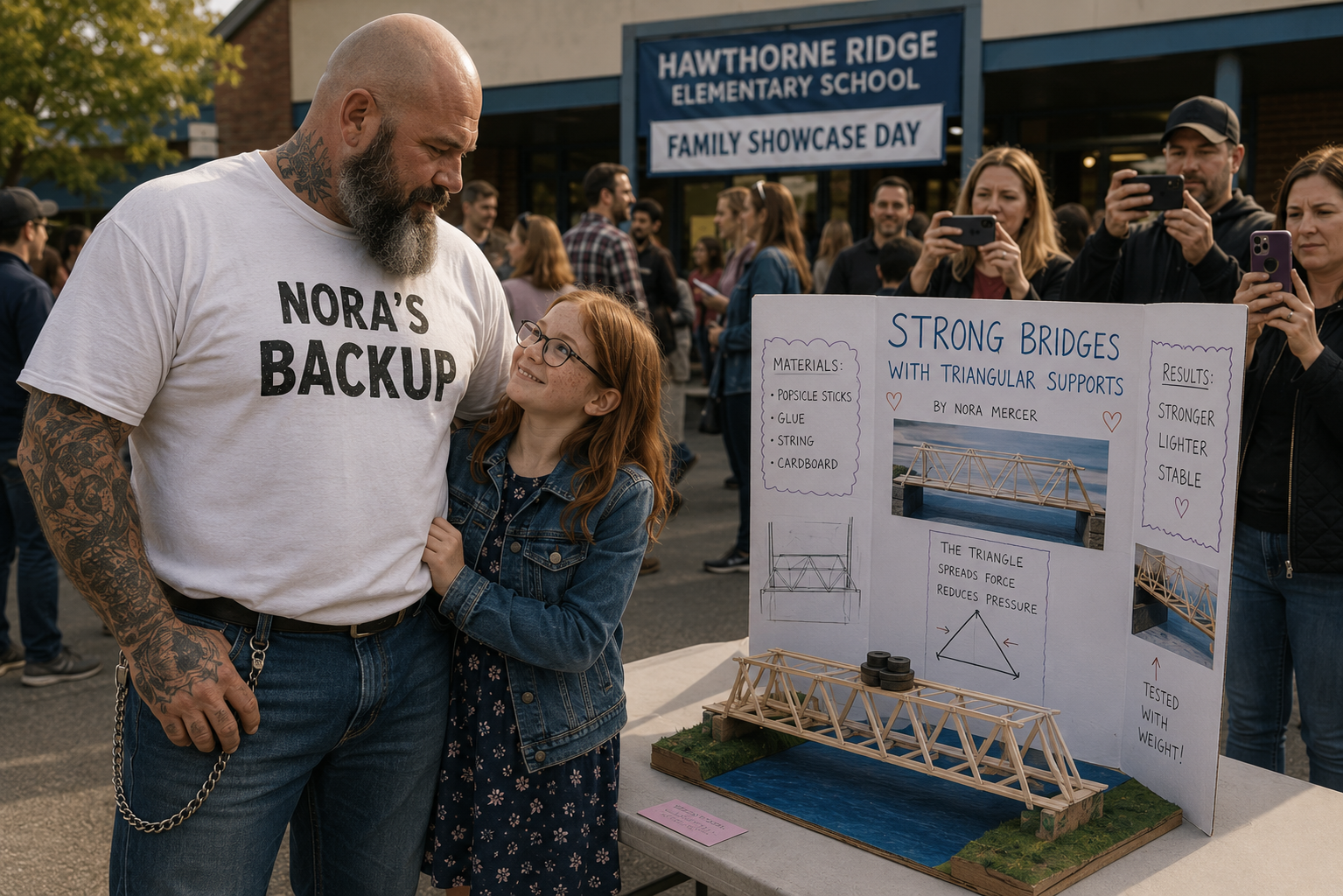
Atlas kept on the white shirt:
NORA’S BACKUP.
At 12:18 p.m., they arrived at Red Hollow.
The abandoned clubhouse sat behind weeds and rusted fencing.
Most windows had been boarded over.
Smoke did not rise from the roof.
That meant little.
Atlas and Adrian entered through the front door carrying an empty document case.
Grant Rusk stood in the old barroom.
Thirty-one.
Clean haircut.
District jacket.
No motorcycle colors.
He looked like a man arriving to inspect a fire alarm.
A phone in his hand displayed live footage from the rear storage room.
Mason sat on the floor.
The door was closed.
A portable heater stood several feet away beside two metal containers.
Atlas stared at the screen.
“Let him out.”
Grant smiled.
“You are not giving instructions.”
Adrian held up the case.
“The statement is here.”
“No, it isn’t.”
Grant’s smile faded.
“Marcus never trusted you enough to give you the original.”
Adrian swallowed.
“You attacked him.”
“I asked him for cooperation.”
“Where is he?”
“Alive when I left.”
Atlas took one step forward.
Grant raised a small remote.
“Another step and the heater overloads.”
Atlas stopped.
Police listened from the woods outside.
Detective Morris needed Grant to confirm the threat and Mason’s location before entry.
Atlas forced himself to remain still.
“What do you want?” he asked.
“The Hale statement. Nora’s recording. Every copy of her list.”
“You abducted a child over a thirteen-year-old statement?”
Grant’s expression hardened.
“That statement does not describe a teenage mistake. It describes kidnapping, arson and conspiracy.”
“You locked Marcus in.”
“I was eighteen.”
“Mason is ten.”
Grant looked at the screen.
“That depends on whether you cooperate.”
Adrian’s face collapsed.
“Leave the boy out of it.”
Grant laughed.
“You watched children get threatened for months.”
“I know.”
“You do not get to develop principles today.”
“No.”
Adrian looked toward the hidden microphone beneath his shirt.
“But I can tell the truth today.”
He began speaking before Grant understood.
“I locked Marcus Hale inside the Red Hollow clubhouse. Grant Rusk installed the exterior latch. We stole charity funds. We threatened Marcus and his family. Wade Mercer lied to protect me after he pulled Marcus from the fire.”
Grant reached for Adrian.
Atlas moved between them.
Grant pressed the remote.
Nothing happened.
Police had cut power to the rear of the building seconds earlier.
Grant stared at the device.
Then ran toward the hallway.
Atlas could have grabbed him.
Instead, he went the other direction.
Toward Mason.
The storage door had been secured with a new metal latch.
Atlas pulled once.
It held.
Thirteen years earlier, he had broken through a wall.
This time, Adrian arrived with a crowbar taken from behind the bar.
Together they forced the latch free.
Atlas opened the door.
Mason sat against the wall, crying.
The heater was dark.
The containers held water, not solvent.
Grant had staged the threat.
But Mason had not known that.
Fear does not become harmless because the weapon is fake.
Atlas stopped at the doorway.
“Mason?”
The boy looked at his shirt.
“Nora’s dad.”
“Yes.”
“Are you dangerous?”
Atlas glanced toward Adrian.
Police shouted in the front room as Grant was taken into custody.
“Sometimes I have been.”
Mason wiped his face.
“Are you now?”
“No.”
Atlas held out one open hand.
“I’m backup.”
Mason took it.
Marcus Hale was found alive in his home.
He had been struck and left unconscious, but his injuries were not life-threatening.
Grant had searched the house and taken what he believed was the original statement.
It was a copy.
Marcus had given the original to an attorney two days earlier.
Nora’s recorder had already uploaded its files to the school’s secured speech-therapy account.
The children’s list had been photographed by three parents.
Grant had tried to destroy evidence that no longer existed in only one place.
That was the mistake powerful people often made.
They assumed silence still depended on one frightened person.
Adrian Cole was arrested.
He eventually pleaded guilty to charges connected to intimidation, obstruction and child endangerment.
He also testified against Grant.
His cooperation reduced his sentence.
It did not erase what he had done.
Atlas visited him once before sentencing.
Adrian asked:
“Do you forgive me?”
Atlas answered:
“That is not the first thing you need.”
“What is?”
“To stop asking injured people to make you feel better.”
Grant Rusk faced charges related to abduction, assault, evidence tampering, coercion and the Red Hollow fire.
The district terminated its security contract.
The investigation spread beyond Hawthorne Ridge.
Several schools had missing camera files and complaints closed without proper review.
Principal Foster resigned after an independent report found that administrators repeatedly minimized credible reports to protect the school’s reputation.
No report called her cruel.
It called her passive.
The difference meant little to the children who had learned to hide.
Hawthorne Ridge changed slowly.
Recess areas gained independent supervision.
Students could report concerns outside the school chain of command.
Medication such as Daniel’s inhaler was monitored more carefully.
Parents no longer received reports using words such as horseplay when the evidence described deliberate harm.
Nora’s original page was placed in a frame inside my office.
Not as a celebration.
As a warning.
Fourteen children should never have needed to design their own map of safe places.
Atlas’s criminal record remained.
He refused efforts to make him sound innocent.
“I assaulted Adrian,” he said whenever someone tried to rewrite the story. “I could have stopped after one hit. I didn’t.”
“But you rescued Marcus,” people said.
“Both are true.”
That became the lesson he wanted Nora to learn.
Good actions did not erase bad ones.
Bad actions did not forbid every good action afterward.
At the next Family Showcase Day, Atlas returned.
Same boots.
Same tattoos.
Same Harley parked outside the gate.
He wore the white shirt again.
But Nora had changed the words.
The front still said:
NORA’S BACKUP.
On the back, in fourteen different colors, the children from her list had written their names.
Mason Hale added his last.
Parents still looked.
A few photographed him.
Atlas noticed.
He did not shrink.
He also did not make himself larger.
He stood beside Nora’s new bridge model while she explained that one support should never be expected to carry an entire structure.
“What happens when one part is under too much pressure?” a student asked.
Nora pointed toward the additional beams.
“The others help.”
Atlas looked down at his shirt.
Nora looked up at him.
He had come to school believing backup meant one large father standing between his daughter and danger.
She had taught him something better.
Backup was a counselor who listened.
A child who recorded the truth.
Parents who compared stories.
A survivor who kept the original statement.
Police officers who followed a plan.
Fourteen names written on one page so nobody could be dismissed as an isolated incident.
It was not one threatening man.
It was a structure.
And for the first time since the bullying began, Nora did not keep one hand hooked through her father’s belt loop.
She stood three feet away from him.
Then five.
Then crossed the courtyard alone to answer another student’s question.
Atlas remained where he was.
Watching.
Not because she could not stand alone.
Because standing alone and being alone were never the same thing.