
THE MEN AT THE KINDERGARTEN DOOR
Part Three
Tank did not take seventeen bikers to Harbor House.
That was exactly what Cole wanted.
He wanted motorcycles surrounding the abandoned shelter.
Leather vests on police cameras.
A frightened child carried through smoke while men who looked dangerous filled every frame.
By morning, the story would become whatever Cole needed it to be.
A biker abduction.
A custody rescue.
A violent confrontation between two groups of extremists.
The truth would disappear beneath the image.
Tank looked at Detective Hannah Cole and said:
“We go quiet.”
She nodded.
“You follow my plan.”
“Yes.”
“No club convoy.”
“Yes.”
“No weapons.”
Tank opened his vest.
Empty.
“The riders stay here.”
Ruth Callahan stepped forward.
“We can help.”
“You can,” the detective said. “By securing this school and documenting every person who enters or leaves.”
Several parents looked uncomfortable.
An hour earlier, they had believed the riders were the threat.
Now those same men and women stood beside the doors while police reviewed names, photographs and pickup permissions.
Tank removed his Steel Harbor vest.
He folded it over the back of a chair.
Then looked at me.
“You stay with the officers.”
“No.”
“Megan—”
“He took my daughter.”
“That’s why you stay.”
I stepped closer.
“You guarded a van for me five years ago without knowing my name. Do not tell me to sit in a preschool while Sophie is inside that building.”
Tank looked toward Detective Cole.
She considered the risk.
Then said:
“You come in the command vehicle. You do not enter Harbor House unless I authorize it.”
I agreed because it was the only answer that moved us closer to Sophie.
Daniel Avery came too.
He knew the building’s original layout.
His mother had purchased Harbor House through a legal trust so abusive partners could not identify its real owner.
After her death, Cole obtained her files but not everything.
The basement archive remained protected by an old mechanical lock.
Daniel believed that was what his brother wanted.
“What’s inside?” Detective Cole asked.
“Original affidavits. Photographs. medical reports. recordings.”
“Against Cole?”
“And the officers who helped him find women after protection orders were issued.”
Tank’s face hardened.
“Why didn’t your mother give it to prosecutors?”
“She tried.”
Daniel looked at me.
“Then one witness disappeared and another withdrew. Caroline believed somebody inside law enforcement was alerting Cole.”
“So she hid it.”
“Yes.”
“And told no one where?”
“She told me enough to find the archive. Not enough to open it.”
“What opens it?” I asked.
Daniel looked at Tank.
“A transport medallion.”
Tank frowned.
“The lighthouse coin.”
Steel Harbor gave numbered brass medallions to riders assigned to sensitive escorts. Each coin proved that the rider had been cleared for a specific transfer.
Tank had carried one during my escape.
Afterward, Caroline Avery told him to keep it.
“She said I might need to prove I showed up,” he remembered.
He reached beneath his shirt and pulled out a chain.
A worn brass disc rested against his chest.
A lighthouse on one side.
A number on the other.
17.
Cole had used Tank’s identity because he needed the man attached to that number.
Not merely his license.
Not merely the club.
The medallion.
Detective Cole said:
“You are not giving him the original.”
Police photographed and scanned it.
A technician prepared a copy.
Tank shook his head.
“He’ll know.”
“How?”
“The edge is damaged.”
He showed them a small crescent-shaped cut.
“Dropped it during Megan’s transfer.”
I remembered a motorcycle scraping the side of the shelter van when a black pickup forced us toward the shoulder.
Tank had placed his bike between the vehicles.
He had nearly gone down.
“That was you,” I whispered.
He looked at me.
“Your daughter was coming early. Driver said we couldn’t stop.”
“You kept the truck away.”
“For fourteen miles.”
I had spent five years imagining an anonymous rider behind the helmet.
Tank had remembered only another assignment.
That was why his name had remained in Caroline’s files.
He had not known he was part of my history.
Cole had known.
Harbor House stood twenty-three miles outside Franklin, beyond a tree line near an abandoned church camp.
The building had been damaged by fire two years earlier.
The roof over the east wing had collapsed.
Windows were boarded.
The front sign had been removed.
Police drones found one white van behind the building.
Thermal imaging showed four people inside.
One small heat signature.
Three adults.
Cole.
His wife, Melissa.
And an unidentified man near the basement stairs.
At 5:18 p.m., Tank approached the front entrance alone.
Police teams waited beyond the trees and near the rear service road.
A microphone was hidden beneath his shirt.
The copied medallion remained in his pocket.
I watched from the command vehicle as the door opened.
Cole Avery appeared.
He was forty-one.
Dark coat.
Trim beard.
Silver ring.
No panic in his face.
Men like Cole did not think of themselves as kidnappers.
They thought they were correcting an injustice.
“Where are the riders?” he asked.
“Not coming.”
Cole smiled.
“You finally learned not to bring witnesses.”
“Where’s Sophie?”
“Safe with her father.”
Tank’s voice became colder.
“You are the reason she needed a shelter.”
“I am the reason she exists.”
“That isn’t the same as being her father.”
Cole’s smile vanished.
He stepped aside.
Tank entered.
The camera on his shirt showed a ruined lobby.
Smoke stains above the doorframes.
Broken furniture.
Caroline Avery’s old shelter rules still visible on one wall:
NO VISITOR ENTERS WITHOUT CONSENT.
NO LOCATION IS SHARED.
NO CHILD IS USED TO FORCE CONTACT.
Cole had placed Sophie in a chair beneath those words.
She was not tied.
Melissa sat beside her, holding one hand on the child’s shoulder.
Sophie saw Tank.
Her eyes widened.
“You’re the ID man.”
“Yes.”
“Where’s Mom?”
“Nearby.”
Cole said:
“She abandoned you to strangers.”
Sophie looked at him.
“My mom says strangers can be safe and family can be dangerous.”
Tank almost smiled.
“That sounds like her.”
Cole pointed toward the basement.
“Medallion.”
“Let Sophie leave first.”
“No.”
“Then you don’t get it.”
Melissa tightened her grip on Sophie’s shoulder.
The little girl winced.
Tank saw it.
So did every officer watching.
“Take your hand off her,” he said.
Melissa did.
Cole laughed.
“There he is. The threatening biker.”
Tank kept both hands open.
“You chose my name because you thought people would believe I took her.”
“They already did.”
“Only until they checked.”
“Most people never check.”
That was the foundation of his entire method.
Fear first.
Documents second.
Disappear before truth arrived.
Cole held out his hand.
“The coin.”
Tank removed the copied medallion.
Cole examined it.
Then looked at the damaged edge.
For one second, he accepted it.
Then he smiled.
“The cut is too clean.”
He dropped the copy.
“You brought police.”
The unidentified man near the stairs drew a handgun.
Tank did not move toward him.
He stepped between the weapon and Sophie.
Cole grabbed the girl from the chair.
She screamed.
Police breached the rear entrance.
Melissa dropped to the floor.
The armed man turned toward the sound.
Tank lifted Sophie and covered her with his body.
The first shot struck the wall.
The second never came.
Officers tackled the gunman before he could fire again.
Cole ran toward the basement, dragging Sophie by one arm.
Tank followed.
Not striking him.
Not reaching for the gun lying near the stairs.
Only keeping close enough that Cole could not pull her out of sight.
At the basement landing, Cole held Sophie in front of him.
In his other hand was a lighter.
Fuel had been poured along the archive-room door.
“You come closer, it burns.”
Tank stopped.
Police held their position above.
Cole looked at Sophie.
“Tell them you want to come with me.”
She was crying.
“No.”
“I’m your father.”
“No.”
“I came for you.”
“My mom comes every day.”
The answer struck him harder than defiance.
Cole tightened his arm.
Tank spoke quietly.
“Sophie, look at me.”
She did.
“Do you remember the pickup rule?”
She sniffed.
“ID first.”
“That’s right.”
He looked at Cole.
“Ask him.”
Sophie’s voice shook.
“Where’s your ID?”
Cole stared at her.
“What?”
“My school says adults prove who they are.”
“I am your father.”
“That’s not an ID.”
An officer later said the exchange distracted Cole for less than two seconds.
It was enough.
Daniel entered through the old laundry corridor behind the archive room.
He pushed open a maintenance hatch that struck Cole’s shoulder.
The lighter fell.
Tank pulled Sophie away.
Police moved down the stairs and restrained Cole.
The fuel never ignited.
The archive remained intact.
Inside were thirty-seven case files.
Recordings.
Court documents.
Names of officers, attorneys and private “recovery agents” who had helped abusive parents locate protected families.
Caroline Avery had built the archive because she knew individual victims could be dismissed.
Patterns were harder to erase.
Cole and Melissa were charged with kidnapping, conspiracy, forgery, identity theft and multiple offenses linked to earlier custody removals.
The armed man had worked for a private parental-recovery organization operating across three states.
Several old cases were reopened.
Daniel testified.
So did I.
Tank did not describe himself as the man who saved Sophie.
He said:
“I stood in the correct place until trained people arrived.”
That was not the whole truth.
But it was the version he could live with.
The next morning, I returned to Oakridge Early Learning Center.
Sophie refused to release my hand.
Seventeen motorcycles were gone.
Only Tank’s Harley remained near the curb.
He stood beside the entrance in a plain work shirt.
No vest.
No line of riders.
Dr. Brooks had asked him to come because several children wanted to thank the “door guards.”
Parents approached him differently.
Some apologized.
One father admitted he had uploaded a video calling the riders armed kidnappers.
Tank answered:
“You were scared.”
“I was wrong.”
“Both can be true.”
The father deleted the video.
Others did not apologize.
They simply stopped looking at Tank as if danger had a uniform.
The school changed its procedures.
Digital custody changes required direct verification with the court.
No child could be removed for a private assessment without two staff members confirming parental consent.
Visitor badges were no longer accepted as proof by themselves.
And every adult—teacher, contractor, police officer, parent or biker—showed identification.
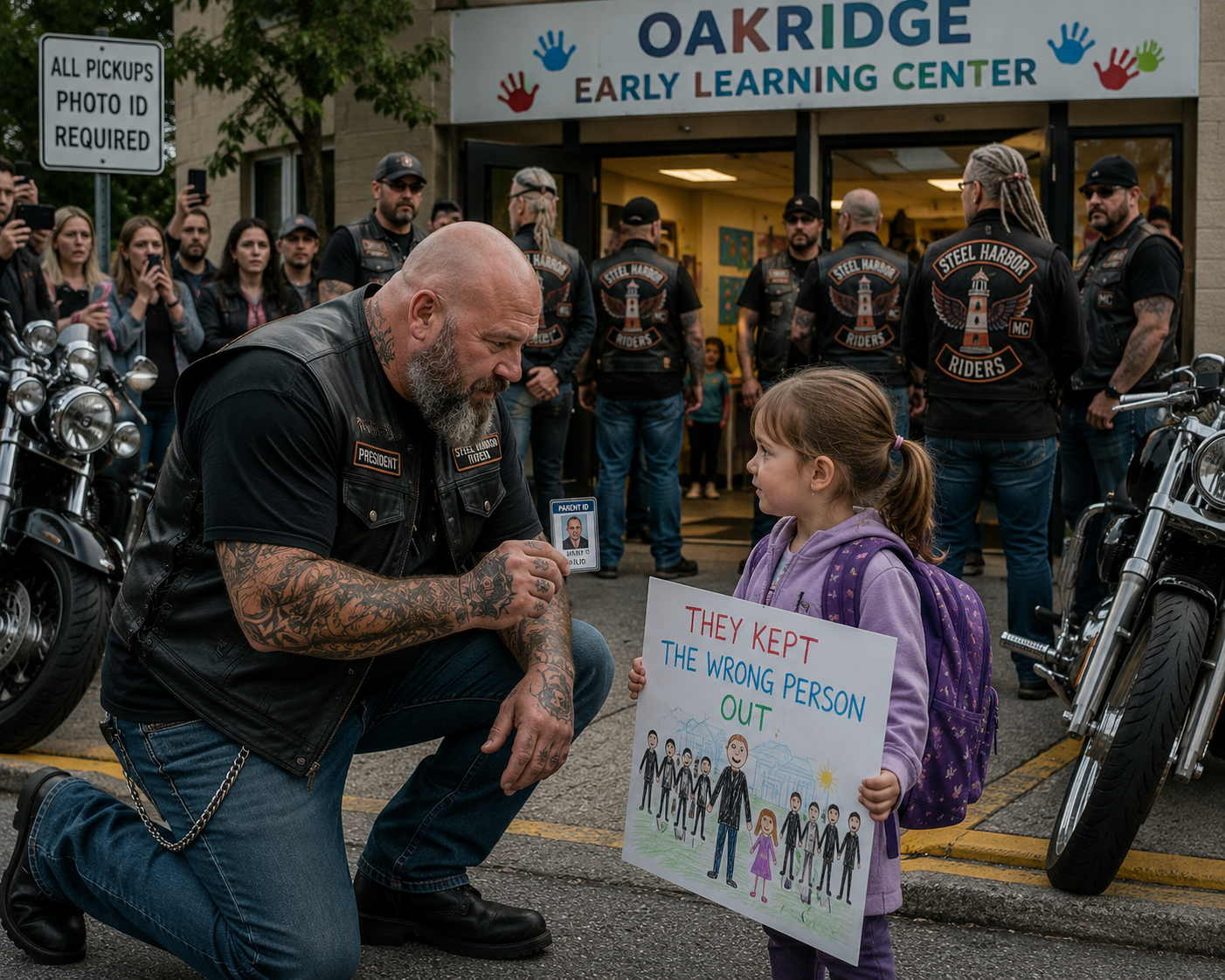
Weeks later, Sophie drew a picture of pickup day.
Seventeen enormous figures stood across the school door.
She gave all of them black shirts and giant beards, including Ruth.
At the center, Tank held up a square card.
Above him, Sophie wrote:
THEY DIDN’T LOCK US IN.
Below it:
THEY KEPT THE WRONG PERSON OUT.
Tank framed the drawing inside the Steel Harbor clubhouse.
The riders continued helping shelters.
But they changed their methods.
No more accepting requests from anonymous callers.
Every escort verified through two independent contacts.
Every document checked before engines started.
They had learned that good intentions could be turned into tools by someone who understood how others would judge them.
I learned something less comfortable.
When I arrived at the school, I had seen motorcycles, tattoos and men across a doorway.
I had decided the danger was the most visible thing.
Cole had counted on that.
He wore clean clothes.
Used legal language.
Carried authentic-looking documents.
Sent a friendly woman in a county jacket to hold my daughter’s hand.
The people protecting Sophie looked frightening.
The people taking her looked official.
Months later, Tank attended the school’s safety day.
A child asked why he had demanded IDs from parents.
He answered:
“Because loving a child is not something strangers can see.”
He held up his license.
“Rules help when appearances don’t.”
Sophie stood beside him.
This time, she was not afraid.
She raised her own handmade card.
It showed her photograph, first name and a purple star.
Tank examined it seriously.
“Looks official.”
“I made it with crayons.”
“Government does similar work.”
She laughed.
Then pointed toward the door.
“You can come in.”
Tank nodded.
“Thank you.”
He crossed the threshold only after she gave permission.
The largest man at the kindergarten entrance had never been trying to keep families apart.
He had been enforcing a simple principle that fear, forged paperwork and respectable clothing could not change:
Before anyone leaves with a child—
prove who you are.