
THE MISSING PAGE
Part Three
Judge Ward refused to let Harold and me go to Archive B alone.
The message demanded both of us before noon.
At 10:36 a.m., prosecutors fitted Harold with a microphone beneath his leather vest.
An investigator placed another inside the seam of my green folder.
The folder contained copies.
Not originals.
The real documents had already been photographed, sealed and transferred to a state investigator who had no connection to family court.
A real police officer remained with Ava and Natalie.
The fraudulent custody order was still visible in the public system, but Judge Ward had signed a handwritten emergency order suspending every transfer involving my daughter.
She gave copies directly to officers.
No electronic filing.
No compromised account.
Ink and witnesses.
For the first time that morning, paper worked in my favor.
Archive B occupied the basement of an old county records annex connected to the courthouse by an underground service corridor.
Harold had been there once.
“Twenty-eight years ago,” he told Detective Rachel Kim as we entered the elevator.
“Why?”
“I asked to inspect my daughter’s file.”
“And?”
“They said it was being transferred.”
“To where?”
He looked at the floor number descending toward the basement.
“Arizona.”
The elevator doors opened onto a narrow hallway lined with metal shelving.
Fluorescent lights flickered overhead.
A sign pointed left:
ARCHIVE A — PUBLIC RECORDS
The arrow pointing right had been removed.
Only two screw holes remained.
Harold touched them.
“Archive B.”
Detective Kim and two officers remained beyond the stairwell door.
They could hear us.
They could reach us quickly.
But Pamela had warned that Molly would be moved if police appeared first.
So Harold and I continued alone.
A steel door waited at the end of the corridor.
I knocked.
A camera above us moved.
Then a speaker clicked.
“Show the page.”
The voice belonged to Pamela Reed.
Harold held up a clear evidence sleeve.
Inside was an old yellow sheet from his custody file.
The original page nine.
I had not known it existed until ten minutes earlier.
Harold had kept it folded behind Molly’s childhood photograph for thirty-two years.
It was the counseling agreement he believed he had signed.
His real signature appeared at the bottom.
On the reverse side was a faint carbon impression from a routing sheet that had once rested beneath it:
REPLACE AFTER EXECUTION — ARCHIVE B
Below the instruction were the initials:
R.C.
Robert Crane.
The document proved Harold had signed one page and the court had filed another.
It was not enough by itself to prove every fraudulent custody case.
It was enough to show where investigators should look.
The steel door unlocked.
Pamela stood inside.
She wore no gray coat now.
Black trousers.
White blouse.
Courthouse identification clipped to her waist.
She looked less like a fugitive than she had looked at legal aid that morning.
That was how she had moved through systems for years.
She looked as though she belonged.
“Phones,” she said.
We handed over the devices investigators had prepared.
Pamela placed them inside a metal drawer.
Then searched the green folder.
She did not find the microphone.
“Where’s Ava?” I asked.
“Safe.”
“You were outside her apartment.”
“I was supposed to collect her.”
“Using a fake order.”
Pamela’s face tightened.
“The order was active.”
“For twelve minutes.”
“Twelve minutes is legally active.”
Harold stared at her.
“No. It’s electronically visible.”
Pamela looked at him.
“That distinction stopped mattering years ago.”
She led us through rows of shelves.
Thousands of family-court files filled the room.
Some were thirty years old.
Others had been printed that morning.
Colored labels divided them into categories:
RELOCATION
EMERGENCY PLACEMENT
GUARDIANSHIP
ALIENATION
At the end of the room, Molly Boone sat beside a metal table.
Her hands were fastened in front of her with a plastic restraint.
She looked exactly like the woman in the photograph.
Older than the seven-year-old Harold remembered.
Older than the twenty-four-year-old described in the Arizona case.
Gray in her hair.
Lines around her eyes.
But the motorcycle pendant remained around her neck.
Harold stopped walking.
“Molly.”
She looked up.
For thirty-two years, he had imagined the first thing he would say if he found her.
It came out as:
“I brought every letter back when they returned them.”
Molly began crying.
Pamela pointed toward the table.
“Page nine.”
Harold did not move.
“Release her.”
“You are not negotiating.”
“You asked me here because you need the original.”
Pamela glanced toward a second door.
Someone else entered.
A woman in her early seventies.
Perfect silver hair.
Dark suit.
A courthouse security card hanging from one pocket.
Harold recognized her.
“Cynthia Reed.”
Pamela’s mother.
Former chief records administrator for Jefferson County Family Court.
Retired eight years earlier.
She had trained clerks.
Managed archive transfers.
Approved access credentials.
And worked with Robert Crane for almost four decades.
Cynthia looked at Harold’s page with something close to affection.
“We wondered where that went.”
“You knew I had it?”
“We suspected.”
“Why not take it before?”
“You were harmless.”
Her eyes moved toward me.
“Until today.”
I asked:
“How many families?”
Cynthia smiled faintly.
“You think this was about stealing children.”
“What would you call it?”
“Correcting unstable arrangements.”
Molly spoke from the chair.
“You sold outcomes.”
Cynthia looked at her.
“Some parents were better positioned to provide stability.”
“Some parents paid more,” Harold said.
Cynthia did not deny it.
Robert Crane identified clients willing to pay.
Cynthia controlled which pages entered the official file.
Temporary counseling agreements became relocation consents.
Medical releases became guardianship waivers.
Signature pages were moved beneath different language.
Later, when courts began using electronic records, Pamela joined legal aid and collected clean signatures from parents who could not afford private attorneys.
Mitchell Crane recruited clients through Family Restoration Network.
The operation did not need fraudulent orders to survive forever.
Only long enough.
Long enough to move a child.
Long enough to cross a state line.
Long enough to make the new arrangement appear established.
Judges were then warned that reversing it would create further instability.
Cynthia called it continuity.
Harold called it what it was.
“Kidnapping with stationery.”
Cynthia’s smile disappeared.
She held out one hand.
“The page.”
Harold placed the evidence sleeve on the table.
Pamela moved toward it.
Molly looked at her.
“What did they promise you?”
Pamela stopped.
Cynthia answered:
“My daughter understands loyalty.”
Molly shook her head.
“She understands leverage.”
Pamela’s face changed.
Molly continued:
“They used your notary account before you were old enough to hold a commission.”
I stared at Pamela.
The Arizona guardianship had carried her registration number when she was nineteen.
“That could send you to prison,” Molly said. “So your mother made sure you kept working.”
Cynthia stepped toward her.
“Be quiet.”
Pamela looked at Cynthia.
“You said Robert used the number without asking.”
“He did.”
“You said you protected me afterward.”
“I did.”
“You built the rest of this around my name.”
Cynthia’s voice hardened.
“We built something that worked.”
The microphone inside my folder carried every word to Detective Kim.
I needed them to keep talking.
“Where is Grace?” I asked.
Molly closed her eyes.
Pamela looked toward a locked cabinet.
Cynthia said:
“That is irrelevant.”
Harold’s voice shook.
“She’s my granddaughter.”
“She was adopted.”
“By whom?”
“A suitable family.”
“Did Molly consent?”
Cynthia said nothing.
That silence answered.
Molly had spent seventeen years searching for Grace.
She disappeared from public records because Cynthia threatened to have her arrested for attempting to interfere with the guardianship.
Robert Crane sent letters claiming Harold wanted no contact.
Letters supposedly from Harold.
All forged.
Molly eventually discovered Archive B through a former clerk.
She contacted Pamela, believing Pamela wanted to expose the operation.
Pamela arranged the meeting that morning.
Then Cynthia appeared.
Pamela whispered:
“I was going to give her the file.”
Her mother looked at her.
“You were going to destroy all of us.”
“I was going to stop.”
Cynthia reached beneath the table and pressed a button.
Metal shutters began descending across the exits.
A red light appeared above the shelves.
SECURE RECORD DESTRUCTION SEQUENCE
Molly stared at the ceiling.
“She’s going to flood the room.”
Not with water.
The archive used an oxygen-reduction fire-suppression system designed to protect records without damaging them.
Once activated, oxygen levels would drop low enough to extinguish fire.
Too low for unprotected people to remain conscious safely.
Cynthia took the original page.
“You will be found after a system malfunction.”
Pamela backed away.
“You said nobody would be hurt.”
“I said it would be clean.”
Harold tore open the evidence sleeve.
Then ripped page nine in half.
Cynthia screamed.
It was the first time she lost control.
Harold tore it again.
“You waited thirty-two years for this page.”
He let the pieces fall.
“So you didn’t notice we gave you a copy.”
Cynthia looked down.
A tiny reproduction mark appeared near the bottom edge.
The original was already with investigators.
Police breached the stairwell door.
Cynthia ran toward the locked cabinet.
Pamela intercepted her.
Not violently.
She simply placed herself in the way and refused to move.
Cynthia struck her daughter across the face.
Pamela stayed there.
Officers forced open the first shutter.
Detective Kim entered with portable breathing equipment.
Harold reached Molly and broke the plastic restraint with a cutter an investigator had hidden inside his glasses case.
The old biker had entered court carrying reading glasses.
Nobody had thought to fear them.
I helped Molly toward the door.
Cynthia was arrested beside the cabinet containing sealed adoption indexes.
Pamela surrendered.
Inside the cabinet, investigators found Grace’s current file.
She was seventeen.
Alive.
Living with an adoptive family in Indiana who had been told Molly had abandoned her and no biological relatives wanted contact.
The family had not participated in the fraud.
They had believed the documents were real.
Grace was not removed from them.
Molly did not demand that.
She requested contact through counselors, slowly and with Grace’s consent.
Harold did the same with Molly.
He did not ask her to call him Dad on the first day.
He did not ask forgiveness.
He handed her the returned letters.
Every one.
She read them over several weeks.
Then called him.
Their first conversation lasted eleven minutes.
The second lasted an hour.
The criminal investigation uncovered more than eighty questionable custody matters across four states.
Mitchell Crane was charged.
So were Cynthia and Pamela Reed.
Pamela cooperated.
Her cooperation did not erase what she had done, but it helped investigators restore records and locate families.
Brent admitted paying for false evidence.
His custody rights were suspended pending criminal and family-court review.
He was not erased from Ava’s life by one dramatic ruling.
The court imposed supervised contact and ordered an independent assessment.
Real protection required more than replacing one unchecked decision with another.
Judge Ward granted me temporary primary custody.
This time, I read every line before signing.
Harold sat beside me.
“Page numbers?”
“Complete.”
“Revision date?”
“Current.”
“Waiver language?”
“None.”
He nodded.
“Now sign.”
Months later, I returned to the courthouse with Ava.
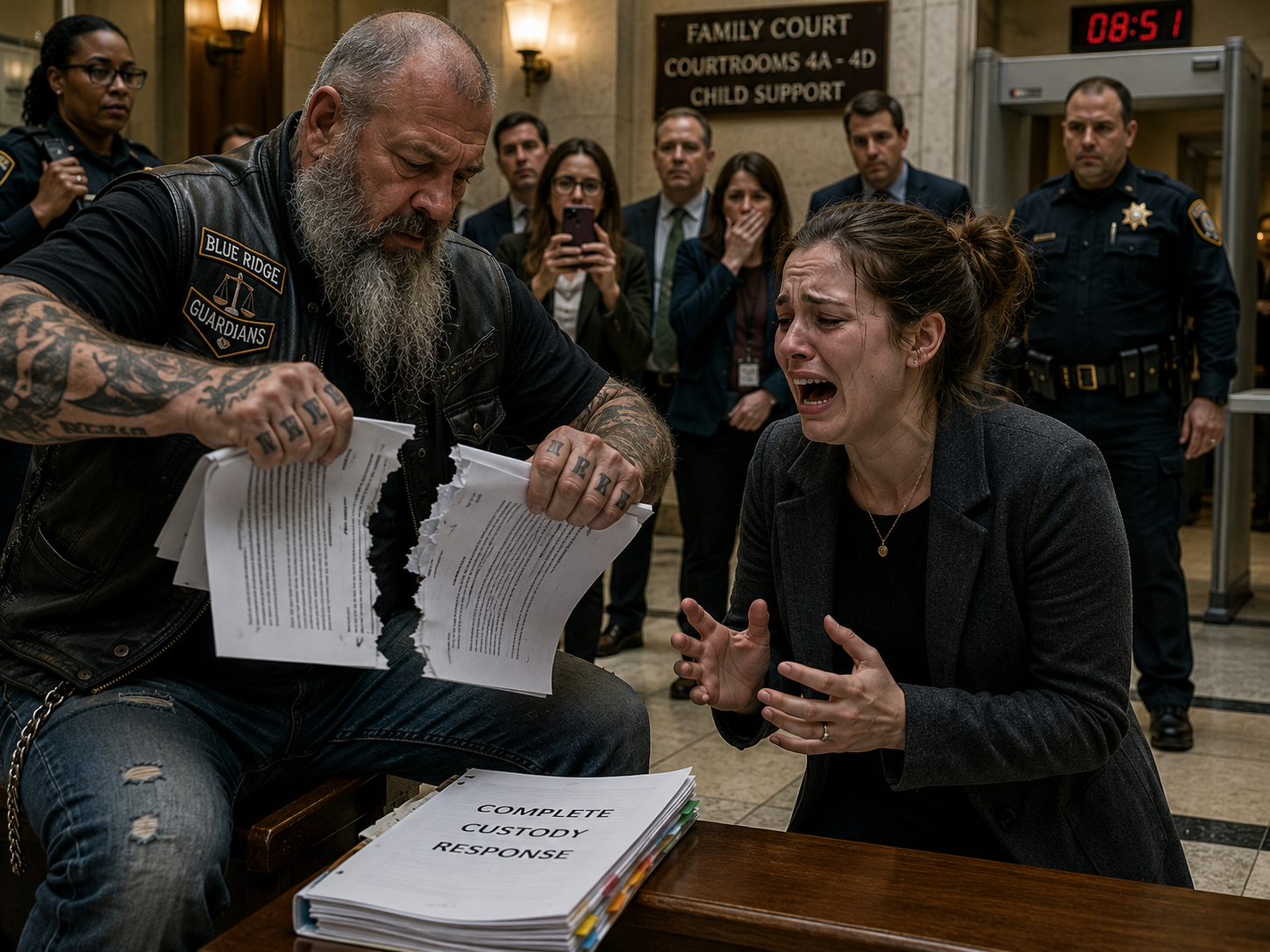
Harold sat on the same bench where I had first seen him.
Leather vest.
Gray beard.
Reading glasses hanging against his chest.
A nervous father sat two seats away holding a stack of custody forms.
Harold glanced at the packet.
“Page numbers jump.”
The man pulled it closer.
“I’m fine.”
Harold nodded.
“Hope so.”
I laughed.
He looked up and saw us.
Ava ran toward him.
She had made him a bookmark from yellow construction paper.
Across it she had written:
CHECK EVERY PAGE.
Harold placed it inside Molly’s old file.
The missing page had once taken his daughter from him.
Thirty-two years later, noticing another missing page had helped bring her back.
Not as the child he had lost.
As the woman she had become.
That was the truth family court had taught all of us too late:
A signature could be copied.
A seal could be stolen.
A respectable person could lie.
A frightening-looking stranger could be the only person in the hallway paying attention.
And sometimes the difference between losing a child and protecting one was not a brilliant argument before a judge.
Sometimes it was one old biker looking down at a stack of papers and asking:
“Where’s page nine?”