
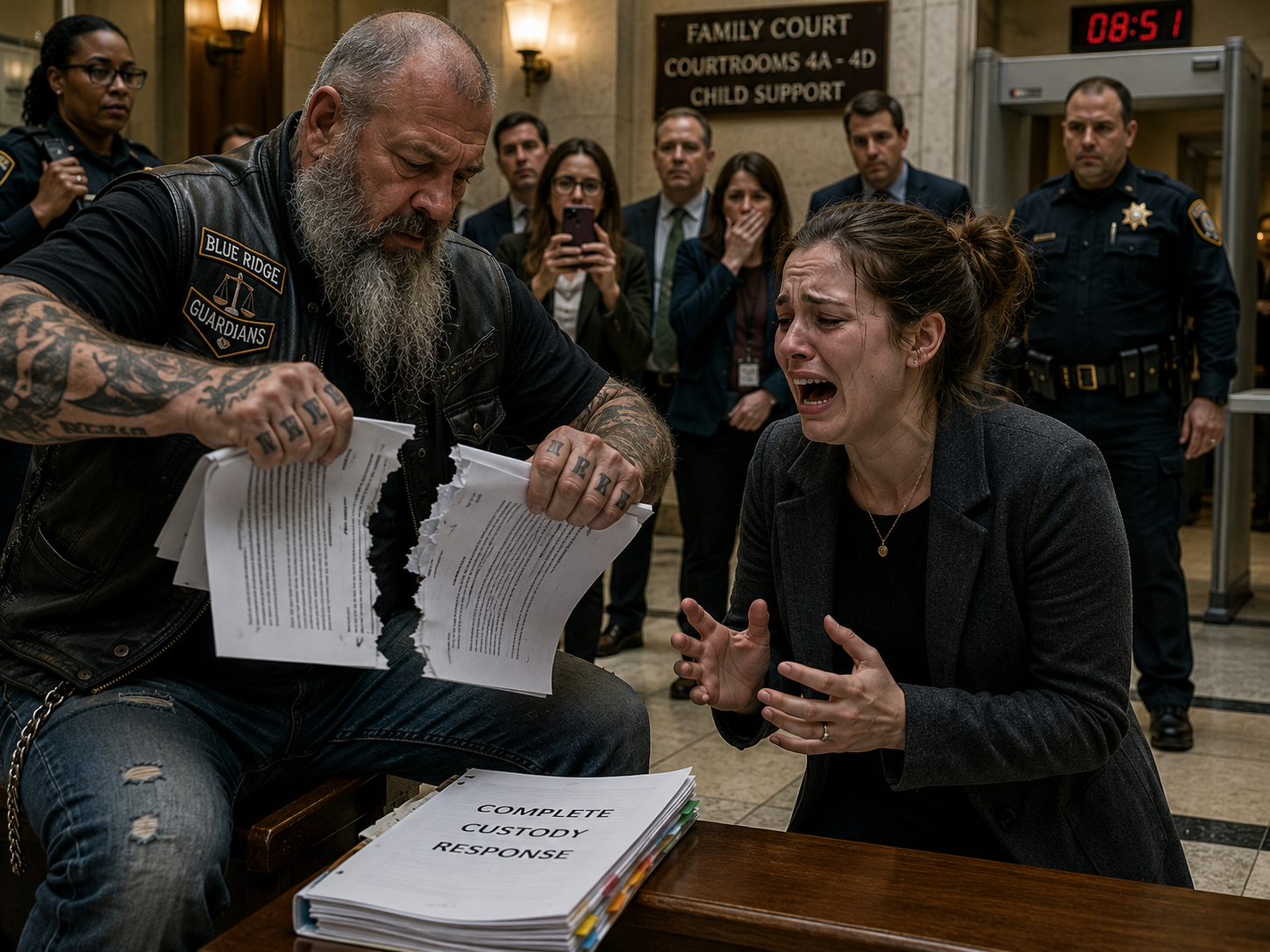
THE MISSING PAGE
Part Two
The judge did not begin the custody hearing.
She ordered the courtroom sealed.
Nobody entered.
Nobody left.
Brent’s attorney objected immediately.
“Your Honor, there is no basis for treating routine supplemental evidence as a criminal matter.”
Judge Evelyn Ward held my notarized statement in one hand and Harold’s thirty-two-year-old document in the other.
“There is when two documents issued decades apart carry the registration number of a notary who has been dead since 2002.”
Brent’s attorney stopped speaking.
That frightened me more than another objection would have.
His name was Mitchell Crane.
He had represented Brent from the beginning.
Expensive suit.
Soft voice.
A habit of describing control as concern.
When Brent removed my car battery, Crane called it “an attempt to prevent an emotionally charged departure.”
When Brent stood outside Ava’s bedroom for three hours, Crane called it “a prolonged family discussion.”
Words were his tools.
That morning, for the first time, he seemed to have run out.
Judge Ward instructed the bailiff to contact courthouse security and the county prosecutor’s office.
Then she looked at me.
“Ms. Mitchell, did you sign this declaration?”
“No.”
“Have you ever met the notary named here?”
“No.”
“Did you provide anyone with a digital copy of your signature?”
I thought about every document I had completed during the previous nine months.
Protection-order forms.
Legal-aid applications.
Housing paperwork.
School records.
“I emailed signed forms to legal aid.”
“When?”
“Several times.”
“Who received them?”
“My attorney and her assistant.”
The assistant’s name was Pamela Reed.
The same woman who had handed me the defective packet.
The same woman whose notary stamp appeared on the false declaration.
Judge Ward looked toward Crane.
“Who provided this document to your office?”
He stood slowly.
“My client.”
Every person in the courtroom turned toward Brent.
He looked at Crane.
That was not the answer he had expected.
Brent rose halfway from his chair.
“You told me it came from Sarah’s lawyer.”
Crane’s face remained controlled.
“I advised you not to speak.”
“You said she signed it.”
“Mr. Lawson.”
“You showed it to me yesterday.”
Judge Ward struck the bench once with her gavel.
“Both of you will remain silent unless questioned.”
Brent sat.
His face had changed.
For months, he had entered hearings knowing exactly what story his attorney planned to tell.
Now he looked like someone discovering he had only been given part of the script.
A prosecutor named Rachel Kim arrived with two courthouse investigators.
They collected both versions of my packet, the false declaration and Harold’s file.
One investigator photographed every page before touching anything.
Harold remained beside me.
His old hands rested on his knees.
I whispered:
“How could the same number be used?”
“It wasn’t the number originally.”
“What?”
He pointed toward the notarization line in his old document.
“The ink is darker than the rest.”
The registration number had been added later.
So had the expiration date.
Thirty-two years ago, nobody had noticed.
Or nobody had wanted to.
Rachel Kim asked Harold to explain his case.
His former wife, Diane, had petitioned to move their seven-year-old daughter, Molly, from Kentucky to Arizona.
Harold opposed the relocation.
He had been twenty-eight.
A mechanic.
Recently sober.
No attorney.
Diane’s lawyer gave him a packet outside the courtroom and said the judge expected him to sign a temporary counseling agreement.
The page he signed was not attached to the packet later filed.
Instead, it appeared beneath language consenting to relocation.
“Did you receive a copy?” Kim asked.
“Not that day.”
“When?”
“Six weeks later.”
“After the relocation?”
“Yes.”
“Who represented your former wife?”
Harold looked toward Mitchell Crane.
“His father.”
Crane’s expression tightened.
The attorney thirty-two years earlier had been Robert Crane.
Founder of Crane Family Law.
Mitchell’s father.
Robert had retired ten years ago and died the previous winter.
Mitchell now operated the firm.
Judge Ward asked:
“Are you suggesting your father altered Mr. Boone’s documents?”
Mitchell answered carefully.
“I was twelve years old at the time. I have no knowledge of his case.”
Harold opened another part of his file.
“I wrote your father seventeen letters.”
“That does not give me knowledge.”
“You worked in his office before law school.”
Mitchell said nothing.
Harold continued:
“The last letter came back opened.”
A handwritten note had been added in the margin.
STOP DIGGING OR YOU WILL LOSE EVEN SUPERVISED CONTACT.
No signature.
But Harold had kept it.
He had kept everything.
Because when someone takes your child using paper, paper becomes both the weapon and the only evidence that the weapon existed.
Rachel Kim turned toward Brent.
“Mr. Lawson, where did you obtain Ms. Mitchell’s declaration?”
Brent looked at Crane.
The judge said:
“Answer the prosecutor.”
“A woman brought it to my office.”
“What woman?”
“Pamela.”
“Pamela Reed?”
“I think so.”
“Had you met her before?”
“Yes.”
My stomach tightened.
“Where?”
Brent looked at me for the first time.
“At a parental-rights seminar.”
I stared at him.
“What seminar?”
Judge Ward warned me not to interrupt.
Brent continued.
The seminar was organized by a group called Family Restoration Network.
It promised to help parents fight “false alienation claims” and “biased custody systems.”
They taught participants how to document emotional instability, identify procedural weaknesses and request emergency custody before the other parent could respond.
Pamela Reed had spoken about legal-aid offices.
“She said mothers like Sarah use free lawyers to overload the system,” Brent said.
My hands began shaking.
“She said she could tell which forms were incomplete and which judges would sign emergency orders.”
Rachel Kim asked:
“Did you pay her?”
Brent hesitated.
“Yes.”
“How much?”
“Three thousand dollars.”
“For the declaration?”
“For case preparation.”
“Did you know the declaration was false?”
“I thought Sarah had signed something similar during intake.”
“You knew she had not signed this document in front of you.”
“Yes.”
“Yet you gave it to your attorney.”
Brent looked toward Crane.
“He told me not to ask how supporting documents were obtained.”
Crane stood.
“Your Honor, my client is attempting to shift responsibility after making unauthorized arrangements outside my office.”
Brent turned on him.
“You introduced me to the seminar.”
The room went silent.
Crane looked at Judge Ward.
“I provided a list of community resources.”
“You said they helped fathers win emergency placement.”
“I did not endorse illegal conduct.”
“You told me Pamela could fix the missing evidence.”
Rachel Kim wrote down every word.
Judge Ward ordered Brent and Crane separated.
Brent was taken to a consultation room with one investigator.
Crane remained at counsel table with security behind him.
My hearing had become a criminal investigation.
But Ava was still at my sister’s apartment.
That mattered more.
I asked Judge Ward:
“What happens to the custody case?”
“The existing temporary order remains in effect.”
“Which order?”
“The shared-custody order from last month.”
I felt sick.
Brent was still authorized to pick Ava up from school and from approved relatives unless the court changed the order.
“He knows where she is.”
Judge Ward looked toward the bailiff.
“Where is the child now?”
“With my sister, Natalie Perez.”
“Is Mr. Lawson authorized to collect her from that address?”
“Technically.”
Judge Ward immediately issued an oral temporary restriction preventing Brent or his representatives from removing Ava.
The clerk began preparing the written order.
I called Natalie.
No answer.
Again.
Nothing.
On the third call, she picked up.
Her voice sounded breathless.
“Sarah?”
“Is Ava there?”
“Of course.”
“Lock the door.”
“What happened?”
“Just lock it.”
I heard the deadbolt turn.
Then Ava in the background asking whether she could have more syrup.
My knees weakened with relief.
I explained enough for Natalie to understand.
Nobody entered.
Nobody removed Ava.
Police were being sent to her apartment.
She promised to keep the curtains closed.
When the call ended, Harold handed me his coffee.
I realized I had been holding my breath.
“Drink.”
“It’s cold.”
“Still coffee.”
I took one sip.
It was terrible.
It helped.
The prosecutor’s investigators searched Pamela Reed’s work station at the legal-aid office.
She was gone.
Her computer had been wiped remotely at 8:52 that morning—six minutes after Brent entered the courthouse.
Her supervisor said Pamela had called in sick.
Her apartment was empty.
Her car remained in the parking lot.
Inside the trunk, police found blank family-court forms, three notary stamps and a box containing photocopies of signatures.
Mine was included.
So was Harold’s.
Not his current signature.
The one he used thirty-two years earlier.
Someone had copied it from his original custody file.
The operation had not merely continued after Robert Crane’s death.
It had preserved old cases.
Rachel Kim requested archived filings connected to Crane Family Law and Family Restoration Network.
A preliminary database search found forty-seven emergency custody cases involving Pamela Reed’s notary credentials.
Twenty-three involved parents represented by Mitchell Crane.
Nine had defective or substituted pages.
Six children had been moved out of state before the paperwork was challenged.
One name in the list made Harold sit down.
Molly Boone-Castillo.
His daughter.
Not his original case.
A case filed seventeen years later in Arizona.
Molly had been an adult by then.
Twenty-four years old.
The petition sought emergency guardianship over her infant daughter.
Harold stared at the screen.
“She had a baby?”
Nobody answered.
He had never known he was a grandfather.
The Arizona case alleged Molly was unstable and voluntarily surrendered temporary guardianship to Diane’s second husband.
The consent document carried Molly’s signature.
The notarization used Pamela Reed’s registration number.
Pamela would have been nineteen at the time and living in Kentucky.
The signature could not have been notarized in Arizona.
Harold gripped the table.
“What happened to the baby?”
Investigators searched.
The child’s name was Grace Castillo.
Guardianship had been granted.
Two years later, Molly disappeared from public records.
No death certificate.
No current address.
No driver’s-license renewal.
Nothing.
Harold’s eyes filled.
“They did it to her too.”
Judge Ward looked toward Mitchell Crane.
“Did your firm represent the petitioners in Arizona?”
Crane remained silent.
Rachel Kim checked the filing.
Local counsel had submitted it.
The referring attorney was Robert Crane.
Harold stood.
The deputy moved closer, expecting anger.
Harold did not approach Mitchell.
He simply asked:
“Where is my daughter?”
Crane requested counsel.
That ended the questioning.
Then my phone rang.
Natalie.
I answered immediately.
“Ava?”
My sister was crying.
“Sarah, police are here.”
“Good. Let them in.”
“No.”
Her breathing broke.
“They say they’re police, but they won’t show badges through the window.”
Harold looked at me.
I put the call on speaker.
In the background, a man knocked heavily on Natalie’s apartment door.
“County child-protection transport,” he called. “We have an emergency removal order for Ava Mitchell.”
Judge Ward stood.
“No such order exists.”
The man outside continued:
“Open the door or we will enter.”
Natalie whispered:
“There’s a woman with them.”
“What does she look like?”
“Brown hair. Gray coat.”
A photograph of Pamela Reed was pulled up on the investigator’s tablet.
I sent it to Natalie.
“That’s her,” she whispered.
Police inside the courthouse began contacting dispatch.
No official units had reached the apartment yet.
The people outside were impostors.
Then a second voice came through the phone.
Brent’s mother.
“Natalie, please open the door. Ava’s father has full custody now.”
I stared toward the consultation room where Brent was being questioned.
He had not planned only for court.
He had planned for the moment I was too distracted to protect Ava.
Natalie screamed.
Wood cracked.
Someone was forcing the door.
Then another sound came through the phone.
A motorcycle engine.
Loud.
Close.
The pounding stopped.
A man outside shouted:
“Get away from the entrance!”
Harold looked toward the courthouse windows.
His face changed.
“That’s a Guardian bike.”
He called the Blue Ridge Guardians.
One rider lived three blocks from Natalie.
Harold had quietly texted him when my first call went unanswered.
Through the speaker, I heard boots on concrete.
Then a deep voice:
“Show me the removal order.”
The impostor replied:
“This is official business.”
“Then show me official identification.”
Silence.
A vehicle door slammed.
Tires screamed.
Natalie began crying harder.
“They’re leaving.”
The biker read the license plate aloud while another neighbor recorded the car.
A real patrol unit arrived ninety seconds later.
Ava was safe.
Pamela Reed was not in the departing vehicle.
The woman had disappeared through the building’s rear stairwell.
Police searched the area.
They found her gray coat in an alley.
Inside one pocket was a second emergency order bearing Judge Ward’s electronic seal.
It granted full temporary custody of Ava to Brent.
The order had not yet been filed.
Attached to it was a transportation authorization naming a private family-recovery agent.
The agent’s name was Harold Boone.
His old driver’s-license photograph appeared beneath it.
Harold stared at the paper.
“They were going to use me.”
The prosecutor nodded.
“Just as they used your signature before.”
Then the courthouse clerk rushed into the room.
She carried a notice from the digital filing system.
Someone had just submitted the fraudulent custody order remotely.
The system accepted the judge’s seal.
The filing became active at 10:17 a.m.
Judge Ward ordered it voided immediately.
The clerk tried.
Her login failed.
Every administrative account connected to the family court had been locked out.
On the public case portal, my custody status changed.
PRIMARY RESIDENTIAL CUSTODY: BRENT LAWSON.
A second entry appeared beneath it:
CHILD TRANSFER IN PROGRESS.
Then Harold’s old file disappeared from the archive.
So did Molly’s Arizona referral.
Someone was not only forging documents.
They were inside the court system, deleting the history that connected every case.
Harold looked at Mitchell Crane.
Crane’s calm expression had finally vanished.
Then his phone vibrated on the evidence table.
One message appeared across the locked screen:
MOLLY IS ALIVE. BRING BOONE AND THE MOTHER TO ARCHIVE B BEFORE NOON.
Beneath it was a photograph.
A woman in her late forties sat inside a windowless records room.
Gray streaks ran through her dark hair.
She held a recent newspaper displaying that morning’s date.
Around her neck hung the small motorcycle-shaped pendant shown in Harold’s childhood photograph of his daughter.
Harold reached toward the phone.
The deputy stopped him.
His voice broke.
“That’s Molly.”
A second photograph arrived.
Pamela Reed stood behind my daughter’s empty car seat at Natalie’s apartment.
She held page nine of my original custody packet.
Across the bottom, someone had written:
ONE CHILD WAS TAKEN WITH A MISSING PAGE. ANOTHER WILL BE TAKEN UNLESS YOU BRING IT BACK.