
THE MAN IN THE BACKUP SHIRT
Part Two
Adrian Cole did not look frightened when Atlas said he had gone to prison to protect him.
He looked annoyed.
That told me more than fear would have.
Principal Foster stepped between the two men.
“Mr. Cole, please remain where you are.”
Adrian glanced at Atlas.
“Is that instruction for both of us?”
“It is for everyone.”
He smiled.
“Then perhaps someone should call security.”
Atlas looked toward the parents filming from the courtyard.
“Call the police.”
The smile weakened.
Principal Foster lowered her voice.
“Let us not escalate this unnecessarily.”
Atlas handed her Nora’s recorder.
“A volunteer threatened children, concealed assaults and used my criminal record to frighten my daughter.”
He nodded toward Adrian.
“He escalated it before I arrived.”
Nora remained behind her father.
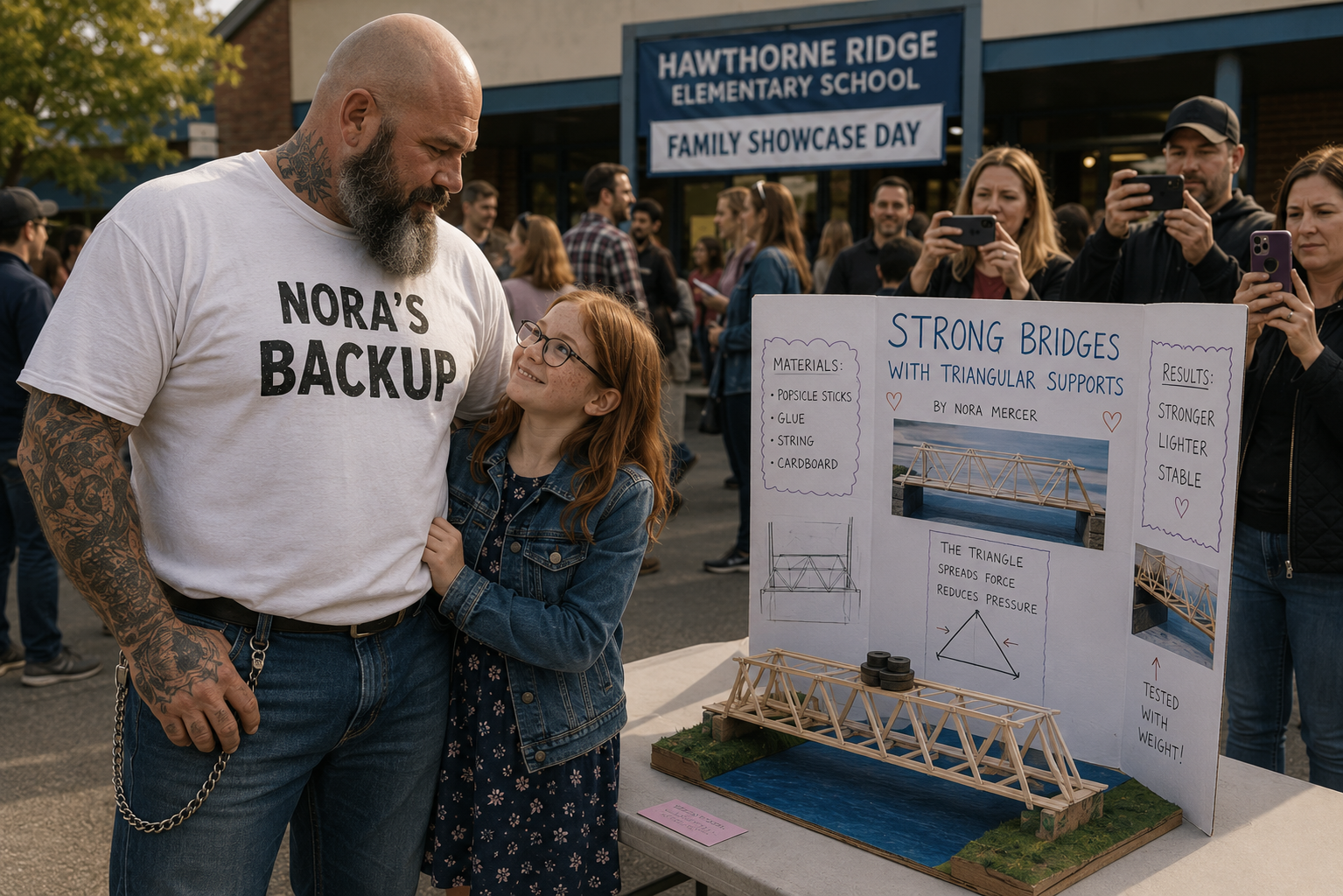
One hand gripped the back of his shirt directly beneath the word BACKUP.
I asked the teachers to take the students inside.
Several parents refused to leave.
The mother whose son had received the threatening note stood beside us.
“My child stays with me.”
Two others joined her.
The situation was no longer about one intimidating father.
It was about fourteen children who had learned where to hide.
Principal Foster finally called the district safety office and local police.
Adrian placed his box of refreshments on the table.
“You are making a serious mistake.”
Atlas looked at him.
“I made the serious mistake thirteen years ago.”
Adrian’s eyes moved toward Nora.
“Does she know everything?”
“No.”
“Then you should be careful which doors you open.”
Atlas stepped forward.
Nora touched his wrist.
He stopped.
Opened his hands.
Then said:
“You don’t get to use what I did for you against her.”
Adrian’s expression hardened.
“You did nothing for me.”
Atlas looked almost tired.
“I kept you out of prison.”
The police arrived nine minutes later.
Adrian immediately became cooperative.
He handed over his volunteer badge.
Answered questions politely.
Said the recording had been taken out of context.
Said he had only warned Nora that her father’s presence could create conflict.
When officers asked why fourteen children had written his name beside accounts of bullying, Adrian described them as “socially vulnerable students reinforcing one another’s perceptions.”
The phrase sounded professional.
That made it uglier.
We moved into the school conference room.
Atlas sat beside Nora.
Adrian sat across from them with an officer near the door.
Principal Foster and I remained at the end of the table.
I placed Nora’s list between us.
“Tell us about Red Hollow,” I said.
Adrian laughed softly.
“That has nothing to do with student conduct.”
Atlas answered:
“It has everything to do with why he thinks I’ll stay quiet.”
He looked at Nora.
“Bug, you don’t have to hear this here.”
She lifted her chin.
“He already told other kids.”
Atlas closed his eyes briefly.
Then nodded.
“Okay.”
Thirteen years earlier, the Granite Kings used an abandoned roadside bar called Red Hollow as a clubhouse.
Atlas had been club vice president.
Adrian handled money.
The club was not officially criminal, but several members stored stolen parts at Red Hollow and used charity rides to move cash.
Atlas claimed he did not know the full extent.
He also admitted that he had known enough to ask fewer questions than he should have.
A seventeen-year-old apprentice named Marcus Hale worked at the body shop used by several club members.
Marcus discovered that Adrian had taken money from a fundraiser intended for the family of an injured rider.
“He photographed the ledger,” Atlas said.
Adrian leaned back.
“This is an allegation from a convicted felon.”
Atlas ignored him.
“Adrian found out.”
“What happened?” Nora asked.
Atlas looked at his daughter.
“He brought Marcus to Red Hollow.”
“Why?”
“To scare him.”
Adrian interrupted.
“Marcus came voluntarily.”
Atlas’s eyes lifted.
“He was seventeen.”
“He wanted to join the club.”
“You locked him in the storage office.”
Principal Foster looked at Adrian.
“Is that true?”
“No.”
Atlas continued.
Adrian demanded Marcus’s phone and the copied records.
Marcus refused.
So Adrian locked the office from the outside and left him there while club members argued over what to do.
A portable heater had been running near several containers of cleaning solvent.
Nobody knew exactly what ignited first.
By the time Atlas arrived, smoke had filled the rear hallway.
“I heard Marcus hitting the door,” he said.
Nora whispered:
“You went inside?”
“Yes.”
Atlas broke through the office wall with a fire extinguisher and pulled Marcus out through the kitchen.
Then he found Adrian in the parking lot.
“I hit him.”
Adrian touched the left side of his jaw as though remembering.
Atlas continued:
“I didn’t stop after he went down.”
That was the aggravated assault charge.
Witnesses saw Atlas attack Adrian.
Nobody admitted Marcus had been locked inside.
The club removed the exterior latch before investigators arrived.
The financial ledger disappeared.
Marcus refused to testify.
“Why?” I asked.
Atlas looked at Adrian.
“Because the Granite Kings told him his family would pay if he talked.”
The officer near the door began writing.
Adrian said:
“There is no record supporting any of this.”
“No,” Atlas replied. “Because I supported your version.”
He told police that the fight had begun over missing club funds.
He said Marcus entered the building on his own.
He never mentioned the locked door.
Nora looked at him.
“Why did you lie?”
Atlas took a long breath.
“Adrian’s wife had died that year.”
Adrian stared at the table.
“His son was eight.”
The boy’s name was Ethan.
With Adrian facing possible kidnapping, arson and financial charges, Ethan would likely have entered foster care.
Atlas had spent part of his own childhood in the system.
He believed protecting Ethan meant protecting Adrian.
“I told myself Adrian would leave the club,” Atlas said. “Raise his boy. Become better.”
Adrian looked up.
“I did.”
Atlas glanced toward Nora’s list.
“No. You became respectable.”
The distinction silenced the room.
“You protected him because of Ethan?” Nora asked.
“Yes.”
“Not because he was your friend?”
Atlas looked at Adrian.
“He was my brother once.”
Not by blood.
By choice.
That had been enough at the time.
Adrian leaned forward.
“You accepted a plea because you nearly killed me.”
“I accepted the sentence I earned.”
Atlas tapped the list.
“And kept quiet about the one you earned.”
Principal Foster removed her glasses.
“Why were you expelled from the Granite Kings?”
Adrian’s face hardened.
Atlas answered:
“Six years ago, we discovered he was taking money from another charity account.”
“That is a lie.”
“We voted you out.”
“You threatened me.”
“I told you never to approach my family.”
Adrian looked toward Nora.
“And yet here we are.”
The officer asked Adrian whether he wished to make a formal statement.
He requested an attorney.
That should have ended the conversation.
Then Nora said:
“There’s more on the recorder.”
Atlas looked at her.
“How much more?”
“I pressed it before recess yesterday.”
She had hidden the device inside the front pocket of her backpack.
The recording lasted twenty-seven minutes.
We listened from the beginning.
Children talking.
Shoes scraping against pavement.
A whistle.
Then Adrian’s voice.
He told two boys that Daniel had complained again about his missing inhaler.
One boy asked whether he would be suspended.
Adrian answered:
“Not if everyone remembers it was a joke.”
Another child said:
“His dad said he’s calling the district.”
Adrian replied:
“His father works for Cole Property Services. He will reconsider.”
The mother beside me covered her mouth.
Her husband did work for Adrian.
Another section captured him telling a girl to return a stolen hearing-aid case but claim she had found it near the swings.
Then came Nora’s confrontation.
She told Adrian she had written down every incident.
He asked where the list was.
She refused to answer.
That was when he mentioned Atlas and Red Hollow.
But the recording continued after Nora had stopped it in the courtyard.
Adrian’s voice moved farther away.
A second adult spoke.
Younger.
Male.
“Does Mercer know about the Hale boy?”
Atlas’s head lifted.
The voice was familiar to Adrian.
I saw it in his face.
He said nothing.
The younger man continued:
“Mason keeps asking what happened to his father.”
Adrian answered:
“Then move him before Family Day.”
My stomach tightened.
I checked Nora’s list.
Mason Hale — behind the old gym stairs.
I looked at Principal Foster.
“Where is Mason?”
She stood.
“He was here this morning.”
“When did anyone last see him?”
Nobody knew.
The officer immediately called for a search of the building.
Teachers checked classrooms.
Bathrooms.
The library.
The equipment shed.
Mason was not found.
The attendance office pulled his records.
He had been signed out at 9:12 a.m.
“By whom?” Atlas asked.
The secretary turned the monitor toward us.
The authorization listed:
Ethan Cole — District Safety Services.
Atlas looked at Adrian.
“Your son.”
Adrian’s expression did not change.
Principal Foster shook her head.
“Ethan Cole is an approved district contractor. He services our camera and alarm systems.”
“Was he scheduled today?” I asked.
“No.”
The officer requested security footage.
Most courtyard cameras worked.
The camera covering the main office exit had stopped recording at 9:06.
The system log showed remote maintenance access from Ethan Cole’s credentials.
Adrian finally spoke.
“My son has nothing to do with this.”
Atlas looked at him.
“Then call him.”
Adrian refused.
The police did it instead.
Ethan answered from a construction site seventy miles away.
He had not visited Hawthorne Ridge.
His district identification badge had disappeared from his truck two days earlier.
Someone had used his login.
Adrian looked genuinely surprised.
For the first time that day, I believed him.
Then the front-office secretary entered holding Mason’s backpack.
“It was under the old gym stairs.”
Inside was a phone.
The screen had been cracked.
One unfinished message remained open to Mason’s father:
Mr. Cole says you lied about the fire. He says come to Red—
Atlas stood.
“Red Hollow.”
Police sent units toward the abandoned property.
I called Marcus Hale using the emergency contact listed for Mason.
He answered after six rings.
“Mr. Hale, this is Julia Hart from Hawthorne Ridge.”
“Where’s my son?”
He already knew something was wrong.
I put the phone on speaker.
Atlas spoke.
“Marcus.”
There was silence.
Then:
“Wade?”
“Did someone contact you?”
Marcus’s breathing became uneven.
“I got a video.”
“When?”
“Ten minutes ago.”
“What did it show?”
“Mason inside the old clubhouse.”
Nora pressed closer to her father.
Marcus continued:
“He was alone. At least in the frame.”
“What did they want?” Atlas asked.
“The Red Hollow statement.”
“What statement?”
“The one I signed after the fire.”
Atlas stared at Adrian.
“You said it was destroyed.”
Adrian’s confidence finally cracked.
“I thought it was.”
Marcus explained that he had kept the original statement hidden for thirteen years.
It named Adrian.
Described the locked door.
Listed the charity funds.
He had recently contacted a detective after learning Adrian volunteered at his son’s school.
Someone must have discovered that.
“Where’s the statement?” the officer asked.
Marcus hesitated.
“At my house.”
A noise sounded on his end.
Glass breaking.
Then a door.
Marcus whispered:
“Someone’s here.”
The call disconnected.
At the same moment, Nora’s recorder emitted a soft beep.
A new file had appeared through its wireless classroom-sync feature.
The speech-therapy application had automatically uploaded audio whenever the device connected to school Wi-Fi.
The timestamp was current.
Someone had turned the recorder back on.
We pressed play.
A child was breathing rapidly.
Mason.
Then an adult voice said:
“Tell Mercer to bring Adrian Cole to Red Hollow.”
Atlas looked toward Adrian.
On the recording, something heavy scraped across concrete.
The adult continued:
“He rescued Marcus from that room thirteen years ago.”
A door slammed.
Then came the final sentence:
“Let’s see whether he can rescue the son before the building burns a second time.”