
Part Three
The chief of police in Seligman was named Martin Vale.
Atlas knew him.
Everybody on that stretch of Route 66 did.
Vale had worked patrol before becoming detective, then lieutenant, then chief. He was sixty-two, broad-faced, silver-haired, and carried himself with the easy confidence of a man who had spent decades being believed.
He had also signed Claire Mercer’s death report.
Officer Tom stared at her.
“You’re sure?”
Claire nodded.
“My mother said Martin helped create the crash scene.”
Atlas looked like he might stop breathing again.
“What does that mean?”
“She told me they used another vehicle.”
“What vehicle?”
“A burned-out car from an impound lot.”
Ray swore under his breath.
Claire continued.
“The body was already inside.”
The room went silent.
Even Molly stopped moving.
Atlas’s voice was low.
“Whose body?”
“I don’t know.”
Claire looked at him.
“I was nineteen. Pregnant. Terrified. Mom said if you learned who the father was, you’d kill him and spend the rest of your life in prison.”
Atlas stared at her.
“Would I have?”
She looked away.
“That was the problem.”
He nodded once.
Not denying it.
Twenty years ago, Duncan Mercer had been a different man.
Still a father.
But angrier.
Faster with his fists.
More convinced that protecting someone and controlling what happened around them were the same thing.
He looked at Molly.
Then at Claire.
“I’m sorry.”
Claire’s expression tightened.
“For what?”
“For making your mother believe hiding you was safer than telling me the truth.”
Nobody expected that answer.
Least of all Claire.
She started crying.
Atlas didn’t move toward her.
That was new too.
He let her have the distance.
Officer Tom said:
“We need to find Denise.”
The brass key lay in Molly’s hand.
Atlas looked at it.
“What blue box?”
Claire wiped her face.
“When Mom staged my death, she gave me almost nothing from my old life.”
“Why?”
“She said anything connected to you could lead people to us.”
“People?”
“Martin.”
Atlas frowned.
“I thought he was helping her.”
“At first.”
Claire looked at Tom.
“My mother said Martin demanded money after the cover-up.”
“Blackmail.”
“Yes.”
“How much?”
“Over years? I don’t know.”
Claire took a breath.
“She kept paying because he had the original evidence that I was alive.”
Atlas’s face hardened.
“And the unidentified body.”
“Yes.”
“What happened recently?”
“Mom stopped paying.”
“Why?”
“Because Martin asked for something different.”
Officer Tom leaned forward.
“What?”
Claire looked at Molly.
“Custody documents.”
Atlas’s expression changed.
“For Molly?”
“Yes.”
“Why?”
“I don’t know.”
The answer bothered everyone.
A corrupt cop could want money.
Silence.
Protection.
But custody of a five-year-old girl made no immediate sense.
Molly raised the key.
“Grandma said the box explains.”
Claire looked at Atlas.
“Where did you keep the blue box?”
He thought.
Then his eyes changed.
“The clubhouse.”
Ray understood immediately.
“The old locker.”
Atlas nodded.
Twenty years earlier, the Iron Lantern Riders had used a converted gas station outside town as a clubhouse.
Most of it had been renovated.
One thing had never moved.
A row of blue steel lockers along the back wall.
Claire had used one as a teenager.
She covered it in stickers.
Atlas had never opened it after her supposed death.
“I kept everything in there.”
Claire stared at him.
“You still have it?”
“I couldn’t throw it away.”
The clubhouse was eleven minutes from the hospital.
Officer Tom called state police before we left.
He did not call Seligman PD.
That detail mattered.
Nobody wanted Martin Vale hearing about the key.
Atlas rode with Ray.
Claire stayed at the hospital with Molly.
I had no reason to go.
I went anyway.
Maybe because the entire thing had begun with people looking at the wrong part of a scene.
By then, I wanted to see the whole picture.
The Iron Lantern clubhouse smelled like coffee, old wood and motor oil.
Forty-eight riders had returned from the festival.
When Atlas entered, every conversation stopped.
Nobody asked questions.
He walked to the back wall.
There it was.
Blue locker.
Number 17.
Claire’s old stickers were still visible beneath scratches and years of dust.
Atlas inserted Molly’s brass key.
It fit.
He hesitated.
Ray stood beside him.
“You want me to?”
“No.”
Atlas turned the key.
The lock clicked.
Inside were old photographs.
A denim jacket.
Two cassette tapes.
A stuffed rabbit missing one eye.
And a smaller blue metal box.
Atlas removed it.
Another keyhole.
Same brass key.
Inside that box was a stack of envelopes held together with a rubber band.
On top:
FOR DUNCAN, IF I CAN’T FIX THIS MYSELF.
Denise’s handwriting.
Atlas sat down.
The first letter was dated three weeks earlier.
He read aloud.
Duncan, if you have this, then Claire has finally let you close enough to hear the truth. Please don’t waste that gift by becoming the man I was once afraid of.
Atlas stopped.
Then continued.
Martin Vale helped me create the lie that Claire died. I believed I was saving her and you. In truth, I created a prison that followed all of us for twenty years.
The next page contained photocopies.
Payments.
Dates.
Bank transfers.
Martin Vale’s initials.
Then photographs.
The burned vehicle.
The morgue intake form.
Dental identification signed by a dentist named Andrew Phelps.
Officer Tom studied the page.
“Phelps died twelve years ago.”
Ray asked:
“Was he involved?”
“Looks like it.”
Another letter.
Martin’s first demand was money. His second was loyalty. His third was Molly.
Atlas looked up.
There it was.
The part nobody understood.
He kept reading.
He told me Molly was his granddaughter.
The room froze.
Claire had said the father of her lost pregnancy was a police officer.
But Molly had been born fourteen years later.
Officer Tom took the letter.
“Keep going.”
Atlas did.
Martin’s son, Evan, found Claire in Nevada years after the staged crash. Claire did not know who his father was when they met. By the time she learned, she was already pregnant with Molly.
Ray whispered:
“You’ve got to be kidding.”
The letter continued.
Evan died in a motorcycle accident six months before Molly was born. Martin blamed Claire. He believed the child was all he had left of his son.
Atlas’s jaw tightened.
“So he wanted her.”
Officer Tom nodded.
“Not legally. Not with Claire alive and resisting.”
Another page.
For five years he demanded visitation. Claire refused. Last month he threatened to reveal the original fraud, expose Claire as legally dead, and challenge her identity documents. He said if Claire had no legal identity, she could not easily defend custody.
That was the leverage.
Not money anymore.
Identity itself.
A woman officially dead for twenty years.
A child whose mother’s records had been constructed under an alias.
A corrupt police chief holding the evidence that could destroy all of it.
Atlas closed his eyes.
“What did Denise do?”
Ray pointed to the final envelope.
Atlas opened it.
Inside was a flash drive and another note.
I recorded him.
Officer Tom took out a laptop.
The audio file began with static.
Then Denise’s voice.
“Say it again.”
Martin Vale answered.
“You think Duncan Mercer can protect her? He couldn’t protect her the first time.”
Denise:
“Molly belongs with her mother.”
Vale laughed.
“Claire shouldn’t legally exist.”
Then:
“I created her death. I can create whatever comes next.”
The room went quiet.
Vale continued.
“You bring Molly to me, or I give the state everything.”
Denise asked:
“And if I refuse?”
His answer was calm.
“Then Claire loses her child, Duncan learns you lied, and everybody discovers whose body you burned.”
Atlas looked at Tom.
“There’s more.”
The recording shifted.
Denise said:
“You killed that girl.”
Vale’s voice changed.
“I didn’t kill anybody.”
“You found her.”
“She was already dead.”
“Who was she?”
Silence.
Then Vale:
“Runaway. Seventeen. Nobody looking hard enough.”
The clubhouse seemed to shrink.
They had built Claire’s false death on the body of another girl.
A real one.
Someone whose family might have spent twenty years wondering where she went.
Atlas looked sick.
The recording ended with Denise saying:
“I’m done.”
Then Martin:
“You don’t get to be done.”
Officer Tom stood.
“We need to find her now.”
State police traced Denise’s phone.
Last signal: an abandoned motel east of Seligman.
Atlas knew the place.
“Old Desert Star.”
The same motel where Martin had once met Denise to exchange money.
Police ordered Atlas to stay behind.
He refused.
Then Officer Tom said something that finally worked.
“If you arrive first looking like revenge, you give Vale exactly the story he needs.”
Atlas stopped.
Tom continued.
“Let us do this right.”
Atlas’s hands closed.
Then opened.
“Bring her back.”
That was all he said.
We waited forty-seven minutes.
Longest forty-seven minutes of my life, and I was not even family.
Atlas sat beneath Claire’s old blue locker holding the one-eyed stuffed rabbit.
At minute thirty-two, Claire called.
Molly was sleeping.
Claire asked:
“Did you find it?”
“Yes.”
“Everything?”
“Yes.”
Silence.
Then:
“Do you hate Mom?”
Atlas looked at the floor.
“No.”
“You should.”
“No.”
“Why?”
He took a long breath.
“Because she made a terrible choice for a reason that made sense to her at the time.”
Claire cried quietly.
Atlas continued.
“I can be angry without making the whole person into the worst thing she did.”
Ray looked at him.
The sentence surprised even Atlas.
Maybe especially Atlas.
At minute forty-eight, Tom called.
They had Denise.
Alive.
Martin Vale had been arrested trying to leave through the back of the motel.
He had a handgun.
He did not fire it.
Denise had bruises around one wrist but no major injuries.
In the trunk of Vale’s vehicle, police found old case files, forged identity documents and a folder containing photographs of Molly taken outside school.
That ended any argument about coincidence.
Martin Vale was eventually charged with kidnapping-related offenses, extortion, obstruction, falsifying public records and crimes connected to the unidentified girl used in Claire’s staged death.
The girl was finally identified through DNA.
Her name was Laura Bennett.
She had run away from a foster placement at seventeen.
Her younger sister had submitted DNA to a missing-person database years later.
Twenty-one years after Laura disappeared, she received a real grave with her own name.
Claire’s legal identity took months to repair.
The process was ugly.
Court hearings.
Affidavits.
DNA testing.
Old documents.
New ones.
But she stopped being a dead woman living under another name.
She became Claire Mercer again.
Not because Atlas demanded it.
Because she chose it.
That distinction mattered.
Denise pleaded guilty to several offenses connected to the original cover-up and cooperated fully against Vale.
She did serve time.
Atlas visited once.
Only once.
I asked him later what he said.
“Nothing dramatic.”
“What did she say?”
“Sorry.”
“And you?”
He looked toward the road.
“I told her I believed she meant it.”
“That’s forgiveness?”
“No.”
He shook his head.
“That’s believing one sentence.”
Claire and Atlas did not become father and daughter again overnight.
There was no movie ending where she ran into his arms.
For months, she called him Duncan.
Then Atlas.
Then one afternoon, almost a year after the festival, Molly fell asleep in his recliner while watching cartoons.
Claire stood in the doorway.
Atlas was sitting on the floor because he didn’t want to wake her.
Claire looked at him and said:
“Dad, there’s a blanket behind you.”
He froze.
She froze too.
Neither mentioned it.
He simply reached for the blanket.
That was how the word came back.
Quietly.
Without ceremony.
The Iron Lantern Riders became part of Molly’s life too.
At first, Claire hated that.
Fifty motorcycles were not exactly subtle.
So Atlas made rules.
No revving outside the house.
No showing up unannounced.
No teaching Molly words Claire would have to explain at school.
Ray broke the third rule twice.
Molly loved them anyway.
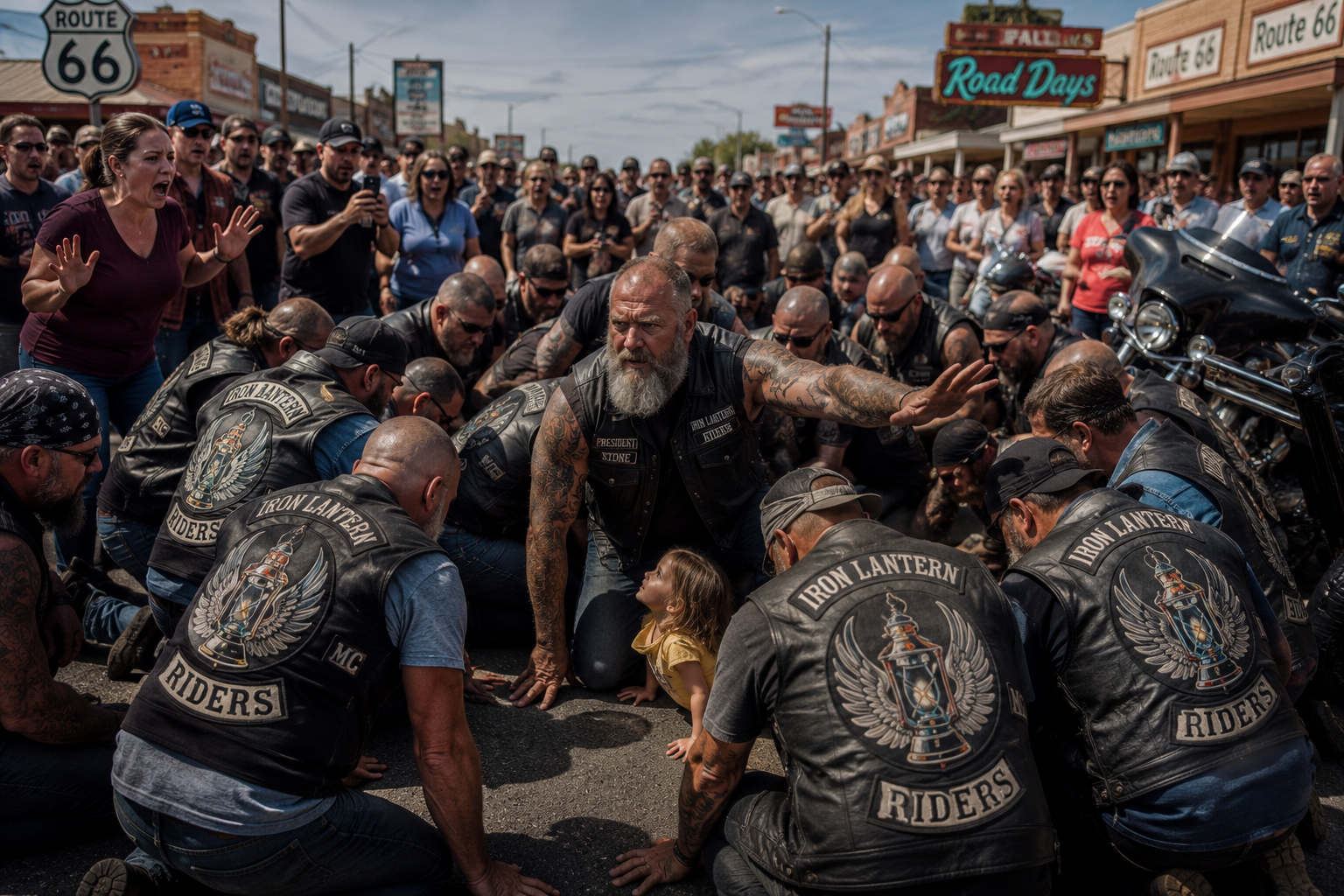
At the next Route 66 Heritage Festival, the club returned.
Same motorcycles.
Same leather.
Same hard-looking men.
But this time the crowd recognized them.
Somebody had posted the full video.
Not the ten seconds of bikers kneeling.
The whole thing.
Atlas hearing a child.
The riders dropping low.
Creating space.
Protecting her from the crowd.
People online called them heroes.
Atlas hated that word almost as much as he had hated being called dangerous.
“We were just the ones who looked down,” he said.
I understood what he meant.
Because the lesson was never really that scary-looking men can be kind.
That was too easy.
The lesson was that crowds make mistakes when they decide what they are seeing before they see enough.
We saw leather and thought threat.
We saw men surrounding a child and thought danger.
Denise saw Atlas’s anger twenty years earlier and believed the only way to protect Claire was to erase her from his life.
Martin Vale saw a grieving family and understood exactly how to weaponize their fear.
Everybody looked too high.
At reputation.
At appearances.
At the loudest version of the story.
Atlas had been the one who dropped to the ground.
The one who looked beneath the moving feet.
Years later, Molly asked why he still kept the tiny pink rabbit inside his vest.
Atlas told her:
“Your mom made it.”
Molly thought for a moment.
Then she disappeared into her room.
She returned with a second patch.
A yellow sneaker.
Badly stitched.
Crooked.
Atlas stared at it.
“What’s this?”
“The day you found me.”
He looked at Claire.
She smiled.
Molly pointed to the inside of his vest.
“Put it next to the rabbit.”
Atlas did.
The enormous biker who had once looked terrifying in a ten-second video now carried two tiny pieces of embroidery against his heart.
One for the daughter he thought he had buried.
One for the granddaughter he found because, when everyone else panicked—
he remembered to look down.