
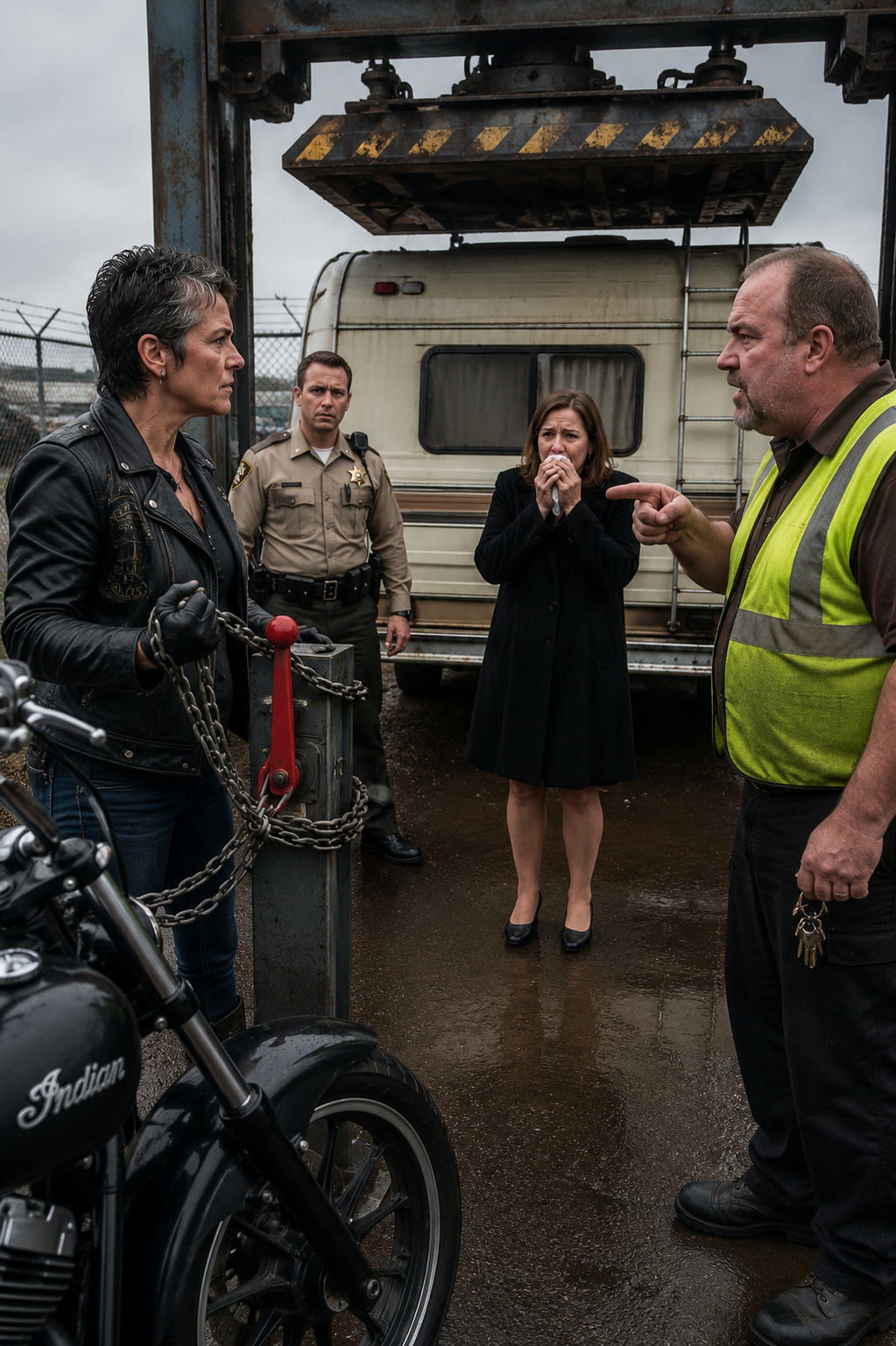
The supervisor’s name was Calvin Price.
Until that moment, he had behaved like a man protecting county procedure. Now he stared at the postcard as if it had recognized him.
Beth noticed first.
“You knew my father?”
Calvin stepped away from the crusher controls.
“I processed the vehicle.”
“That wasn’t my question.”
Mara handed the postcard to the deputy. The paper was soft at the edges, stained by engine grease and rain. George had written Mara’s name and the address of a repair shop outside Knoxville. The postmark came from a sorting center forty miles away.
Three days after his death.
The deputy turned it beneath the light.
“Could’ve been delayed.”
“It wasn’t,” Mara said. “I received it yesterday.”
Calvin glanced toward the camper.
Not the cedar box.
The dashboard.
Mara followed his eyes.
She had spent twenty-seven years repairing motorcycles and old vehicles. She knew the difference between someone looking at a machine and someone looking at a place where they had left something.
She moved toward the driver’s door.
Calvin blocked her.
“This vehicle is county property.”
The deputy raised one hand.
“Let her open it.”
Calvin did not move.
Beth’s brother, Lucas, stepped forward. He had said almost nothing since Mara arrived. He was a broad man in his fifties with the stiff posture of someone trying not to show pain.
“My father died in that camper,” he said. “You told us he was found alone.”
“That’s what the report says.”
“You wrote the report.”
Calvin’s jaw tightened.
Mara used the brass key.
The camper smelled of dust, cedar oil, and the faint medicinal sweetness of George’s cough drops. A wool blanket remained folded across the narrow bed. His reading glasses sat beside an open Bible. Nothing looked disturbed until Mara reached the dashboard.
The radio had been removed.
Not stolen.
Removed carefully.
Four screws had been returned to their holes afterward, but the dust around them had been wiped away.
Mara crouched and reached into the empty space.
Her fingers touched wire, cold metal, and then a small plastic cassette recorder taped behind the panel.
Calvin lunged.
The deputy caught his arm before he reached her.
No one shouted. The movement was too quick and too revealing for that.
Calvin stopped resisting almost immediately.
Beth stared at him.
“What did my father record?”
“I don’t know.”
Mara looked at the recorder. A strip of masking tape covered the buttons. George had drawn a black arrow toward PLAY and written one word beneath it.
Together.
Beth brought the cedar box inside.
Her hands trembled as she placed it on the small table. Lucas stood beside her. Mara remained near the doorway, close enough to help but far enough to let the family decide.
Beth pressed the button.
For several seconds, only static filled the camper.
Then George’s voice emerged, thin but unmistakable.
“If you’re hearing this, someone ignored what I asked.”
Beth closed her eyes.
George coughed on the recording, caught his breath, and continued.
“Eleanor is in the cedar box. The tickets are for the place where I met her. Mara knows how to get us there.”
Mara’s face changed.
She had never been told that.
The tape clicked softly.
Then George said, “Calvin, if you’re standing with them, tell my children what you did with the first letter.”
Every person in the camper turned toward the open door.
Calvin was no longer beside the deputy.
The handcuffs lay empty on the gravel.
And the county truck carrying George Whitmore’s personal files was already moving toward the gate.