
Part Five
The fire alarm screamed through Carter County Nursing Center as nurses began pushing residents into the hallway.
Red lights flashed over the walls.
Someone shouted for the west wing to evacuate.
Knox did not move.
He was staring at the receptionist’s screen.
MARGARET ELLIS — TRANSFERRED
No destination.
No receiving facility.
No physician listed.
Nothing.
Elena grabbed the radio from her shoulder.
“Dispatch, I need fire response confirmed and every exit on Carter County Nursing Center covered.”
Static.
Then:
“Units en route.”
Daniel looked toward the hallway.
“This isn’t a coincidence.”
“No,” Elena said.
Knox turned to the receptionist.
“Where’s Henry?”
She blinked.
“Henry Knox?”
“Yes.”
“Room 218.”
“Still here?”
“I think so.”
Elena caught Knox’s arm before he moved.
“No.”
“Let go.”
“You are not going into that room alone.”
“He might know where Margaret went.”
“He has advanced dementia.”
“He remembered my name.”
Elena held his gaze.
“That doesn’t make him safe.”
Knox looked down at her hand.
She released him.
“Together.”
We took the stairs.
Residents moved past us in blankets and wheelchairs.
Staff members were trying to keep everyone calm.
The alarm made calm impossible.
Room 218 was open.
Empty bed.
No Henry.
Daniel stopped in the doorway.
“Where is he?”
A nursing assistant passing behind us said:
“They moved Mr. Knox twenty minutes ago.”
Elena turned.
“Who?”
“I don’t know.”
“Ambulance?”
“No.”
The woman looked frightened now.
“Private transport.”
“Destination?”
“I thought cardiology.”
“Which hospital?”
She hesitated.
“Nobody told me.”
Elena swore under her breath.
Margaret moved.
Henry moved.
Same morning.
Then the fire alarm.
Someone was clearing the board.
Knox looked around the room.
Very little remained.
A sweater.
Plastic cup.
Bible.
And on the bedside table, a picture frame faced down.
Knox turned it over.
It was a photograph of him.
Not recent.
Maybe age ten.
School portrait.
Blond hair.
Missing front tooth.
Knox stared at it.
“He had this?”
Daniel closed his eyes.
Ruth stood in the doorway, one hand gripping the cane.
“Evelyn sent school pictures to me.”
Knox looked at her.
“You gave him one?”
“No.”
Daniel said:
“I did.”
Everyone turned.
“When?”
“Twenty-four years ago.”
Knox’s face hardened.
“You were in contact with Henry?”
“Once.”
“You keep finding new ways to make this worse.”
Daniel accepted that.
“I needed him to believe I wanted money.”
“Why?”
“To learn whether he still had people watching you.”
“And?”
“He did.”
Knox looked at the photograph again.
Then something behind the frame caught his attention.
A folded piece of paper.
He opened it.
Only one sentence.
Written shakily.
ASK MARGARET ABOUT THE CHURCH.
Daniel went pale.
“What church?”
Ruth whispered:
“St. Agnes.”
Knox looked at her.
“How do you know?”
“Evelyn volunteered there.”
Daniel shook his head.
“No. Margaret did.”
Elena was already moving.
“Address?”
Ruth gave it.
St. Agnes sat twelve minutes away.
We never reached it.
Three blocks from the nursing home, Elena’s radio crackled.
“Unit Twelve, possible private medical transport stopped at East Sheldon and Gurley. Driver fled.”
Elena hit the brakes.
“What patients?”
“Two elderly occupants.”
Knox’s hand gripped the dashboard.
“Names?”
Static.
Then:
“Male identified as Henry Knox.”
Everyone stopped breathing.
“And the woman?”
“Margaret Ellis.”
Elena turned the cruiser around.
By the time we reached the intersection, police had blocked traffic.
A white medical transport van sat crooked against the curb.
Rear doors open.
Henry Knox was strapped into one wheelchair.
Margaret sat beside him.
Alive.
A paramedic checked her oxygen.
She looked ancient.
Smaller than Ruth.
White hair.
Sharp eyes.
Very awake.
Henry seemed barely conscious.
Knox got out of the truck.
Margaret saw him.
Her entire expression changed.
“Gabriel.”
He stopped.
Again.
Another stranger who knew his name.
Another piece of a childhood everybody had kept except him.
Elena approached first.
“Margaret Hale?”
The old woman looked at her.
“I haven’t used that name in thirty years.”
“That wasn’t my question.”
Margaret smiled.
“You’d have made a good prosecutor.”
Then she looked at Knox.
“You have Evelyn’s face.”
He almost laughed.
“Everybody keeps saying that.”
Margaret nodded toward Henry.
“He hated that.”
Knox stared at the old man.
Henry’s eyes fluttered open.
For a second there was nothing.
Then he saw Knox.
His mouth moved.
“Blue.”
Knox went rigid.
Henry smiled weakly.
“My boy.”
“No.”
Knox stepped closer.
“I was never your boy.”
Henry seemed confused.
Then angry.
“Mine.”
That one word carried more possession than affection.
Margaret spoke quietly.
“He always thought people belonged to him.”
Henry turned toward her.
Recognition sharpened his face.
“Lawyer.”
Margaret smiled.
“Yes, Henry.”
His hand began trembling.
“You stole it.”
“No.”
“I built that company.”
“You stole Daniel’s company.”
Henry’s breathing changed.
Paramedics exchanged looks.
Elena said:
“Margaret, what happened this morning?”
“A man came to transfer me.”
“Name?”
“He gave one.”
“Real?”
“No.”
“How do you know?”
“He said he was from Desert Valley Medical.”
“There is no Desert Valley Medical.”
“I know.”
Henry started muttering.
“Burn it.”
Knox looked at him.
“What?”
Henry’s eyes focused on something only he could see.
“Burn the box.”
Daniel stepped forward.
“What box?”
Henry looked at him.
And for one astonishing second, dementia cleared.
“Danny.”
Daniel stopped breathing.
Henry laughed.
“You should’ve stayed dead.”
Knox moved so fast I didn’t see the first step.
Elena caught him across the chest.
“Gabriel!”
Henry laughed again.
Thin.
Ugly.
“Still angry.”
Knox struggled once.
Then stopped.
He looked down at Elena’s arm across him.
At his own hands.
At Henry.
And stepped back.
“No.”
Henry’s smile faded.
Knox’s voice was quiet.
“You don’t get that version of me.”
Ruth began crying.
Daniel looked away.
Margaret watched Knox carefully.
Then nodded.
“Evelyn would be glad.”
Knox looked at her.
“I need answers.”
“You need proof.”
“Both.”
Margaret pointed toward the church visible beyond the rooftops.
“St. Agnes.”
“What’s there?”
“The original trust.”
Daniel inhaled.
“You kept it.”
“Yes.”
“All these years?”
“Yes.”
“Why?”
“Because everybody searching for financial records searched banks.”
Margaret smiled faintly.
“Nobody searched hymnals.”
Twenty minutes later, police escorted us into St. Agnes.
Margaret led us to a small chapel behind the main sanctuary.
Third pew.
Left side.
She pointed toward a wooden kneeler.
Daniel removed four screws.
Inside the hollow compartment was a sealed metal cylinder.
Elena opened it.
Documents.
Original trust instrument.
Stock certificates.
Federal correspondence.
Affidavits.
And one envelope labeled:
GABRIEL
Knox stared at it.
Margaret said:
“Evelyn wrote that after she realized she was being poisoned.”
He looked at her.
“She knew?”
“Yes.”
“Why didn’t she go to a hospital?”
“She did.”
“And?”
“Henry had spent years making her look unstable.”
Knox’s expression changed.
“He told doctors she drank.”
“Yes.”
“Depression.”
“Yes.”
“Medication problems.”
“Yes.”
Margaret’s voice hardened.
“By the time Evelyn began accusing him, he had already built the story everybody would use to dismiss her.”
Ruth whispered:
“He did the same thing to me.”
Margaret nodded.
“That was his method.”
Not murder first.
Discredit first.
Isolation.
Control.
Then everything else became easier.
Elena examined the documents.
“This is enough for a criminal investigation.”
Daniel shook his head.
“Henry won’t stand trial.”
“Maybe not.”
Elena looked at him.
“But others may.”
The records named accountants.
Drivers.
Doctors.
A former deputy.
Corporate officers.
People who had helped Henry for money, fear or convenience.
Knox held Evelyn’s envelope.
His fingers shook as he opened it.
The letter inside was short.
He read silently at first.
Then stopped.
Ruth asked:
“What does it say?”
Knox swallowed.
He read aloud.
My Blue Boy,
His voice failed.
He began again.
If you have reached this letter, then too many people kept too many truths from you. I am sorry I became one of them.
Knox sat in the pew.
I told myself every lie was protection. Sometimes it was. Sometimes it was fear wearing protection’s clothes. You deserved better.
Daniel lowered his head.
Ruth cried quietly.
Knox continued.
Daniel loved you. Ruth loved you. I loved you. None of us loved you perfectly. Do not spend your life measuring which of us failed you most. You will lose years that belong to you.
Knox stopped reading.
For a long time.
Then continued.
Henry will want you to believe blood makes ownership. It does not. Money does not. Guilt does not.
You belong to yourself.
Knox pressed one fist against his mouth.
I had known him for years.
I had never seen him cry.
Not until then.
If Daniel is alive, hear him before you judge him. If Ruth comes back, let her speak before you send her away. You may still choose to leave them. That choice belongs to you too.
Then the last line:
And Gabriel—whatever they tell you happened to me, you were never the reason.
Knox folded over.
Not dramatically.
Just elbows on knees.
Face in both hands.
Thirty-five years.
Maybe more.
A child believing every disappearance had happened because he was difficult to keep.
A man believing Evelyn died because trouble followed him.
A biker carrying supplies for strangers because somewhere inside him was still a little boy who thought suffering became dangerous when nobody noticed it.
Ruth moved toward him.
Stopped.
“May I?”
Knox looked up.
She was asking permission to touch him.
Maybe for the first time in their lives.
He nodded.
Ruth sat beside him.
She put one hand over his.
Daniel remained several feet away.
Knox noticed.
“You too.”
Daniel looked surprised.
“Come here.”
He sat on the other side.
Nobody called it forgiveness.
It wasn’t.
It was simply three people finally sitting in the same place without anyone disappearing.
Henry died four months later.
His dementia prevented a conventional trial.
But the records from St. Agnes triggered federal and state investigations into Knox Medical Logistics and several surviving executives.
Assets tied to Daniel’s stolen ownership were frozen.
Years of litigation followed.
In the end, Knox received more money than he had ever imagined possessing.
He kept the motorcycle shop.
That surprised nobody who knew him.
He used most of the settlement to create the Evelyn Reed Street Care Fund.
Mobile medical vans.
Foot care.
Wound treatment.
Dry socks.
Hygiene kits.
Temporary motel rooms.
Legal help replacing lost identification.
And one absolute rule:
Nobody receiving help could be photographed without explicit permission.
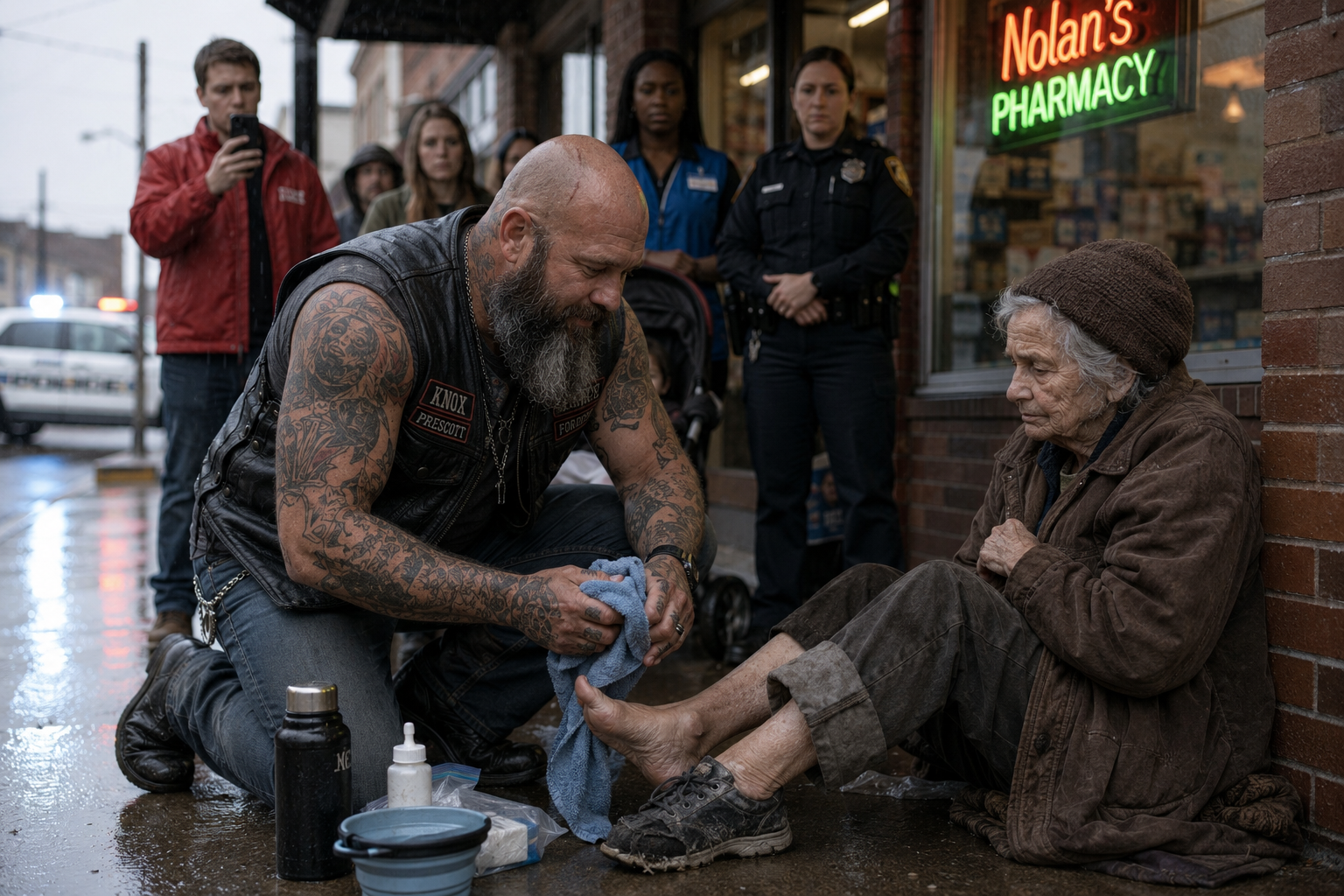
The teenager outside the pharmacy never knew he had accidentally started something that eventually served thousands of people.
Ruth moved into supportive housing.
Not Knox’s house.
Neither of them wanted to pretend thirty-five missing years could be repaired by sharing a refrigerator.
They started with breakfast once a week.
Sometimes it went badly.
Sometimes Ruth talked too much.
Sometimes Knox asked questions he regretted.
Sometimes they sat for twenty minutes without speaking.
But she stopped disappearing.
Daniel rented a small apartment three blocks from the motorcycle shop.
Closer than before.
This time openly.
Knox made him work for the relationship.
Daniel accepted that.
One afternoon, almost a year after the sidewalk incident, I walked outside my shop and found Knox crouched beside a homeless man near the bus stop.
Same leather vest.
Same tattoos.
Same enormous hands.
He was opening the familiar saddlebag.
Warm water.
Clean socks.
Gauze.
A blue towel.
Not Evelyn’s original one.
That stayed framed inside his office.
This towel was new.
In one corner, someone had embroidered:
B.B.
I asked him later what it meant.
He smiled.
“Blue Boy.”
“You embroidered that?”
“Absolutely not.”
“Ruth?”
“No.”
“Daniel?”
He looked offended.
“Man can barely sew a button.”
“Then who?”
Knox nodded toward my shop window.
A little girl from the family shelter was sitting inside making friendship bracelets at my worktable.
She had seen the old towel in his office.
He had told her the story.
Not all of it.
Just enough.
“She made it.”
I looked at his wrist.
There was a bracelet there too.
Blue thread.
Crooked plastic letters.
STAY
Knox saw me looking.
“She said I’m not allowed to take it off.”
“Are you?”
“Apparently not.”
I smiled.
Then he grew quiet.
“You know the weird part?”
“What?”
“The first day Ruth saw me, I thought she was the one who needed saving.”
He looked toward the sidewalk.
“I was wrong.”
“About her needing help?”
“No.”
He shook his head.
“About there only being one person on that sidewalk who needed it.”
Rain began falling lightly.
Knox pulled his leather vest closed.
Then he walked back toward the man waiting beside the bus stop.
For most of his life, Gabriel Knox had believed being strong meant becoming impossible to hurt.
Evelyn had taught him something else.
Ruth had taught him too late.
Daniel had learned it the hardest way.
Strength was not carrying everything alone.
It was deciding what you would carry forward.
The truth.
The people who were willing to stay.
And enough warm water for the next stranger sitting in the rain.