
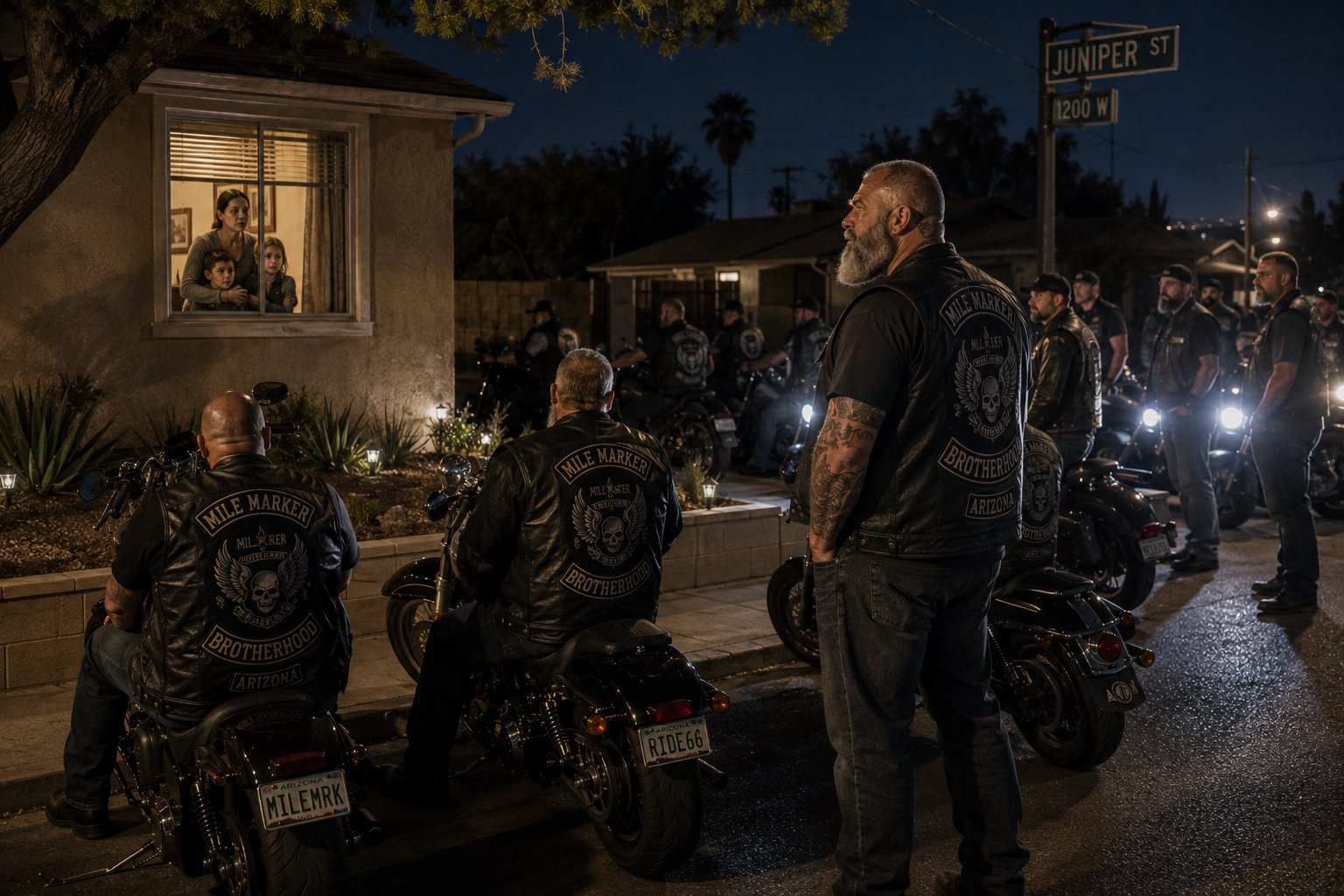
THE MEN WHO STOOD OUTSIDE
Part Three
The bloodstained shirt changed everything.
Until then, Ryan Grant had been a dangerous husband violating boundaries through other people.
Now police had a possible connection to something larger.
Officer Warren did not explain much that night.
He couldn’t.
The shirt went to the state laboratory.
Vernon Pike’s storage unit was sealed.
The surveillance files were photographed, bagged, indexed and removed.
Melissa sat at her kitchen table with both hands around a glass of water she never drank.
Mack stood outside.
Exactly where he had stood every night.
He did not come in.
Even then.
I finally stepped onto the porch.
“You can come inside.”
He shook his head.
“She didn’t ask.”
“She’s falling apart.”
“I know.”
“You’ve been guarding this house for three weeks.”
“Still her house.”
That answer irritated me.
Then I understood it.
For years, Ryan had entered rooms because he believed he had the right.
Opened drawers.
Checked phones.
Read messages.
Decided where Melissa could go and who she could speak to.
Mack was not going to turn protection into another form of control.
So I asked her.
“Mack is outside.”
Melissa looked toward the window.
“Tell him he can come in.”
He entered through the front door for the first time on the twenty-first night.
He removed his boots.
That surprised Melissa.
“You don’t have to.”
“Your carpet.”
“It’s old.”
“Still yours.”
He sat at the far end of the table.
Not beside her.
Officer Warren returned shortly after midnight.
He carried a folder.
“We identified the blood.”
Melissa’s face changed.
“Whose?”
“Not Ryan’s.”
She closed her eyes.
Warren continued.
“It belongs to a man named Daniel Cross.”
I had never heard the name.
Melissa had.
She stared at him.
“No.”
Mack noticed.
“You know him?”
Melissa nodded slowly.
“Ryan worked with him.”
“What kind of work?”
“Commercial electrical contracting.”
Warren opened the folder.
“Daniel Cross disappeared eleven weeks ago.”
The room went silent.
I remembered what Melissa had said.
Three months ago.
Ryan coming home with blood on his shirt.
Evan awake.
The garage.
The knife.
Melissa whispered:
“His wife said he ran away.”
Warren nodded.
“That’s what Ryan told investigators too.”
Mack’s expression hardened.
“What actually happened?”
“We don’t know yet.”
“But the shirt?”
“Daniel’s blood.”
Melissa started shaking.
“What did Ryan do?”
Warren did not speculate.
Police officers who survive long enough learn that facts are safer than guesses.
He said:
“We need to speak to Evan.”
“No.”
Melissa’s answer came instantly.
Warren nodded.
“I understand.”
“No, you don’t.”
She stood.
“He is seven years old.”
“I know.”
“He already heard Ryan tell me I was stupid every day. He already learned to hide Sophie in his room when Ryan got angry. He already thinks it was his job to protect us.”
Her voice broke.
“I am not letting another adult make him responsible for fixing this.”
Mack looked at Warren.
“Can they use a child specialist?”
“Yes.”
“Recorded interview?”
“Yes.”
“Mother nearby?”
“Usually.”
Melissa looked at Mack.
He did not tell her what to do.
He simply said:
“You can ask questions until you understand the process.”
That was the difference between him and Ryan.
Ryan gave instructions.
Mack gave her room.
The interview took place the following afternoon at a child advocacy center.
I stayed with Sophie.
Melissa sat behind the observation glass.
A forensic interviewer spoke with Evan for forty-three minutes.
He did not understand why everybody cared about the garage.
At first.
Then she asked what he remembered.
Evan drew pictures.
The house.
The garage.
Ryan.
A red shirt.
A black bag.
Then a blue truck.
Officer Warren leaned closer to the glass.
“What’s the truck?”
Melissa whispered:
“Daniel drove a blue Silverado.”
Evan said Ryan had come home late.
He was angry.
His shirt was wet.
He went into the garage carrying what Evan called “a long silver thing.”
The interviewer asked:
“Like what?”
Evan thought.
“A kitchen knife, but not ours.”
Melissa closed her eyes.
Then Evan said something nobody expected.
“There was another man.”
Warren looked at her.
“Who?”
The interviewer asked the same.
Evan drew a baseball cap.
Gray truck.
My stomach tightened.
Vernon.
Evan remembered looking from the hallway.
Ryan and Vernon were arguing.
Vernon said:
“You said he’d sign.”
Ryan said:
“He changed his mind.”
Then Vernon noticed Evan.
Ryan saw him too.
Evan ran upstairs.
Later, Ryan came into his bedroom.
He sat beside him.
And said:
“You didn’t see anything.”
The interviewer asked:
“What did you say?”
Evan looked down.
“I said okay.”
“Did you believe him?”
“No.”
“Why not?”
“Because his hands were shaking.”
That was the piece Ryan had been afraid of.
Not that Evan witnessed a murder.
He hadn’t.
But he had seen enough to place Vernon with Ryan on the night Daniel disappeared.
Enough to destroy Ryan’s original statement that he had been home alone.
Enough to connect Vernon to the missing man.
Police searched Ryan’s garage that evening.
They found traces of Daniel Cross’s blood beneath old epoxy near a floor drain.
Then they searched a rural job site Ryan’s company had abandoned months earlier.
Three days later, Daniel’s body was recovered from a drainage trench beneath a concrete utility pad.
Ryan was arrested before sunrise.
Not for abusing Melissa.
Not for violating the protective order.
For Daniel Cross’s murder.
Vernon Pike was arrested the same day on conspiracy, evidence tampering and stalking-related charges.
Caleb Grant admitted paying Vernon to track Melissa’s movements.
His explanation was simple.
Ryan told him Melissa was “using the children against him.”
He believed his brother.
That sentence appeared repeatedly over the next year.
I believed him.
Neighbors.
Relatives.
Coworkers.
People who had seen Ryan be charming at barbecues.
People who had watched Melissa become quieter and decided marriage was complicated.
People who saw bruises and accepted explanations because questioning them would have required action.
Mack hated that sentence.
One night, after the arrests, I asked why.
“Because belief isn’t passive.”
He looked toward Melissa’s dark house.
“Sometimes believing the wrong person costs somebody else everything.”
The bikers stayed another four nights.
Not because Ryan was free.
Because fear does not read court filings.
Melissa knew Ryan was in jail.
Her body did not.
A truck backfired and she dropped a plate.
Someone knocked unexpectedly and she locked herself in the bathroom.
Evan asked whether jail had windows Ryan could climb through.
Sophie started sleeping with shoes beside her bed.
Mack never told them they were safe.
He said:
“You’re safer tonight.”
That was more honest.
On the twenty-fifth morning, Melissa crossed the street carrying coffee.
Mack was packing his saddlebag.
“You’re leaving.”
“Yeah.”
Her face tightened.
The old panic returned.
He saw it.
“We’re not disappearing.”
“Then why stop?”
“Because this can’t become the only reason you sleep.”
She looked at the empty camp chairs.
“I sleep because you’re here.”
“I know.”
“That’s bad?”
“No.”
Mack shook his head.
“But eventually you need to know the locks work even when I’m not looking at them.”
Melissa stared at him.
“What if something happens?”
“Call police.”
“And if I’m afraid?”
“Call Rachel.”
“And if I’m still afraid?”
Mack handed her a card.
One number.
No club logo.
No dramatic slogan.
Just:
MACK DOYLE
She smiled.
“You really know how to ruin an emotional goodbye.”
“I’m gifted.”
Then Evan came running outside.
“Mr. Mack!”
Mack crouched.
Evan held a small metal object.
A padlock.
Old.
Rusty.
“What’s this?”
“Mom said you fix stuff.”
Mack examined it.
“Sometimes.”
“It doesn’t lock.”
“Want me to fix it?”
Evan shook his head.
“I want you to break it.”
Melissa looked confused.
“Why?”
Evan said:
“Dad used it on the garage cabinet.”
Nobody spoke.
The cabinet where Ryan had hidden things.
The place Evan had been warned never to touch.
Mack held out the lock.
“You sure?”
Evan nodded.
Mack set it on the curb.
He took a hammer from his saddlebag.
One strike.
The corroded shackle broke.
Evan smiled.
Mack handed both pieces back.
“Keep them.”
“Why?”
“So you remember locks work both ways.”
Evan frowned.
“What does that mean?”
Mack thought.
“Sometimes they keep bad things out.”
He pointed to the broken lock.
“And sometimes you need permission to open what somebody used to keep you scared.”
Evan probably did not understand.
Melissa did.
She cried.
Mack pretended not to notice.
The criminal case lasted eighteen months.
Daniel Cross had discovered Ryan and Vernon were stealing materials from commercial job sites and billing clients for equipment that never existed.
Daniel threatened to report them.
Ryan asked him to meet at the garage.
The argument escalated.
Ryan stabbed him.
Vernon helped move the body.
Then Ryan went home.
Evan saw the aftermath.
When Melissa finally left months later, Ryan panicked for two reasons.
He wanted control over his family.
And he needed Evan close enough to influence what the boy might eventually say.
Vernon was hired not simply to find Melissa.
He was tracking routines.
Court dates.
Medical appointments.
Places where Ryan might force an unsupervised encounter with Evan while maintaining plausible deniability.
The plan never reached that point.
Twenty-seven motorcycles sitting on Juniper Street made quiet surveillance difficult.
That was the irony.
Mack’s club had not solved the murder.
They had done something less dramatic and more important.
They made enough space for the truth to survive long enough to be heard.
Ryan was convicted.
Vernon took a plea and testified.
Caleb received probation for his part in the surveillance and permanently lost contact privileges with the children.
Melissa moved six months later.
New town.
Smaller house.
No address shared publicly.
She went back to school and eventually became a victim-services paralegal.
Evan started baseball.
Sophie stopped sleeping with her shoes beside the bed.
Not all at once.
Healing is rarely cinematic.
It looks boring from the outside.
A child sleeping through the night.
A mother buying groceries without checking the parking lot six times.
A family hearing a motorcycle and not immediately wondering who is coming.
Three years later, I attended the annual Mile Marker Brotherhood fundraiser.
Melissa came too.
She brought Evan and Sophie.
Mack was standing beside a grill wearing the same black vest.
Sophie ran toward him.
He held up both hands.
“Permission?”
Melissa laughed.
“Yes.”
Only then did he lift Sophie into his arms.
That tiny pause told me more about him than any story about his past.
Later, I asked Megan about Andrea.
Mack’s niece.
The little girl who had once hidden in a closet while her mother died.
She was forty now.
A therapist.
She had helped create the Brotherhood’s survivor-watch program.
“You know why Uncle Mack never goes onto the porch?” she asked.
“I assumed boundaries.”
“That too.”
She looked across the parking lot at him.
“But after Mom died, he spent years believing he should’ve been inside that apartment.”
“He wasn’t there.”
“I know.”
“He couldn’t have known.”
“I know.”
She smiled sadly.
“He knows now too.”
Then she said something I never forgot.
“He finally understood that protecting someone doesn’t mean standing where they are.”
She nodded toward Mack.
“Sometimes it means standing where the danger has to pass first.”
That was what those twenty-one nights had been.
Not bikers replacing police.
Not vigilantes hunting a bad husband.
Not men playing heroes outside a frightened woman’s house.
They were witnesses.
Visible.
Patient.
Disciplined.
People willing to make fear inconvenient.
The last time I saw Melissa’s old house on Juniper Street, another family lived there.
No motorcycles.
No couch against the door.
No notebooks filled with license plates.
Just children’s bicycles on the lawn.
But one thing remained.
Near the curb, somebody had screwed a small metal plate into the base of the dead streetlight where Mack parked that first night.
It did not name the club.
It did not mention Ryan.
It said only:
YOU ARE ALLOWED TO LEAVE.
Underneath, smaller:
AND YOU ARE ALLOWED TO BE SAFE AFTERWARD.