
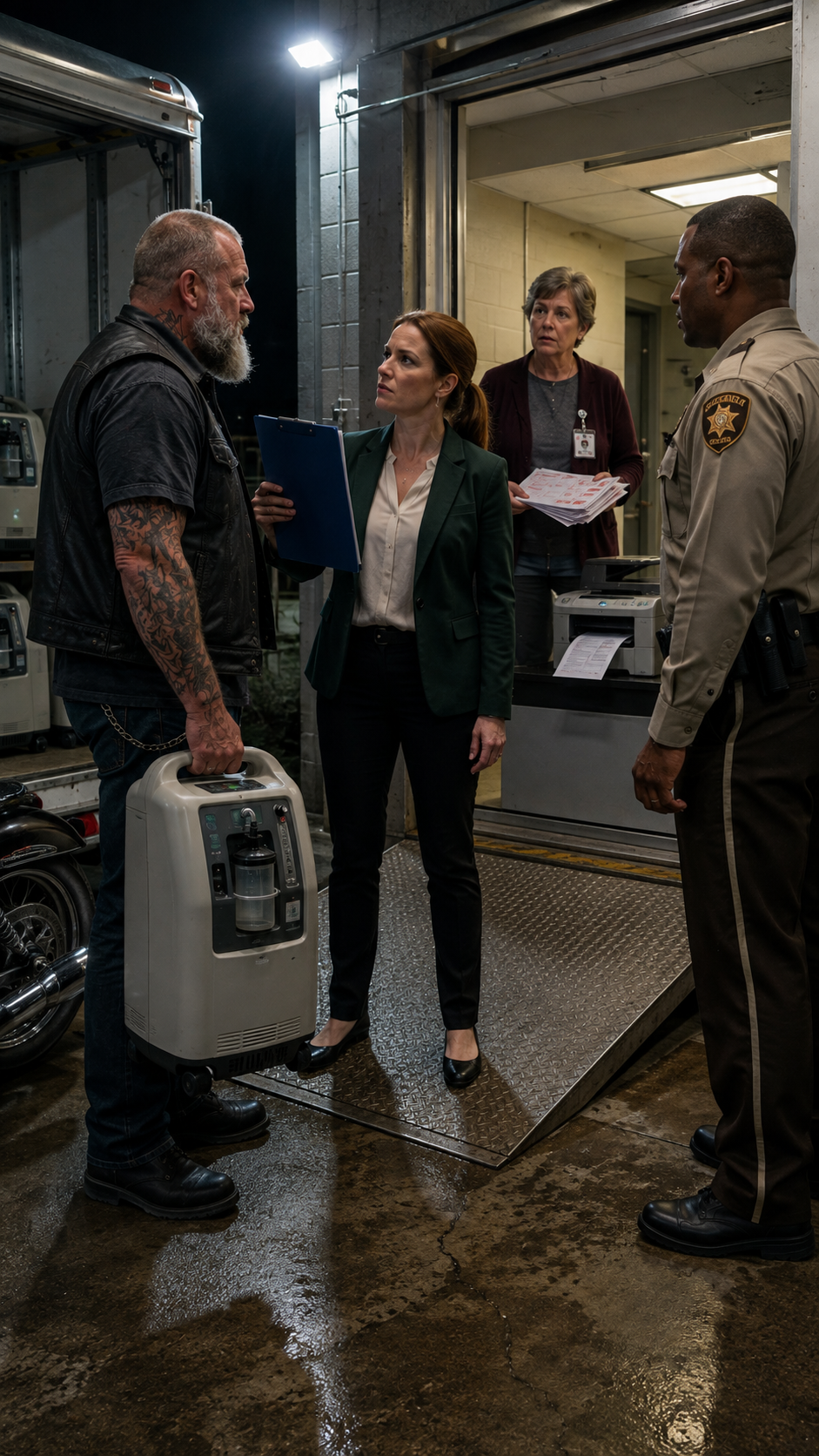
Mast reached Mrs. Talbot’s house before the second patrol car.
Preacher’s motorcycle stood in the driveway with its headlight still on. The concentrator waited beside the porch, untouched.
The front door was open.
Inside, Preacher lay on the kitchen floor, conscious but unable to move. A clear adhesive patch had been pressed beneath his collar. The woman who invited him inside had used a fast-acting sedative.
Mrs. Talbot was gone.
Deputy Bell found a transport label inside the concentrator’s battery compartment. It carried the same billing code as Walter’s paperwork and a departure time twenty minutes earlier.
Janet traced the code through Willow Ridge’s old accounting server.
Continuity House was not a hospice.
It was a private rehabilitation facility built inside a closed mining hospital near Beckley. The company transferred dying or isolated patients there, declared them dead, then reassigned their insurance identities to clients who could pay for procedures without creating official records.
Patients who still had valuable coverage were kept alive under new names.
Those who became difficult were given medication until the paperwork matched reality.
State police entered the facility before sunrise.
They found eight missing patients, including Mrs. Talbot, in rooms without personal belongings or external telephones. Three of Mast’s riders had been sedated after arriving with equipment. The others had noticed the concealed modules and remained outside their delivery addresses until police reached them.
No rider died.
The death certificate generated for Preacher was cancelled eighteen minutes before its scheduled time.
The man directing the operation was Dr. Aaron Crane’s son, Matthew. His father’s electronic signature had remained active after his death, allowing the company to approve transfers, hospice orders and certificates without a living physician reviewing them.
Matthew had expected Janet to resist the closure.
He had expected her to call Mast.
The modified machines were bait designed to reveal which patients still had relatives, neighbours or advocates willing to interfere. Once the devices reconnected, the transport teams knew exactly where to go.
They had underestimated how many witnesses Mast would create.
Janet preserved the servers.
I preserved the asset records.
Deputy Bell preserved the transport packets.
The riders preserved the patients by refusing to leave them alone.
Matthew Crane and seven company employees were charged with fraud, kidnapping, unlawful confinement and offences connected to several deaths previously recorded as natural respiratory failure.
Willow Ridge’s parent company collapsed completely.
The equipment did not return to bankruptcy storage.
A federal judge ordered every device transferred directly to the patients whose insurance had paid for it.
Walter Price lived another eleven months.
Mast visited him most Sundays, usually carrying a replacement filter or some unnecessary tool so neither man had to admit the visit was social.
Preacher recovered slowly. He joked about being defeated by a woman half his size, but stopped laughing when anyone called the riders heroes.
“We delivered machines,” he said. “The patients had already survived the hard part.”
Janet lost her administrator’s licence for falsifying the destruction forms.
Months later, the state hired her to help audit home-care equipment because she understood exactly how records were manipulated.
I testified that her lie had saved lives.
On the first anniversary of the raid, twenty-three concentrators stood outside the former Willow Ridge building. Each carried a small metal plate engraved only with the patient’s real name.
Mast walked past them in silence.
At Walter’s machine, he stopped.
Mrs. Price had placed his old cracked plastic card beneath the handle. Lena’s photograph remained taped to the back.
DAD, BELIEVE THE SMELL BEFORE THE LABEL.
Mast touched the edge once, then stepped away.
For years, people had trusted certificates, signatures and medical systems because those things looked more respectable than a tattooed man asking uncomfortable questions.
The machines had labels.
The patients had names.
Only one of those deserved to decide who was still alive.