
Part 3 — The Workshop Behind the Funeral Home
The custom wheelchair should have cost more than thirty thousand dollars.
Ray had eight hundred and twelve.
That was the amount Daniel left in an envelope at Dawson Cycle Works, mostly small bills saved from extra weekend clinic shifts. On the front he had written FOR MOVEMENT, NOT FLOWERS.
Ray used the first two hundred dollars to buy aluminum tubing. He ruined half of it.
A motorcycle frame could absorb vibration through suspension and a rider’s legs. A pediatric wheelchair had to support a growing child whose spine, hips and skin could be injured by a difference of millimeters. Ray understood metal, but he was not a rehabilitation engineer.
So he called the people Daniel had treated.
The first was Dr. Priya Shah, a seating specialist at the children’s hospital. She refused to approve a homemade medical device. Ray brought Daniel’s measurements to her office, placed them on the desk and said, “Then teach us not to hurt her.”
Priya inspected the papers.
She came to the shop that Thursday.
Next came Marlene Ortiz, a retired aerospace machinist whose husband rode with the Iron Mile Riders. She designed an adjustable frame that could widen as Maisie grew. A club member named Frank Delaney machined the locking joints. Another, Ellis Boone, rebuilt the braking system using components rated far beyond the chair’s expected load.
Nobody worked alone.
That became Ray’s first rule.
His second rule was that the chair could not leave the shop until every medical component passed inspection. His third was that Maisie must believe her ideas mattered more than the adults’ opinions.
That third rule created the secret mailbox.
Ray placed a red metal box outside our backyard fence with the words DESIGN DEPARTMENT painted beneath the lid. I thought it belonged to the utility company. Maisie knew better.
Every Monday, she left a drawing inside.
She requested purple wheels, a princess throne, star lights, a secret pocket and a button that made “a brave sound” whenever adults talked over her. Ray replied on unsigned index cards, asking practical questions disguised as royal decisions.
Should the throne carry books or stuffed animals?
Did the princess need a rain cover?
Where should emergency medicine travel?
Would she rather have a loud horn or lights?
Maisie answered everything.
She had been helping build the chair for four months without seeing it.
The Iron Mile Riders gathered at Ray’s shop on Thursday nights. Neighbors heard saws, grinders and the occasional Harley engine. Those were the meetings I saw from our kitchen window—the men unloading cushions, tubing, batteries and cardboard templates into Ray’s pickup.
I assumed they were restoring an old motorcycle.
Then the shop’s landlord sold the building.
Ray received thirty days to leave. He moved the project to the rear workshop of Delaney Funeral Home, where Frank’s older sister managed burials and allowed the club to work after closing.
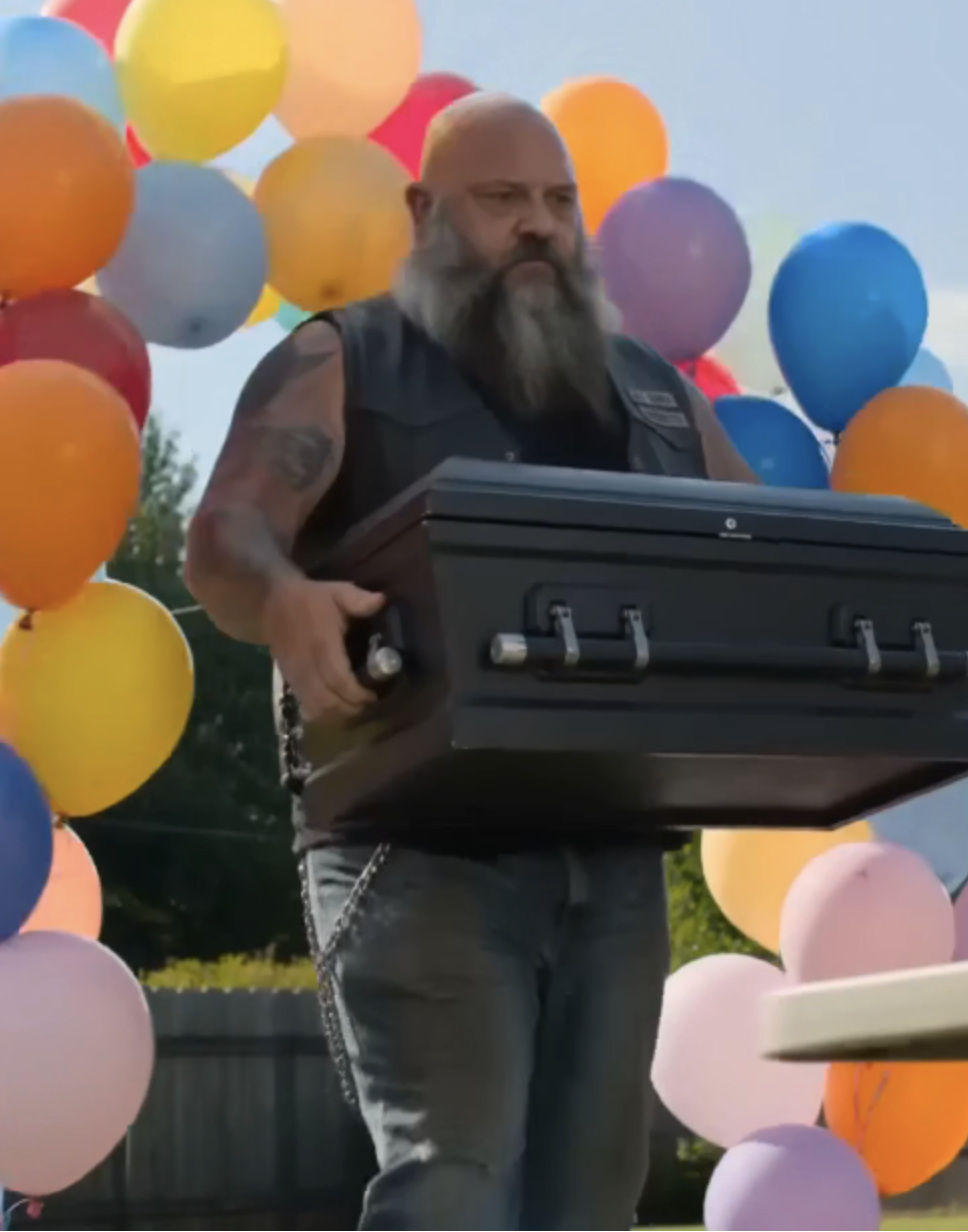
That was where the black transport case began.
The finished chair could not fit through the funeral home’s narrow rear door while fully assembled. It also needed protection during rain, road vibration and the final hospital inspection. Frank offered a long wooden shipping container formerly used for casket hardware displays.
It was rectangular.
Ray rebuilt it with a curved waterproof lid.
He installed brass carrying handles from a damaged ceremonial casket because they were strong, balanced and available at no cost. The bikers painted the case black to hide mismatched boards, then added silver stars because Maisie had complained that “all grown-up equipment looks sad.”
It was never intended to resemble a child’s coffin.
Once finished, it resembled nothing else.
Frank warned Ray.
Priya warned him.
Every member of the club warned him.
“Put it in a van under a blanket,” Wade Hollis, the club president, said.
“Blanket catches on controls,” Ray answered.
“Build a square crate.”
“Water pools.”
“Paint it white.”
“Shows road dirt.”
Wade stared at the curved black lid and brass handles. “A room full of parents is going to think you’ve lost your mind.”
Ray ran a hand across the silver stars. “Probably.”
“Then change it.”
“Works as built.”
That was Ray’s weakness. Once an object performed its purpose safely, appearances stopped mattering to him.
But the box caused a larger problem than bad judgment.
One week before the party, I followed Ray’s truck.
I had seen him speaking to Maisie outside school beside the red mailbox. She gave him another drawing, and he handed her a small metal crown. When I called her name, Ray stepped away immediately.
I demanded to know what he was doing.
“Keeping a promise,” he said.
“To Daniel?”
“Yeah.”
“You already kept the promise that mattered to you. You gave him that ride.”
Ray’s expression did not change, but his left hand closed slowly.
I followed him across Springfield to the funeral home and watched six bikers carry the black case through the rear entrance.
Through an open door, I saw child-sized wheels beside it.
I did not see the chair.
I saw a coffin-shaped box, men who had been secretly contacting my daughter and a set of measurements written by my dead husband.
I called the police.
Two officers searched the workshop. They opened the case, inspected the project and found nothing criminal. Ray refused to file a complaint against me. He only asked the officers not to describe the chair because it was meant to be a surprise.
The officers respected his request.
I did not apologize.
Instead, I told Ray to stay away from the birthday party.
He nodded.
“Understood.”
Then he asked whether the hall’s front doors were thirty-six inches wide.
I slammed my car door.
What I did not know was that the chair had failed its first hospital inspection that morning. The left brake slipped under load, the battery compartment lacked sufficient ventilation and the lateral support pressed too close to Maisie’s ribs.
The club had six days to rebuild three months of work.
Ray slept in the funeral home workshop.
He sold his Harley on the fifth day.
Part 4 — The Motorcycle Missing From the Parking Lot
I did not notice the missing Harley during the party.
Twenty-two motorcycles stood outside the community hall, their engines cooling beneath the August sun. The Iron Mile Riders had parked in two clean rows, but Ray had arrived in the passenger seat of Wade’s pickup.
I assumed his bike was being repaired.
Ray had owned the midnight-blue Road King for twenty-three years. He rebuilt its engine twice, replaced the fuel tank after the Joplin collision and refused offers far above its actual value. Daniel once joked that Ray would sell one of his kidneys before selling that motorcycle.
Daniel had been wrong.
The adaptive seating system required a molded pressure-relief cushion. Insurance would cover one only after delivery of an approved chair, yet the chair could not pass final inspection without it. The manufacturer demanded $4,600 in advance.
The club relief fund held enough money.
Ray would not touch it.
The Iron Mile Riders had removed him as road captain after I accused him of shortening Daniel’s life. Wade did not believe me, but several members argued that taking a medically fragile man on a motorcycle had been reckless. Ray refused to explain Daniel’s condition before the ride or the private conversation that led to it.
He placed his patch on the table before the vote.
“You don’t owe them silence,” Wade told him.
“Owe Daniel.”
“Daniel’s gone.”
“Promise isn’t.”
Ray left the meeting without his colors.
The club continued building the chair anyway, but Ray would not accept money from men whose emblem he no longer wore. He listed the Harley online and sold it to an unknown buyer in Tulsa.
The payment covered the cushion, new brakes, ventilation panels and final testing.
At the birthday party, I learned this only after Maisie asked why the chair’s control panel contained a tiny blue motorcycle.
The image was painted beside a round silver button.
“Brave sound,” Ray explained.
Maisie pressed it.
Instead of a horn, the room filled with three seconds of a Harley’s low, uneven idle—the exact engine note of Ray’s Road King. He had recorded it before the buyer loaded the motorcycle onto a trailer.
Maisie laughed so hard her paper crown slipped over one eye.
The adults remained quiet.
Ray crouched beside the new chair and began explaining the transfer process to Priya, who had arrived through a side entrance carrying medical forms. She checked the brakes, frame locks and pressure settings once more.
“Approved,” she said.
That single word changed the chair from a beautiful garage project into a medically reviewed mobility device.
Still, I could not let Maisie use it.
Not yet.
The metal plate beneath the footrest carried Daniel’s handwriting. The hidden compartment contained his envelope. The motorcycle button carried the sound of something Ray had sacrificed without telling anyone.
Too many dead and missing things had been placed around my child.
“What is the other half of the promise?” I asked.
Ray stood.
His knees cracked beneath him.
“Read the letter.”
The envelope had been sealed with blue medical tape. Daniel had written my name on the front, but beneath it was a second instruction.
NOT UNTIL SHE CHOOSES THE CHAIR.
Maisie rolled her old wheelchair closer. “I choose it.”
“You haven’t sat in it.”
“I chose it when I drew it.”
Ray glanced at me, waiting.
That made me angry again. “You let an eight-year-old decide?”
“Her chair.”
“She’s a child.”
“Still her chair.”
Priya intervened before I answered. She explained that Maisie would not leave the hall in the new system until the fit was checked under load. The birthday reveal did not replace clinical care. The custom frame had emergency manual controls, anti-tip bars and removable decorative panels. Every silver star could disappear, and the chair would remain functional.
Ray had planned for growth, repairs and changing tastes.
He had even planned for the day Maisie might stop wanting to be a princess.
That detail broke something in me.
Daniel used to say good adaptive equipment should not trap a child inside the age when adults first felt sorry for her. It should change when she changed.
Ray had remembered.
We transferred Maisie into the chair.
The cushion settled beneath her. Priya adjusted the side supports while Ray watched from several feet away, hands folded behind his back so he would not interfere. Maisie tested the control stick, moved forward six inches and stopped.
The chair did not tilt.
It did not groan.
Her shoulders remained level for the first time in months.
She turned left, circled the black transport case and drove toward the cake while the gold stars inside the spokes revolved around her.
The children stopped hiding behind their parents.
They began following her.
One boy asked whether the lights could flash. Another wanted to know whether the secret compartment held treasure. Maisie pressed the brave-sound button, and the recorded Harley filled the room again.
Then the control panel spoke.
Not with a machine voice.
With Daniel’s.
“Easy on the corners, Bug.”
Maisie froze.
So did I.
Ray stepped backward as if he had been struck.
I grabbed the armrest. “What did you put in this chair?”
“Wasn’t me.”
Daniel’s voice came again, weaker beneath a hiss of hospital-room noise.
“If you’re hearing this, Hammer ignored at least six good reasons to quit. Before your mother blames him, open the envelope.”
Every face turned toward me.
My hands could barely break the seal.
The letter inside was not a farewell.
It was a confession.
Daniel had not asked Ray for one final ride through the Ozarks.
He had asked Ray to help him disappear for forty-three minutes so he could complete one last part of Maisie’s chair without me knowing.
And the destination had not been the hills.
It had been Dawson Cycle Works.
Part 5 — What Daniel Built During the Forty-Three Minutes
On that cold March afternoon, Ray did not take Daniel farther than four miles.
He secured him in the adaptive sidecar, covered his legs with two blankets and drove to the repair shop at less than thirty miles per hour. Wade followed in a pickup carrying Daniel’s oxygen equipment. A hospice nurse waited inside the workshop.
Nothing about the ride was careless.
Everything had been planned.
Daniel wanted to record instructions while sitting beside the unfinished frame. He believed Maisie would someday hear weakness in his voice, but he did not want her to hear it from a hospital bed. He wanted the sounds around him to be tools, rolling wheels and men building something that would outlast his body.
Ray had positioned a recorder on the workbench.
For forty-three minutes, Daniel described what Maisie needed.
Not technically. He had already written the measurements. He described how she became impatient when adults spoke over her, how she hid snacks beneath her left thigh, how rain frightened her after a storm flooded our first apartment and why every chair needed a pocket within reach of her stronger hand.
He told the bikers never to place his photograph on the backrest.
“She needs people looking at her,” he said, “not at the dead man behind her.”
Then Daniel recorded three short messages for the control panel.
“Easy on the corners, Bug.”
“Ask where she wants to go.”
And the last one:
“Movement counts.”
Ray objected to the voice recordings. He believed they would tie Maisie to grief.
Daniel agreed to a condition. The recordings would not be installed permanently. They would live inside a removable silver module, and Maisie alone would decide when to keep, change or erase them.
The silver crown Ray had given her outside school was the release key.
The chair belonged to her.
Even its memories.
Before leaving the shop, Daniel used a hand engraving tool to scratch BUILD HER SOMETHING THAT MOVES into a thin steel plate. His grip failed twice. Ray offered to finish the letters.
Daniel refused.
That explained why the final word slanted downward.
It also explained the cut I had seen on Daniel’s thumb.
The last pages of his letter were addressed to me.
He knew I would blame Ray for the ride. He had asked Ray to keep the details private until Maisie’s new chair was ready because he feared I would stop the project if I learned he had spent his limited strength in the workshop.
He was right.
“I have asked him to carry your anger,” Daniel wrote, “because he is strong enough to stand near it. That does not make it fair.”
I lowered the letter.
Ray stared at the black case.
“You could have told me after the funeral,” I said.
“Promised not to.”
“He knew I would hate you.”
“Yeah.”
“And you agreed?”
“Yeah.”
“Why?”
Ray looked at Maisie testing the chair’s turning radius between the tables. “Needed the work finished.”
For five months, he had accepted my accusation because defending himself required breaking Daniel’s final confidence. He lost his club patch, customers and motorcycle without offering the one explanation that could have protected him.
That was not the final twist.
The unknown buyer from Tulsa entered the hall.
She was a thirty-eight-year-old Army veteran named Captain Elena Ruiz. A roadside bomb in Afghanistan had injured her spine and left her unable to balance a motorcycle. Daniel treated her during two years of rehabilitation. Ray later built adaptive hand controls for her trike.
Elena had seen the online listing for Ray’s Road King.
She bought it using money collected from nineteen former patients Daniel had helped.
The motorcycle had never gone to Tulsa.
It waited outside behind the hall.
The club opened the rear doors. Afternoon light fell across the midnight-blue tank, and the Road King rolled inside without its engine running. Every person who had contributed had signed the underside of the seat where Ray could not erase their names.
He stared at the motorcycle.
Then he looked at Wade.
“You knew?”
“Found out yesterday.”
“Money?”
“Paid.”
“Not mine.”
Elena moved forward on forearm crutches. “Neither was the chair.”
Ray’s jaw tightened.
She pointed toward Maisie. “That didn’t stop you.”
He had no answer.
Wade carried Ray’s old Iron Mile Riders patch folded across both hands. “We should’ve waited for the truth.”
Ray did not take it.
“We judged you while you were keeping a promise,” Wade continued. “Some of us stopped showing up. Some let you sell the bike before asking what the work cost. Patch won’t erase that.”
“No.”
“It can tell people where we stand now.”
Ray examined the worn fabric. One corner had been repaired with black thread. The road-captain bar was gone.
He removed the gloves from the coffin-shaped case and placed them beneath the patch.
“Not captain,” he said.
“Wasn’t offering rank.”
“Not asking anyone to forget.”
“Neither are we.”
Ray accepted the patch but did not put it on.
Instead, he walked behind Maisie’s chair, opened the secret compartment and slid the folded emblem inside.
“Safe there,” he said.
Maisie looked over her shoulder. “You’re supposed to wear it.”
“Need stitches.”
“I have tape.”
For the second time that afternoon, purple tape repaired something adults had allowed to break.
Maisie fixed the patch temporarily to the back of Ray’s vest, directly over the pale outline where it had once been sewn. The placement was crooked. One corner curled upward.
Nobody corrected her.
Then my daughter took the silver crown key, inserted it beneath the control panel and removed Daniel’s voice module.
She held it for several seconds.
I feared she would erase it.
Instead, she opened the secret compartment and placed the module beside Ray’s patch.
“I don’t need Dad to tell me every turn,” she said. “Just the hard ones.”
Ray lowered his head.
His left hand began to shake.
That was all.
Part 6 — The Box That Became a Workbench
The black transport case never returned to the funeral home.
Ray wanted to dismantle it. I wanted it out of my sight. Maisie refused both suggestions.
She said it had frightened everyone because nobody knew what was inside. That meant the box needed a new job.
The Iron Mile Riders carried it to Dawson Cycle Works, where Ray cut the curved lid lengthwise and mounted both halves against the wall. One became a folding workbench. The other became a low design table accessible to children using wheelchairs.
The brass handles remained.
So did the silver stars.
Every Thursday evening, families began bringing damaged mobility equipment to the shop. Ray tightened loose frames, replaced worn tires and adjusted footrests. Priya inspected medical components, while Marlene kept records and refused to let the bikers describe precision machining as “hammering until it behaves.”
They called the project Move Night.
Nobody paid.
Families who wanted to contribute brought materials, food or broken equipment that could be salvaged. A ten-year-old boy donated the wheels from his outgrown chair. Elena taught teenagers to measure clearances. Maisie sat at the black design table and asked each child the question Daniel had insisted adults remember.
“Where do you want to go?”
Her princess chair changed as she did.
At nine, she removed the crown-shaped side panels because they caught on classroom desks. At ten, she replaced the gold stars with dark blue reflectors. At eleven, she asked Ray to change the brave-sound button from the Road King’s engine to three sharp notes she had recorded on a keyboard.
Ray made every alteration without complaint.
He preserved one silver star beneath the seat.
The black transport case became a local story, though newspapers often simplified it. Headlines said bikers had delivered a miracle chair in a coffin. Ray hated the word miracle.
“Brakes,” he would say. “Bearings. Good cushion. Nothing magic.”
He was right.
Magic would have required no sacrifice, no mistakes and no medical inspection. Maisie’s chair had needed all three.
On Daniel’s birthday, Ray and I finally took the forty-three-minute route from the hospice to the old repair shop. He rode the recovered Road King. I followed in my car while Maisie drove beside me in an accessible van.
At the shop, Ray showed me the mark where Daniel’s engraving tool had slipped across the workbench.
I placed my fingers against it.
“I said you stole five days from us,” I told him.
Ray leaned against the bench. “You were hurting.”
“That doesn’t make it true.”
“No.”
“I’m sorry.”
He considered the words for a long time, then reached beneath the design table and handed me Daniel’s old measuring tape.
“Keep that,” he said.
It was the closest Ray ever came to saying we were square.
Part 7 — The Girl Who No Longer Needed a Princess Throne
Five years after the birthday party, Maisie entered the Springfield community hall again.
She was thirteen and had refused balloons.
The high-backed princess seat was gone. In its place was a lighter graphite support system designed for school corridors, city sidewalks and the adaptive basketball team she had joined the previous winter. The original purple wheels hung above Ray’s workbench at Move Night.
The silver footplate remained.
So did Daniel’s crooked engraving.
Ray arrived late, riding the midnight-blue Road King. Age had stiffened his injured ankle, and he needed several seconds to straighten after lowering the kickstand. His beard had turned almost white, but the Iron Mile Riders patch still covered the back of his vest.
Beneath it, Maisie had added a narrow purple strip.
It read DESIGN DEPARTMENT.
The gathering was not a birthday party. Maisie had organized a mobility-equipment drive for children whose insurance appeals were still pending. Twenty-three repaired chairs and walkers stood in two rows where the black box had once rested.
Near the cake table sat a frightened six-year-old girl in a gray hospital wheelchair.
She refused to touch the new chair prepared for her.
Adults explained the supports, the brakes and the lighter frame. The child shook her head harder each time.
Maisie rolled forward.
She did not tell the girl to be brave. She did not say the chair would change her life.
She pressed a button beneath her armrest.
Three seconds of an old Harley’s uneven engine note filled the hall.
The girl looked up.
Maisie pointed toward Ray. “That sound belonged to his motorcycle before he sold it because my chair needed a cushion.”
Ray folded his arms. “Got the bike back.”
“Eventually.”
The little girl studied him. “Did you build mine too?”
“Helped.”
“Is it scary?”
Ray looked at the bright green wheels and padded seat. “Only if you don’t pick the color.”
The child touched one wheel.
Then the other.
A few minutes later, she crossed the hall under her own control while her mother walked behind her crying quietly into both hands.
Ray watched from the doorway. He never stepped into the photographs.
Before he left, Maisie opened the compartment beneath her seat and removed Daniel’s silver voice module. She had not played it in almost two years.
She clicked it into the control panel.
Her father’s voice returned, faint but clear.
“Ask where she wants to go.”
Maisie looked toward the little girl circling the empty black stands.
“Where do you want to go?” she called.
The child pointed through the open doors.
“Outside.”
Ray started the Road King. The low V-twin pulse entered the hall, mingling with the smaller electric sound of two wheelchairs moving toward daylight.
This time, nobody pulled their children away.