
Part Three
Riverbend Care Center sat forty-two minutes east of Briarwood.
We made it in thirty-four.
Elena drove.
Marcus rode beside her.
I sat in the back, calling Riverbend’s front desk over and over.
No answer.
Then busy.
Then voicemail.
Marcus stared through the windshield.
“My mother was lucky.”
I looked at him.
He kept his eyes on the road.
“She fell three times and lived.”
Nobody answered.
He continued.
“Arthur didn’t.”
Elena tightened her hands on the wheel.
“You didn’t cause any of this.”
“I know.”
He said it like he was trying to decide whether he believed it.
Then he looked back at me.
“Your father’s at Riverbend?”
“Yes.”
“What unit?”
“Memory care.”
His face changed.
Of course.
Another person whose complaints could be dismissed.
Another chart waiting to say confused.
I called again.
This time someone answered.
“Riverbend Care Center.”
“My name is Claire Donnelly. I’m calling from Briarwood. Has a Hearthwell Mobility shipment arrived today?”
Silence.
“Who is this?”
“I need you to stop distribution of any walkers or wheelchairs delivered this morning.”
“I’m sorry, I can’t discuss—”
“People have been injured.”
Marcus reached back.
“Speaker.”
I turned it on.
He leaned toward the phone.
“This is Marcus Hale. Police are with us. Do not put one of those devices under a resident.”
The woman’s tone changed.
“Sir, I don’t know what—”
A crash sounded through the phone.
Then shouting.
The line went dead.
Elena hit the lights.
No siren.
Just speed.
When Riverbend appeared ahead, an ambulance was already parked outside.
My stomach dropped.
We ran through the lobby.
A nurse was shouting for space.
A wheelchair lay on its side near the dining room entrance.
One rear wheel had folded inward.
An elderly man sat against the wall, blood along his temple.
Not my father.
I hated the relief I felt.
Marcus crouched beside the wheelchair.
“Don’t move it.”
A paramedic looked at him.
“Who are you?”
“Fabricator.”
Elena flashed her badge.
“Preserve the equipment.”
The paramedic nodded.
Marcus examined the frame.
New paint.
New sticker.
Old metal beneath.
Same dark fracture.
Same Hearthwell label.
A woman in navy scrubs came running toward us.
“I’m Rebecca Shaw, administrator.”
Elena said:
“Lock every Hearthwell device in this building.”
Rebecca looked confused.
“We just received twenty walkers and six wheelchairs.”
“Lock them.”
“What’s happening?”
Marcus stood.
“Your new equipment isn’t new.”
Rebecca looked at the broken chair.
Her face drained.
Five minutes later, staff were collecting every device from the morning shipment.
Three had already been issued.
One had failed.
The other two had not.
Yet.
I found my father in Room 108.
He was sitting in a recliner watching an old baseball game with the sound off.
“Claire?”
I knelt beside him.
“Hi, Dad.”
He looked at the commotion in the hallway.
“What did I do?”
“Nothing.”
“You look angry.”
“I’m not angry at you.”
He nodded, satisfied.
Then pointed toward the bathroom.
“They gave me a new walker.”
My heart stopped.
“Where is it?”
“Lady took it.”
“Did you use it?”
“Once.”
“Did it feel strange?”
He thought.
Then nodded.
“Left side shook.”
I closed my eyes.
Of course it did.
A maintenance technician brought it to Marcus.
He placed it on a table.
Pressed the rear support.
The frame clicked.
Marcus looked at me.
“Same.”
Elena photographed everything.
Then Riverbend’s administrator handed her the delivery paperwork.
Supplier:
Hearthwell Mobility Solutions.
Purchase authorization:
Northlake Senior Living.
Regional approval:
Michael Voss.
And another name.
Daniel Mercer — Chief Financial Officer.
Elena frowned.
“Who’s Mercer?”
Rebecca said:
“Northlake corporate.”
Marcus took out his phone.
“Different from Michael?”
“Yes.”
“He approve this?”
Rebecca pointed at the signature.
“Apparently.”
That changed the shape of the case.
Michael wasn’t the top.
He was part of it.
Northlake had structure.
Budgets.
Invoices.
Billing targets.
People signing from above.
This wasn’t one husband exploiting one nursing home.
It was organized.
At 4:22 p.m., the state health department ordered all twelve Northlake facilities to quarantine Hearthwell equipment.
By 5:10, four more defective devices had been found.
By 7:00, the number was nineteen.
At midnight, it was thirty-seven.
I did not sleep.
Neither did Marcus.
The next morning, we returned to Briarwood.
Evelyn was eating toast in the dining room.
Marcus sat beside her.
She touched the bruise beneath her eye.
“They believe me now?”
He looked at her.
“Yeah, Ma.”
She nodded.
“Good.”
Then she spread butter on her toast as if that settled the matter.
Marcus watched her for a long time.
I sat across from them.
“Helen wants to talk.”
His expression hardened.
“Police?”
“With her attorney.”
“Then she can talk to police.”
“She asked for you.”
He leaned back.
“No.”
Evelyn looked at him.
“Go.”
Marcus turned.
“Ma.”
“You want answers.”
“She had answers four months ago.”
Evelyn stared at him.
“And you still want them.”
He hated when she was right.
We met Helen in the conference room.
No polished suit this time.
Sweater.
No makeup.
Her attorney sat beside her.
Elena stood near the door.
Helen looked at Marcus.
“I knew after Arthur.”
“You said that.”
“I knew the equipment was unsafe.”
Marcus said nothing.
“I didn’t know Michael was selecting residents.”
That caught me.
“Selecting?”
Helen looked at me.
“The codes.”
C.
F.
D.
“And the thirty, sixty, ninety?”
“Yes.”
Marcus leaned forward.
“So say it clearly.”
Helen’s eyes filled.
“Michael told facilities directors that certain residents were likely to qualify for higher care levels.”
“Because they were declining?”
“No.”
She swallowed.
“Because they could be made to appear as if they were declining.”
The room went silent.
My stomach turned.
“How?”
Helen looked at the table.
“Equipment failures.”
Marcus’s chair creaked under his hands.
Elena stepped closer.
Helen continued.
“Not catastrophic failures.”
“What does that mean?” I asked.
“Loose brakes. Uneven legs. unstable wheels.”
“Enough to cause falls.”
“Yes.”
“Enough to make residents afraid to walk.”
“Yes.”
Marcus whispered:
“Enough to make them need more assistance.”
Helen nodded.
“And then you bill more.”
“Yes.”
That single word finished the whole structure.
Cheap salvage equipment purchased through a related company.
Repainted.
Relabeled.
Returned as “new.”
Residents classified as cognitively impaired or frail received the worst pieces because their complaints were easiest to dismiss.
Falls increased care levels.
Higher care levels increased reimbursement and private-pay charges.
Northlake profited twice.
Once from equipment that barely cost anything.
Again from the injuries it caused.
I asked:
“How much?”
Helen’s attorney shifted.
She answered anyway.
“Michael said the care-level adjustments produced several million dollars annually across the group.”
Marcus stared at her.
“And Arthur?”
Helen began crying.
“He was not supposed to die.”
Marcus stood.
His chair moved backward.
“No.”
Elena tensed.
Marcus pointed at her.
“Don’t say that.”
Helen flinched.
“He was not supposed to die.”
“None of them were supposed to fall.”
“I know.”
“You knew after Arthur and kept going.”
“I tried to stop it.”
“How?”
“I emailed corporate.”
“Then?”
“They threatened me.”
“With what?”
“My license. My job. Criminal liability for the earlier invoices.”
Marcus laughed bitterly.
“So you protected yourself.”
Helen looked at him.
“Yes.”
No excuse.
No softening.
“Yes.”
Marcus stood there.
Then sat again.
That answer mattered.
Not enough.
But it mattered.
“What about the inspection stickers?”
“Craig replaced them.”
“Because?”
“To make it appear the devices had passed review after complaints.”
“And you knew?”
“Yes.”
Marcus looked away.
Evelyn had fallen the third time after Helen already knew.
That was the part he could not get around.
Neither could I.
Helen eventually signed a cooperation agreement.
She gave investigators access to internal emails, billing spreadsheets and recordings of calls with Michael Voss.
Michael tried to blame Hearthwell.
Hearthwell was him.
Then he blamed Craig.
Craig turned himself in two days later and produced photographs of damaged frames arriving from Northlake facilities with instructions to “make clinical-ready at lowest cost.”
He also produced one email from Daniel Mercer.
It read:
Prioritize C/D residents. Complaint credibility is low. Capture acuity lift before quarterly close.
No one could call that misunderstanding.
The federal investigation began within a week.
Northlake’s board removed five executives.
State regulators suspended admissions at four facilities.
Families filed lawsuits.
Arthur Klein’s death was reopened.
So were six other serious fall cases.
Marcus testified three months later.
He wore a dark suit.
No leather vest.
His tattoos still showed beneath the cuffs.
The opposing attorney tried to reduce him to what people expected.
“Mr. Hale, you have a criminal record?”
“Yes.”
“You have previously been convicted of assault?”
“Yes.”
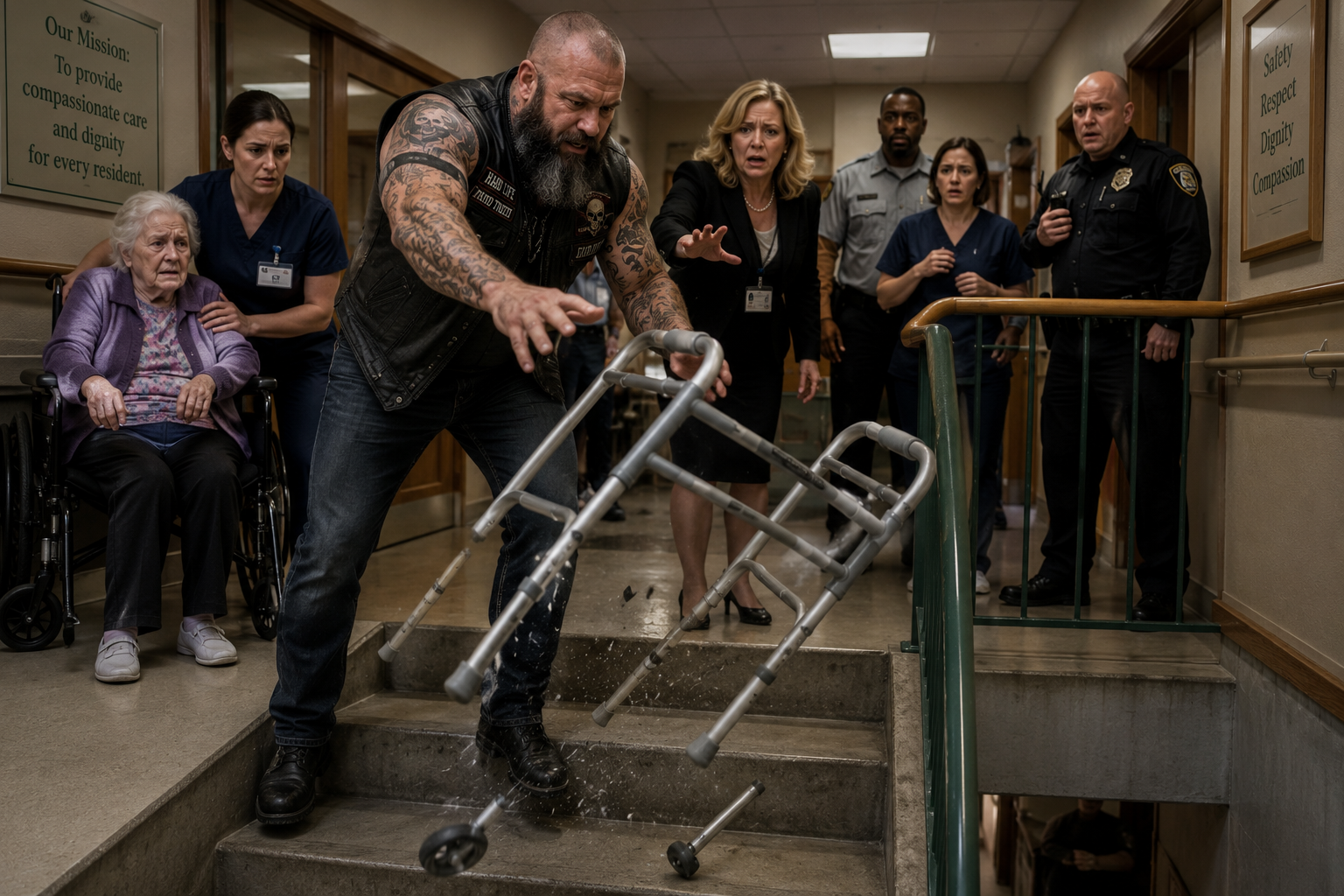
“You threw a walker down a stairwell inside a senior care facility?”
“Yes.”
The attorney paused.
“You would agree that you have a tendency toward destructive behavior?”
Marcus looked at the broken walker displayed in an evidence bag.
“No.”
The attorney smiled.
“No?”
Marcus leaned toward the microphone.
“I have a tendency to break things that are already pretending not to be broken.”
The courtroom went quiet.
That line made the news.
What did not make the news was what happened after.
Marcus went back to work.
Evelyn stayed at Briarwood for another six weeks until the state approved her transfer.
She moved to a smaller nonprofit residence twelve miles away.
On moving day, Marcus brought her a new walker.
Not hospital silver.
Dark blue.
He had fabricated it himself with an engineer who specialized in mobility devices.
Every weld inspected.
Every fastener documented.
Evelyn stared at it.
“You made this ugly.”
Marcus looked offended.
“It’s powder-coated.”
“It’s ugly blue.”
“You like blue.”
“I liked blue in 1989.”
I laughed.
Marcus did not.
“You want another color?”
She smiled.
“No.”
He knew she was teasing.
Before she stood, he crouched beside the frame.
He showed her each adjustment pin.
Each brake.
Each joint.
“This is solid.”
Evelyn touched his face.
“I know.”
“No.”
He looked at her.
“I need you to know.”
Her expression softened.
She placed both hands on the walker.
Then stood.
One step.
Two.
Three.
No click.
No shift.
No collapse.
Marcus followed beside her without touching.
That part mattered.
He was ready to catch her.
But he let her walk.
A year later, Northlake Senior Living agreed to a massive civil settlement and restitution fund.
Michael Voss and Daniel Mercer faced criminal charges tied to fraud, conspiracy, falsification of records and elder neglect.
Craig testified.
Helen lost her administrator’s license.
She avoided prison because of her cooperation, but she never worked in long-term care again.
Some people thought that was too little.
Marcus was one of them.
But when I asked Evelyn, she said:
“Punishment is for courts. I just wanted them to stop telling me I imagined it.”
That became the part I remembered.
Not the money.
Not the headlines.
Not even the walker breaking on the concrete stairs.
The sentence.
I just wanted them to stop telling me I imagined it.
Two years later, Marcus started a small nonprofit inspection program with three retired machinists and a biomedical engineer.
They called it Solid Ground.
They inspected donated walkers, wheelchairs, ramps and transfer equipment for low-income seniors.
Free.
Every device received a metal tag after inspection.
Not a sticker.
Stamped aluminum.
Impossible to peel off and replace without leaving evidence.
The first tag Marcus ever stamped went onto Evelyn’s blue walker.
It read:
SG-0001
Below it, in smaller letters:
LISTEN FIRST.
I asked him why.
He shrugged.
“Machines make noise before they fail.”
“And people?”
He looked toward Evelyn, who was sitting beneath a tree opening a butterscotch candy.
“Usually do too.”
He had loosened the wrapper for her.
Of course he had.
Fear edits people.
So do institutions.
They take a bruised old woman and write confused.
They take an angry son and write dangerous.
They take a complaint and write anxiety.
They take a preventable injury and write decline.
But metal keeps its own record.
Oxidation.
Stress marks.
Bad welds.
Old fractures hiding beneath new paint.
And sometimes all it takes to expose a lie is one person stubborn enough to believe that a weak voice may still be telling the truth.
Marcus never apologized for throwing the walker down the stairs.
Whenever someone asked whether he regretted it, he gave the same answer.
“No.”
Then, after a pause:
“I regret that my mother had to fall three times before anybody listened.”