
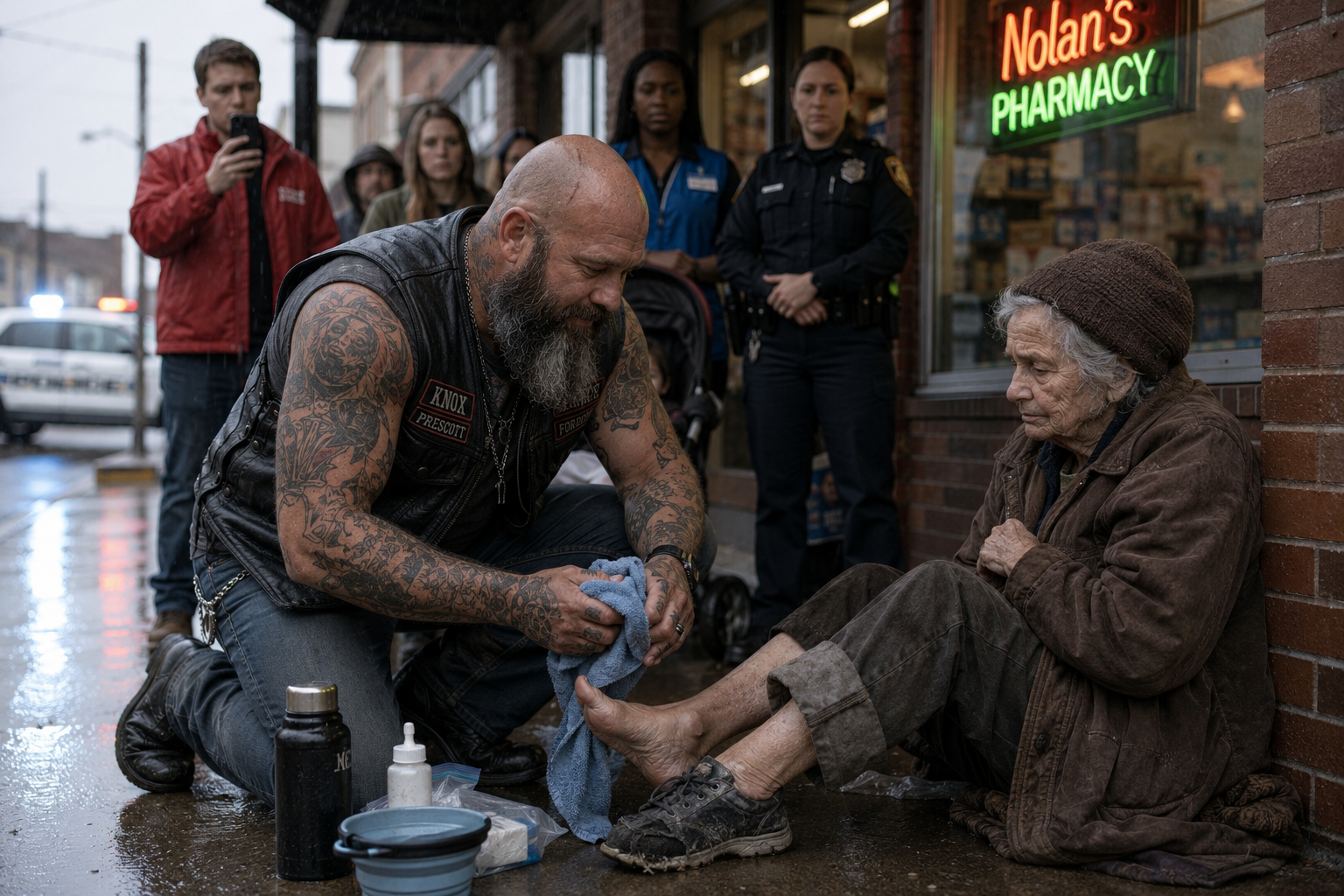
Part Two
Knox did not sit down again.
He stood in the rain with the old photograph in one hand and looked at Ruth as though the ground beneath the pharmacy had shifted several inches.
“You were my mother?”
Ruth wiped her face with the back of one hand.
“I was one of them.”
Officer Elena Ward frowned.
“What does that mean?”
Ruth looked toward her.
Then back at Knox.
“Evelyn raised you.”
“That isn’t what I asked.”
“No.”
Ruth swallowed.
“I gave birth to you.”
Nobody spoke.
Knox looked at the photograph again.
At the younger Ruth.
At Evelyn.
At the small blond boy between them.
His voice came out rough.
“Then who was Evelyn?”
Ruth answered immediately.
“The woman who saved both of us.”
Knox laughed once.
It was not amusement.
“You’re going to have to do better than that.”
Marlene stepped forward.
“Maybe we should get her inside.”
Ruth tensed instantly.
“No shelter.”
“Not a shelter,” I said. “My shop.”
She looked at me.
“Two doors down. Dry. Private.”
Knox stared at her for another few seconds.
Then he picked up the fallen basin, emptied the rainwater and packed everything back into his saddlebag.
He did not offer Ruth his hand.
That mattered.
He had learned enough in five minutes to understand she might not take it.
Instead, he said:
“Can you walk?”
“With help.”
Elena brought the folding chair closer.
Ruth shook her head.
Knox lowered himself beside her.
“You can hold my shoulder.”
She hesitated.
Then placed both hands on him.
He stood slowly.
The entire crowd watched.
This huge tattooed man rising from the pavement with a seventy-something homeless woman leaning against him like he was a wall built specifically not to move.
Nobody filmed.
Not anymore.
Ten minutes later, Ruth was sitting in the back room of my alterations shop with dry socks, tea, and a blanket around her shoulders.
Knox stood near the window.
Elena remained by the door.
Marlene had returned to the pharmacy.
I stayed because Ruth asked me to.
Maybe because I was the only person in the room who had no history with any of them.
Ruth held the old photograph against her chest.
Knox said:
“Start at the beginning.”
Ruth stared into her tea.
“I was eighteen when I met Evelyn.”
Knox said nothing.
“She was twenty-two. Nursing school.”
Ruth smiled faintly.
“I was supposed to be studying too.”
“For what?”
“Nothing useful.”
Knox almost smiled.
Almost.
Ruth continued.
“We were both working nights at a roadside motel outside Albuquerque.”
The photograph.
“That motel?”
“Yes.”
“What year?”
“1984.”
Knox did the math.
“I was born in 1985.”
“Yes.”
“Who was my father?”
Ruth stopped.
Knox noticed immediately.
“Who?”
“His name was Henry Knox.”
Knox’s face tightened.
“That was Evelyn’s husband.”
“Yes.”
The room went still again.
Knox stared at her.
“You had a child with my mother’s husband.”
Ruth’s eyes filled.
“Yes.”
“Did she know?”
“Not at first.”
Knox turned away.
Elena looked at me.
Neither of us spoke.
Ruth kept going because there was no gentle version left.
“Henry was thirty-two. Married. Charming when he wanted to be.”
Knox’s jaw tightened.
“He told me he and Evelyn were separated.”
“Were they?”
“No.”
“Did you know that when you got pregnant?”
“No.”
“And when you found out?”
“I tried to leave.”
Knox turned back.
“What does that mean?”
Ruth wrapped both hands around the cup.
“Henry didn’t like being left.”
Knox’s expression changed.
I had seen men recognize other men without needing details.
“What did he do?”
Ruth stared at the table.
“He hit me.”
Knox’s hands closed.
Elena immediately said:
“Gabriel.”
He looked at her.
She shook her head once.
Not now.
He opened his hands.
Ruth continued.
“I called Evelyn.”
Knox frowned.
“You called his wife?”
“Yes.”
“Why?”
“Because I didn’t know anyone else.”
That answer seemed to hurt him.
“She came?”
“Within an hour.”
Ruth smiled faintly.
“She broke his nose.”
For the first time, Knox laughed.
A real one.
Short.
Surprised.
“That sounds like her.”
Ruth nodded.
“She took me to her sister’s place.”
“What happened to Henry?”
“He apologized.”
Knox gave her a look.
“I know.”
Ruth shook her head.
“You asked.”
“So Evelyn stayed with him?”
“For a while.”
“Why?”
Ruth looked at him.
“People stay for complicated reasons.”
Knox understood that too.
You could see it.
“When I was born?”
“Evelyn was there.”
“In the hospital?”
“No.”
Knox frowned.
“You weren’t born in a hospital.”
He stared at her.
“Where?”
“A trailer outside Grants.”
“Why?”
“Henry found me again.”
Elena’s expression hardened.
Ruth’s voice dropped.
“I had been moving around. Different names. Different towns.”
“You were hiding.”
“Yes.”
“From my father.”
“Yes.”
Knox looked at the photograph again.
“Then what?”
“You came early.”
Ruth’s eyes softened for the first time.
“Tiny thing.”
Knox looked almost offended.
“I was never tiny.”
“You were six pounds and screamed like you were being cheated.”
That got another small laugh from him.
Ruth smiled.
“Evelyn delivered you.”
Knox went still.
“She did?”
“Yes.”
“She was a nurse by then?”
“Almost.”
Ruth touched the blue towel folded beside her.
“She wrapped you in a blue blanket because that was all we had.”
Blue boy.
Knox looked away.
“So why did Evelyn raise me?”
Ruth’s smile vanished.
“Because Henry found us.”
The room tightened.
“He came to the trailer?”
“Yes.”
“Alone?”
“No.”
Ruth looked toward Elena.
“With a sheriff’s deputy.”
Elena frowned.
“Name?”
“Frank Mallory.”
She wrote it down.
Knox said:
“What did he want?”
“You.”
The answer landed like a weight.
“Why?”
“Henry had decided he wanted a son.”
Knox’s expression became flat.
Ruth continued.
“He said I was unstable. Said I drank. Said I used drugs.”
“Did you?”
“Not then.”
Knox noticed the distinction.
“Later?”
Ruth nodded.
“Much later.”
“What happened that day?”
“Evelyn told him the baby had died.”
Knox stared at her.
“What?”
“She had falsified paperwork from a nurse she knew.”
Elena raised an eyebrow.
“That’s a serious crime.”
Ruth looked at her.
“It kept him alive.”
Elena said nothing.
Ruth continued.
“Henry believed it.”
Knox looked down at himself as if checking.
“And then?”
“Evelyn took you.”
“Where?”
“Arizona.”
“Why didn’t you go?”
Ruth’s hands began shaking.
“I was supposed to.”
Knox’s face changed.
“There it is.”
Ruth looked up.
“What?”
“The part where you left.”
She closed her eyes.
“Yes.”
Knox took one step closer.
“You said somebody paid you.”
Ruth nodded.
“Who?”
“Henry.”
Knox’s jaw flexed.
“That makes no sense. He thought I was dead.”
“He did.”
“Then why pay you?”
“To disappear.”
“Why?”
“Because I knew things.”
“What things?”
Ruth’s voice went quieter.
“He had been running stolen prescription drugs through clinics and pharmacies.”
Elena leaned forward.
“In New Mexico?”
“New Mexico and Arizona.”
Knox frowned.
“My father?”
“Yes.”
“He was a truck driver.”
“That was the story.”
Ruth shook her head.
“He owned two transport companies under other names.”
Knox stared at her.
“Why would Evelyn stay married to him?”
“She didn’t.”
Ruth looked at him.
“She left him three months after she took you.”
Knox thought about that.
“She raised me alone for a while.”
“Yes.”
“But I remember him.”
Ruth’s eyes filled.
“Because he came back.”
Knox went completely still.
“What?”
“When you were five.”
He stared.
“No.”
“You don’t remember?”
“I remember a man.”
Ruth nodded.
“You called him Dad.”
Knox turned toward the window.
The scar above his eyebrow seemed deeper suddenly.
“He lived with us for maybe a year.”
“Yes.”
Ruth’s voice shook.
“He found Evelyn.”
Knox’s hand rose slowly toward the scar.
“This.”
Ruth looked at it.
Her face collapsed.
“Yes.”
Elena stepped closer.
“How did he get that scar?”
Knox answered without looking at anyone.
“Glass.”
Ruth whispered:
“Henry threw a bottle.”
Knox shut his eyes.
“I remember Mom saying I fell.”
“She lied.”
“Why?”
“To protect you from knowing what he was.”
Knox turned.
“And where were you?”
Ruth flinched.
That question had been waiting thirty-five years.
“Gone.”
“Paid.”
“Yes.”
“How much?”
“Ten thousand dollars.”
Knox stared at her.
“You sold me for ten thousand dollars.”
“No.”
“Sounds like it.”
Ruth began crying.
“I thought you were safe with her.”
“You took his money.”
“Yes.”
“And left.”
“Yes.”
Knox leaned both hands against the cutting table.
His breathing changed.
Ruth did not defend herself.
That was the only reason he stayed.
Finally he asked:
“What did you do with it?”
“Bus ticket. Motel rooms. A month later almost all of it was gone.”
“Drugs?”
“Eventually.”
“Which ones?”
“Whatever made me stop thinking.”
The honesty was brutal.
Knox looked at her.
“Why did Mom tell me you died?”
Ruth stared at the blue towel.
“Because I asked her to.”
His face tightened.
“You asked her?”
“Yes.”
“Why?”
“Because I came back.”
Knox froze.
“When?”
“You were eight.”
“No.”
“Yes.”
“I would remember.”
“You never saw me.”
“What happened?”
Ruth rubbed her hands together.
“I had been sober nine months.”
“Good for you.”
The cruelty in his voice made me flinch.
Ruth accepted it.
“I found Evelyn.”
“How?”
“She was working at a clinic in Prescott.”
Knox nodded slowly.
“I remember that clinic.”
“I watched you leave school one afternoon.”
His eyes narrowed.
“You watched me?”
“From across the street.”
“Why didn’t you talk to me?”
“Because you looked happy.”
Knox laughed bitterly.
“That was your reason?”
“No.”
She looked at him.
“Your mother begged me not to.”
“Evelyn?”
“Yes.”
“Why?”
“Henry was searching again.”
The anger drained from Knox’s face.
“What?”
“He had learned the death certificate was false.”
Elena stopped writing.
“When?”
“Around 1993.”
Ruth nodded.
“He wanted you back.”
Knox shook his head.
“Why?”
“I don’t know.”
“You said he wanted a son.”
“At first.”
Ruth looked terrified now, even decades later.
“By then it was something else.”
“What?”
“He needed your name.”
Knox frowned.
“For what?”
Ruth reached inside her coat.
Elena tensed.
Ruth moved slowly.
She pulled out a folded plastic envelope.
Inside were several papers.
Old.
Yellowed.
She handed them to Knox.
He unfolded the first.
His expression changed.
“What is this?”
“Life insurance.”
Knox read.
Then looked at her.
“My policy?”
“No.”
Ruth shook her head.
“Evelyn’s.”
Knox went still.
“Beneficiary?”
“You.”
Knox looked down.
“And?”
“Two hundred fifty thousand dollars.”
“That was a fortune back then.”
“Yes.”
“Mom never had that kind of policy.”
“She didn’t buy it.”
Knox stared at Ruth.
“Henry did.”
The room became cold.
“Why?”
“Because Evelyn had started collecting evidence against him.”
Knox’s face changed.
Elena understood before he did.
“He planned to kill her.”
Ruth nodded.
Knox laughed once.
No humor.
“She died of cancer.”
Ruth’s eyes filled.
“That’s what you were told?”
Nobody breathed.
Knox’s face emptied.
“My mother had breast cancer.”
“No.”
“Stop.”
“She was sick.”
“No.”
Ruth’s voice trembled.
“Gabriel, Evelyn did not die from cancer.”
He stepped back.
“You don’t get to do this.”
“I have to.”
“I buried her.”
“I know.”
“She lost her hair.”
“She was poisoned.”
Elena’s head snapped up.
“With what?”
“I don’t know.”
Knox stared at Ruth as though she had become something dangerous.
“She had chemotherapy.”
“She had treatment because doctors thought they were treating autoimmune complications.”
“No.”
Ruth slid another paper from the envelope.
A lab report.
Old.
Handwritten notes.
Knox did not take it.
Ruth placed it on the table.
“She sent this to me six weeks before she died.”
Knox looked down.
“What is it?”
“Heavy metal screening.”
Elena picked it up.
“Arsenic.”
The word sat there.
Knox’s knees seemed to weaken.
He grabbed the chair.
“Who did it?”
Ruth’s answer came quietly.
“Henry.”
Knox looked at her.
“He was gone by then.”
“No.”
“Yes.”
“You didn’t know.”
Knox’s eyes filled with something far worse than anger.
“Where is he?”
Ruth shook her head.
“I don’t know.”
“You came here after thirty-five years and you don’t know?”
“I know where he was.”
“When?”
“Three months ago.”
Knox went still.
Ruth looked toward the street.
“Carter County Nursing Center.”
Elena frowned.
“That’s thirty miles east.”
Ruth nodded.
“He has dementia.”
Knox laughed.
Of course.
Life had waited until the man who might finally answer could barely remember the questions.
“Why were you outside the pharmacy?”
Ruth did not answer.
Knox looked at her broken shoes.
The coat.
The paper cup.
“You came here looking for me.”
“Yes.”
“Why?”
“Because I went to see him.”
Knox’s jaw tightened.
“And?”
Ruth reached into the plastic envelope again.
This time she pulled out a small cassette tape.
Old microcassette.
A handwritten label covered one side.
Evelyn — May 1999
Knox’s face changed.
“What is that?”
“Henry had it.”
“How?”
“I don’t know.”
“Where?”
“In a box beside his bed.”
She held it out.
Knox did not move.
Ruth’s hand trembled.
“He doesn’t know my name anymore.”
Knox stared at the cassette.
“But when I played this…”
Her voice broke.
“He remembered yours.”
Knox finally took it.
On the other side of the tape, in different handwriting, were four words:
For Gabriel when safe.
Knox looked at Ruth.
“What’s on it?”
She began crying.
“Your mother.”
He swallowed.
“Saying what?”
Ruth stared at him.
“That if Henry ever came back for you, there was one thing you needed to know.”
Knox’s voice dropped.
“What?”
Ruth answered:
“Henry Knox wasn’t your father.”
Knox stared at her.
Then at the tape.
And for the first time since I had known him, the biggest biker in Prescott looked less like a man facing his past than a little boy realizing he had never actually known where he came from.