
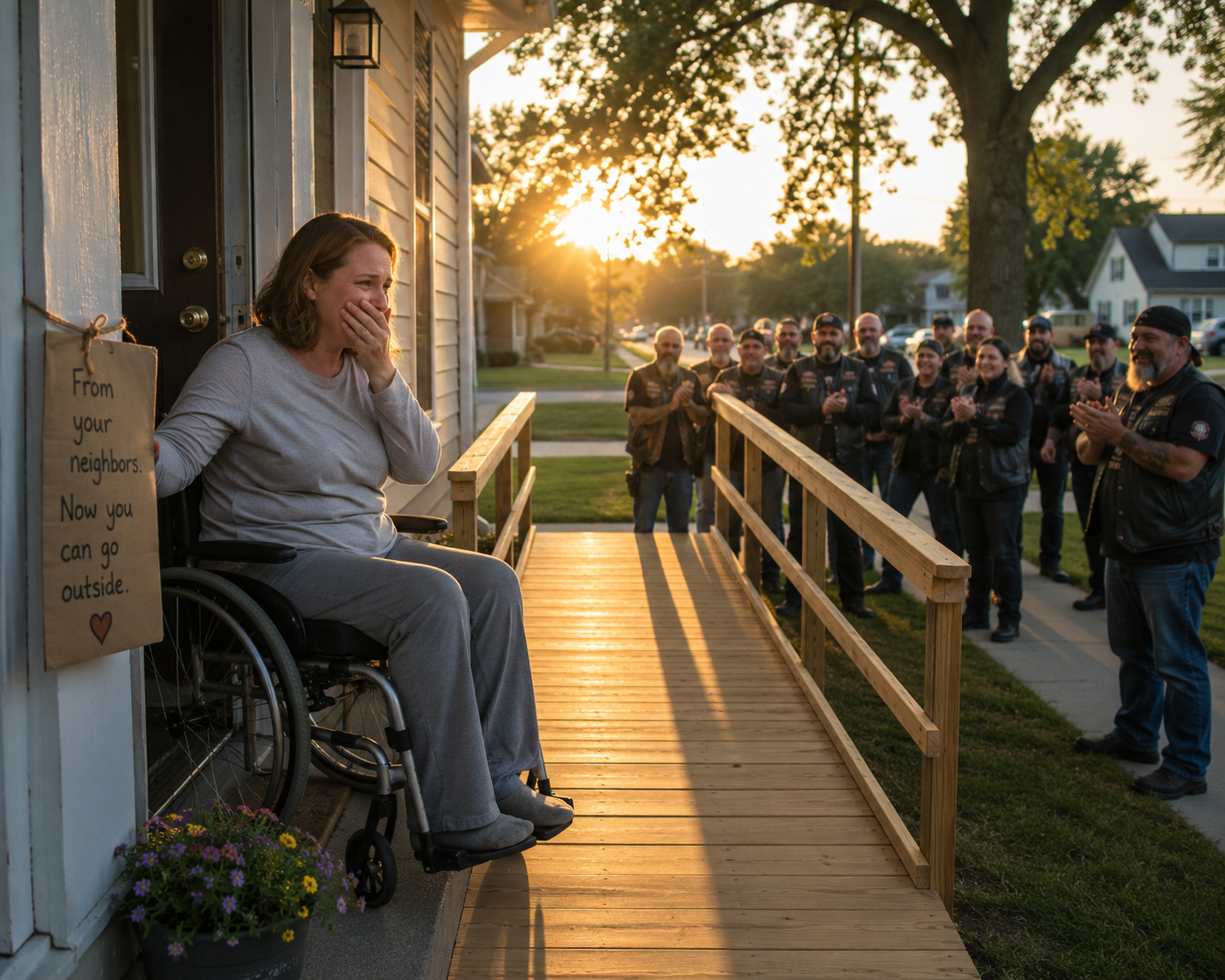
THE RAMP BUILT BEFORE DAWN
Part Three
Julia did not ask Detective Keller whether Nathan was alive.
She asked:
“Where would they take him?”
Her voice was steady.
Only her hands revealed the fear.
They gripped the wheels of her chair so tightly that her knuckles had gone white.
Keller studied the image on Nathan’s phone.
The inspection report.
The photograph of Julia’s porch.
The handwritten phrase:
Mobility event would significantly alter owner’s ability to remain.
“This document came from somewhere,” he said. “Where did Nathan find it?”
Rebecca Sloan opened the file information on the phone.
“The photograph was taken twenty-seven minutes before he disappeared.”
“Location data?”
She checked.
Then looked toward Walter.
“Ridgeway’s redevelopment office.”
Walter frowned.
“The old rail depot?”
“Adjacent building.”
Detective Keller began making calls.
Ridgeway Neighborhood Renewal Fund operated from a converted freight office beside the abandoned depot. Officially, the building closed at five.
According to the phone’s location history, Nathan had gone there at three-thirteen that afternoon.
He remained eighteen minutes.
Then returned to Julia’s street.
He must have entered the office, photographed the inspection report and left before anyone realized what he had found.
“They followed him here,” Julia said.
Keller nodded.
“And took him before he could explain.”
Walter looked toward the damaged ramp.
“They also cut that support.”
“To frighten her?” I asked.
Rebecca shook her head.
“If the ramp failed while Julia used it, Ridgeway could classify the property as unsafe and argue that remaining there posed an immediate medical risk.”
Julia stared at the half-cut beam.
“They wanted another accident.”
Nobody contradicted her.
Walter took out his phone.
“Can the Saints help search?”
Keller’s answer was immediate.
“No vigilantes.”
“They’re not vigilantes.”
“You have nearly thirty motorcycle riders who just discovered somebody abducted their friend’s brother.”
Walter considered that.
“Fair concern.”
“You stay here.”
Walter looked toward Julia.
She spoke before he could argue.
“Listen to him.”
His eyebrows lifted.
“You’re ordering me around now?”
“Yes.”
“Recovery is going well.”
Despite everything, Julia almost smiled.
Keller drove toward the depot with county officers.
State police were alerted.
Traffic cameras began searching for the white van.
Rebecca requested an emergency court order freezing every Ridgeway-controlled property transfer connected to the neighborhood.
The Ashland Saints did not chase anyone.
They did something more useful.
Frankie Bell contacted former building inspectors who knew Ridgeway’s projects.
Marlene Torres reviewed public utility records.
Isaiah Brooks called contractors who had worked inside the old freight buildings.
Within forty minutes, Walter’s phone rang.
He listened.
Then handed it to Rebecca.
A former Ridgeway electrician remembered a hidden loading bay beneath the redevelopment office.
It had once connected the freight building to a storm-maintenance tunnel leading beneath the depot.
The tunnel did not appear on modern plans.
Detective Keller was still approaching the main entrance.
Rebecca called him immediately.
The information changed the rescue.
Officers did not announce themselves at the front door.
A second team entered through the old maintenance tunnel.
At six-forty-two that evening, police found Nathan inside a basement records room.
His hands were bound with plastic ties.
A bruise covered one side of his face, but he was conscious.
Two employees had been ordered to make him sign a statement claiming he stole the inspection documents and fabricated the mobility note.
The false rehabilitation coordinator was there too.
Her real name was Melissa Wallace.
She was Grant Wallace’s wife, not his sister.
Grant managed property acquisitions for Ridgeway.
Melissa worked as a private claims investigator contracted by Ridgeway’s insurance company.
She had access to hospital schedules, rehabilitation referrals and accident records.
The van driver who struck Julia was not a random employee.
He was Grant’s cousin.
Phone records later showed that Grant had called him nine minutes before the collision.
The driver waited near the intersection until Julia’s car approached.
Then accelerated through the red light.
Investigators found no written order saying:
Injure Julia Mercer.
Criminal plans rarely arrive labeled honestly.
Instead, there were messages.
She refused the third offer.
Without vehicle access, she cannot stay.
Create leverage before rezoning vote.
And one message sent twenty minutes before the crash:
Confirm mobility event today. Avoid fatal outcome.
They had not intended to kill Julia.
They had intended to disable her.
That distinction mattered to lawyers.
It did not matter to Julia.
Grant Wallace was arrested at the depot’s rear loading dock while attempting to leave with boxes of financial records.
Melissa and the two men holding Nathan were also arrested.
The van driver was taken into custody the following morning.
Police searches uncovered files on twenty-three homeowners.
Each person had resisted selling property needed for Ridgeway’s access corridor.
Beside their names were private details.
Debt.
Age.
Medical conditions.
Family conflicts.
Insurance disputes.
Information that could be turned into pressure.
Julia’s file was marked:
Independent. Limited nearby support. Property access vulnerable following mobility reduction.
The company had studied her life until it found a way to make her home unusable.
Then it offered to save her from the problem it created.
Nathan returned to Waverly Street shortly after midnight.
Julia waited in my living room because police would not allow anyone inside her house until the damaged ramp and property had been checked.
When Nathan entered, she did not roll toward him.
He stopped near the doorway.
His wrists were bandaged.
“I’m sorry,” he said.
Julia looked at the bruising on his face.
“Are you hurt?”
“I’m okay.”
“That wasn’t my question.”
He understood.
“Nothing broken.”
She nodded.
Then:
“You transferred my house.”
Nathan closed his eyes.
“Yes.”
“You believed people you had never met instead of telling me what you were doing.”
“Yes.”
“You decided I needed to leave.”
His voice weakened.
“Yes.”
Walter stood near the kitchen but said nothing.
Nathan continued:
“I kept thinking I could fix everything before you found out.”
Julia looked toward the window.
“That is what people say when they want control to sound like help.”
He accepted it.
“I know.”
“No, you know now.”
The sentence echoed what Walter had once said about responsibility.
Julia looked back at her brother.
“I needed assistance.”
Nathan nodded.
“You treated me like I had lost judgment with my legs.”
He began crying.
Not dramatically.
Quietly.
“I was terrified.”
“So was I.”
“I thought if the hospital took the house—”
“You should have asked me.”
“I thought you would say no.”
“I might have.”
“That’s why I—”
He stopped.
Because he finally heard himself.
Julia finished for him.
“That was my right.”
Nathan lowered his head.
“Yes.”
Forgiveness did not arrive that night.
Neither did reconciliation.
Julia allowed him to sit.
That was all.
Sometimes the first rebuilt piece of a relationship is simply permission not to leave.
The legal fight lasted eighteen months.
The transfer to Mercer Residential Holdings was voided because it had been obtained through fraud, undisclosed conflicts and misuse of the power of attorney.
Julia’s ownership was restored.
Ridgeway’s redevelopment project collapsed.
Executives faced charges involving conspiracy, fraud, kidnapping, aggravated assault and attempted coercion of multiple property owners.
Several hospital and insurance employees were investigated for improperly sharing confidential information.
The county purchased part of Ridgeway’s seized land and converted it into an accessible public park.
Julia received a settlement.
She hated the word.
“It sounds like money settles what happened.”
Rebecca corrected her.
“It does not settle the harm. It settles the case.”
Julia used part of the money to renovate her house.
Wider doors.
Lower kitchen surfaces.
An accessible bathroom.
A lift to the second floor.
She kept the ramp.
The original one.
Not because it was perfect.
It was not.
The sabotaged support had to be replaced.
Two rail sections warped after the overnight rain.
The blue visibility line required repainting every year.
But Julia refused to tear it down.
Twenty-nine people had built it before dawn because they believed a closed door was a construction problem rather than her destiny.
She wanted to remember that.
The Ashland Saints never accepted payment.
Julia tried.
Walter returned the check.
She tried donating to the club.
They returned that too.
Finally, Frankie Bell explained:
“You keep assuming the ramp belongs to us because we built it.”
“Doesn’t it?”
“No.”
He pointed toward her house.
“It became yours the moment your wheels touched it.”
Julia eventually found a way around their refusal.
She created the Open Door Project.
The program paid for accessibility modifications for people trapped at home while waiting for insurance or public assistance.
Walter served on the board.
Evelyn inspected every design.
Isaiah supervised construction.
Marlene handled lighting and electrical work.
Nathan managed paperwork, but only after Julia established a rule that appeared in bold on every form:
NO DECISION ABOUT A PERSON WITHOUT THAT PERSON.
The first ramp they built belonged to a retired bus driver recovering from an amputation.
The second helped a child using a power wheelchair reach her backyard.
By the fifth project, reporters began calling the Ashland Saints “the midnight ramp bikers.”
Walter disliked the name.
“It makes us sound like a home-improvement gang.”
“You are a home-improvement gang,” Julia told him.
“That seems legally complicated.”
Three years after the accident, Julia returned to teaching.
Not full-time.
Two music classes each afternoon.
The school lowered a section of the orchestra platform so her wheelchair could move between the students.
She began playing cello on her porch again.
The first evening she did, everyone on the street came outside.
Walter sat across from her on his motorcycle.
I occupied my usual observation post with a glass of tea.
Nathan leaned against the new porch railing.
He and Julia were better.
Not restored to what they had been.
Built into something more honest.
Halfway through the music, Julia stopped.
“What?” Walter called.
She looked at the ramp.
“I was just thinking about that first morning.”
“The county inspector?”
“No.”
“The ownership fraud?”
“No.”
“The attempted collapse?”
Julia sighed.
“You make every memory worse.”
“It’s a gift.”
She smiled.
“I was thinking about opening the door.”
For fifty-three days, that doorway had shown her everything she could not reach.
Then one morning, it showed her a path.
The bikers had believed they were building a ramp.
They had built something more difficult to measure.
Proof that receiving help did not make Julia helpless.
Proof that independence did not mean doing everything alone.
Proof that accessibility was not charity, generosity or a special favor.
It was the difference between possessing a front door and being able to use it.
Years later, the note Walter tied to the railing remained framed inside Julia’s hallway.
THE WORLD DIDN’T LEAVE.
YOU JUST NEEDED ANOTHER WAY TO REACH IT.
The sentence was not entirely true.
Parts of the world had tried to leave her behind.
A company saw her injury as leverage.
Systems placed her on waiting lists.
People made decisions about her body, her house and her future without asking.
But other people stayed.
They measured.
Cut.
Sanded.
Carried boards through rain.
Repaired what someone else tried to break.
And every morning after that, when Julia opened her front door, she no longer saw four steps telling her where she could not go.
She saw the road her neighbors had built while she slept.
Then she rolled outside.