
Part 1
When my father raised his glass that night, the ice cubes clicked against the crystal like little teeth.
“To Dylan,” he said, voice already warm with bourbon and self-congratulation. “The first real soldier in this family.”
Everybody at the table laughed. My mother laughed with that quick breathy sound she used when she wanted the room to stay easy. My aunt Linda slapped the table. Dylan ducked his head and grinned, embarrassed but pleased, the way golden boys learn to be. The chandelier threw soft yellow light over the roast, the silverware, the wineglasses, all of it polished within an inch of its life. If you didn’t know better, you’d think you were looking at one of those glossy holiday catalog families where nobody ever says the quiet part out loud.
I sat there with my fork halfway to my mouth and felt something small and old inside me go still.
My father turned to Dylan again. “The Tate name is back where it belongs. Navy blood. Field work. Sand and saltwater. Not—” He waved vaguely in my direction with his glass. “Not paperwork.”
The gravy on my plate had already started to skin over. I could smell rosemary, butter, black pepper, all of it too rich and too warm. My mother leaned across me to refill Dylan’s wine, then tipped the bottle toward my glass and stopped halfway.
“You shouldn’t drink much, sweetheart,” she said. “You’ve got work tomorrow, right?”
“I just got back from Bahrain,” I said.
She barely looked at me. “Vacation?”
My father snorted. “At the Pentagon? Must be nice.”
I let the silence sit there. I had spent the previous week sleeping in bursts under fluorescent lights, signing off on a regional extraction plan while sand scratched at the sides of armored vehicles and two different embassies kept changing the rules every six hours. I still had the crease from a flight mask pressed faintly into the bridge of my nose. None of them noticed. None of them ever did.
Dylan set his napkin down. “Dad.”
“What?” my father said. “You’re almost through BUD/S. That means something. Hell, that means everything.”
Dylan looked uncomfortable, and for a second I felt sorry for him. That was the thing people never understood about favorites. They got fed poison too. Just in prettier dishes.
I cut into my steak. “Congratulations, Dylan.”
He gave me a small, grateful smile. “Thanks, Cam.”
My father heard the softness in it and immediately hardened. “Your brother’s earned this. Real men wash out of that pipeline every day.”
I looked up. “And the women?”
He smiled without humor. “You always did like making a point.”
No, I thought. I liked existing. You just heard that as defiance.
The table drifted on without me. Coronado. Hell Week. Team guys. Brotherhood. My father’s old stories from the Navy got bigger with each pour. My mother glowed at all of it, passing bread, correcting no one, smoothing every sharp edge except the ones aimed at me. She was good at that. She could make neglect feel almost polite.
By the time dessert came out, I had stopped tasting anything.
Later, when everyone migrated to the den and the TV volume rose with the men’s voices, I slipped upstairs to my old room. The hallway smelled faintly like lemon polish and the stale cold of central air. My mother had turned the room into a kind of storage shrine to the daughter she preferred: high school ribbons in a shadow box, a cracked ceramic lamp, the faded quilt she’d made before I left for college. The only military photo in sight was the one from West Point graduation, shoved behind a stack of scrapbooks on the bookshelf.
I pulled it free.
Dust filmed the glass. Underneath it was a younger version of me in dress gray, chin up, eyes hard, trying not to look disappointed that my father hadn’t come. My mother had sent flowers with a card that said We’re proud of you, sweetheart, even though I knew she’d written it after I called crying from a pay phone outside the barracks because every other cadet on the parade field had somebody there.
I wiped the dust away with my sleeve.
At eighteen, I’d thought achievement would force recognition. At twenty-two, I thought deployment would. At thirty, after Iraq and Syria and enough classified rooms to make whole years blur together, I finally understood something uglier: some people can watch you bleed for your country and still decide you only shuffled paper because that version of you is easier for them to live with.
Downstairs, laughter rolled up through the vents.
I set the photo back on the shelf and stood there a minute longer, staring at my own face. It was strange, looking at proof you had always been real.
The next morning I drove back toward D.C. under a sky the color of old tin. The roads were lined with late-fall trees, gold and rust and thinning out at the tops. My rental still smelled faintly like airport coffee and somebody else’s pine air freshener. A talk radio host was discussing troop readiness when I pulled into my building garage and cut the engine.
There was a single envelope in my mailbox.
Cream cardstock. Navy crest.
I tore it open right there under the weak fluorescent light.
You are cordially invited to attend the graduation ceremony for Naval Special Warfare Candidate Dylan Tate…
I almost smiled at that. Of course they’d sent me the formal invitation after assuming I’d just show up in a sundress and clap on cue.
Then I saw the keynote speaker’s name.
General Alan Monroe.
For a second all I could hear was the hum of the overhead light and the blood moving in my ears. Alan Monroe had once looked at a half-collapsed operations map in Syria, listened to three colonels argue for twelve straight minutes, and then turned to me—the youngest person in the room—and said, “Tate, what’s the move?” He had pinned a medal on me in a dust-choked hangar two years later and told me my worst habit was vanishing inside my own discipline.
He would know exactly who I was.
I stood there with the invitation trembling lightly in my hand, feeling the first real crack in the lie my family had built around me.
If Monroe saw me in Coronado, everything would change. The only question was whether I was ready to watch it happen.
Part 2
I put two suitcases on my bed that night.
One held civilian clothes: slacks, a cream blouse, a navy wrap dress, flats that wouldn’t blister on concrete. The other held my dress blues.
The uniform looked almost unreal in lamplight. Dark fabric. Sharp creases. Ribbons lined up with a precision that had taken years to earn and less than a minute for my family to dismiss without ever seeing. The star insignia sat in a velvet box beside it, small and bright and cold. I didn’t touch it at first. I just stood there in stocking feet on the hardwood floor, listening to the distant rattle of traffic beyond my apartment windows.
Two lives. That was what it felt like.
In one, I was Cameron Tate, the daughter who “worked at the Pentagon” and had somehow turned soldiering into filing cabinets. In the other, I was the woman whose phone rang when men got trapped in bad weather, when special operations plans fell apart at midnight, when commanders needed somebody who could think while everyone else performed panic.
The part that stung wasn’t that my family didn’t understand the details.
It was that they never asked.
My phone buzzed against the nightstand. Commander Davis.
I answered on the second ring. “Davis.”
“Ma’am. Sorry to bother you at home.”
“You always say that right before bothering me at home.”
He laughed once. “General Monroe asked whether you’d be attending the Coronado ceremony.”
I looked at the uniform. “Did he.”
“He did. I told him you were on personal leave and off duty.”
“Good.”
A short pause. “If you wear the blues, ma’am, there’ll be no hiding the stars.”
I sat on the edge of the bed. “I’m not hiding. I’m choosing where to spend my energy.”
“Yes, ma’am. For what it’s worth, Monroe sounded… pleased.”
That was the thing about military language. Pleased could mean proud, amused, dangerous, or ready to blow a hole through somebody’s excuses.
“Thanks, Davis.”
Another buzz hit before I even set the phone down. My mother.
Bring something light for Coronado, the text read. No need for formal clothes. It’s just family.
I stared at the message so long the screen dimmed. Then I opened the velvet box, picked up the star, and pinned it where it belonged.
The metal made a tiny, decisive click.
By the time I landed in San Diego two days later, the marine layer had burned off and the whole city looked sun-washed and expensive. Palm trees, tan stucco, salt in the air. My parents were already checked into the resort hotel near Coronado, the kind of place with citrus water in the lobby and white orchids nobody was allowed to touch. When I walked in wearing jeans, sunglasses, and a black blazer over a T-shirt, my mother looked relieved.
“Oh, good,” she said. “You didn’t overdo it.”
I kissed her cheek. She smelled like department store perfume and hairspray. My father was at the bar with Dylan, both of them in loafers and pressed shirts, talking with another family about training attrition rates like they personally oversaw the whole pipeline.
“Cam,” Dylan said, smiling when he saw me. He looked leaner than the last time I’d seen him, sun-browned and sharpened by training. There were new lines around his mouth. Good ones. Earned ones.
I hugged him. “You holding up?”
“Ask me after tomorrow.”
My father turned on his stool. “You finally made it. Hope you didn’t have to move too many paper stacks around to get leave approved.”
Dylan closed his eyes for half a second. My mother pretended to adjust her bracelet.
I took off my sunglasses. “Still leading from the front, Dad.”
He grinned, not realizing I meant it.
That afternoon we toured the base-adjacent event area with the rest of the families. Folding chairs were being lined up in perfect rows. Flags snapped in the wind so hard they sounded like sheets cracking on a clothesline. Somewhere farther off, gulls cried over the water. The Pacific smelled like salt and engine oil and the faint rot of seaweed heating in the sun.
My mother drifted into conversation with a woman whose son was graduating alongside Dylan.
“This is my daughter Cameron,” she said. “She’s in government work. Pentagon side. Very administrative.”
The woman smiled at me politely. “That must be nice. Stable.”
I looked at my mother.
She kept smiling.
“Depends on the week,” I said.
As we passed through one of the security checkpoints, a young lieutenant took my ID, looked up, then straightened so fast it was almost a flinch.
“Ma’am,” he said, with an entirely different tone.
I gave him the smallest shake of my head.
His eyes flicked to my family, then back to me. “Enjoy the ceremony.”
My father frowned once we were past him. “What was that about?”
“Military manners,” I said.
He grunted like that answered anything. Maybe for him, it did.
The next morning came bright and sharp. The kind of California sun that made every surface look overexposed. I dressed alone in my hotel room, shirt first, then jacket, then ribbons, then the star. The fabric settled onto my shoulders with a familiar weight that always made me stand straighter before I consciously chose to. When I looked in the mirror, the woman staring back at me didn’t look secretive.
She looked done.
My mother nearly dropped her clutch when I opened the door.
“Oh,” she said.
My father’s eyes moved over the uniform with confusion first, then irritation, as if I had violated some social agreement. “What’s all this?”
“It’s my dress uniform.”
“For a family ceremony?”
“For a military ceremony,” I said.
Dylan, already in pre-ceremony transit with the other candidates, wasn’t there to see the walk from the parking area to the stands. That was a shame, because it was almost funny. Families turned to look. A couple of enlisted men on detail stepped subtly out of my path. My mother kept glancing around like she was hoping nobody important would notice me. My father’s mouth had gone flat.
We took our seats. The ocean wind whipped at the edges of the programs in our laps. Graduates stood in formation, rows of white caps and rigid shoulders under the hard blue sky. Then the dignitaries arrived.
General Alan Monroe crossed to the podium in full dress uniform, silver hair cut close, stride still clean and fast despite the years. He started speaking about discipline, sacrifice, failure, resilience. His voice carried over the field like it always had—unhurried, dry, impossible to ignore.
Then he looked up.
Right at me.
I felt it before anything changed. That split-second recognition. That small narrowing of the eyes that said memory had slammed into the present at full speed. He stopped mid-sentence.
Around us, the crowd shifted, confused.
Monroe stepped away from the podium.
My father leaned forward. “What is he doing?”
I already knew.
He wasn’t looking at the graduates anymore. He was walking straight across the field toward me, and the closer he got, the colder my hands became.
Part 3
The first thing I heard was not the crowd.
It was the sound of Monroe’s shoes striking the parade deck—measured, unhurried, loud enough in my head to drown everything else. Sun flashed off his insignia. The microphone behind him picked up a little hiss of feedback as he moved too far from it. All around us, the neat order of the ceremony bent around one fact I had spent years refusing to force on my family.
He stopped three feet in front of me.
Then he saluted.
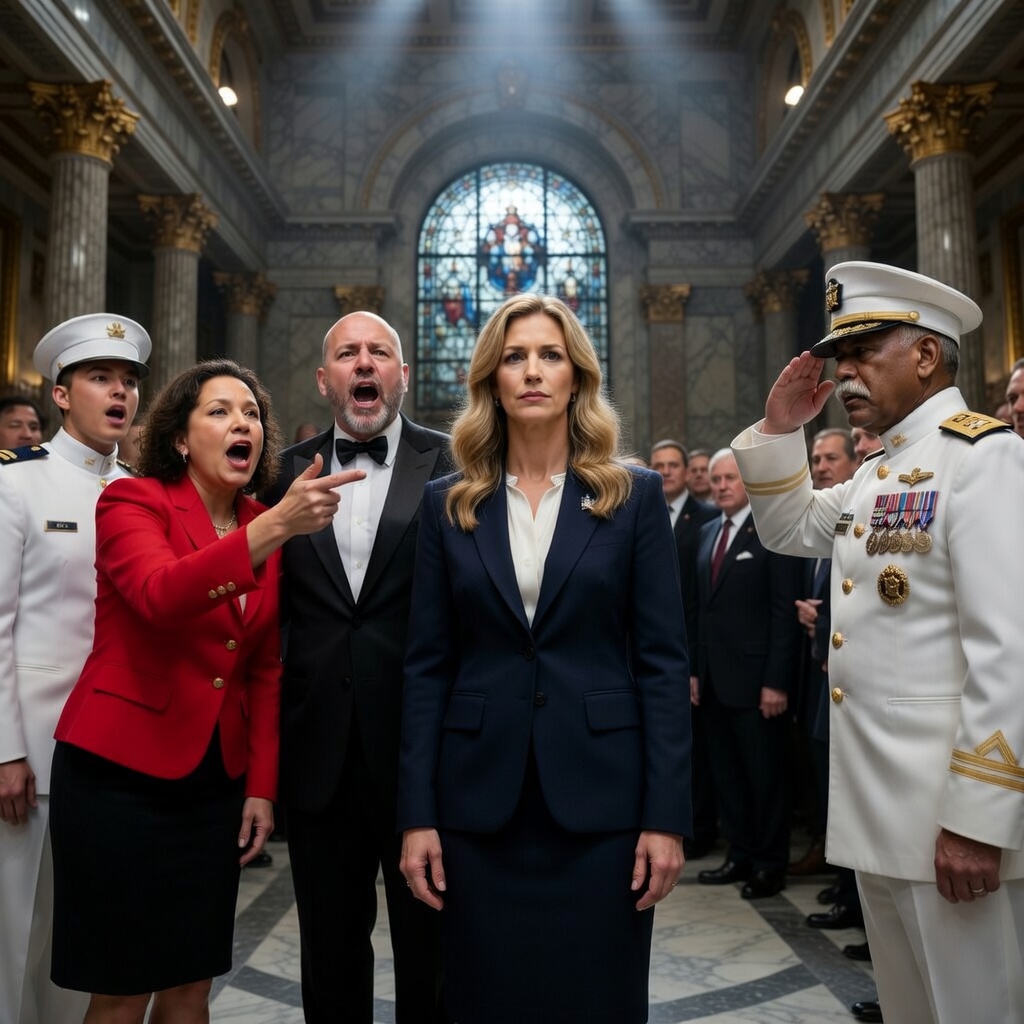
“Brigadier General Cameron Tate,” he said, voice carrying even without the mic. “Ma’am. It’s an honor to see you here.”
The field went dead silent.
I stood and returned the salute automatically, muscle memory taking over long before my thoughts caught up. “General.”
Somewhere to my left, my mother made a sound like she’d forgotten how to breathe. My father didn’t make any sound at all. He just stared.
Monroe turned back toward the microphone, but he didn’t go all the way to the podium. He spoke from where he stood, close enough that every word landed inside my family before it reached the speakers.
“For those of you celebrating a graduate today,” he said, “you know the visible cost of service. What most civilians never see is the weight carried by the leaders who make sure our sons and daughters come home at all. General Tate commanded one of the most difficult special operations rescue chains in recent memory. Some of the men standing on this field owe their safe return, directly or indirectly, to decisions she made.”
A murmur rolled through the stands.
Monroe’s mouth tipped at one corner. “And if any of you studied the Aleppo extraction case at advanced leadership courses, yes. That was her too.”
That did it.
Applause broke first in one cluster, then another, then became a full-body standing ovation that rose like weather. Men and women got to their feet. A few active-duty personnel saluted. Phones came out. Somebody behind me whispered, “Holy hell.” I didn’t look at anyone except the formation line where Dylan stood.
He had turned his head just enough to see me.
And then, in perfect form, he raised his hand in his first salute as a newly minted operator and gave it to me.
That nearly undid me.
It wasn’t because I needed it. By then I was too old, too scarred over, too practiced at not needing what should have been given freely. It was because he looked proud and shocked and deeply, painfully sincere all at once. There was no performance in it. No family theater. Just recognition.
I held his gaze for a second, then nodded once.
The rest of the ceremony happened in pieces, as if somebody had cut it into strips and rearranged it. Speeches. Names. Cheering. The slap of the wind. My mother crying quietly with a hand over her mouth. My father sitting absolutely still, like moving too much might make the moment real. By the time the graduates were dismissed and the field dissolved into hugs and photographs, the story had already escaped us. I could see it happening in real time on the phones around me.
A decorated general hidden in plain sight at her brother’s graduation.
Families love that kind of myth.
Too bad it wasn’t one.
Dylan got to me first.
He came in fast, still carrying that post-ceremony energy, part adrenaline, part disbelief. Up close I could smell sunscreen, starch, and the clean salt of ocean air on his uniform. He stopped like he wasn’t sure whether to hug me or brace.
“You’re Cameron Tate,” he said.
I barked out a laugh. “Last I checked.”
“No. I mean—” He looked wrecked in the strangest way, eyes bright and stunned. “The Cameron Tate. The Aleppo case study. We covered it in leadership discussions. Half the instructors talked about that mission like it was a standard nobody could meet.”
I felt my jaw tighten a little. “Funny. My family thought I worked copy machines.”
His face fell. “Cam…”
I softened because none of this had started with him. “Congratulations, Dylan. Really.”
He nodded once, hard. “You too. I guess for… all of it.”
Then my mother was there, grabbing my forearm with both hands like I might disappear into thin air if she loosened her grip.
“Why didn’t you tell us?” she asked.
There it was. The question people always ask when they’ve spent years ignoring the answer.
“I did,” I said. “You changed the subject.”
“That is not fair,” my father snapped, arriving a beat later. Color had climbed high into his face. “You never said you were—”
“What?” I asked. “Important? Senior enough? Worth listening to?”
“You know that’s not what I mean.”
“No,” I said, keeping my voice even. “I actually don’t.”
A camera flashed from somewhere nearby. Reporters had started drifting over, drawn by Monroe’s detour and the energy shift around us. My mother noticed and immediately tried to rearrange her face into something composed and maternal. It made anger bloom in me so fast it felt almost hot.
Dylan saw it too.
“Maybe not here,” he said quietly.
My father ignored him. “If this was true, if your rank was—if all this was—”
I laughed then, sharp and ugly. “Dad, do you hear yourself?”
He stopped.
I could feel people half-watching, pretending not to. The sea wind snapped the corner of the ceremony program against my leg. Somewhere a child cried because he’d dropped his juice. It was such a normal mess of a scene for a moment that should have been simple, and that made it worse.
My mother lowered her voice. “We’re your family.”
“Yes,” I said. “You are.”
What I didn’t say was and that’s why it hurt the way it did.
Dylan shifted his cap under his arm. “I didn’t know,” he said. “About any of it. I just… I joined because one of the men who taught us talked about a commander who never asked anybody to do what she wouldn’t do herself. I wanted to be that kind of leader someday.”
My throat tightened unexpectedly.
“Then do it your way,” I told him. “Not mine. And definitely not Dad’s.”
Something in my father’s expression flinched.
Monroe approached again, this time slower, giving me an out if I wanted one. “General,” he said. “Press is asking whether you’d be willing to make a brief statement.”
I looked at my family. My mother’s mascara had smudged at the corners. My father looked old in a way I had never seen before. Dylan looked like a man discovering that half his map had been wrong from the start.
“Fine,” I said.
The statement took less than a minute. I said the graduates were the point of the day, not me. I congratulated them, wished the families well, and refused every attempt to turn it into a redemption story. By the time I finished, the clip had already started circulating.
When I got back to my hotel room that night, my phone was vibrating itself off the nightstand. Twelve missed calls. Seven texts. Two voicemails from my mother. One from my father. A dozen messages from officers I hadn’t spoken to in years, all some version of Guess the secret’s out.
I turned the phone face down and went to shower.
Back in D.C. two days later, the Pentagon felt both exactly the same and faintly tilted. People looked up when I passed. A colonel from logistics nearly walked into a planter because he was staring at his phone and then at me. Commander Davis met me outside a briefing room with a file tucked under one arm and an expression that tried very hard not to be amused.
“Ma’am,” he said, “small situation.”
“When you say it like that, it’s never small.”
“The front desk called. Your parents are downstairs.”
I stopped walking.
“They’re asking to see you,” he said.
The corridor lights hummed softly overhead. Far down the hall somebody laughed. My pulse slowed instead of speeding up, which told me more than anger ever could.
After all these years, they wanted a meeting. I just didn’t know whether they were coming to know me—or to fix the story they’d told about themselves.
Part 4
“Tell them I’m in a meeting,” I said.
Davis studied my face for half a second. “Yes, ma’am.”
I walked the rest of the hall at the same pace I’d been walking before, which felt important. No rushing. No visible reaction. No sign that the people who had trained me to disappear could still make my heartbeat trip if they arrived in the wrong building.
My office overlooked one of the internal courtyards, all clipped hedges and gray concrete and men moving with folders tucked under their arms. Ten minutes later, curiosity got the better of me. I crossed to the window and looked down toward the visitor exit.
There they were.
My mother stood with both hands wrapped around something rectangular. Even from three stories up, I could tell what it was when the light hit the glass.
My West Point photo.
The one from my old room. The one that had sat dusty for years while they bragged about Dylan in every restaurant within thirty miles of their house.
My father said something to the escorting guard. My mother turned once, toward the building, not toward any particular window, just toward the idea of where I might be. Then they were led out through the revolving door and gone.
I went back to my desk and found I could not focus on a single word in the folder in front of me.
At 1900, Dylan called.
I almost let it go to voicemail. Almost. Then I answered.
“You got the family update?” he asked.
“That depends. Is the update that Mom brought a framed photograph to federal property like she was dropping off a science fair project?”
He exhaled, half laugh, half misery. “Yeah. That sounds about right.”
I leaned back in my chair. “What do you want, Dylan?”
“Not to defend them.”
That got my attention.
He kept going. “They’re wrecked, Cam. Dad’s been online for forty-eight hours reading rank charts and articles about joint operations. Mom keeps saying she thought you just… didn’t like talking about your work.”
I looked out at the courtyard. Night had started laying blue-gray across the concrete.
“I didn’t,” I said. “Not with them.”
A pause. “I didn’t know.”
“I believe you.”
He let that sit. “I’m not asking you to make them feel better.”
“Good.”
“I just… I wanted you to know I’m not them.”
That landed harder than I expected.
I rubbed the bridge of my nose. “I know.”
After we hung up, I stayed in the office too long, sorting papers I didn’t need to sort, answering emails with a precision that felt like anger wearing a tie. It was almost 2200 when the red banner alert hit my secure screen.
Severe blizzard event. Anchorage forward installation compromised. Fuel bay collapse. Multiple personnel unaccounted for. Immediate joint coordination required.
Everything in me sharpened.
I called Davis before I was even fully standing. “Get the ops team in. Wheels up as soon as we can assemble air.”
His answer came without hesitation. “On it.”
By midnight I was in a transport plane with twenty-one personnel, two medics, three special operations planners, and enough gear to make the cargo hold smell like canvas, jet fuel, and cold metal. The inside of military aircraft always had the same soundtrack: engine roar, harness buckles, the occasional shouted sentence swallowed by the rest. Red overhead lights turned every face hollowed and strange.
Davis handed me the updated map packet. “Forty-three total at risk. Some trapped near the collapsed fuel storage area, others cut off in adjacent structures. Weather is getting worse faster than forecast.”
“Any fatalities confirmed?”
“Not yet.”
That yet sat between us.
I strapped in and studied the map under the red light. Snow bands. Wind projections. Probable whiteout corridors. The kind of operation that killed people not because anybody lacked courage, but because weather did not care about courage. Weather only cared whether you respected it.
Across from me, one of the younger captains kept flexing his gloved hands. Nerves. First major winter extraction, probably. I remembered being that young and thinking the point of leadership was not to show fear. It had taken years to learn the point was to keep fear from doing the talking.
At some point in the dark hum of the flight, my mind slid backward without permission.
Eighteen. West Point acceptance packet in my hands. My father standing at the kitchen counter in the same house where he would later toast Dylan as the first real soldier.
“That’s a school for men,” he’d said.
I had laughed then because I thought he must be joking.
He wasn’t.
Back in the present, I looked around the cargo bay at men who trusted me because my record told them what my family refused to learn. It should have soothed something. Mostly it made the old wound feel dumber.
We landed outside Anchorage in the kind of darkness that comes from storm cover, not night alone. Rotor wash threw snow so hard against my face it felt like handfuls of sand. My first breath outside burned all the way down. Floodlights turned the air white and moving, as if the whole world had become static.
“Comms check,” I barked.
Voices answered in bursts through the radio.
“Alpha good.”
“Bravo good.”
“Medical good.”
We moved.
The base looked half-erased. Shapes of buildings, half-buried vehicles, emergency lights smeared red through the blowing snow. Men were already digging, hauling, shouting over the wind. The collapsed fuel bay had buckled inward like a cheap toy. Ice crusted everything. My boots slipped once and caught.
A sergeant in a frost-whitened balaclava ran up. “General, we’ve got six still unaccounted for near the south side and maybe more in the maintenance corridor. We lost visual three minutes ago.”
“Maybe?”
His eyes darted toward the wreckage. “Snow sealed the last opening.”
The wind hit us sideways so hard I had to plant my stance.
Into my headset, a voice cracked with static. “Ma’am, we’re losing line markers on the east approach.”
Then another voice, tighter, younger: “We’ve got movement under the bay. Repeat, possible survivors under the bay.”
I looked at the twisted metal, the white screaming air, the men already straining at support beams that might give way again if we guessed wrong.
Forty-three lives.
No margin.
I pulled my goggles down and stepped toward the wreckage. “Then we dig,” I said.
The storm swallowed the last of the light, and for one brutal second it felt like the whole night was holding its breath to see if I would lose them.
Part 5
Cold changes sound.
That’s the first thing people who’ve never worked in it don’t understand. A blizzard doesn’t just bury roads and freeze fingers. It sharpens some noises until they cut and swallows others whole. Metal groans louder. Breath rasps harsher. Human voices come at you in jagged pieces, then vanish like they never existed.
For the next six hours, my world narrowed to orders, angles, numbers, and bodies.
We rigged temporary bracing against the collapsed section of the fuel bay while Bravo team tunneled in from the south side. A medic vomited once from exertion and went right back to work. Somebody’s glove tore on twisted aluminum and left a black-red smear on the ice. Headlamps flashed through the snow like frantic stars.
“Slow that lift,” I yelled. “If that beam shifts, the whole pocket comes down.”
“Copy!”
I dropped to one knee beside the access gap we’d cut and shoved myself halfway through. The air inside the wreckage was somehow worse—still cold enough to hurt, but tight with the smell of fuel, scorched wiring, wet insulation, and the flat copper edge of blood. My shoulder scraped steel. My flashlight beam caught a face.
Young. Awake. White with shock.
“Hey,” I said. “You with me?”
He blinked against the light. “Thought—thought that was it.”
“Not tonight.” I reached farther. “Can you move your left leg?”
He tried and made a noise through his teeth. “No.”
“Okay. Don’t be brave. Be honest.”
He gave the smallest laugh, almost a sob. “Honest is I can’t feel my foot.”
“Great. Hate that for us.” I shifted my weight. “On three, I’m getting a strap under you.”
That was how it went. One body. Then another. Then three more out of the maintenance corridor, two barely conscious and one yelling for somebody named Vega until we found Vega alive forty yards away under a slab of roofing with a busted collarbone and a concussion. We pulled men out by drag harness, by hand, by whatever worked. One staff sergeant lost his boot in the suction of packed snow and kept digging in one sock until a medic cursed him into a replacement pair.
Every fifteen minutes somebody updated the board.
Thirty-seven accounted for.
Thirty-nine.
Forty.
Forty-one.
The wind screamed harder.
At one point the south brace shifted and everybody froze because the wreckage let out a sound like a ship dying. I shoved my shoulder under a line with two engineers and felt steel tremble above us. Snow blasted through the opening into my face, melting instantly against skin already gone numb. For half a second I had the pure animal certainty that the whole structure was about to come down and fold us into it.
It didn’t.
“Move!” I roared. “Use the gap while we have it!”
Later, long after the part of me that wanted warmth had burned out, we found the last two in a utility trench half-filled with snow. One was conscious enough to start apologizing for “causing trouble.” I told him if he said one more stupid thing I’d make him walk to medical out of spite. He tried to grin and then nearly passed out.
By dawn, all forty-three were alive.
Some were hurt bad. A few would be in surgery for hours. One might lose fingers. But alive was alive, and out there in the brittle blue-gray morning that followed the storm’s worst fury, alive felt close enough to miraculous.
The local media had gotten wind of the operation before we even finished triage. A camera crew caught me outside the command trailer while I was peeling off one glove with my teeth because my hands had gone clumsy from cold.
“General Tate,” the reporter said, microphone already up, “can you tell us what this operation means?”
I looked past her at the line of litters heading toward the field hospital, at the steam of human breath rising into air that still wanted to kill us, at the medics moving without drama because exhaustion had made them efficient.
“It means no one got left behind,” I said. “That’s all that matters.”
The clip ran everywhere by evening.
I saw it once in the debrief tent on somebody else’s phone before I told them to put the damn thing away and focus. But I knew my family would see it. I knew because America loves two stories above all others: the comeback and the reveal. The internet had already had the reveal in Coronado. Alaska gave them the comeback for free.
When we got back to D.C. forty-eight hours later, the city looked weirdly soft. Wet streets. Low clouds. Cherry trees still months from bloom. The hangar smelled like oil and stale coffee and relief. Davis met me on the tarmac with a file and the expression of a man who knew better than to congratulate me before I’d slept.
“Forty-three,” he said.
“Forty-three,” I agreed.
He handed me the file. “Initial commendation paperwork. Also a recommendation packet from Monroe and Northern Command.”
I flipped it open as we walked. Leadership under extreme environmental threat. Joint rescue excellence. Promotion consideration.
I shut it again. Titles were useful. They were not the point.
Back in my office, there was a package on my desk that hadn’t been there before. Plain brown paper. Hand-addressed. My mother’s handwriting. I almost didn’t touch it.
But there was dirt on the bottom seam. Fine gray-brown grit, the kind you only get from storage boxes and unfinished basements.
I slit it open with my letter opener.
Inside was a yellowed envelope with my own handwriting on the front.
Mom and Dad.
Bahrain, 2006.
My chest went tight.
There was also a note folded on top of it.
Cameron,
We found what we should have read years ago. Please let us explain.
—Mom
For a long second all I could do was stare at that line.
Found. Not received. Not remembered. Found.
The envelope smelled faintly like dust and cardboard and the stale air of a place where things get hidden because nobody wants them in sight.
I sat down very slowly.
If that letter had been in the basement all these years, then my family hadn’t just failed to see me.
Somebody had put me away.
Part 6
I made them wait six days.
Long enough for my father to call twice and leave nothing but his name on voicemail. Long enough for my mother to send three emails, each softer than the last. Long enough for me to finish the Alaska after-action review, sign a dozen procurement authorizations, sleep badly, wake up angry, and look at the Bahrain envelope every morning without opening it.
When I finally agreed to a meeting, I chose a fourth-floor conference room with no windows and a table so polished it reflected everybody’s hands.
Neutral ground.
No comfort.
No family photos, no roast dinners, no old scripts to hide inside.
Davis brought them up and shut the door behind them.
My mother entered first, clutching her purse to her body with both hands. My father followed, shoulders still broad but somehow collapsed inward anyway. Dylan came last, in civvies this time, carrying his SEAL cap in one hand like he didn’t want to walk in dressed as anybody’s symbol.
For ten full seconds, nobody spoke.
The HVAC hummed. A wall clock clicked. My father’s wedding ring tapped once against the back of a chair as he pulled it out.
“We didn’t know,” he said finally.
I almost laughed.
“You’re starting with that?”
He flinched, which was new. My father had spent my whole life talking as if hurt only traveled downhill.
My mother sat carefully, smoothing invisible wrinkles from her skirt. “Cameron, please. We know we failed you.”
“No,” I said. “You minimized me. Repeatedly. In public. In private. At every point where it would have cost you nothing to just look straight at me.”
Tears flooded her eyes so fast it felt rehearsed even though I knew it wasn’t. That was the ugly thing about old patterns. Genuine feeling could still wear a manipulative face.
“We’re proud of you,” she whispered.
I held her gaze. “No, Mom. You’re shocked. Pride belongs to people who paid attention.”
Dylan looked down at the table.
My father leaned forward, palms flat on the polished wood. “I served. You know I respect service.”
I felt something hard and bitter move through me. “You respect service when it arrives in the shape you already approve of.”
“That’s not fair.”
“Fair?” I repeated. “Fair was me being eighteen with a West Point acceptance in my hand and you telling me it was a school for men. Fair was me graduating without you in the stands. Fair was me getting deployed and Mom sending Be careful, don’t do anything dangerous like I was some teenager driving too fast and not a commissioned officer in a war zone.”
My mother covered her mouth.
I kept going because I was done protecting them from the record.
“Fair was last month when I said I’d just come back from Bahrain and you asked if it was a vacation. Fair was Dad toasting Dylan as the first real soldier in the family while I sat at his table in a uniform you trained yourselves not to see.”
Silence.
The kind that strips a room down to its studs.
Dylan lifted his head. “I’m sorry,” he said.
I turned to him.
He swallowed once. “Not for what they did. I know that wasn’t mine. But I let it stand. I let them compare us like it was normal. I laughed off stuff I should’ve pushed back on harder.”
I believed him, which made my anger at him evaporate even more completely than it already had. Dylan had been raised inside the same house, but he had not made every choice in it.
“That’s not the same thing,” I said quietly.
“It still matters.”
“Yes,” I said. “It does.”
My father reached into a leather folder he’d brought and slid the Bahrain letter across the table. The envelope looked fragile in his thick hand.
“We found a box in the basement,” he said, voice rough. “Old mail. Newspaper clippings. Things we should have—” He stopped, corrected himself. “Things we should’ve dealt with.”
I stared at the envelope and did not touch it.
My mother wiped under her eyes. “Can we come to your promotion ceremony, if it happens?”
The question was so nakedly hopeful it almost offended me.
“I haven’t even been officially notified,” I said.
“But if you are—”
“Why?” I asked. “So you can clap on time?”
My father shut his eyes.
Dylan looked like he wanted to disappear through the floor.
I finally reached for the envelope. The paper was soft at the edges from age. My own handwriting looked younger than I remembered—less certain, more careful, as if neatness might make me easier to love.
“You don’t get to show up for the public parts of my life now and call that repair,” I said. “That’s not repair. That’s witness management.”
My mother made a wounded sound. “What do you want from us?”
Truth, I thought. But truth this late was just excavation.
“What I want,” I said aloud, “is for you to stop asking me to make this easier for you.”
Nobody had a response to that.
The meeting ended without hugs. Without any of the cinematic lines families say on TV when they get handed one last chance. My father stood, then sat back down, then stood again. My mother whispered that she loved me. I did not answer. Dylan held my gaze long enough to say something else without words—something like I’m here if you want one honest person out of that house.
When the door shut behind them, I sat alone in the conference room and opened the Bahrain letter.
The first page was what I expected.
Hi Mom, hi Dad. Long week. Hot enough here to make the inside of your nose feel sunburned…
Then came the younger me trying so hard not to ask for anything directly that the wanting leaked out between the lines anyway. I hope Dad’s knee is doing better. Tell Dylan good luck at regionals. I know this work probably sounds boring from home, but sometimes boring means people lived.
Halfway through, something slid from between the pages and landed on the table.
A newspaper clipping.
My Bronze Star ceremony. Ten years old. Local paper. My name in the headline.
There was a crease right through the middle and a faint ring at the corner like somebody had once set a coffee mug on it.
I picked it up slowly.
The article had been read. Folded. Kept.
Somebody in that house had seen my name years ago and put it away anyway.
Part 7
I called Dylan that night.
Not my parents. Him.
He answered on the first ring. “You okay?”
“No,” I said. “Do you know what else was in that basement box?”
A pause. Then, “I was hoping you wouldn’t ask me that over the phone.”
Ice moved through my chest.
“Tell me anyway.”
I heard him exhale. Somewhere in the background, a car door slammed. “There were letters. A lot of them. Official stuff, personal stuff. Envelopes from your units. A framed program from West Point that was never opened. Newspaper clippings. A couple photos.”
“Opened?”
“Some. Not all.”
I closed my eyes.
“Did they know?” I asked.
He took too long to answer.
“Dylan.”
“Yes,” he said quietly. “At least some of it. Dad admitted he saw one of the clippings years ago. Mom knew the mail kept getting set aside. She said she thought he’d deal with it when he was ready.”
The room around me changed temperature.
All those years I had told myself neglect and ignorance were different kinds of injury than betrayal. Less deliberate. Less personal. Easier, maybe, to survive if not to forgive.
Turns out I had been giving them credit they had not earned.
“Why?” I asked.
His voice went low. “Dad said he didn’t want me growing up in your shadow.”
I laughed then, once, and it sounded awful.
“Anything else?”
Another hesitation. “He said every time something came in about you, it felt like proof he’d been wrong. About West Point. About the Army. About… you.”
I looked across my apartment at the suit jacket I’d left over a chair, one sleeve hanging empty toward the floor.
“Thanks,” I said.
“Cam—”
“Don’t,” I told him. “Not tonight.”
After I hung up, I sat in my living room with the clipping in one hand and the Bahrain letter in the other until the city lights outside my window blurred. There is a particular kind of grief that arrives not when you are unloved, but when you find out your love was actively managed, stored, hidden, controlled like evidence somebody hoped would expire if left in the dark long enough.
At twenty-three, I had written from Bahrain as if clarity might save me.
At forty-two, I could see the page for what it was: a younger woman documenting her own erasure in polite sentences because she still thought kindness might earn her visibility.
My secure phone buzzed just before midnight.
Promotion recommendation approved. Formal notification to follow.
I read the message twice and felt almost nothing.
Twenty minutes later, my personal phone lit with my father’s name.
I answered because I wanted to hear him do it. I wanted to hear whether the truth sounded any different in his mouth now that it had nowhere left to hide.
“Cameron,” he said.
His voice was wrecked. I took no comfort in that.
“You hid my life in the basement.”
Silence on the line. Then, “Yes.”
No excuse. Just that.
I stood and crossed to the window, looking out over the black cut of the river.
“Why?”
He inhaled shakily. “Because every envelope made me feel like I’d misjudged you, and I didn’t know what to do with that.”
“That’s your answer?”
“No.” His voice thinned. “The worse answer is I was afraid. You were good. Better than I expected. Better than I was willing to say out loud. And Dylan… he looked at me the way sons do when they think their father has a map. I didn’t want that map to point to someone I hadn’t understood. Not a daughter. Not one who proved me wrong.”
There it was.
Ugly. Petty. Small enough to fit in a basement box, and mean enough to shape twenty years.
My mother came on the line then, sobbing before she spoke. “I should have stopped him.”
“Yes,” I said.
“I kept telling myself it was temporary. That once things settled down—”
“Mom.” My voice came out flatter than I intended. “You watched it happen.”
Her crying sharpened.
The part of me that would once have softened didn’t move.
“I need you both to hear me clearly,” I said. “Coronado didn’t reveal my rank. It revealed your choices. Those are not the same thing.”
My father said my name again, but I cut across it.
“You don’t get forgiveness because the truth finally embarrassed you.”
On the other end, somebody made a broken sound. It might have been either of them.
“I’m not keeping score,” I said. “I’m setting a boundary. Do not come to my office again. Do not come to my home. Do not come to my promotion unless I personally ask you to. If there is an emergency, Dylan can contact me. Otherwise, we’re done.”
“Cameron—”
“We’re done,” I repeated, and ended the call.
I slept for maybe two hours.
By morning, I had orders to transfer to Guam as part of a Pacific command restructuring, effective after my promotion ceremony. The ocean, the Pacific, the far edge of the map—distance wrapped in official language. Davis pretended not to notice how quickly I signed.
The next week turned into a blur of briefings, notifications, handoffs, and one very controlled conversation with public affairs after they suggested a “family resilience angle” for the promotion story. I told them if they used the word resilience about my parents, I would personally make their month miserable.
Dylan texted once every few days. Never pushing. Just honest things. Dad isn’t drinking. Mom took the box upstairs. I found your graduation program pressed flat under a toolbox. I’m sorry.
I answered him. Not always right away. But I answered.
The night before I flew out for my first Guam site visit, another message came in.
Dad says he’s coming to your promotion whether you invite him or not.
I read it standing at the gate while passengers lined up around me, all carry-ons and airport irritation and ordinary lives. Outside the glass, rain slicked the tarmac silver.
Distance didn’t always keep people out.
Sometimes it only gave them farther to travel.
Part 8
Guam smelled like salt, wet concrete, hot earth, and flowers I didn’t know the names of.
The first morning I woke there, the air coming through the hotel balcony doors already felt alive on my skin—heavy, warm, a little sweet. The Pacific out beyond the base perimeter looked too blue to be trusted. In D.C., water always seemed political somehow, boxed by bridges and government buildings and old arguments. Here it stretched out like it didn’t owe anybody explanation.
I ran before sunrise most days.
Down along the shoreline where the road curved by limestone and scrub and the waves came in with a clean, steady rhythm. There were feral chickens in the grass sometimes, ridiculous and stubborn. Tiny geckos flashed across walls. By six-thirty the heat rose enough to flatten your shirt against your spine. It was impossible to stay wrapped as tightly in yourself in weather like that. The place kept prying my fists open.
Pacific Command had given me a temporary office overlooking the water until the full transition finalized. Maps on one wall. A framed mission patch on another. A desk too wide for one person but not wide enough for all the decisions that landed on it. The work was exactly what I wanted—joint readiness, disaster response coordination, maritime rescue planning, the kind of leadership that mattered because distance and weather and human error never took the day off.
The people were easier too.
Not soft. Never soft. Just direct.
Commander Nate Mercer from Coast Guard liaison showed up on my second day carrying a stack of storm-readiness assessments and a coffee so strong I could smell it before he spoke. Mid-forties, sun-lined, dry sense of humor. The kind of man who looked at my rank, registered it, and then immediately started arguing over helicopter fuel distribution numbers because that was the actual problem at hand.
“You run before dawn,” he said later that week when he saw me on the seawall with a bottle of water.
I raised an eyebrow. “That surveillance or observation?”
“Observation. Surveillance would’ve involved binoculars and a budget request.”
I snorted. “Good to know.”
He leaned on the rail beside me, not too close. “A lot of people come out here and either try to conquer the place or romanticize it. You just look less tense every day.”
“That obvious?”
“To anyone who’s ever gotten away from a bad room.”
I looked at him then. Really looked. He didn’t ask what kind of room. Didn’t offer a therapy slogan. Just stood there in the thickening heat with the ocean throwing white light behind him.
That was the first moment in months I felt something in me unclench without force.
Dylan visited three weeks later, with permission, not assumption.
That mattered.
I met him at a small place off base that served grilled fish, red rice, and iced tea so sweet it felt like dessert. Ceiling fans clicked overhead. The open windows let in salt air and the sound of scooters whining past.
He looked older than he had in Coronado. Not aged exactly. Settled differently. Less eager to occupy the center of a room.
“You picked a good exile,” he said, glancing at the water.
“Exile implies punishment.”
He gave me a rueful smile. “Fair.”
We talked about work first because it was easier. His team. My command shift. The way the Pacific could turn from postcard to catastrophe in six hours. Then, eventually, the other thing.
“They’re still writing,” he said.
“I know. The letters keep finding me.”
“Mom sent the old flag.”
“I got it.”
He looked relieved. “I wasn’t sure you would keep it.”
“I kept it,” I said. “I didn’t hang it.”
That seemed to make sense to him.
He stirred his drink with the straw wrapper twisted into a little damp rope. “Dad’s quieter.”
“Good.”
“He asked me if I thought you’d ever come home for Christmas again.”
I broke a piece of fish apart with my fork. “And what did you say?”
“I said home might not mean that house to you anymore.”
A laugh almost escaped me. “You learn fast.”
His eyes held mine. “I had a good case study.”
We let that sit. Out on the road, a truck backfired. Somebody in the kitchen dropped metal onto tile and cursed. The world remained blessedly ordinary while we worked around the wreckage of our family like two people sorting valuables after a fire.
When we were leaving, Dylan handed me a formal envelope.
“Official notice,” he said.
I opened it in the parking lot.
Promotion ceremony. Major General. D.C. Attendance optional but encouraged. Guest list pending.
The paper crackled in the damp air.
Dylan watched my face carefully. “You don’t have to invite anybody you don’t want there.”
“I know.”
“And if you want me there—”
“I do.”
Something softened in him. Not triumph. Relief.
I submitted the guest list the next day.
Commander Davis. General Monroe. Dylan Tate.
No parents.
For the first time in my life, making a family choice felt clean.
The night before the ceremony, D.C. was cold enough that my breath showed under the floodlights outside the base entrance. Cars rolled through security in slow bursts. I had just stepped out of the driver pickup lane after being dropped from an evening reception when I saw two familiar figures near the visitor check-in.
My mother in a dark coat, clutching gloves she wasn’t wearing.
My father beside her, jaw set, shoulders squared like stubbornness could pass for dignity.
Both holding temporary visitor badges.
My invitation list had one family name on it, and it wasn’t theirs.
So how, exactly, were my parents standing under the lights outside my promotion ceremony like they belonged there?
Part 9
I stopped walking.
The cold came at me through the front of my dress coat, sharp and clean, but the anger was hotter. Not explosive. Worse than that. Focused.
Dylan was already there too. He stood three feet from them with both hands shoved into the pockets of his peacoat, looking trapped between guilt and disbelief.
“I didn’t invite them,” he said the second he saw my face.
“I know,” I said.
My mother took one step forward. “Cameron, please.”
“No.”
The word came out calm enough to make her flinch harder than if I’d shouted.
My father’s throat worked once. “We just wanted to see it.”
“You saw Coronado,” I said. “You saw Alaska. You’ve seen enough public moments for a lifetime.”
“This isn’t public to us,” my mother said, and then seemed to hear how wrong that sounded.
I laughed softly, with no humor in it at all. “That’s exactly the problem.”
Cars rolled past on the outer road. A Marine at the gate glanced over, read the body language, and looked away with the impeccable discretion of somebody who understood rank and family mess both.
Dylan stepped aside, giving us room but not abandoning the scene. I appreciated that. He wasn’t hiding anymore.
My father reached into his coat and pulled out a folded sheet of paper. Not a letter. A photocopy.
The Bronze Star clipping.
The one that had fallen from my Bahrain envelope.
He held it like evidence in a courtroom. “I brought this because I wanted to tell you myself.”
“You already did,” I said. “You hid it.”
His face tightened. “I was ashamed.”
“That’s a feeling, Dad. Not an action.”
He nodded once, hard, as if I’d hit him. “Then here’s the action. I saw the article. I took it off the counter before your mother could frame it. I put your mail in the basement more than once. I told myself I was protecting the family. Really, I was protecting my own ego because my daughter became the kind of soldier I never imagined, and I couldn’t stand that I’d been wrong.”
The words hung in the cold air between us, white as breath.
My mother’s eyes were red-rimmed. “I let him. That’s my part. I thought if I kept peace in the house, someday there’d be time to fix it. I chose quiet over you. More than once.”
I believed her. That was what made it unforgivable.
Not that they were lying now. That they weren’t.
A gust of wind lifted the edge of my coat and snapped it against my leg. Somewhere behind us music from the reception hall leaked through an opening door—strings, low conversation, glasses touching. Celebration was happening fifty yards away. My parents had brought rot to the threshold of it anyway.
“You don’t get to arrive late and call it love,” I said.
My mother closed her eyes.
My father stared at me like he was trying to memorize a language he should have learned years ago. “I know you don’t forgive us.”
“No,” I said. “I don’t.”
The plainness of it seemed to land hardest. People expect anger. Tears. Some dramatic speech about how maybe one day. What they never expect is a boundary spoken without heat.
He swallowed. “Do you hate us?”
I thought about that honestly.
Hate would have required more intimacy than I was willing to keep giving them.
“No,” I said. “I think you failed me in ways that shaped my whole life. I think you’re sorry now because the truth is visible. I think those things can both be real without canceling each other out. But no, Dad. I don’t hate you.”
My mother made a desperate movement, hands clasping in front of her. “Then let us stay. Just sit in the back. We won’t say anything.”
I looked at Dylan. Then at my father. Then at the badge clipped crookedly to my mother’s coat.
And I pictured that basement box.
My letters. My photos. My name filed away so my brother could shine uninterrupted and my father wouldn’t have to taste the fact that his daughter had outgrown his imagination.
“No,” I said again. “My promotion is not where you come to feel the consequences prettily.”
For a moment nobody moved.
Then Dylan took a breath. “You should go in, Cam.”
I nodded.
He stepped beside me. “I’m still coming.”
“I know.”
My father looked at him, startled and wounded all at once. Maybe he had really believed golden sons were permanent property.
The ceremony itself was held in a hall bright with polished wood, flags, and too much ceremony lighting. Generals, admirals, civilian officials, staff officers. The whole ritual. My name read into the room. The new star box presented. Speeches about leadership, strategic vision, operational excellence.
For the pinning, I had chosen Monroe and Dylan.
Not because blood entitled him. Because honesty had.
When the time came, Dylan’s hands were steady on one shoulder, Monroe’s on the other. The metal clicked into place through the fabric. Two stars now. He stepped back and looked at me with an expression I had never once seen from him when we were kids.
Not admiration exactly.
Respect.
The room applauded. Cameras flashed. I stood there with my chin lifted and felt almost none of the old ache. That surprised me. I had imagined reaching this point and feeling vindicated, or sad, or furious, or finally full.
Instead I felt clean.
Afterward, in the receiving line, people pressed my hand and offered congratulations, job well dones, jokes about the Pacific being the best place in the inventory. Monroe leaned close once and murmured, “You handled the gate better than I would have.”
“I had practice.”
He smiled without asking.
Dylan found me after the crowd thinned. “They left,” he said.
“Good.”
“Dad saluted you before he got in the car.”
I looked past him at the dark windows reflecting the room back at itself. “That one was for him, not me.”
He let out a breath. “Yeah. I know.”
Before I could say anything else, an aide hurried over with a secure phone.
“Ma’am. Pacific alert.”
I took the phone, and the operations officer on the other end didn’t waste time.
Typhoon escalation. Emergency redirection. Maritime assets in storm track.
Then the sentence that made the whole room narrow to a point.
One of the vessels inside the projected impact corridor was carrying Dylan’s team.
Part 10
The Pacific looks beautiful right up until it starts trying to kill people.
By 0200 I was back on a command floor lit by screens and red task lights, jacket off, sleeves rolled, coffee going cold near my elbow. Satellite images spun over the wall displays in bands of cloud so dense they looked solid. The typhoon had built faster than forecast and shifted west-northwest just enough to shove three military vessels, two contracted relief ships, and one island medevac corridor into the danger window.
Including Dylan’s team.
I knew that because I had asked once, precisely once, where he’d be next month. He’d laughed and told me to stop pretending I wasn’t being a sister. I’d told him operational curiosity was not affection. He’d said, “Lie prettier.” That was the entire conversation.
Now his ship’s call sign sat on my board with a red weather ring around it.
I did not give it special treatment.
That mattered. Maybe more than anything else. The old family disease was favoritism. I was not carrying that sickness into command.
“Status,” I said.
Mercer stood at the table with weather reports spread under one hand. “Outer bands already clipping the medevac island. Port options shrinking. If we don’t reroute in the next forty minutes, we start losing aircraft windows.”
A Navy captain on the other side of the board tapped a coordinate with two fingers. “Surface vessel seven reports steering issue. Dylan’s team is embarked there as support package for evac ops.”
I looked at the screen. Tiny symbols. Numbers. Lives reduced to operational shorthand until the shouting started.
“Can they make the southern corridor?”
“Not with the steering issue.”
“Then get repair guidance to them and prep rotary transfer if the sea state gives us anything at all.”
Mercer grimaced. “That’s a big if.”
“Then I want bigger pilots.”
Nobody laughed. Good. We were past humor.
For the next two hours I ran the operation the way you run all the ones that matter: one ugly decision at a time. Pull back here. Risk farther exposure there. Prioritize civilians on the island clinic because weather didn’t care about uniform. Get fuel moved. Get a cutter moving. Launch when the lull cracked open, not when caution felt emotionally satisfying.
At 0417, comms with Dylan’s vessel went intermittent.
At 0432, the island clinic generator failed.
At 0440, one of our helicopter crews caught a break in the bands and asked for permission to punch through to the clinic and then attempt the ship if fuel allowed.
“Approved,” I said. “And tell them if they get one clean pass, they use it well.”
The operations room smelled like electronics, old coffee, rain blowing in every time the side door opened, and the faint human acid of fear under control. Men and women around me kept their voices steady because that was their job. I loved them for it in the fierce, impersonal way commanders sometimes do when everybody in the room understands the work better than they understand themselves.
At dawn the island evac started moving.
Eighteen civilians out on the first lift. Seven more on the second. A nurse who refused to board until her last patient went. Two toddlers wrapped in emergency blankets so bright they hurt the eyes on the video feed.
Then the sea turned worse.
Mercer ran a hand down his face. “We may lose the ship window entirely.”
“We’re not there yet.”
“No, ma’am.”
He looked like he wanted to say something personal and wisely chose not to.
At 0611, comms came through from Dylan’s vessel in a spray of static and half words. Steering degraded. Deck unsafe. One injured. Taking water over bow. Request immediate guidance.
I grabbed the handset myself. “Vessel seven, this is Major General Tate. Listen carefully. You hold present heading nine more minutes and prepare for stern-side transfer. Cutter three is approaching your lee. Do not chase the swell. Let it come to you.”
Static. Then a voice I recognized even shredded by interference.
“Copy… Tate.”
Dylan.
My pulse hit once, hard, and then smoothed because there was no space for anything else.
“Secure your people,” I said. “No heroics on the deck. I mean it.”
A rough laugh ghosted through the speaker. “You always know… what to say.”
Then static swallowed him.
The stern transfer took seventeen minutes that felt like a year somebody kept dragging longer. On the live feed the sea looked black-green and furious, lifting steel like toys. Spray hit the camera so hard half the image went white. Men moved in harness lines across a bucking deck, disappearing and reappearing in sheets of water. Every step looked like a bad idea. Every second they stayed there was worse.
One went down.
My chest locked.
Then two others hauled him up and dragged him across.
“Count,” I snapped.
The operations petty officer read from the manifest, finger shaking once against the page and then steadying.
One by one the marks moved from red to amber to green.
All transferred.
One injury, stable.
No fatalities.
I let myself exhale exactly once.
Mercer slid a fresh cup of coffee toward me without comment. I took it and found my hand was finally trembling. Just a little.
By evening the worst of the operation had resolved. Ships rerouted. Clinic cleared. Weather still ugly but survivable. We shifted from rescue to recovery posture. The command floor thinned. Chairs scraped back. Somebody in the corner took their boots off and immediately got yelled at by a chief.
Dylan called twelve hours later from the cutter.
His voice was hoarse and exhausted and alive.
“You sound terrible,” I said.
“So do you.”
I leaned back in my chair and looked out the rain-streaked window at a piece of dark ocean lit by security floodlights. “Occupational hazard.”
He was quiet for a second. “You didn’t move us ahead of the civilians.”
“No.”
“I know.” Another pause. “That mattered.”
“Yes,” I said.
He let out a breath. “Dad wrote me a letter before I deployed. First honest thing he’s ever written me, maybe. Said if I was ever in trouble and you were anywhere near the board, he hoped I’d understand what real leadership looked like.”
I stared at the glass, at my own faint reflection looking older than it had at Coronado. “Interesting timing.”
“He knows.”
“He should.”
Dylan shifted on the line. I could hear metal somewhere behind him, ship sounds, the low ordinary language of sailors cleaning up after surviving something. “Will you ever go back? For Christmas, I mean. Or… anything.”
“No,” I said.
He didn’t argue.
“Some doors,” I went on, “don’t need to be slammed. They just need to stay closed.”
“Can I still come through them?”
That almost got me.
“Yes,” I said, after a beat. “You can.”
When we hung up, a courier was waiting outside my office with a small stack of routed folders and one personal envelope.
No return address on the front. Just my name in my father’s handwriting.
Thin envelope. Light in my hand. Somehow heavier than the typhoon had been.
I turned it over once and realized there was only one battle left, and it wasn’t in the Pacific.
Part 11
I opened the letter on a Saturday morning with the balcony doors open.
Guam was bright already. Heat rising off the walkway. Somebody down below was hosing sand off diving gear, and the water made that soft pattering sound against concrete. A myna bird hopped along the railing like it owned the place. Beyond all of it, the Pacific moved in long blue sheets under a white-gold sky, too busy being itself to care what anybody deserved.
The letter was one page.
No excuses. No sermon. No request to meet.
Just the truth, written in a hand I had watched sign birthday cards and tax forms and checks for Dylan’s baseball gear, a hand that had never once written me something this honest when I was young enough to need it.
He admitted he had hidden the letters because every piece of my success felt like an indictment. He admitted he had loved me in a way that was smaller than a father should love his child. He admitted that when he toasted Dylan as the first real soldier, part of him already knew the lie had gone on too long. He said my mother had failed me differently, by making a home out of silence, and that he had let her call that peace because it protected him too.
The last line said this:
I am not asking to be forgiven. I am only trying, finally, to stop lying.
I read it twice.
Then I folded it back along the same crease and set it in the drawer with the Bahrain letter and the Bronze Star clipping and the transfer orders and all the other pieces of the life I had once thought needed defending.
I did not write back.
That was the choice, in the end. Not revenge. Not public humiliation. Not one of those dramatic reconciliations people crave because they think pain is only meaningful if it circles back into family.
I chose accuracy.
My parents were sorry. They had failed me anyway.
My father had learned the truth. He still did not get to step back into my life as if insight were the same as repair.
My mother cried when Dylan visited me the following spring and told her I had made captain’s coffee in my kitchen while briefing a typhoon response in socks and an old academy T-shirt. She asked if I was happy. Dylan told me later he answered, “More than when she was trying to win you two over.”
That was enough for me.
I saw him three more times that year, always because he asked, always because he respected the edges I had put around the rest. We built something sibling-shaped from the wreckage. Not childhood. We were too old for that. Something better, maybe. Chosen in adulthood. Honest in a way children can’t afford to be.
As for the rest of my life, it kept moving.
There were missions. Storms. Long meetings with maps and fuel numbers and people who mistook certainty for competence. There were mornings on the seawall with Mercer, who eventually stopped pretending our coffee habit was accidental. He never pushed, never tried to rescue me from anything, never turned my history into a puzzle he deserved to solve. Sometimes that restraint felt more intimate than confession. Whether it became love or simply steadiness, I let it arrive in its own clothes.
In my quarters, I finally hung the West Point photo.
Not the official portrait. The candid one Monroe’s office sent me later from an archive request—me at twenty-two, cap under my arm, laughing at something out of frame, sunlight in my eyes, looking like a woman no one had managed to erase despite trying.
The repaired flag stayed folded in a cedar box on the shelf beneath it.
Not as a tribute to my parents’ regret.
As proof that some torn things can be mended without pretending the seam isn’t there.
A year after Coronado, I stood on the beach at sunset after a joint readiness exercise and watched the sky go orange, then violet, then blue-black. The sand was still warm under my shoes. Helicopters thudded faintly in the distance, heading home. Behind me, on the bluff, my staff were laughing over something dumb one of the pilots had said. Ordinary sounds. Good ones.
My phone buzzed with a text from Dylan.
Mom asked if I think you’ll ever forgive them. I told her that’s not the question anymore.
I typed back before I could overthink it.
It never was.
A minute later, another message.
You good?
I looked out at the water.
At the horizon line so clean it seemed drawn with a ruler.
At the life I had built with my own hands, my own judgment, my own stubborn refusal to keep begging for a seat at a table that had always had my name crossed out on the card.
Yes, I wrote back. I’m good.
And I was.
Not because my parents finally understood.
Not because the world saluted.
Not because rank, medals, titles, or public recognition had somehow filled the old empty spaces.
I was good because I had stopped mistaking being seen too late for being loved well.
My parents lived with what they had done. I lived without needing them to undo it.
That was the ending.
Clear. Clean. Mine.
THE END!