
PART 2: SEVENTEEN MINUTES
“Bravo, hold your position.”
Lieutenant Harris waited.
Static.
Then:
“Convoy One, repeat.”
“Do not depart. We have a synchronization failure.”
Another pause.
Bravo’s commander responded.
“Our mission clock says your convoy is seventeen minutes overdue.”
Harris looked at Ryan.
Ryan shook his head.
“Tell them our current verified time.”
Harris transmitted it.
Silence followed.
Then Bravo answered:
“We’re showing seventeen minutes ahead.”
Now both teams understood.
During the communication interruption, different systems had recovered using different time references.
On paper, everything still looked correct.
Both units believed they were following orders precisely.
But they weren’t operating on the same clock.
Harris contacted operations.
“Freeze all time-sensitive movement until synchronization is verified.”
This time, nobody questioned the delay.
Technicians compared radio logs, vehicle systems, and the mission server.
Ryan watched the numbers change across the displays.
Eventually, operations established one verified reference.
Both units reset to it.
“Bravo confirms synchronized.”
Harris checked Ryan’s face.
“Rendezvous?”
Ryan calculated the corrected window.
“If we depart now, they can remain in position and we’ll still overlap safely.”
Harris raised his hand.
“Convoy move.”
The six vehicles finally rolled through the gate.
Nearly an hour later, Ryan saw the other unit waiting at the rendezvous point.
Exactly where they were supposed to be.
As his vehicle stopped, Bravo’s commander walked over.
He looked at Harris.
“What caught the error?”
Harris pointed toward Ryan.
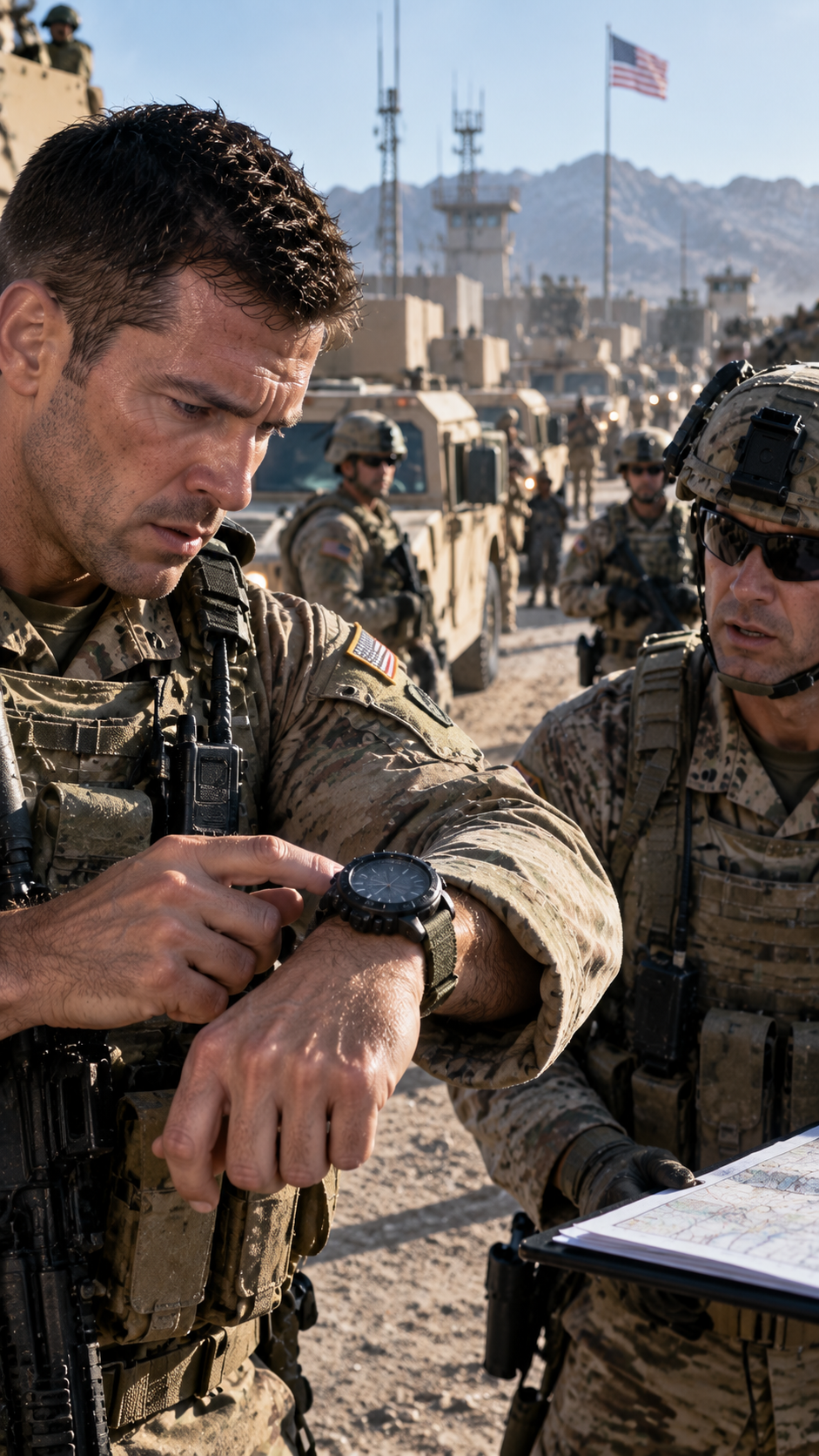
Ryan raised his wrist.
“A broken watch.”
The commander laughed.
Then realized Ryan wasn’t joking.
Later, back at base, technicians confirmed what had happened.
The storm had interrupted the synchronization signal.
Some devices automatically corrected.
Others retained their previous time.
One system performed an additional adjustment after reconnecting.
Individually, every display appeared normal.
That was what made the problem dangerous.
Nothing looked broken.
Except Ryan’s watch.
It had simply stopped.
And because it stopped, Ryan remembered exactly when the disruption occurred.
The next morning, Harris found Ryan sitting outside the operations building.
He nodded toward the old watch.
“You replacing that thing?”
Ryan smiled.
“Probably should.”
Harris sat beside him.
“For what it’s worth, that broken watch did more yesterday than some working equipment.”
Ryan laughed.
“It didn’t save anything, sir.”
“It made you ask a question.”
Ryan looked at the scratched glass.
“That was enough.”
The incident changed procedures within the unit.
Before future coordinated movements, teams didn’t simply ask:
“What time do you have?”
They verified that everyone was using the same reference.
Ryan’s old watch eventually stopped working completely.
He never repaired it.
Instead, he kept it in his locker.
The hands remained frozen at 05:58.
Years later, after becoming a platoon sergeant, Ryan showed it to young soldiers during training.
One recruit asked:
“Why keep a watch that doesn’t work?”
Ryan placed it on the table.
“Because once, this watch was the only thing telling us something was wrong.”
The recruit looked confused.
Ryan continued:
“Never assume two people understand the same plan just because they’re both following instructions.”
He tapped the watch.
“Verify.”
Years passed.
Ryan forgot many ordinary days from his military career.
But he never forgot those seventeen minutes.
Two units.
Two clocks.
Both believing they were right.
And one old watch that stopped at exactly the right moment.
Because sometimes the smallest warning isn’t the problem.
Sometimes it’s the only thing that tells you a much bigger problem has already begun.