
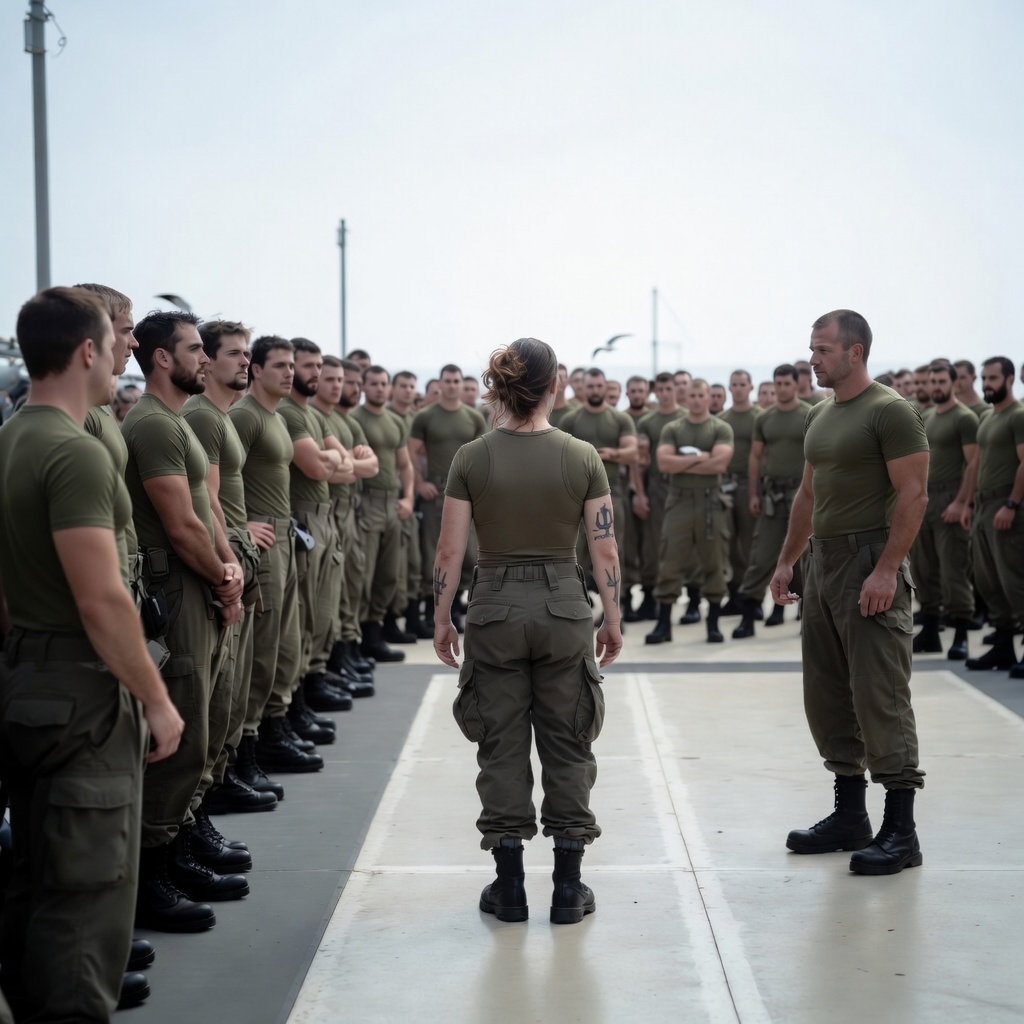
“PLEASE FORGIVE US MA’AM..” They Knocked Her Down Twice, Then She Snapped Both Their Arms Before 300 Navy SEALs
Part 1
The first thing I noticed was the smell.
Not fear. Not sweat, though there was plenty of that hanging over the training mats like a hot, sour blanket. It was salt. Pacific salt, sharp and clean, blowing in from beyond the low buildings at Coronado and mixing with the rubbery stink of sun-baked canvas.
Three hundred Navy SEALs stood in a loose horseshoe around me, all shoulders and tattoos and sun-browned faces. Some had their arms folded. Some leaned against equipment racks. A few chewed gum like they were waiting for a bad stand-up comic to get booed offstage.
I stood in the center of the mat in plain gray fatigues with no patch, no rank, no unit insignia. My hair was twisted into a knot tight enough to pull at my scalp. My boots were clean because I had cleaned them myself that morning in a hotel bathroom sink with a travel brush and a hand towel.
That detail seemed funny to me, standing there in front of men who had kicked doors off hinges in places most Americans couldn’t find on a map.
A gull cried overhead.
Then Petty Officer Rourke laughed.
“Look, ma’am,” he said, rolling his shoulders like he was loosening up for a prizefight, “with all due respect, this is the Teams. We don’t need yoga lessons from a JAG Corps secretary.”
The men laughed with him.
It came in one low wave, not cruel enough to be shocking, but casual enough to tell me everything I needed to know. They weren’t laughing because Rourke was funny. They were laughing because he had said what most of them were already thinking.
I kept my eyes on him.
He was a big man. Six-three, maybe six-four. Two hundred thirty pounds, give or take, with a jaw like it had been cut from ship steel. A faded trident tattoo sat on his forearm, flexing when he curled his fingers into his palms.
He expected anger.
Most men like him did.
They pushed until a woman snapped, then called the snap proof she didn’t belong there.
I gave him nothing.
Master Chief Elias Vance stood near the edge of the formation, tablet tucked under one arm. He had said almost nothing since introducing me, and I respected him for it. His face had the worn, wind-carved look of a man who had spent more nights awake than asleep. He was watching my feet, not my face.
That told me he knew more than the others.
Rourke took another step forward.
“Seriously,” he said, lifting his hands toward the crowd as if inviting them into the joke. “Who even are you? They told us we were getting a subject matter expert on close quarters. We get you. No rank. No unit. No patch. You a contractor? CrossFit coach from La Jolla?”
A few men laughed again, but quieter this time.
Maybe they noticed I still hadn’t blinked.
“My name is Cole,” I said. “Instructor Cole.”
My voice sounded exactly the way I wanted it to sound. Flat. Clear. Boring.
Rourke smiled wider.
“Instructor of what? Paperwork? Hurt feelings? Because out here, ma’am, we do things a little different.”
I looked past him for half a second.
Behind his right shoulder stood another man, Petty Officer Gage. He had a thick neck, a shaved head, and hands that looked like they could crush a coffee mug without effort. He wasn’t smiling as much as Rourke, but his eyes were worse. Rourke wanted an audience. Gage wanted permission.
That was information.
Every room has a temperature. Every crowd has a pulse. This one had shifted from amusement to appetite.
I had felt that change before.
In a tiled hallway outside a prison interrogation room in Iraq.
In a warehouse in Virginia with black plastic over the windows.
In a hospital basement where a man with a broken nose whispered, “She doesn’t look like the one they sent last time.”
People often said what they believed before they realized they had confessed.
Rourke bounced lightly on the balls of his feet.
“You want to teach us?” he said. “Show us you belong on this mat.”
The gull cried again.
Somewhere behind me, a metal chain clinked against a flagpole.
Master Chief Vance did not interrupt. He did not rescue me. Good. Rescue would have ruined the lesson before it began.
I nodded once.
Rourke’s smile twitched. He had wanted resistance, protest, a little speech about respect and professionalism. My acceptance bothered him more than anger would have.
I walked toward the center of the mat.
The canvas was warm under my boots. Scuffed. Pale from sun and use. There were old sweat stains around the edges and a darker patch near the middle where men had been thrown down thousands of times by men just like them.
I stopped with my feet shoulder-width apart.
Rourke circled me.
The men watched.
I let my hands hang loose.
“Light spar,” Rourke said. “Don’t want anyone filing complaints.”
That got a few more laughs.
He lowered his level.
Too early.
His left foot turned in.
Too much weight on the lead leg.
His right hand floated half an inch away from his ribs.
A habit, not a mistake. Habits are doors. You just have to wait until the owner opens them.
He lunged.
For one clean second, all I saw was his shoulder driving toward my hip and the pale scar above his eyebrow catching the sun.
I could have stopped him.
Instead, I let him hit me.
His body slammed into mine, and the crowd roared as my feet left the ground.
The sky flashed white.
The mat rushed up.
I hit hard enough to make the canvas clap beneath my back.
The sound pleased them.
But as I rolled with the impact, palms angled, chin tucked, breath narrow in my ribs, I saw Master Chief Vance’s face.
He wasn’t pleased.
He was worried.
Not for me.
For them.
I came back to my feet before the cheering finished, brushed dust from my sleeve, and looked at Rourke again.
His grin had changed. It had grown brighter, yes, but also less certain around the edges.
He had knocked me down.
So why did it feel, even to him, like I had just taken his measurements?
Part 2
“It’s just physics, ma’am,” Rourke said. “Mass times velocity.”
He said it loud enough for the men in the back to hear, and they rewarded him with another round of laughter. But the laughter had gaps in it now. Uneven spaces. Small hesitations where curiosity slipped in.
I rolled my right shoulder once.
It wasn’t for pain. It was to check the joint, feel the warmth in the capsule, make sure the landing had gone exactly where I wanted. My body answered in the language bodies use when you’ve spent enough years listening. Fine. Ready. No damage.
Rourke didn’t know that, of course.
He saw a woman he had just thrown.
He saw proof.
Men like him loved proof when it flattered them.
I kept my breathing slow.
Four counts in.
Two held.
Four counts out.
The ocean wind moved across the mat and lifted a few loose strands of hair near my cheek. I could smell sunscreen now, tobacco gum, hot rubber, and the faint metallic tang from the pull-up bars baking behind the crowd.
Rourke came in again.
This time he didn’t shoot low right away. He threw a jab that wasn’t really meant to land, then a heavy right cross that was. I let the jab pass close enough to feel air move along my cheekbone. I turned my wrist and touched his right forearm with two fingers, shifting the cross just wide.
Not blocking.
Never blocking.
Blocking is an argument with force. I preferred misdirection.
His second punch came faster. He had good hands for a big man. Better than I expected. His hips knew how to turn. His shoulders stayed loose. Someone had trained him well, and combat had done the rest.
Still, he wanted too badly to teach me a lesson.
Want creates noise.
I gave ground, half a step, then another. His feet followed mine. He thought he was pressuring me. He didn’t see that I was walking him toward the darker patch in the canvas, where the surface dragged a fraction more underfoot.
His left boot caught.
Only a little.
Enough.
His balance rose.
His chin followed.
I saw the opening, then let it pass.
Not yet.
The first mistake in any demonstration is showing the ending before the audience understands the question.
Rourke feinted high and dropped low.
Better timing this round. He caught my ankle with one hand, drove through my knee line, and swept the leg before I could fully rotate away. Or before I allowed myself to.
The second fall was flatter.
Less dramatic.
More convincing.
My back struck the mat, and the breath left me in a short controlled burst. I heard one man mutter, “Damn,” almost admiringly. Rourke stood above me, chest rising, sweat shining at his temples.
There it was.
The moment he wanted.
Me down. Him standing. Three hundred witnesses.
“Had enough?” he asked.
I stayed where I was for one extra breath.
The sun sat behind his head, bright enough to turn him into a black-edged shape. Beyond him, Gage shifted his weight from heel to toe. He wanted in. I could feel it before he said anything.
Rourke’s shadow crossed my face.
I closed my eyes.
The crowd thought I was embarrassed.
Maybe hurt.
Maybe finished.
That was useful.
Behind my eyelids, I replayed him.
First entry: left shoulder low, right hip delayed, grip heavy after contact.
Second entry: overcommitment after success, breath held during drive, left elbow wide after level change.
Temperament: public dominance, easily reinforced by crowd response, escalates when calm is not reciprocated.
Gage: lateral aggression, protective loyalty, less verbal, likely to grab rather than strike if given permission.
The mat smelled stronger from down there. Old sweat. Dust. A faint chemical cleaner that had never quite defeated either.
“Ma’am?” Rourke said, dragging the word out.
That was when Gage chuckled.
“Let me finish this,” he said.
There are moments when a room stops being a room and becomes a scale.
One side holds rules. Procedure. Professional restraint.
The other side holds what people reveal when they think the rules no longer protect someone.
Gage stepped onto the mat.
The men didn’t laugh this time.
A few shifted. One looked toward Master Chief Vance. Another lowered his eyes.
But no one spoke.
That silence mattered more than the mockery.
I opened my eyes.
The sky was still too bright.
I sat up slowly, then stood.
My ribs expanded once. My fingers opened and closed once. I let my face change, not into anger, but into decision.
Rourke noticed.
His smile faded.
Master Chief Vance took half a step forward.
I saw his hand lift slightly.
Then he saw my left foot turn.
He stopped.
That was the moment I knew he truly understood.
Rourke and Gage moved without needing to talk. They had trained together, maybe fought together. Rourke angled in from my front. Gage drifted to my right, wide enough to split my attention.
A pincer.
Simple. Effective. Arrogant.
Rourke threw first.
Wide right hook. Not a training punch. Not light. A hard, ugly shot dressed up as a lesson.
Gage lunged half a beat behind it, both hands reaching for my upper body.
Everything narrowed.
No crowd.
No wind.
No gulls.
Just joints, angles, breath, timing.
I stepped forward.
Not back.
Into the punch.
Inside the arc.
My left hand found Rourke’s elbow from underneath, as gently as if I were catching a falling cup.
My right palm settled on the back of his shoulder.
His eyes widened.
He understood too late that his arm no longer belonged to him.
And as I shifted my weight through my hips, I heard the first wet pop roll across the mat like a secret everyone wished they hadn’t learned.
Part 3
Rourke didn’t scream at first.
That surprised some of the men. I saw it in their faces later, the way they talked about that tiny silence before the pain reached him. But I understood it. The body has a delay when certainty breaks. It spends half a second trying to deny the impossible.
His elbow had bent the wrong way.
Not far enough to destroy his career. Far enough to end the lesson he thought he was giving.
His breath came out as a strangled sound, and his knees softened.
But my movement hadn’t finished.
That was the part no one expected.
A fight is not a series of separate pictures. It is one sentence written in pressure.
Rourke’s collapsing weight became my frame. My shoulder turned. My foot cut across the mat. Gage, still moving into the space where he thought I would be, found only air and the side of Rourke’s body.
He tried to correct.
Too late.
His forward hand reached across my line. His right knee locked for a fraction of a second. His hips were behind his chest.
A big man, falling into his own momentum.
I hooked behind his knee with my foot, caught his wrist, and turned my torso the opposite way.
His shoulder gave with a sharper sound.
A crack this time.
The kind of sound that makes even hard men look down at the ground.
Gage hit the mat beside Rourke, his face suddenly pale under the tan. Rourke curled around his damaged arm, mouth open, eyes glassy with shock. Gage tried to rise and immediately stopped, his good hand hovering near his shoulder like he was afraid touching it would make it real.
The entire training ground went silent.
I had heard silence like that before.
After a door charge fails.
After a radio call comes back with the wrong voice.
After a person realizes the thing they underestimated has teeth.
I stood between the two men and let my hands fall loose at my sides.
My breathing was still even.
Not because I was superhuman. Because I had done only what was necessary. No more. No wasted motion. Violence is exhausting when ego drags it around by the collar.
Somewhere near the back of the formation, a man whispered, “Jesus.”
No one answered him.
Master Chief Vance stepped onto the mat.
His boots made a heavy sound on the canvas, slow and deliberate. He did not look at Rourke. He did not look at Gage. His eyes stayed on mine as he walked toward me.
For a moment, I thought about the first time I had met him.
A windowless room.
A folder without a label.
Vance sitting across from me with both hands around a paper cup of coffee, studying me the way men study maps before entering bad country.
“I don’t need someone impressive,” he had said then. “I have impressive men. I need someone who can keep them alive when impressive gets them killed.”
That was six weeks ago.
Now his men lay at my feet, and his jaw tightened as if the lesson had cost him more than he intended.
He stopped in front of me and gave a small nod.
There was apology in it.
There was also recognition.
Then he turned to the formation.
“Corpsman,” he said.
The word cracked through the air.
Two medics moved fast, one kneeling beside Rourke, the other beside Gage. The crowd parted without being told. Nobody joked. Nobody muttered. Nobody looked comfortable in his own skin.
Vance raised the tablet he had carried all morning.
“You men wanted to know who this is,” he said.
His voice was quiet, which made it worse. Men like Vance didn’t need volume. Authority sat on him like weather.
“You thought you were watching a sparring match go wrong. You weren’t. You were watching the first lesson.”
I didn’t move.
Rourke groaned while the corpsman immobilized his arm. Gage whispered something through clenched teeth that sounded like a prayer or a curse.
Vance tapped the tablet.
“Name: Anna Cole.”
A few eyes flicked toward me.
“Rank: redacted.”
The air changed.
I felt it. Everyone did.
“Unit: redacted.”
There it was again. The silence deepened, but this silence was different from the first. Less stunned. More alert.
Redacted was a word with weight in that world. It meant doors they had never walked through. It meant files they could not open. It meant the joke had been made in the dark, and now someone had turned on the lights.
“Instructor Cole,” Vance continued, “is the lead curriculum designer for the Asymmetric Threat Response Program. She is a senior consultant for close-quarters defense across joint special mission units. The system she came here to teach you was built from more than a decade of battlefield data, after-action reports, and encounters where the weapon failed, jammed, disappeared, or became irrelevant because the enemy was already inside arm’s reach.”
He looked across the formation, face by face.
“The techniques she just used on two men who outweighed her by roughly two hundred pounds combined—she didn’t learn them from a manual.”
He paused.
“She wrote the manual.”
I watched the information move through them.
It didn’t move like admiration. Not yet.
It moved like nausea.
Men replaying their own laughter. Their own silence. Their own willingness to let two of their brothers turn a professional demonstration into a public humiliation because the person on the mat did not look the way they thought danger should look.
Vance lowered the tablet.
“I invited her here personally,” he said. “I asked her to come because the battlefield is changing, and some of you are still trying to solve tomorrow’s problem with yesterday’s ego.”
No one breathed loudly.
“You judged her by size. By gender. By the absence of a trident. By the lack of noise. You looked at one of the most competent professionals I have ever known and decided she was decoration.”
His voice hardened.
“Assumptions are cancer. Assumptions get you killed. Worse, they get the man beside you killed.”
Rourke looked away from the corpsman and closed his eyes.
For half a second, I almost felt sorry for him.
Almost.
Then I remembered his hook.
Not the words. Words were easy. Words were cheap.
The hook had told the truth.
Vance turned back toward me. He straightened, heels together, shoulders square.
Then Master Chief Elias Vance saluted me in front of three hundred Navy SEALs.
The sound of his hand cutting the air seemed louder than the breaking joints had been.
“Instructor Cole,” he said, “on behalf of my command, I apologize for the unprofessional and disgraceful conduct of my men. You have the floor.”
One man at the front snapped to attention.
Then another.
Then another.
The sound spread through the formation like a hard rain of boots and shame.
Three hundred men stood rigid before me.
I returned Vance’s salute.
When I lowered my hand, every eye was on me.
Only minutes earlier, they had wanted me gone.
Now they were waiting for me to speak.
And the strangest part was, what I had to say next was not what any of them expected.
Part 4
“The first lesson is complete,” I said.
My voice sounded small against the ocean wind, but no one missed a word.
“The second lesson begins now.”
A few men blinked.
I saw confusion first. Then embarrassment. Then something more useful than either.
Attention.
That was all I had ever needed from them.
I pointed to the mat.
“We will start with center of gravity and base.”
Nobody moved.
For one absurd second, it looked like three hundred of the hardest men alive had forgotten how training worked.
“Pair off,” Vance growled.
They moved then.
Fast.
Boots scuffed. Men cleared space. Rourke and Gage were carried toward the infirmary, and no one looked directly at them for long. Their absence left a strange hole on the mat, like a missing tooth you couldn’t stop touching with your tongue.
I spent the next hour teaching them how to stand.
That irritated some of them at first. I could see it in their shoulders. These were men who had jumped from aircraft into black water, cleared compounds under fire, and dragged wounded teammates through alleys filled with smoke. Being told to adjust their feet by two inches felt insulting.
Good.
Insult is often the doorway to learning, if pride doesn’t lock it shut.
“Your body is honest,” I told them. “Your ego lies.”
A young SEAL near the front swallowed hard when I said that. He had laughed loudly earlier. I remembered his face because he had a thin white scar running from his ear toward his jaw, and when he laughed, the scar didn’t move with the rest of him.
I used him first.
“What’s your name?”
“Petty Officer Miller, ma’am.”
He said ma’am like it hurt.
“Step forward.”
He did.
He was broad, strong, early twenties, with the restless energy of someone who still believed exhaustion was proof of character.
“Push me,” I said.
He hesitated.
Vance’s expression became granite.
Miller pushed.
Not hard at first.
I didn’t move.
“Actually push me.”
His jaw set. He drove both palms into my shoulders.
I let his force enter my frame and travel down through my hips into the mat. His face tightened. My boots stayed where they were.
Then I shifted my left heel half an inch.
He pushed again.
This time I stepped back easily.
Miller stared.
“That,” I said, “is base.”
I moved around him, adjusted his stance with the side of my boot, and pressed two fingers into the hollow below his collarbone.
He toppled backward onto the mat.
Not hard. Enough to turn his ears red.
A few men made small sounds before remembering laughter was no longer safe.
I offered Miller a hand.
He took it.
His palm was callused, damp, warmer than mine.
“Again,” I said.
He got up faster this time.
By midday, the mood had changed.
Not softened. Never that. These men did not soften easily. But the hostility had thinned into concentration. They watched my hands. My feet. The angle of my hips. They asked questions with the same intensity they had used earlier to judge me.
I preferred questions.
Questions meant they had found the edge of what they knew.
The sun climbed until the mat seemed to breathe heat through my boots. Sweat ran down backs and darkened shirts. Somewhere behind the training shed, someone started a diesel engine. The low rumble sat under my voice as I walked them through entry angles and recovery paths.
I did not mention Rourke.
I did not mention Gage.
I didn’t have to.
Their lesson was lying in the infirmary with ice packs and slings.
But as the men worked, I felt a second current under the first.
Not all resistance had left.
It rarely did.
Some men were ashamed. Some were impressed. Some were simply practical enough to learn from anyone who could make them better.
But a few watched me with something darker.
Not contempt.
Suspicion.
Near the back of the formation stood Lieutenant Commander Hayes, the only officer who had not laughed earlier. He hadn’t defended me either. He had watched the whole thing with a face smooth as polished bone.
Whenever I turned, his eyes slipped away from mine.
The third time it happened, I noticed the small black phone in his hand.
Military training areas had strict rules about personal devices.
Especially that morning.
Especially with me there.
When our eyes finally met, he put the phone into his pocket and gave me a polite nod.
It should have meant nothing.
Instead, the back of my neck went cold.
Because only four people on that base knew exactly why I had really been sent to Coronado.
And Lieutenant Commander Hayes was not one of them.
Part 5
By lunch, the story had already started changing.
I heard pieces of it in the mess hall before I even picked up a tray.
“She didn’t even move.”
“No, she moved. That was the thing. Like smoke.”
“Rourke’s elbow went backward, man. Backward.”
“Gage looked like he got hit by a truck.”
I stood near the coffee station, holding a paper cup that smelled faintly of bleach and burnt grounds, and listened without turning around.
Stories are living things. Feed one shock and silence, and it grows legs before sundown.
The mess hall was loud when I entered. Metal trays. Forks. Chairs scraping concrete. Men speaking in the shorthand of people who spend too much time together under pressure.
Then the sound lowered.
Not stopped.
Lowered.
A narrow path opened between tables.
No one saluted. I wasn’t there in that capacity. But men nodded. Some stood halfway, unsure what respect looked like when it had arrived late and wearing gray fatigues.
I nodded back when appropriate and kept walking.
Respect made me more uncomfortable than ridicule.
Ridicule had edges I could measure.
Respect had expectations.
I took a seat alone near a window facing the training yard. The ocean was a blue strip beyond the buildings. Sunlight flashed off windshields in the parking lot. My sandwich tasted like cold turkey and refrigerator plastic.
Vance sat across from me without asking.
He placed his tray down carefully. Eggs, rice, black coffee. No dessert.
“You held back,” he said.
“I always hold back.”
“Not always.”
I looked at him.
His eyes didn’t move.
There it was, the small door between what the base knew and what Vance knew. He had read the classified summary. Not the whole file. Nobody got the whole file anymore. But enough.
A woman at a table behind us dropped a fork. It hit the floor with a bright, ringing clatter.
Vance lowered his voice.
“Rourke and Gage will heal.”
“Yes.”
“They’ll be angry for a while.”
“They should be embarrassed first. Anger later, if they can afford it.”
One corner of Vance’s mouth moved, not quite a smile.
“You saw Hayes.”
It wasn’t a question.
I took a sip of coffee. It was terrible. Military coffee often tastes like punishment brewed from old rope, but this cup had ambitions beyond that.
“He had a phone.”
“I saw.”
“In a restricted area.”
“I saw that too.”
I set the cup down.
“Then why is he still walking around?”
Vance looked out the window, not at me.
“Because if I grab him now, I catch a man with a phone. If I wait, maybe I catch who he’s talking to.”
The room seemed to tilt slightly around that sentence.
So Vance suspected him too.
That was new.
I tore the crust from my sandwich and lined the pieces on the edge of my plate. An old habit. My sister used to tease me for it when we were kids, back before my family learned that silence could be sharper than knives.
“Tell me what you know,” I said.
Vance’s jaw flexed.
“Two months ago, a training contractor at Little Creek received a package with no return address. Inside was a flash drive.”
I watched his hands.
Still.
Good liars overperform stillness. Vance didn’t. His stillness had weight.
“What was on it?”
“Three clips. All from closed sessions. All showing portions of your system.”
My fingers stopped moving.
Outside, a truck beeped as it backed toward the supply bay.
“How much?”
“Enough to worry people.”
“People are always worried.”
“Enough to bring you here under a cover assignment.”
There it was.
Not just training.
Audit.
Trap.
I had been sent to teach the Cole system, yes. But also to find out if someone inside Naval Special Warfare was leaking restricted close-quarters doctrine before it reached units overseas.
The first leak had been sloppy.
The second had been cleaner.
The third had included a camera angle only possible from inside a secure training environment.
I looked toward the far corner of the mess hall.
Hayes stood near the exit, talking to a senior chief. His posture was relaxed. His smile arrived half a second before it should have.
Performers always bothered me.
“Why wasn’t I told Hayes was a suspect?” I asked.
“Because he wasn’t.”
“Until?”
“Until he asked three questions about you yesterday that he should not have known to ask.”
The air behind my ribs tightened.
“What questions?”
Vance looked back at me.
“He asked whether your left knee still limited lateral rotation.”
My knee had been injured in Moldova seven years earlier.
The report had never included my name.
“He asked whether you preferred live resistance before demonstration.”
Only three instructors knew that.
“And?”
Vance leaned closer.
“He asked if the rumors about Black Lantern were true.”
I kept my face empty.
But my stomach turned cold.
Black Lantern was not a rumor.
It was a graveyard with paperwork.
And if Hayes knew that name, then the leak at Coronado was not about training doctrine anymore.
It was about me.
Part 6
That afternoon, I taught wrist control while watching every reflection I could find.
Windows. Sunglasses. The polished side of a water cooler. A truck mirror parked near the edge of the lot. Anything that might show me who was watching when they thought I wasn’t looking.
Paranoia is just pattern recognition with a bad reputation.
The men paired off in rows, practicing slow entries from grabs and shirt pulls. Their bodies moved awkwardly at first. Too much strength. Too much certainty. They wanted to muscle through angles that only opened when you stopped insisting.
“Less,” I said again and again.
That became the word of the day.
Less force.
Less reach.
Less pride.
Less noise.
Miller improved fastest. That didn’t surprise me. Embarrassment can become fuel if you don’t pour self-pity on it.
“You’re anticipating,” I told him when he tried to counter before his partner fully committed.
He frowned. “Isn’t that good?”
“Anticipation is guessing in a nice uniform.”
His partner grinned.
Miller didn’t.
Good. He was listening.
“Feel the pressure first,” I said. “Then answer.”
A breeze moved through the training area, carrying the smell of kelp and diesel. The sun had shifted west, turning everything flatter and harsher. Men’s shadows stretched across the mat like dark bars.
Hayes appeared near the equipment shed at 1430.
He wore sunglasses now.
No phone visible.
He spoke briefly to Vance, then stood alone with his arms folded. Watching.
I adjusted a SEAL’s grip and let my eyes pass over Hayes as if he meant nothing.
He meant something.
I just didn’t know what yet.
At 1500, I asked for volunteers to demonstrate blind-side recovery.
Nobody laughed this time.
Six hands went up.
That was progress.
I picked a senior operator named Knox because he hadn’t tried to impress me all day. He was compact, quiet, with old scar tissue along his knuckles and the wary patience of someone who had survived enough to distrust easy answers.
“Attack from my right,” I told him. “Slow first.”
He did.
Clean entry. Good base. No wasted motion.
I redirected, stepped behind his center line, and placed him on the mat without impact.
He got up nodding.
“Again?” he asked.
“Faster.”
He came faster.
I felt his weight commit, turned under his arm, and stopped with his wrist pinned lightly against his own shoulder. I didn’t finish the lock.
No need.
Knox froze.
A murmur moved through the group.
“That’s the difference,” I said. “The goal is not to win the exchange. The goal is to control the next decision.”
Knox looked at me over his trapped arm.
“That sounds like intelligence work.”
“It sounds like staying alive.”
From the edge of my vision, Hayes moved.
Just a step.
Then he stopped.
That answer had bothered him.
Interesting.
We ended at 1700. Men stayed after, practicing in small clusters. No one wanted to be the first to leave. That was another thing about elite groups. Once respect appeared, so did competition. If one man learned, every man wanted to learn faster.
I gathered my notes from a folding table.
There were only three pages. Most of the real curriculum was in my head and in files stored where curious men could not reach them. Still, one page had been moved.
Not stolen.
Moved.
Half an inch to the left.
I knew because I lined the top sheet with the table’s scratch marks every time I set it down.
I kept my expression neutral and lifted the pages.
Under them sat a small white card.
No logo.
No handwriting.
Just a number printed in black.
Room 214.
My hotel room.
For one second, the sounds around me went watery and far away.
Men laughing softly now, not cruelly.
Tape peeling from a wrist.
Someone coughing.
The wind pushing grit along the pavement.
I placed the card inside my notebook.
Vance approached from behind.
“Problem?”
I didn’t turn.
“Maybe.”
His voice lowered. “Talk to me.”
“Not here.”
I could feel Hayes looking at us.
I closed the notebook and slid it under my arm.
“Same schedule tomorrow?” I asked loudly.
Vance caught on without missing a beat.
“0700. Don’t be late.”
A few men smiled at that. The kind of smile soldiers give when tension has somewhere safer to go.
I walked off the training ground alone.
That was intentional.
If someone wanted me unsettled, I wanted them confident.
The parking lot shimmered with heat. My rental car was exactly where I had left it. Silver sedan. Government-clean. Boring enough to disappear.
Before opening the door, I checked the handle, the seam under the frame, the rear tire wells.
Nothing.
Inside, the car smelled like vinyl, dust, and the peppermint gum I had left in the cup holder.
I drove three blocks before I saw the black SUV behind me.
Not too close.
Not too careful.
A mediocre tail, which meant either Hayes was worse than I thought, or someone wanted me to notice.
At the next red light, my phone buzzed once.
Unknown number.
The message contained only five words.
You should have stayed buried.
Part 7
I did not go back to the hotel first.
That is how people get killed in bad fiction and worse operations.
Instead, I drove past it.
The black SUV followed.
At the corner of Orange Avenue, I turned right without signaling. The SUV made the turn two cars later. I took a slow loop past a bakery, a surf shop, a line of tourists in flip-flops waiting outside a taco place. Coronado looked innocent in late afternoon light, all white stucco and palm shadows, the kind of place where danger had to wear sunglasses to avoid seeming rude.
I parked near a grocery store and went inside.
The automatic doors breathed cold air over my face. The smell changed from salt and asphalt to citrus cleaner, cut flowers, and roasted chicken under heat lamps. I picked up a basket and walked like a woman deciding between dinner options.
A man followed me in after twenty seconds.
Not Hayes.
Younger. Civilian clothes. Navy haircut he hadn’t bothered to disguise. Gray T-shirt, cargo shorts, running shoes too new for comfort. He pretended to inspect avocados with the seriousness of a surgeon.
I went to aisle seven.
Cereal.
Children on boxes grinned under fluorescent lights.
My phone buzzed again.
Same unknown number.
Second chances make people sentimental.
I stared at the message long enough to feel anger rise, then pressed it flat.
Anger narrows vision.
I needed width.
At the end of the aisle, the man in the gray shirt appeared. He picked up a box of cornflakes and read the nutrition label upside down.
Amateur.
Or pretending to be one.
I turned into the next aisle and stopped beside shelves of canned soup. The metal cans reflected tiny bent versions of everything behind me. Gray shirt paused at the corner.
I waited until a woman pushing a cart passed between us.
Then I moved.
Not fast enough to startle the woman.
Fast enough that gray shirt lost me for half a second.
I slipped through the swinging door marked Employees Only and entered a back hallway lined with boxes and mop buckets. The air smelled of cardboard, bleach, and onions. A radio played country music somewhere near the loading dock.
Gray shirt came through the door too quickly.
I was behind it.
I caught his wrist, turned his thumb toward his shoulder, and guided him face-first into a stack of paper towels. He grunted. I pressed his arm just far enough to explain the future.
“Name,” I said.
“Ma’am, wait—”
I increased the pressure.
His knees bent.
“Name.”
“Davis. Petty Officer Davis.”
“Who sent you?”
“Master Chief.”
I held him there.
That answer was either true or stupid.
Sometimes both.
“Why?”
“To keep eyes on you.”
“Without telling me?”
“He said you’d spot me anyway.”
I released him.
Davis stumbled back, rubbing his wrist and looking embarrassed enough to be believable.
I studied his face. No panic. No hostility. Just wounded pride.
“You’re bad at tailing people,” I said.
“Yes, ma’am.”
“That was not an invitation to agree.”
“No, ma’am.”
The back door opened, and a teenage stock clerk froze with a case of bottled water in his arms.
Davis and I looked at him.
He looked at Davis’s red wrist, then at me.
“Sorry,” he said, and backed out.
I sighed.
“Call Vance.”
Davis did.
Thirty seconds later, Vance’s voice came through on speaker.
“You broke him?”
“No,” I said. “But I considered it.”
Davis stared very hard at the floor.
Vance exhaled through his nose. “You got the message?”
“Yes.”
“Hotel?”
“Compromised.”
“I agree.”
“That card came from your side of the fence.”
“I know.”
There was something in his voice I didn’t like.
Not surprise.
Grief.
“What happened?” I asked.
A pause.
“Rourke is missing.”
The fluorescent lights hummed overhead.
“What do you mean missing?”
“I mean he was in the infirmary, sedated, arm immobilized, under orders not to leave. Corpsman stepped out for seven minutes. Came back, bed empty.”
My first thought was impossible.
My second thought was not if someone helped him.
“Gage?”
“Still there. Angry, drugged, and confused.”
“Hayes?”
“On base. In a meeting he requested with legal.”
Convenient.
Very convenient.
I looked at Davis.
He had gone pale.
Vance continued, “Rourke’s truck is gone. His phone is off. Security camera outside the infirmary glitched during the window.”
“That’s not a glitch.”
“No.”
The grocery store radio crackled faintly through the wall. A singer drawled about whiskey and regret.
I closed my eyes for one breath.
Rourke had been humiliated in front of his brothers. His pride was shattered. His arm was damaged. If someone had approached him in that state with the right words, he would not be hard to steer.
Especially if those words included me.
“What did the last camera catch?” I asked.
“Nothing useful.”
“Try me.”
Vance hesitated.
“Rourke walking out with a woman in medical scrubs.”
My skin went cold.
“What woman?”
“Face covered. Ball cap. Average height. Dark hair.”
The old ghosts in my head stirred.
There had been a woman at Black Lantern.
Average height.
Dark hair.
Dead, according to the report.
But the dead had a habit of texting when men got careless.
Part 8
Vance moved me to a safe house that night.
He did not call it that. Men like Vance preferred dull names for dangerous things. Temporary lodging. Alternate quarters. Controlled environment.
It was a small beige house ten minutes from base, tucked behind a row of identical small beige houses that looked designed by someone allergic to memory. The living room smelled of dust, lemon cleaner, and the stale emptiness of government property. The furniture was practical and ugly. Brown couch. Metal lamps. Kitchen table scarred by old coffee rings.
I liked it immediately.
Ugly rooms have fewer hiding places.
Davis stayed outside in a parked car, pretending not to watch the street. Vance stood in the kitchen with his phone in one hand and a cup of coffee in the other. He had made the coffee himself. It was worse than the mess hall version.
I drank it anyway.
Pain builds character. Bad coffee builds tolerance.
On the table between us lay three photographs printed from security footage.
Rourke leaving the infirmary.
Rourke beside a side exit.
Rourke getting into his truck with a woman in scrubs.
The woman’s face was mostly hidden by the brim of a cap and a surgical mask, but something about the tilt of her head made my chest tighten.
Memory is not always visual.
Sometimes it is posture.
Sometimes it is the way a person carries silence.
Vance watched me over the rim of his cup.
“You know her.”
“I might.”
“Black Lantern?”
I said nothing.
He set the cup down.
“I read what they gave me.”
“No,” I said. “You read what they survived giving you.”
The refrigerator clicked on with a low shudder.
Outside, tires hissed along the street.
Vance waited.
That was one of his strengths. He could stand inside silence without rushing to fill it. Most men couldn’t. Most men mistook silence for a challenge.
“Black Lantern was a joint program that officially never existed,” I said. “Officially, it evaluated non-ballistic neutralization methods in denied environments.”
“And unofficially?”
“Unofficially, it became a place where ambitious people tested how much morality they could remove from skill before skill stopped being useful.”
Vance’s face did not change.
But something behind his eyes did.
“There were twelve instructors,” I continued. “Four analysts. Six field evaluators. One medical lead. One program director.”
“And the woman?”
“Dr. Lena Vale. Medical lead.”
I touched the edge of one photograph.
“She studied pain compliance, stress response, joint vulnerability, adrenal delay. Brilliant. Charming. Completely convinced that ethics were a luxury invented by people who didn’t understand war.”
“She died?”
“That’s what the report says.”
“What do you say?”
I looked at the woman in the photograph.
“I say I watched a building burn in Moldova and learned not to trust fire as a witness.”
Vance leaned back against the counter.
“What happened there?”
I could have given him the clean version. The version with acronyms and dates and no smell. But he had earned more than that.
“We found out Vale was selling pieces of the program,” I said. “Not to one buyer. To several. Militias. Private contractors. Intelligence cutouts. Anyone with money and enough violence to interest her.”
Vance swore softly.
“When we moved to shut it down, someone warned her. By the time my team arrived, the facility was already in chaos. Files wiped. Staff gone. Prisoners loose.”
“Prisoners?”
I looked at him.
He understood enough not to ask again.
“The fire started in the east wing. We recovered bodies. Some were identifiable. Some weren’t. Vale was listed among the dead because her badge and dental record were found in the medical lab.”
“But you didn’t believe it.”
“I believed what I was told for three days.”
“What changed?”
I turned one photo toward him.
“This.”
The woman in scrubs wore no jewelry. No visible marks. But her left hand, caught in one blurry frame as she opened Rourke’s truck door, showed the smallest bend in the ring finger.
A healed fracture.
I had caused it in Moldova when Vale reached for a syringe tray instead of raising her hands.
Vance looked from the photo to me.
“You’re sure?”
“No.”
“Cole.”
I exhaled.
“Yes.”
The word seemed to darken the kitchen.
Vance picked up his phone.
“I’m locking down the base.”
“No.”
He stopped.
“She wants that,” I said. “Chaos. Movement. Men with weapons looking outward while she’s already inside the decision loop.”
“She kidnapped one of my men.”
“She recruited one of your men.”
His jaw tightened.
That distinction hurt him.
Good. It needed to.
“Rourke left because someone gave him a story that made his humiliation useful,” I said. “Maybe revenge. Maybe redemption. Maybe proof that I’m not what you say I am.”
Vance stared at the photographs.
“What does she want?”
I heard the text message again in my mind.
You should have stayed buried.
“Not the curriculum,” I said.
“Then what?”
I looked toward the dark window above the sink. For a moment, my reflection stared back at me, pale and tired, with eyes older than the rest of my face.
“She wants the part of Black Lantern I took when I left.”
Vance’s voice went flat.
“What part?”
Before I could answer, Davis shouted from outside.
Then came the sound of tires.
Fast.
Too fast for that quiet little street.
Headlights blasted through the kitchen window, and the front wall exploded inward.
Part 9
The safe house filled with dust and white noise.
For a second, I saw everything in pieces.
The kitchen table flipping.
Vance’s coffee cup bursting against the wall.
Glass spraying inward like bright insects.
The front of a black pickup truck resting halfway through the living room, engine screaming, radiator hissing, headlights burning through the dust.
Then sound came back.
Davis yelled outside.
Someone fired two shots.
Not at us.
Warning shots? Suppression? Panic?
I hit the floor behind the kitchen island as Vance dragged the table over with one hand and reached for his sidearm with the other. His movements were calm, which was good, because calm spreads faster than orders if people trust the source.
“Status?” he barked.
Davis answered through the broken front of the house. “Two vehicles! Three, maybe four hostiles! Rourke’s truck behind them!”
My mouth tasted like plaster.
“Rourke?” I shouted.
“Can’t confirm!”
The pickup’s driver door opened.
A man stumbled out wearing a motorcycle helmet and body armor under a loose jacket. He carried a compact weapon low against his chest. Not military issue. Commercial. Expensive.
Vance fired once.
The man dropped behind the engine block.
“Kitchen exit,” I said.
Vance nodded.
We moved low.
A round punched through a cabinet above us, showering cheap white dishes across the counter. The air smelled of cordite, coolant, dust, and the sharp chemical stink of deployed airbags.
I reached the back hallway and stopped.
Too quiet.
The front assault was loud. Loud attacks often exist to make you run into quiet ones.
I held up a fist.
Vance froze.
A shadow shifted under the back door.
I stepped left just as the door kicked inward.
The man entering expected a target at chest height. I was already below his line, catching his weapon hand and driving the muzzle into the doorframe. He pulled the trigger. The shot blew splinters into the hall.
I turned his wrist.
He dropped the gun.
Then I drove two fingers into the nerve cluster above his clavicle and took his balance with my knee behind his.
He hit the floor hard.
I did not break his arm.
I wanted him able to answer questions.
Vance stepped over him, zip-tied his wrists with the efficiency of long practice, and kicked the dropped weapon away.
“Alive?” he asked.
“For now.”
Outside, another engine revved.
Then a voice came through a speaker.
Mine.
Not my real voice.
A recording.
“Instructor Cole is compromised,” the speaker blared. “She is armed, unstable, and responsible for the assault on personnel this morning. Detain on sight.”
For half a heartbeat, even Vance looked stunned.
That half heartbeat was what the voice was designed to buy.
“Deepfake,” I said.
“Good one,” he muttered.
“Good enough.”
The speaker continued, louder now, bouncing off the houses.
“Repeat. Cole is hostile. Cole is hostile.”
Porch lights flicked on down the street.
Neighbors.
Civilians.
That changed everything.
“They’re trying to flush us toward police response,” I said. “If local units arrive hearing that—”
“They shoot the wrong person.”
“Or hesitate long enough for Vale to leave with Rourke.”
Vance’s eyes cut toward me.
“You still think she’s here?”
“No. She’s watching.”
The man on the floor groaned.
I crouched beside him and pulled off his helmet.
Civilian. Late thirties. Broken nose healed crooked. Pupils wide but focused.
“Who hired you?” I asked.
He smiled through blood on his teeth.
“Lady said you’d ask that.”
I pressed my thumb lightly beneath his ear.
His smile vanished.
“Name.”
“Vale,” he gasped. “Dr. Vale.”
My skin tightened, though I had expected it.
“Where is she?”
“She said you’d know.”
I increased pressure.
He shook under my hand.
“She said the loud men always run to the fire. The quiet ones go back to the grave.”
The words hit harder than they should have.
The grave.
Moldova.
No.
Not Moldova.
Black Lantern had a second archive. I had taken it from the burning facility and hidden it where no digital search could find it. Not in a server. Not in a bank. Not in a safe.
In the one place Vale would assume I could never bear to return.
My childhood home in Oregon.
Under the floorboards of the room where my father had told me I was no longer welcome if I chose duty over family.
I had not been back in seven years.
Vance saw my face.
“What grave?”
The speaker outside cut off abruptly.
Then Davis shouted, “They’re moving!”
Tires shrieked.
I ran to the shattered front room and saw Rourke’s truck disappearing around the corner behind the second vehicle.
In the passenger seat, lit for one brief second by a passing streetlamp, sat Rourke.
His injured arm was strapped across his chest.
His face was bruised, pale, furious.
And in his good hand, he held my old family photograph.
Part 10
We left Coronado before midnight.
Not officially.
Officially, I was secured at an undisclosed location while Naval Criminal Investigative Service coordinated with base command. Officially, Vance was overseeing containment. Officially, Petty Officer Rourke was classified as missing under suspicious circumstances.
Officially, a lot of people were lying to keep from admitting how badly the floor had opened beneath them.
Unofficially, Vance and I boarded a military transport north with two go-bags, sealed orders, and one prisoner who had decided he liked breathing more than loyalty.
His name was Mercer.
Former contractor. Former Marine. Current idiot.
He sat zip-tied two rows behind me, watched by Davis, who had insisted on coming after failing at surveillance and surviving a vehicular assault in the same day. I didn’t object. Shame had sharpened him.
The aircraft smelled of oil, nylon straps, and cold metal. Red cabin lights made everyone look bloodless.
Vance sat across from me.
“You never answered,” he said over the engine noise.
“No.”
“What did you take from Black Lantern?”
I looked down at my hands.
The knuckles were scraped from the safe house fight. A thin line of blood had dried along my thumb. Small injuries always looked more personal than large ones.
“Names,” I said.
“Of buyers?”
“Of buyers, handlers, protected assets, internal sponsors. Everyone Vale traded with. Everyone who helped her disappear.”
Vance’s eyes narrowed.
“That kind of list would burn careers.”
“It would do more than that.”
“Where is it?”
“In Oregon.”
His gaze sharpened. “With your family?”
I laughed once.
Not because it was funny.
“My family would sell the house before they protected anything of mine.”
That was more truth than I meant to give him.
Vance heard it and did not step closer. Another point in his favor.
“My father was sheriff in a small county,” I said. “Believed in order. Believed in reputation. Believed daughters should be grateful when men explained the world to them.”
The engine droned under my words.
“My mother believed whatever kept the peace at dinner.”
“And you?”
“I left.”
“That was the crime?”
“No. The crime was coming back different.”
I could still smell that kitchen if I let myself. Pine cleaner. Fried onions. Wet wool from my father’s coat drying by the stove. My younger brother Mark leaning in the doorway, smiling like my pain was weather he had predicted.
After Moldova, I had returned home for three days. Not to rest. To hide the archive. I was injured, concussed, and stupid enough to think blood meant sanctuary.
My father found the encrypted drive in my bag.
He thought it was proof I had brought danger into his house.
He was right.
He demanded I surrender it to him.
I refused.
Mark called me paranoid. My mother cried quietly into a dish towel. My father told me I had always mistaken stubbornness for strength.
Then he said something I never forgot.
“Whatever you’re running from, Anna, you probably earned it.”
I left before dawn.
Never went back.
Now Vale had Rourke and my family photograph, which meant she had found the house, entered the room, and dug under the floor.
Or wanted me to believe she had.
Vance leaned forward.
“You think your family is in danger?”
I stared at the red cabin light reflecting on the floor.
“I think Vale knows exactly which old wound to press.”
“That’s not an answer.”
“My father wouldn’t call me if a knife was already at his throat. Pride would stop him before fear did.”
Vance absorbed that.
Then he said, “We’ll check.”
I looked at him.
He didn’t say you should call.
He didn’t say maybe they’ve changed.
He didn’t say family is family.
That made it easier not to hate him.
Davis came up the aisle.
“Mercer’s ready to talk more.”
“He was ready ten minutes ago,” Vance said.
“More ready now.”
I stood and walked back.
Mercer’s face was swollen where I had introduced it to the hallway floor. He watched me approach with the cautious respect of a man who had recently discovered consequences.
“Dr. Vale said Rourke was the key,” he said.
“To what?”
“To making them doubt you.”
“Who is them?”
He swallowed.
“The SEALs. Command. Anyone watching.”
“Why Rourke?”
“Because he hated you enough to be useful, but not enough to know he was being used.”
That sounded like Vale.
“What did she promise him?”
Mercer looked at my hands, then away.
“She told him you set him up. That Vance brought you in to humiliate the Teams and sell the new program. That if he helped expose you, he’d get his honor back.”
Davis cursed under his breath.
I didn’t.
There it was again.
Pride dressed as justice.
“What’s in Oregon?” I asked.
Mercer shook his head.
“I don’t know. She just called it the witness.”
The aircraft dipped slightly.
My stomach followed.
The witness.
Not the archive.
Not the list.
The witness.
I turned back toward Vance.
He saw it immediately.
“What?”
I sat down slowly.
“The archive wasn’t the only thing I left in that house.”
Part 11
We landed in Oregon under a sky the color of old pewter.
Rain streaked the aircraft windows before the wheels touched down, thin and steady, the kind of rain that didn’t fall so much as occupy the air. By the time we reached the rental SUV, my hair had gone damp at the edges and my jacket smelled like wet pavement.
The town looked smaller than I remembered.
They always do.
Pine Ridge sat between dark hills and logging roads, a place of diners, churches, feed stores, and people who knew your business before you decided whether to tell it. The main street had changed just enough to feel insulting. A new pharmacy. A closed hardware store. The same bar with a new sign pretending it wasn’t the same bar.
I sat in the passenger seat while Vance drove.
Davis followed in a second vehicle with Mercer secured in the back and two federal agents Vance trusted enough to dislike openly.
“What witness?” Vance asked.
He had waited until we were ten minutes from town.
Kind of him.
Cruel of me to make him.
“His name is Nikolai Sokolov,” I said.
Vance glanced at me.
“Russian?”
“Moldovan-born. Former logistics broker. He moved money and people for Vale’s buyers until he realized people who move secrets often become loose ends.”
“You extracted him?”
“I hid him.”
“In your father’s house?”
“In a storm cellar under the detached garage.”
Vance stared at the road.
Rain ticked against the windshield.
“For how long?”
“Thirty-six hours.”
“That’s not what your face says.”
I watched pine trees blur past.
“He was supposed to be picked up by a federal team. The team never came. Black Lantern was collapsing. Communications were compromised. I was bleeding through a bandage and hallucinating from lack of sleep.”
“So what happened?”
“My brother found him.”
Vance said nothing.
“Mark followed me. He thought I was hiding money. Drugs. Something he could use. Instead he found Nikolai half-dead under a tarp with a hard drive taped to his ribs.”
“The archive.”
“Yes.”
“What did Mark do?”
“He called my father.”
I remembered the cellar light swinging overhead. Nikolai whispering in Russian, then English, please, please, no police. My father standing with his old service pistol pointed at the ground but ready. Mark behind him, grinning because at last I had done something he could turn into a story where he was the hero.
My father wanted to call state police.
I told him he couldn’t.
He said I didn’t give orders in his county.
Nikolai begged.
My mother cried upstairs.
By sunrise, I had moved Nikolai and the archive. By noon, the first men came looking. My father realized I had not been paranoid. He also realized he had almost handed a witness to killers.
He never apologized.
Men like my father considered shame a private illness.
“Where is Nikolai now?” Vance asked.
“I don’t know.”
“You don’t know?”
“He disappeared after federal protection took him. New name. New life. I never asked where.”
“But Vale called him the witness.”
“Yes.”
“Meaning she found him.”
“Or found enough to make me run toward him.”
We turned onto my old road.
My hands went still in my lap.
The house appeared at the end of a long gravel drive, white paint peeling near the porch, roof dark with rain. The maple tree by the mailbox had grown huge. Its lower branches sagged over the drive like tired arms.
My father’s sheriff cruiser was gone, of course. He had retired three years ago. I knew that from a newspaper clipping someone mailed me without a return address.
Probably my mother.
Probably a plea.
Probably a trap I had refused to enter.
Vance parked behind a muddy pickup.
A porch light burned despite the morning.
The front door opened before we reached it.
My mother stood there in a blue cardigan, thinner than I remembered, hair mostly gray now. Her hand flew to her mouth when she saw me.
For one moment, I was twenty-nine again, exhausted and bleeding in her kitchen, wanting my mother to choose me.
Then my father appeared behind her.
Still tall. Still broad. Older, yes, but not smaller in the way I had secretly hoped. His eyes moved from me to Vance to the road behind us.
“Anna,” he said.
Not daughter.
Not thank God.
Just Anna.
My mother whispered, “You came.”
I looked past them into the hallway.
The family photograph was missing from the wall.
The same one Rourke had held in the truck.
“Where is Mark?” I asked.
My father’s face closed.
And that was when I knew the betrayal had not stayed buried in the past.
Part 12
My father stepped onto the porch and pulled the door partly shut behind him, as if the house still belonged to a version of this family where secrets could be kept outside with muddy boots.
“Where is Mark?” I asked again.
Rain tapped the porch roof. Somewhere beyond the house, water rushed through the drainage ditch beside the road.
My mother looked at my father.
That small glance told me everything.
“He’s in trouble,” she said.
My father’s jaw tightened. “Ellen.”
“No,” she said, and her voice broke on the word. “No more.”
I had waited years to hear my mother say no to him.
The tragedy was that she had saved it for a day when it was too late to matter.
Vance stood half a step behind me, silent but present. Davis had parked lower on the drive. Mercer remained in the second vehicle with the agents. The whole scene felt too domestic for the danger inside it. Rain barrels. Porch swing. A chipped ceramic planter shaped like a duck.
My father looked at me.
“Mark called last night.”
“From where?”
“He wouldn’t say.”
“What did he want?”
My mother answered before my father could edit the truth.
“He wanted the box.”
There it was.
Not archive. Not witness. Box.
My throat tightened.
“What box?”
My father’s eyes hardened.
“Don’t do that.”
I almost smiled.
Even now.
Even standing in a house targeted by a dead woman and her hired guns, my father still mistook command for control.
“Where is it?” I asked.
“In the garage,” my mother whispered.
My father turned on her. “Ellen.”
“She needs to know.”
“She brought this here.”
The words landed exactly where he aimed them.
For years, I had imagined this conversation. In some versions, I shouted. In others, I explained every classified detail until he understood how wrong he had been.
But real pain is quieter than rehearsal.
“Yes,” I said. “I brought it here.”
My father blinked.
“And then Mark found it,” I continued. “And you almost called police because trusting me was harder than assuming I was guilty.”
His face reddened.
“You came into my house with a fugitive.”
“I came into your house with a witness men were trying to murder.”
“You didn’t tell me that.”
“You wouldn’t hear me.”
Rainwater slid from my hair down the back of my neck.
My mother covered her mouth again.
My father looked away first.
That should have felt like victory.
It didn’t.
“Mark called,” I said. “He asked for the box. What did you tell him?”
My father didn’t answer.
My stomach dropped.
“What did you tell him?”
“He said he could make this go away,” my father said.
Vance shifted behind me.
“How?”
My father looked at Vance like he resented anyone else hearing family shame.
“He said Anna stole government property. He said people were coming. He said if we gave him what she hid, they’d leave us out of it.”
I laughed once, cold and short.
“And you believed him.”
“He’s my son.”
“I was your daughter.”
The porch went silent except for rain.
My mother began to cry.
I did not look at her. If I did, some old childish part of me might reach for comfort that had never arrived on time.
Vance’s voice was low.
“Sir, where is Mark now?”
My father swallowed.
“The mill.”
My old town had three kinds of graveyards. The cemetery behind the church, the old logging roads, and the abandoned mill by the river where kids used to dare each other to drink beer and summon ghosts.
“Why there?” I asked.
My father rubbed a hand over his face.
“Because I told him I’d bring the box.”
Vance became very still.
“When?”
My father looked at his watch.
“In forty minutes.”
I turned toward the garage.
My father caught my arm.
It was instinct. Old authority. A sheriff stopping a disobedient daughter.
I looked down at his hand.
Then at him.
He released me.
Smart.
Inside the garage, dust and oil and wet wood wrapped around me like memory. The old workbench still stood against the wall. My father’s tools hung in perfect outlines. A red toolbox sat beneath the pegboard.
The floorboards near the back corner had been lifted recently.
The box was gone.
I closed my eyes.
“Dad,” I said, using the word for the first time in years.
He flinched.
“Tell me you didn’t already give it to him.”
No one answered.
I opened my eyes and turned.
My father’s face had gone gray.
And outside, from the road beyond the maple tree, came the sound of a truck horn: two short blasts, just like my brother used to do when he came home drunk after midnight.
Part 13
Mark arrived smiling.
That was what I hated most.
Not the betrayal. I had expected betrayal from him in the abstract way you expect winter to be cold. But the smile—easy, boyish, almost relieved—made something old and fragile inside me finally stop moving.
He stepped out of a dark pickup at the end of the drive, rain dotting his tan jacket. He was forty now but still carried himself like the charming teenager who could break a window, blame the neighbor’s kid, and somehow get pie afterward.
Rourke sat in the passenger seat.
His arm was strapped to his chest, his face pale and tight with painkillers or rage or both. He would not look at me at first.
Dr. Lena Vale got out from the back seat.
No mask this time.
Dark hair pinned neatly. Pale skin. Calm eyes. A face seven years older than the one I remembered from Moldova, but not softer. Never softer.
“Anna,” she called.
Her voice was warm enough to make my mother step back.
Vance raised his weapon.
Davis and the agents moved into position near the vehicles.
Vale smiled.
“Careful. Small town. Lots of windows. Lots of people who don’t know what they’re seeing.”
She was right.
Curtains had shifted in two neighboring houses.
A man across the road stood under his carport pretending to smoke.
This was not a battlefield.
That made it more dangerous.
Mark lifted one hand. In the other, he held a weatherproof metal case about the size of a lunchbox.
My box.
My father made a sound behind me. Not a word. Something smaller.
“Mark,” my mother whispered.
He looked at her and softened his smile.
“Mom, it’s okay. I’m fixing it.”
I stared at him.
“You’re selling a witness list to a dead war criminal.”
His smile twitched.
Vale laughed lightly.
“War criminal. That’s dramatic.”
“You always preferred clinical terms.”
“And you always preferred moral ones. That was your limitation.”
Rourke finally looked at me.
His eyes were bloodshot.
“You set me up,” he said.
“No.”
“Liar.”
Vale had done good work. She had taken his humiliation, wrapped it in conspiracy, and handed it back as purpose.
I knew better than to argue with a man still clutching the knife someone else had put in his hand.
“Rourke,” I said, “she doesn’t care about your honor.”
His jaw clenched.
“She told me what you are.”
“What am I?”
“A ghost with a body count.”
The words should have hurt.
They didn’t.
Maybe because they were closer to true than I liked.
Vale took a step forward.
“We can all leave with what we came for,” she said. “I get the case. You get your family breathing. The SEAL gets to learn that his commanders lied to him. Everyone survives.”
“My family?” I asked.
Mark’s expression changed.
Just slightly.
There it was.
The little boy caught stealing.
“You didn’t tell her,” I said.
Vale glanced at him with mild annoyance.
“Tell me what?”
Mark swallowed.
My father spoke from behind me, voice rough.
“Anna.”
I didn’t turn.
“Tell me what?”
Mark looked at the case in his hand.
“I called her,” he said. “Years ago.”
The rain seemed to stop making sound.
“When?”
“After you left. After the men came. I found a number in the papers you dropped.”
“I didn’t drop papers.”
His face hardened.
“Fine. In your bag.”
My mother gasped softly.
My father closed his eyes.
Mark pushed on, defensive now. “I didn’t know what it was. I just knew you had brought trouble into our house, and I thought if I told someone, they’d come get it and leave us alone.”
Vale watched me with bright interest.
I understood then.
The leak in Moldova.
The failed pickup.
The men arriving at my family home.
The reason Nikolai nearly died.
Not a mole in federal protection.
Not a compromised channel.
My brother.
Stupid, jealous, greedy Mark, looking through my bag because he thought anything I had must somehow belong to him too.
“How much?” I asked.
He blinked.
“What?”
“How much did she pay you then?”
His silence answered.
My mother sobbed.
My father said Mark’s name like a prayer that had failed.
I looked at them both.
For years, part of me had wondered whether I had been too hard. Too cold. Too unwilling to forgive people who were scared.
That part died quietly in the rain.
Vale extended her hand.
“The case, Mark.”
He hesitated.
Rourke opened his door and stepped out unsteadily, good hand near the weapon tucked at his waist.
“Don’t,” Vance warned.
Everything tightened.
I moved before Rourke drew.
Not toward him.
Toward Mark.
He flinched backward, lifting the case. I caught his wrist and folded him down against the hood of the truck with just enough pressure to make him cry out. The case fell. I kicked it back toward Davis.
Rourke drew.
Vance fired into the truck’s front tire.
The gunshot cracked through the wet morning.
Rourke froze.
“Drop it,” Vance said.
For once, Rourke listened.
Vale moved then, fast and clean, not toward the case but toward me. She had always loved misdirection too.
Her hand flashed silver.
A syringe.
Of course.
I released Mark and pivoted. The needle sliced past my sleeve. I caught her wrist, and for one moment we stood close enough that I could smell her perfume under the rain, something expensive and floral and wrong.
“You should have stayed buried,” she whispered.
I looked into her eyes.
“So should you.”
She smiled.
Then tried to break her own thumb to slip the hold.
I let her.
Pain did not surprise me.
Her freedom did.
As she twisted away, I followed the motion, stepped behind her center, and took her balance the way I had taken Rourke’s. But Vale knew the system. Not all of it, but enough to be dangerous. She dropped, rolled, and came up with a small blade from somewhere near her boot.
Davis moved in.
“Back,” I snapped.
This was not arrogance.
This was math.
Vale wanted a hostage, a distraction, a body between her and consequences.
I would not give her one.
She lunged low.
I yielded, redirected, felt the edge kiss my forearm, then trapped her elbow against my ribs. Her shoulder aligned under my hand.
I could have dislocated it.
I did not.
I rotated farther.
Her knife fell.
She hit the gravel face-first, and this time I placed my knee between her shoulder blades and pinned her wrist until Vance cuffed her.
It was over in twelve seconds.
Most endings are.
Mark lay against the truck crying about his wrist. My mother knelt in the mud beside him, reaching out, then stopping, not sure whether comfort was allowed after truth. My father stood motionless in the rain, looking smaller at last.
Rourke stared at Vale in cuffs.
His face collapsed slowly as the story she had given him fell apart.
“I didn’t know,” he said.
I looked at him.
“No,” I said. “You didn’t want to.”
That was all I gave him.
Part 14
Three days later, Rourke apologized again.
Not in front of the formation this time.
Just me, Vance, and the sound of waves beating against the rocks beyond the training center.
His arm was still immobilized. His face looked older than it had when I first met him, though only a week had passed. Shame ages people faster than pain.
“I believed her because it was easier,” he said.
“Yes.”
He looked at me as if he expected more.
Comfort, maybe.
Absolution.
I gave him neither.
“She knew exactly what to say,” he continued. “About being humiliated. About command using me. About you being dangerous.”
“You are a SEAL,” I said. “People will always know what to say. That is not the problem. The problem is whether you hand them the steering wheel.”
His eyes dropped.
“I’m sorry.”
“I accept that you are sorry.”
His head lifted slightly.
“That’s not the same thing as forgiveness.”
“No.”
The wind moved between us.
Somewhere behind him, trainees shouted cadence. The sound rose and fell like a machine made of lungs.
Rourke swallowed.
“Will you ever?”
I thought about my father on the porch. My mother crying into rain. Mark in federal custody, still insisting he had only done what anyone would do to protect himself. Vale silent in an interrogation room, smiling whenever someone said the word conscience.
I thought about all the people who believed regret was a bill they could pay late and still expect service.
“No,” I said.
Rourke flinched, but I did not soften it.
“You can become better,” I said. “You should. You owe that to yourself and every man who depends on you. But my forgiveness is not part of your recovery plan.”
For a long moment, he stared at the ocean.
Then he nodded.
Not happily.
Honestly.
That was enough.
The formal inquiry took weeks.
Vale’s arrest opened doors people had spent years bricking shut. Names surfaced. Careers ended. Quiet resignations bloomed across agencies and contractor boards like mold exposed under wallpaper. Nikolai Sokolov was found alive under another name in Montana, running a repair shop and teaching his daughter chess. He testified by secure video with shaking hands and a voice that did not break.
Mark took a deal.
My mother wrote me six letters.
I read the first line of each and put them away.
My father called once. I watched the phone ring until it stopped.
People think not forgiving is the same as staying angry.
It isn’t.
Anger keeps a chair open at your table for people who harmed you.
I had no chairs left for them.
At Coronado, the Cole system became official curriculum.
I hated the name.
The men loved it because men love naming things that scare them into respectability.
Gage recovered and returned to training first. He apologized simply, then worked harder than almost anyone. He did not ask me to make him feel clean. That made it easier to teach him.
Rourke came later.
Quieter.
Less certain.
More useful.
One morning, I watched him stop a young candidate from mocking a civilian analyst who had arrived to brief drone pattern recognition. Rourke didn’t raise his voice. He just placed a hand on the candidate’s shoulder and said, “The thing you dismiss is usually the thing that gets you killed.”
The candidate shut up.
That was change.
Not redemption.
Change.
Redemption is a word people use when they want the past to become decorative.
I preferred evidence.
Six months after the first demonstration, Vance had the torn section of training mat framed and mounted in the main hall. The canvas still held faint marks from that morning. Dust. Sweat. The darker patch where Rourke’s foot had caught. Beneath it, a brass plaque read:
Assumptions are a weapon the enemy uses against you.
No names.
I liked that.
Names make people look for heroes and villains when they should be looking for patterns.
On my last day at Coronado, the sun came up clean over the training yard. The air smelled of salt, rubber, and coffee from somewhere nearby. A new class stood in formation, younger faces, fresh arrogance, nervous energy hiding under shaved heads and straight backs.
Vance introduced me with no biography.
No redacted theatrics.
No legend.
“This is Instructor Cole,” he said. “Listen.”
That was all.
I stepped onto the mat.
The candidates watched me.
Some with curiosity.
Some with doubt.
One or two with the familiar shine of young men preparing to be unimpressed.
I almost smiled.
The work never ended.
“Pair off,” I said. “We’ll start with how to stand.”
A hand rose near the back.
A broad kid with bright eyes and more confidence than sense.
“Ma’am,” he said, “with respect, when do we get to the real fighting?”
A ripple moved through the class.
Vance looked at me.
Rourke, standing near the side with his healed arm folded across his chest, looked down at his boots.
I walked toward the young candidate until I stood close enough to see the tiny shaving cut under his chin.
“The real fighting,” I said, “starts before you know you’re in one.”
His smile faded.
Good.
I touched two fingers to his shoulder, adjusted his foot half an inch, and watched understanding begin the painful work of replacing assumption.
By noon, he had fallen eight times.
By sunset, he was asking better questions.
That night, I packed my gray fatigues into a duffel and left base without ceremony. Vance drove me to the airfield. Neither of us said much. We were both old enough to know that important things rarely improve when decorated with extra words.
At the gate, he handed me a paper cup of coffee.
I took one sip and grimaced.
“This is terrible.”
“I know,” he said.
I looked at the runway lights stretching into the dark.
For the first time in years, the past felt behind me instead of under my feet.
Not gone.
Never gone.
But placed where it belonged.
I had not forgiven my brother. I had not excused my father. I had not mistaken my mother’s late regret for protection. I had not given Rourke peace he had not earned.
I had built something better than forgiveness.
A life no longer arranged around the people who failed me.
When the transport door opened, Vance offered his hand.
I shook it.
“Where next?” he asked.
I glanced back once at the base, at the dark outline of the training hall, at the framed piece of canvas hanging inside like a quiet warning.
“Somewhere loud,” I said. “They usually need me most.”
Then I climbed the steps alone, carrying everything that mattered, leaving behind everything that didn’t.
THE END!