
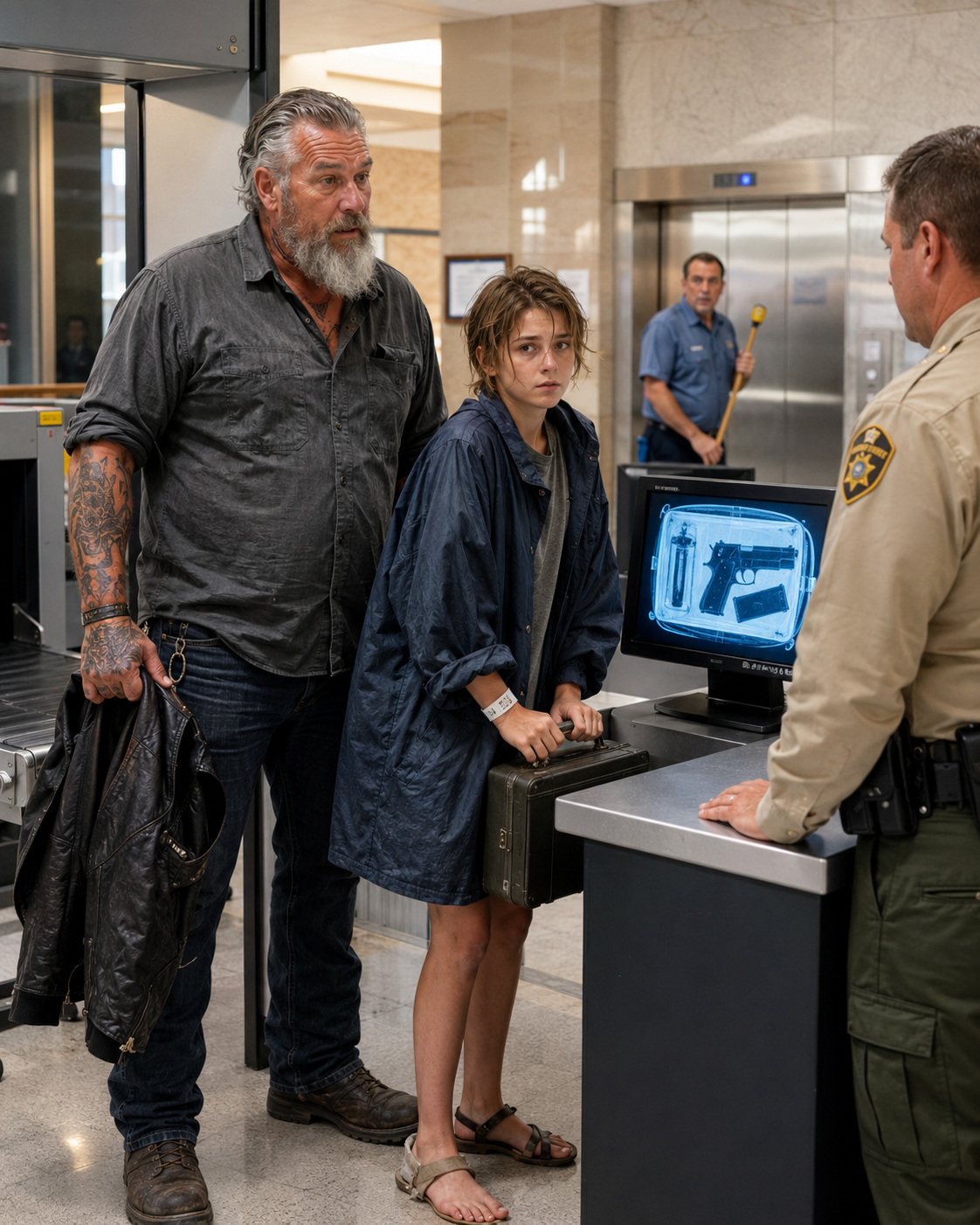
Victor Shaw stopped when the bailiff raised one hand.
He did not drop the second evidence case.
He placed it carefully on the floor, stepped away from it, and held both palms toward the ceiling.
Rowan stared at the wedding ring on his left hand.
“That’s my dad’s.”
Victor looked at her.
For the first time, his expression lost its professional blankness.
“I know.”
Harbor rose from the security bench, but the deputy moved between them.
“You planted the weapon,” Harbor said.
“Yes.”
The admission unsettled everyone more than a denial would have.
Victor nodded toward the first case, now open beneath the X-ray monitor.
“The firing pin is missing. The pills are calcium tablets. The badge is counterfeit.”
“You framed me.”
“I stopped you from entering that grand-jury room.”
Harbor’s voice remained low.
“Explain the difference.”
Victor looked toward the elevator.
“Your testimony was never scheduled to be heard.”
The courthouse clerk checked the docket again. Harbor’s name appeared beside a sealed proceeding, but there was no assigned grand jury, no prosecutor and no courtroom number.
Only an internal transfer code.
The deputy asked where the code led.
Victor pointed toward the restricted elevators.
“Basement medical holding.”
Rowan moved closer to Harbor.
The deputy noticed and loosened his posture, leaving space between her and everyone else.
Victor said Harbor’s testimony had been collected weeks earlier through interview notes, foster records and statements taken under the promise of grand-jury protection. Someone had used those documents to create a psychiatric emergency file under Harbor’s name.
If he entered the elevator with the evidence case, security would discover the weapon after the doors closed.
He would be classified as armed, unstable and threatening a child witness.
Rowan would be returned to the agency.
Harbor would disappear into county custody before any lawyer knew where he had been taken.
The deputy examined the pistol.
“Why not warn him?”
“I tried.”
Victor described three unanswered calls, a letter returned unopened and a message delivered to Harbor’s motorcycle shop by a courier who later denied receiving it.
“The agency monitors his phone,” Rowan said.
Everyone turned toward her.
She twisted the shelter wristband beneath her sleeve.
“They monitor mine too.”
Harbor looked at the plastic band.
“How do you know?”
“It gets warm before they come.”
The clerk passed a handheld scanner over it.
A small indicator blinked beneath the clasp.
The band contained a cellular locator.
The shelter had told Rowan it monitored medication times.
Rowan had never taken medication.
The deputy cut the band from her wrist and sealed it inside an evidence pouch.
Victor watched the elevator numbers above the doors.
“We need to move.”
The bailiff tightened the restraints around his wrists.
“You are not directing courthouse security.”
“Then ask why the elevator is coming down.”
The indicator changed from four to three.
No one had pressed the call button.
The deputy opened Victor’s second case.
Inside were no weapons.
There were twelve sealed identity packets, several courthouse access cards and a portable transmitter connected to a small microphone.
The top packet carried Rowan’s photograph.
The name beneath it was not Rowan.
The clerk opened the packet.
It contained six birth certificates issued across three states, each with a different surname but the same photograph. Medical histories had been transferred between identities. School records began and ended without explanation. Two files declared her missing.
One declared her dead.
Rowan looked at the pages without touching them.
“Which one is me?”
Nobody answered immediately.
Harbor removed his folded leather vest from the bench and wrapped it around her shoulders.
“You’re the kid standing here.”
She looked up at him.
“That doesn’t fix the papers.”
“No.”
He kept his hands away once the vest was settled.
“But we start with what’s still true.”
The elevator reached the second floor.
Victor raised his cuffed hands slightly.
“The ring opens the basement witness room.”
The deputy looked at it.
“Why are you wearing it?”
Victor’s eyes moved toward Rowan.
“Her father gave it to me.”
“You buried him,” Rowan said to Harbor.
Harbor’s jaw tightened.
“Twelve years ago.”
“There was no body,” Victor said.
Harbor turned toward him.
The funeral home had refused an open casket because of fire damage. Identification came from dental records, a club medallion and a wedding ring recovered near the warehouse machinery.
Victor lifted his hand.
“This is the original.”
Harbor stepped close enough for the deputy to raise an arm between them.
“Where is Thomas Vance?”
Rowan reacted to the name.
Her father’s name had been forbidden inside every placement home she remembered. Staff called it part of a false family narrative caused by early trauma.
Victor answered quietly.
“In this courthouse.”
The elevator reached the lobby.
Its doors opened.
Two county medical transport officers stood inside with an empty wheelchair, restraint straps folded neatly along its sides. A woman in a gray suit stood behind them holding a sealed order.
She introduced herself as Assistant County Attorney Miriam Cross.
“We are here for the child witness.”
The deputy stepped in front of Rowan.
“Under whose authority?”
Miriam presented the order.
It directed that Rowan be placed in emergency psychiatric observation after assaulting a courthouse employee and attempting to introduce a firearm into a protected proceeding.
The incident time was printed as 9:42 a.m.
It was only 9:31.
The deputy stared at the page.
Miriam saw the time and recovered quickly.
“A clerical error.”
“No,” Victor said. “A scheduled outcome.”
Miriam looked at him with recognition she failed to hide.
The deputy closed the elevator with the medical team still inside and ordered the courthouse locked down.
Miriam protested that Rowan was a danger to herself and others.
Rowan stood beside Harbor without speaking.
The deputy asked who had witnessed the alleged assault.
Miriam named the maintenance worker.
Victor raised his cuffed hands.
“I am the maintenance worker.”
The young clerk made a small sound that might have been a laugh if the situation had been less frightening.
That brief reversal ended the argument.
Miriam was escorted to an interview room while the courthouse administrator verified the order. The judge assigned an independent child advocate to Rowan and prohibited any agency employee from approaching her.
Victor’s restraints remained.
The planted weapon was still a crime.
He did not ask anyone to excuse it.
He asked only that the ring be taken to the basement before the agency realised its order had failed.
The deputy removed it from Victor’s finger and examined the inside. A thin metal ridge ran beneath the engraving. It matched the emergency-key slot on an access card inside the second case.
The courtroom speaker clicked again.
Thomas Vance’s voice returned.
This time it was not a recording.
“Rowan?”
She stepped toward the nearest wall speaker.
“Dad?”
A long breath came through the system.
“You’re taller.”
Rowan’s face folded, but no sound came out.
Harbor closed his eyes.
Thomas had been alive when Harbor stood beside an empty casket, when Rowan entered foster care, and during every year the club searched for a child hidden beneath changing names.
Harbor leaned toward the microphone.
“Sparrow?”
Thomas laughed once, weakly.
“You still sound angry.”
“Where are you?”
“Basement level three.”
Victor looked toward the restricted elevator.
Thomas said the agency had kept him under a psychiatric identity after the warehouse fire. He survived because he knew where the original placement ledgers were stored and how the false identities connected.
He had been moved between hospitals, county buildings and secure care facilities whenever investigators came close.
Victor found him six months earlier while transporting records for the agency.
Instead of reporting him, Victor began copying files and searching for Rowan.
The wedding ring was Thomas’s proof that Victor had permission to approach Harbor.
“Why didn’t you come yourself?” Harbor asked.
The speaker remained silent long enough for Rowan to press both hands against the wall.
Then Thomas said, “Because they built the case against you from my testimony.”
Harbor went still.
Thomas explained that medication, isolation and threats against Rowan had been used to force statements from him. He had identified Harbor’s club as violent, claimed the riders intended to abduct his daughter and signed the withdrawal of the original guardianship petition.
“I thought I was keeping her away from the agency,” he said.
“You put her inside it,” Harbor replied.
“I know.”
The words carried no defence.
Rowan looked at Victor.
“Can we get him out?”
Victor glanced toward the basement access cards.
“That was the plan.”
An alarm sounded from the clerk’s computer.
Not a fire alarm.
A transfer notification.
The screen showed Thomas Vance being moved from basement medical holding to an undisclosed state facility.
Departure had already been authorised.
The deputy pressed the elevator call button.
Nothing happened.
All three restricted elevators had been disabled remotely.
Thomas’s voice returned through the speaker, sharper now.
“Harbor, listen to me. The basement room has another exit.”
“Where?”
“Vehicle tunnel beneath the east steps.”
Security cameras switched automatically to the underground transport bay.
A white medical van waited beside an open service door.
Two attendants pushed a wheelchair toward it.
The man seated in the chair was thin, silver-haired and restrained across the chest.
Rowan touched the monitor.
“Dad.”
Thomas raised his face toward the camera.
One attendant noticed.
He reached up and covered the lens.
The screen went dark.
Then Thomas’s voice came through the wall speaker one final time.
“Don’t follow the van.”
Harbor gripped the edge of the desk.
“Why?”
Thomas’s breathing became uneven.
“Because I’m not the witness they’re moving.”
Rowan turned toward Victor.
The elevator behind them chimed.
Its doors opened onto an empty car.
On the floor lay Harbor’s original evidence case.
And inside it, where the planted gun had been, someone had placed a photograph of Rowan asleep in the back of a different white van.