
PART 3
Grizz read Sarah’s final sentence again.
The only way to defeat William is for our daughter to see her father become a different man.
For most of his life, Grizz had treated anger like evidence.
If his body reacted strongly enough, something must be wrong.
If somebody threatened his family, action had to be immediate.
If fear arrived, he turned it into motion before anyone could see it.
That night, sitting beside Ruby in a hospital room while paper stars moved across the ceiling, he did something harder.
Nothing.
He stayed seated.
Detective Foster watched him.
“So what do you want to do?”
Grizz looked at Ruby.
Then at the photograph of his supposedly dead father.
“Whatever doesn’t involve me finding him.”
Foster nodded.
“That’s a good start.”
Ruby smiled faintly.
“Mom would say that was growth.”
Grizz looked offended.
“You’re nine.”
“I can still recognize growth.”
William Mercer was found four days later.
Not by bikers.
Not by Grizz.
By investigators following vehicle-auction records, shell companies, tax filings, and an old driver’s license issued under another name.
He lived outside Fort Wayne, Indiana.
Small house.
Detached garage.
No dramatic criminal compound.
No armed guards.
No secret motorcycle club waiting behind a fence.
Just a seventy-eight-year-old man who had spent sixteen years letting his sons and everyone who loved them believe he was dead.
Detective Foster called Grizz from the hallway outside Ruby’s room.
“We found him.”
Grizz’s face changed.
“Alive?”
“Yes.”
“Did he run?”
“No.”
“What did he say?”
“He asked whether Sarah was still alive.”
Grizz looked at the floor.
Foster continued.
“He didn’t know she died.”
That mattered.
Because it meant the surveillance around Ruby had not necessarily been constant.
Someone had sent William information.
Maybe Colin.
Maybe another associate.
The network was smaller than Grizz feared.
Still dangerous enough.
Investigators executed search warrants.
William’s garage contained old motorcycle frames.
Parts.
VIN plates.
Business records.
Insurance correspondence.
And photographs.
Many photographs.
Some of Grizz.
Some of Colin.
Several of Sarah.
A few of Ruby.
The newest picture was six years old.
Taken before Sarah died.
No recent hospital surveillance.
No evidence William had followed Ruby during her illness.
Grizz listened carefully when Foster explained that.
Then asked:
“So he stopped?”
“We don’t know why.”
Later they learned.
Sarah had confronted him.
Not physically.
Not directly.
She mailed him a package.
Copies of enough evidence to show what she had.
And one note:
If you ever photograph my daughter again, everything goes to federal investigators.
William believed her.
For a while.
He disappeared deeper.
Colin did not.
Colin Mercer was arrested at an auction site in Ohio.
He tried to leave when officers approached.
That did not help him.
His phone contained messages with William.
Older than anyone expected.
One thread discussed Sarah.
She still thinks Warren can save her.
William replied:
Warren only knows one kind of saving. Let him use it.
Grizz read the message twice.
Then handed the printout back.
There it was.
The strategy Sarah had understood.
William did not need to beat Grizz.
He needed Grizz to beat someone else.
Every violent reaction damaged Grizz more effectively than any direct attack.
The alley assault.
The guilty plea.
The prison time.
The family fracture.
All of it began with one predictable response.
Grizz getting angry first.
Thinking second.
Ruby asked him later:
“Did Grandpa make you hit Uncle Colin?”
“No.”
That answer came immediately.
“He wanted me to.”
“But you still chose it.”
“Yes.”
Ruby nodded.
Then:
“So both things are true.”
Grizz looked at her.
“Who taught you that phrase?”
“Everybody keeps saying it.”
Fair.
William’s fraud operation had begun more than twenty years earlier.
Stolen motorcycles were stripped.
Reassembled.
Re-identified.
Insurance paperwork manipulated.
Businesses created and closed.
Colin eventually joined.
Then improved it.
Sarah discovered enough pieces to threaten both of them.
The garage fire was deliberate.
Investigators found an old insurance file containing photographs that contradicted the original electrical-fire conclusion.
An accelerant pattern had been documented, then minimized.
Why?
A private investigator working for the insurer accepted payment from one of William’s companies.
That investigator was dead.
But bank records remained.
The case expanded.
Federal investigators became involved because stolen vehicles crossed state lines.
Some charges were too old.
Others were not.
Recent fraud activity connected to Colin gave prosecutors current offenses.
William’s fake identity and financial activity created additional exposure.
There was no single courtroom revelation where every past wrong received a matching sentence.
Real life rarely balances accounts that neatly.
Grizz hated that.
Ruby did not understand why.
“Bad guys go to jail.”
“Sometimes.”
“They did bad things.”
“Yes.”
“So?”
Grizz looked at her.
“Sometimes the law can prove some things and not others.”
“That’s dumb.”
“Yes.”
“Can I tell the judge?”
“No.”
“Why?”
“Because I’d like to stay out of prison this time.”
She considered that.
“Good plan.”
The question of Grizz’s own conviction came next.
Sarah’s files showed Colin had used threats and fraudulent documents to pressure the family.
That did not erase the assault.
Grizz had still beaten him.
The prosecutor who reviewed the old case said exactly that.
Grizz nodded.
“I know.”
People expected him to fight for exoneration.
He didn’t.
“What do you want?” Foster asked.
“The record to say Sarah wasn’t involved in the fraud.”
That was all.
Her name mattered more to him than his.
The old investigative file was amended.
Evidence now supported Sarah’s role as a whistleblower rather than participant.
Her involvement in the garage records was reclassified accordingly.
Grizz received copies.
He brought one to the cemetery.
Ruby came with him.
He placed it beside Sarah’s headstone inside a clear plastic sleeve.
Ruby frowned.
“Paper will get wet.”
“Temporary.”
“Mom can’t read it.”
“I know.”
“Then why bring it?”
Grizz thought.
“Because I needed to.”
Ruby accepted that.
Children often understand rituals adults pretend require logic.
The third wish remained unresolved.
Ruby reminded him the morning after William’s arrest.
“You still didn’t promise.”
Grizz was helping her arrange breakfast.
“I promised with the pinky.”
“You didn’t say it.”
“Technicality.”
“Fairy rules.”
He sighed.
She held out her hand.
“Dad.”
This time he did not hesitate.
He hooked his pinky around hers.
“If you get better, I won’t become who I was before.”
Ruby watched him carefully.
“That’s not enough.”
“Of course it isn’t.”
“You have to promise even if I don’t.”
Grizz froze.
She continued:
“If treatment doesn’t work.”
“Ruby.”
“No.”
Her voice stayed calm.
“I don’t want you gentle only because you’re waiting to see what happens to me.”
He looked away.
She squeezed his hand.
“I want you to stay this version anyway.”
That was harder than promising hope.
Hope has conditions.
Character does not.
Grizz looked back at her.
“I promise.”
“Forever?”
“As long as I’m here.”
Ruby smiled.
“Good.”
Then:
“You can take off the dress now.”
Grizz stared.
“You waited until after the promise?”
“Yes.”
“You’re cruel.”
“I have cancer.”
“You cannot use that for everything.”
“Watch me.”
Treatment continued.
It was not miraculous.
Ruby did not suddenly recover because the story needed a happy ending.
There were fevers.
Admissions.
Blood counts that frightened everyone.
One treatment cycle was delayed.
Another produced better results.
Then came the words everyone had been afraid to hope for.
No detectable disease.
Not cured.
Not guaranteed.
But remission.
Grizz heard the oncologist say it and did not celebrate immediately.
He asked three questions.
Then five.
Then Ruby kicked his boot.
“Dad.”
He stopped.
She smiled.
“You’re doing paramedic brain.”
“I’m not a paramedic.”
“Whatever mechanic version.”
He laughed.
Then cried.
So did I.
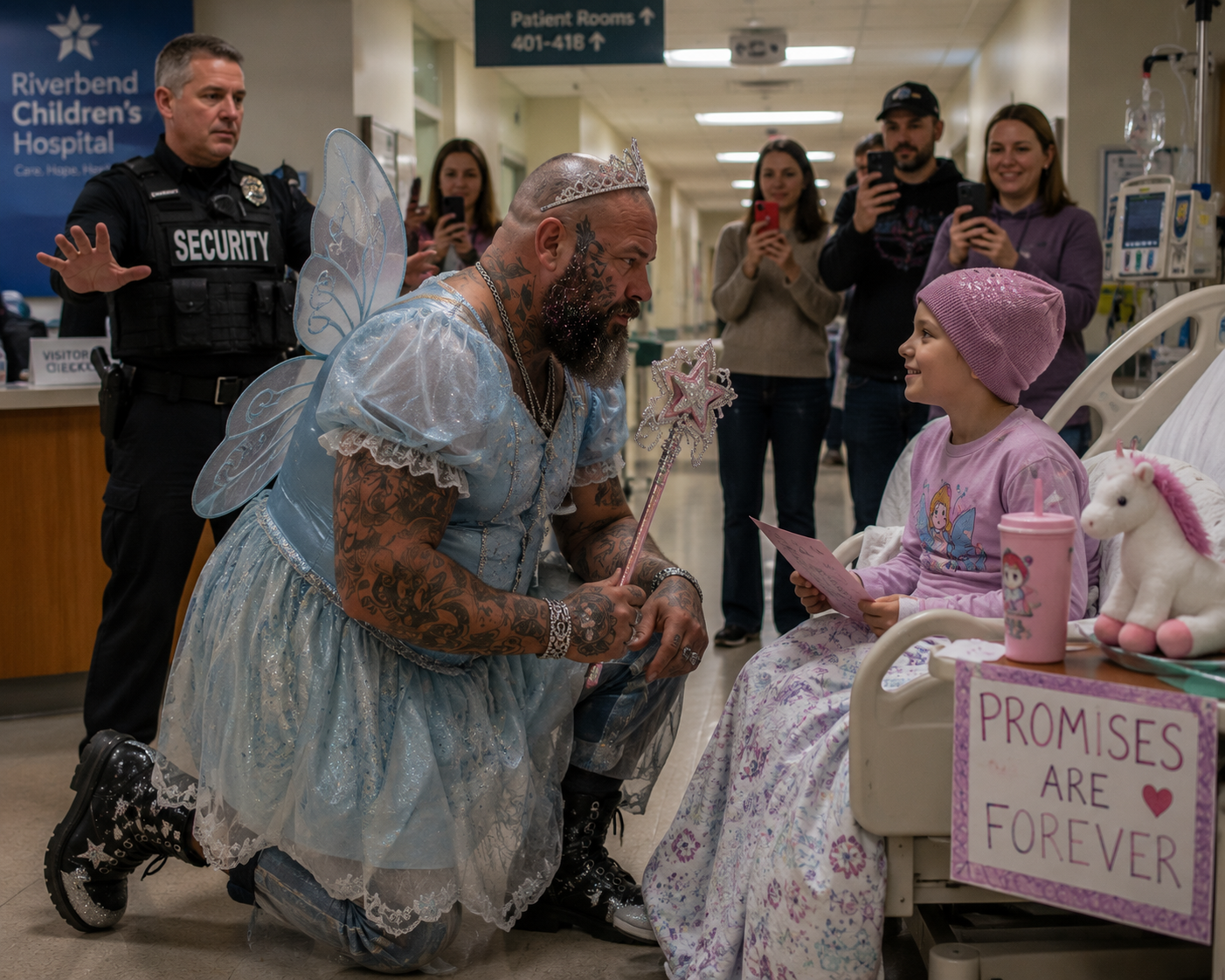
Months later, Ruby returned to the hospital for follow-up carrying the same rhinestone scepter.
Grizz wore normal clothes.
She looked disappointed.
“No wings?”
“Absolutely not.”
Officer Mark Ellis happened to be at the entrance.
He recognized them.
“Sir, I need you to surrender the wand.”
Grizz stared at him.
Mark smiled.
Ruby laughed so loudly everyone turned.
That was how the hospital lobby remembered him eventually.
Not as the face-tattooed biker who refused security.
As Ruby’s fairy.
Children on the oncology floor started asking whether the “scary fairy” would visit again.
Grizz pretended to hate it.
Then somehow a storage locker at the hospital acquired:
One oversized blue gown.
A repaired set of transparent wings.
Three plastic crowns.
And a new wand because the original now belonged in evidence storage until prosecutors released it.
Grizz complained about every visit.
He still came.
The biker club helped with the second wish again the following winter.
Not for Ruby.
For the whole floor.
Paper stars across the ceiling.
Battery lights.
A projector.
No spectacle.
No roaring engines outside patient rooms.
Just a night sky in a hallway where children sometimes forgot whether it was morning or evening.
Ruby supervised.
She was merciless.
“That star is crooked.”
A biker named Moose looked up.
“It’s a star.”
“Stars can still have standards.”
Grizz whispered:
“I created this.”
“You helped.”
“Worst mistake of my life.”
Ruby heard.
“Second worst.”
He raised an eyebrow.
“What was first?”
“Lip gloss refusal.”
William Mercer eventually pleaded guilty to financial and identity-related offenses.
Colin faced separate charges connected to fraud and obstruction.
Neither sentence restored Sarah’s years of fear.
Neither removed Grizz’s prison record.
Neither returned the time everyone lost.
But the evidence became public.
That mattered.
Sarah was no longer remembered in the case file as a suspicious bookkeeper attached to criminal activity.
She was documented as the person who discovered it.
Ruby asked once:
“Was Mom brave?”
Grizz answered:
“Yes.”
“Were you?”
He thought longer.
“Sometimes.”
She nodded.
“Better answer.”
The hardest test of his promise came later.
Not in court.
Not with William.
At the shop.
A young mechanic damaged a customer’s custom fuel tank.
Expensive mistake.
Years earlier, Grizz would have exploded.
Everyone expected it.
His jaw tightened.
Hands closed.
The mechanic stepped backward.
Grizz noticed.
That was the important part.
He opened his hands.
Took one breath.
Then said:
“Tell me exactly what happened.”
The young man did.
They fixed it.
It cost money.
Nobody got screamed at.
That evening Grizz told Ruby.
She looked pleased.
“Third wish working.”
“Cost me nine hundred dollars.”
“Magic is expensive.”
“You sound like a hospital administrator.”
A year after the fairy incident, Ruby stood in the same fourth-floor hallway.
Hair growing back.
Still monitored.
Still taking medication.
Still living with uncertainty.
But standing.
The paper stars were gone.
One remained.
Small.
Blue.
Taped above Room 417.
Ruby had written something on it.
Grizz lifted her so she could stick it higher.
“What does it say?” I asked.
She made me read it myself.
MAGIC IS WHEN SOMEONE CAN SCARE YOU AND STILL CHOOSES NOT TO.
I looked at Grizz.
He frowned.
“Too many words.”
Ruby rolled her eyes.
“You hate feelings.”
“I wore a dress for you.”
“Exactly.”
He set her down.
She took his hand.
Not because she needed help walking.
Just because she wanted to.
For years, Grizz believed strength meant becoming dangerous enough that nobody could hurt the people he loved.
Sarah learned the cost of that belief.
Ruby inherited the aftermath.
And somehow, inside a hospital full of frightened families, plastic crowns, IV pumps, and children making impossible wishes, she taught him something simpler.
Gentleness was not what happened when anger disappeared.
It was what happened when anger arrived—
and you chose what to do with your hands.