
PART 3
Ava read the line again.
I was waiting for you.
Bear looked like the sentence had physically moved him backward.
“What does that mean?”
Ava unfolded the rest of the note.
Her hands shook.
Ethan stood beside Maddie.
Officer Kelley remained close enough to intervene if anybody stopped thinking.
Nobody did.
Ava read aloud.
Gabriel, if Ava finds this before you do, that means she has become old enough to ask questions you were never good at answering.
Bear closed his eyes.
“That sounds like her.”
Ava kept reading.
Do not come looking for me because Calvin expects you to.
Everyone went still.
He knows anger is the easiest road back to you.
Bear looked toward Ethan.
Same pattern.
Again.
Maria continued:
If he believes you are searching, he will use you to find what I hid.
Ava lowered the letter.
“What did she hide?”
Officer Kelley pointed toward the key.
“Probably whatever that opens.”
The key carried one stamped number.
307
Ethan whispered:
“Storage.”
Bear nodded.
There had been an old self-storage facility near the towing yard.
Unit numbers in the three hundreds.
Closed years ago.
Or so they thought.
Officer Kelley photographed the key and letter.
Nobody rushed out to find Unit 307.
That was the important part.
Thirteen years earlier, Bear would have.
He would have taken the key.
Called three bikers.
Found Calvin.
Broken doors.
Destroyed evidence.
This time he sat down.
Ava noticed.
“You’re not going?”
“No.”
“Why?”
He looked at her.
“Because your mother specifically told me not to be stupid.”
“That never stopped you before.”
Ethan laughed.
Bear glared at him.
Then laughed too.
Small.
But real.
Police traced the storage company the next morning.
The old property had been sold, but records survived.
Unit 307 had once been rented under the name:
M. Hale
No one recognized it.
Then investigators compared handwriting on the original lease.
Maria’s.
The unit had remained prepaid for fourteen years.
Cashier’s checks mailed annually from different states.
Officer Kelley called Bear.
“She was maintaining it.”
Bear stared at the garage wall.
“Alive.”
“At least whoever controlled the account was.”
“What’s in the unit?”
“We’re getting a warrant.”
He hated that answer.
But accepted it.
Progress.
Unit 307 contained almost nothing.
One metal filing cabinet.
One locked toolbox.
Three motorcycle helmets.
A box of photographs.
And a ledger sealed inside two plastic bags.
Original transaction records.
VIN numbers.
Auction dates.
Payments.
Names.
Enough to show Calvin Mercer’s operation had continued long after the towing-yard incident.
But the photographs mattered more to Bear.
Maria.
Different years.
Different places.
Georgia.
Missouri.
Kansas.
Oklahoma.
Sometimes alone.
Sometimes beside women nobody recognized.
In one recent photograph, she stood outside a small family-services office in Tulsa.
Three months earlier.
Ava stared.
“She was here.”
Bear whispered:
“Yes.”
“She was this close?”
He had no answer.
Then investigators found another folder.
Label:
FRIDAY
Inside were notes.
Not about motorcycles.
About fathers.
Widowers.
Divorced men.
Former club members.
Men struggling with children after losing wives or partners.
Bear stared at one page.
Lucas Grant.
Chloe’s father.
Another:
Andre Coleman.
The twins.
Then Ethan Ross.
Maddie.
And finally:
GABRIEL HOLLOWAY — WATCH AVA, NOT HIM. SHE’LL KNOW WHEN HE’S READY.
Bear sat down hard.
Ethan read over his shoulder.
“She knew about Hair Shop.”
Ava whispered:
“How?”
Nobody knew.
Not yet.
The answer came from a phone number hidden inside Maria’s ledger.
A prepaid line.
Still active.
Police contacted the carrier.
Then an attorney called before investigators reached Maria.
Her name was Denise Harper.
Family-law attorney in Tulsa.
She represented a woman living under protected contact information.
Maria Holloway.
Alive.
Bear could not speak when Officer Kelley told him.
Ava did.
“Can I see her?”
The attorney answered through speakerphone.
“Maria wants that.”
Bear closed his eyes.
Ava looked at him.
“Do you?”
He opened them.
“Yes.”
Then corrected himself.
“If you do.”
That mattered.
Ava nodded.
“I do.”
The meeting happened three days later.
Neutral office.
No motorcycle club.
No reporters.
No neighborhood.
Bear wore a plain gray shirt.
Ava carried Maria’s old hair kit.
Ethan and Maddie waited elsewhere.
I was not supposed to be there.
Ava asked me to come.
Maybe because I had started the neighborhood suspicion.
Maybe because by then I represented another adult who needed to learn something.
Maria entered at 2:14 p.m.
Forty-one years old.
Dark hair streaked with gray.
Thin.
One scar near her jaw.
Ava froze.
Bear did too.
Maria looked at him first.
Then at Ava.
She covered her mouth.
Ava whispered:
“Mom?”
Maria nodded.
“Yes.”
No dramatic running embrace.
No music.
No instant healing.
Ava stood there for nearly a minute.
Then asked:
“Why did you leave me?”
Maria’s face broke.
“Because I was scared.”
“Of Calvin?”
“Yes.”
“Of Dad?”
Maria looked at Bear.
“No.”
Then:
“Of what your father would do if Calvin forced him to choose between evidence and violence again.”
Bear looked down.
Maria continued.
“I knew Calvin could make Gabriel move before he thought.”
Ava said:
“He doesn’t do that as much now.”
Bear almost smiled.
Maria did.
“That’s what I was waiting for.”
Bear looked up sharply.
“You waited thirteen years for me to become less angry?”
Maria shook her head.
“No.”
“I waited until Ava was old enough to recognize the difference between protection and control.”
That silenced him.
Maria explained the photograph given to Maddie.
Calvin was alive.
That part was true.
The warehouse-fire death had been staged using remains misidentified through manipulated dental records.
Investigators later confirmed records had been falsified by a dentist who had worked with Calvin’s towing business.
Calvin disappeared under aliases.
Maria kept moving because she knew the ledger could expose him.
Why not go federal immediately?
She tried.
Twice.
The first investigator she contacted died before the case developed.
The second said her evidence was incomplete and warned her Calvin had already learned she was asking questions.
Maria stopped trusting systems.
That was understandable.
It was also costly.
Ava said:
“You could’ve called Dad.”
Maria nodded.
“Yes.”
“Why didn’t you?”
“Because every time I imagined it, I saw him getting on his motorcycle.”
Bear said nothing.
She looked at him.
“You would’ve gone after Calvin.”
Thirteen years earlier?
Yes.
Bear knew it.
Maria continued.
“And Calvin would’ve been ready.”
The old threat was never simply violence.
Calvin wanted the original ledger.
He believed Maria had hidden it somewhere Gabriel could eventually lead him.
So Maria stayed away from Bear.
Stayed away from Ava.
Watched indirectly.
That was the part Ava struggled with.
“You watched me?”
Maria nodded.
“Sometimes.”
“How?”
“School photos. Public events. Your grandmother. Later, Denise.”
Ava frowned.
“You knew about Hair Shop?”
“Yes.”
“How?”
Maria smiled faintly.
“Your grandmother told me before she died that you were making your father learn braids.”
Bear groaned.
“She knew too?”
Maria nodded.
“She kept secrets badly.”
“Apparently not badly enough.”
The hidden key inside the hair kit had been Maria’s final contingency.
She left it with Bear’s mother before disappearing.
Instructions:
Give Ava the kit only if Gabriel had become the kind of father who could listen without taking over.
Bear stared.
“So my mother was evaluating me?”
Maria almost laughed.
“Constantly.”
“That tracks.”
Ava looked at both of them.
“So Friday Hair Shop was an accident?”
Bear answered:
“Yes.”
Maria shook her head.
“Not entirely.”
Everyone turned.
She had been quietly referring struggling fathers to community grief groups for years.
When she heard Bear had started Friday Hair Shop, she began passing the idea through women who knew some of the families.
Not directing.
Not recruiting children secretly.
Just suggesting that certain fathers might benefit from a practical activity with their daughters.
Ethan was one.
Lucas another.
The girls created the list on their own.
Maria had nothing to do with that.
Ava did.
“That was me,” she said.
Bear looked at her.
“I know.”
“You mad?”
“No.”
“Worried?”
“Extremely.”
“Better.”
Calvin’s arrest came six weeks later.
Maria’s ledger gave investigators a roadmap.
Recent auction fraud made the case current.
Bank transfers connected aliases.
Vehicle records connected shell companies.
Witnesses who once feared speaking now compared stories.
That was exactly what Calvin had spent years preventing.
Isolation had protected him.
Conversation destroyed it.
No biker confrontation.
No parking-lot showdown.
Calvin was arrested outside a commercial auction while trying to use false identification.
Bear watched the news clip from the garage.
His hands stayed open.
Ava noticed.
“Third-level dad improvement.”
He frowned.
“What are the levels?”
“I’m still designing them.”
“Terrifying.”
Maria did not move home.
That mattered.
Ava had imagined reunion as restoration.
It wasn’t.
Maria rented an apartment nearby.
She and Ava met gradually.
Dinner.
Hair appointments.
Counseling.
School events.
Bear attended some.
Not all.
Some conversations belonged to mother and daughter.
He learned that too.
One Friday, Maria came to Hair Shop.
Every man stopped talking.
Bear looked terrified.
Maria stared at his attempt at a Dutch braid.
“This is criminal.”
“Good to see you too.”
Ava laughed.
Then handed Maria a comb.
“Fix him.”
Maria stood behind Bear.
For the first time in thirteen years, she touched his hair.
What little he had.
Then sighed.
“This is hopeless.”
Bear nodded.
“Finally, medical consensus.”
Ethan started therapy.
Not because Bear told him to.
Maddie asked.
He agreed.
He stopped sitting in his truck until midnight.
Not immediately.
At first he came inside ten minutes earlier.
Then thirty.
Then one Friday he cooked dinner before Hair Shop.
Maddie told everyone.
He pretended to hate the attention.
Lucas learned to braid Chloe’s hair properly.
Andre learned his daughters did not need advice every time they spoke.
Sometimes they only wanted him to listen.
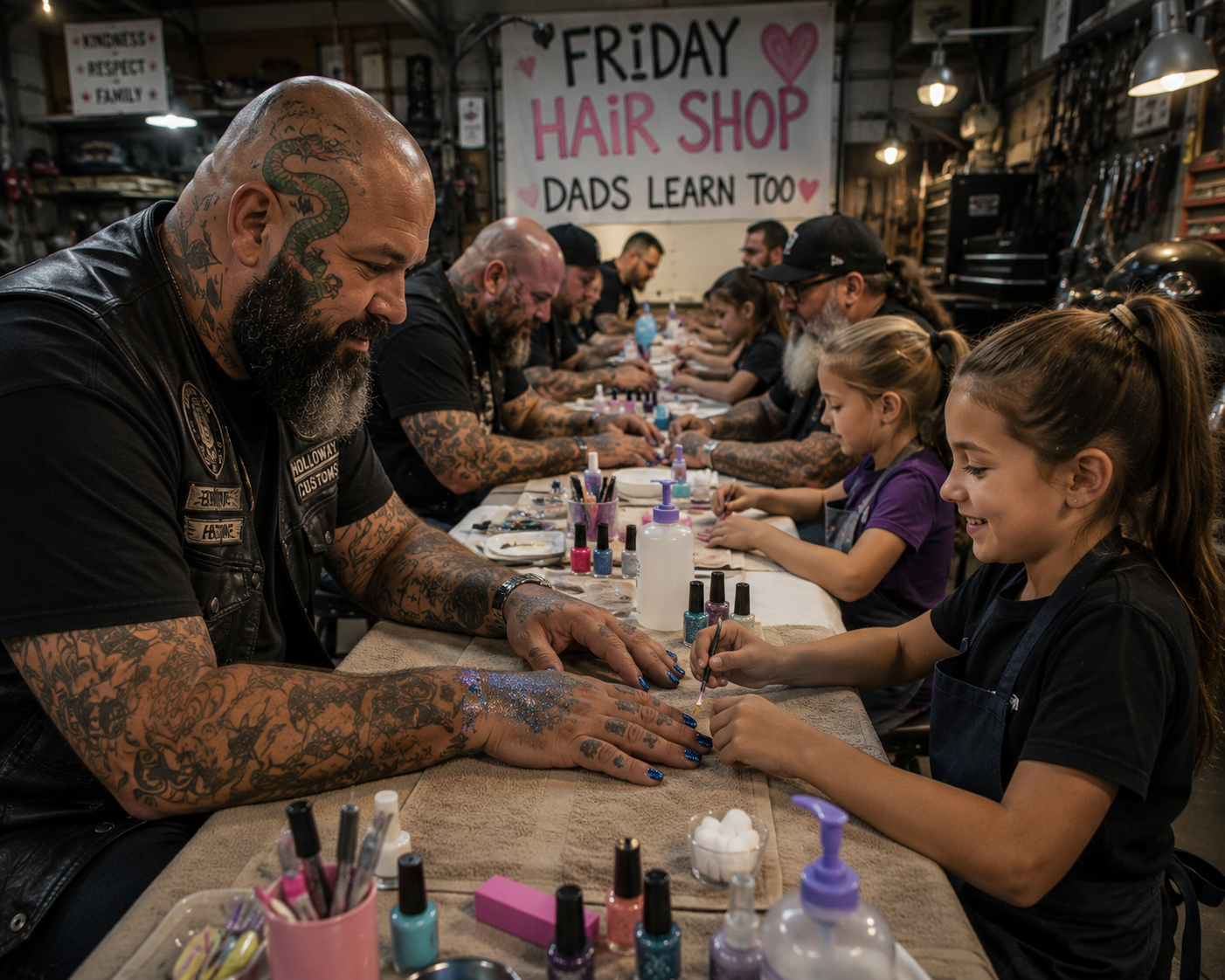
Friday Hair Shop changed too.
No longer just fathers and daughters.
Grandfathers came.
Uncles.
Older brothers with guardianship.
Mothers sometimes joined.
The rule became simple:
One adult.
One child.
Hands busy.
Phones down.
Talk if you want.
Silence if you don’t.
Nobody had to explain grief before being allowed inside.
The neighborhood apologized eventually.
Including me.
I walked across the street one Friday with a tray of cookies.
Bear opened the garage door.
His fingernails were green.
He looked at the tray.
“Bribery?”
“Apology.”
“For calling police?”
“Yes.”
He considered.
Then took one cookie.
“Accepted halfway.”
“Halfway?”
“You still took pictures through my window.”
That hurt because it was true.
“I’m sorry.”
He nodded.
“Then stop doing that.”
Simple.
No dramatic forgiveness speech.
Boundary.
Useful.
I put my phone away.
A year later, Ava’s original Friday List hung framed inside the garage.
Not the private details.
Those were removed.
Only the heading remained:
WHO GOES HOME TO A QUIET HOUSE?
Under it, a new line:
ASK. DON’T ASSUME.
Bear hated sentimental decorations.
He allowed that one.
Beside it sat Maria’s old pink hair kit.
Empty now.
The key was evidence for months, then returned.
Bear offered it to Ava.
She shook her head.
“Don’t need it.”
“Why?”
“It already opened what it was supposed to.”
Bear looked impressed.
“That’s annoyingly poetic.”
“Mom says I get it from her.”
“Of course she does.”
Friday evenings still brought motorcycles to Briarwood Avenue.
The windows still rattled.
Tattooed men still walked little girls into a garage.
The door still closed.
But nobody called police anymore.
Inside, fathers learned braids.
Girls painted nails.
People ate pizza.
Sometimes nobody said anything important.
Sometimes somebody finally did.
That was the part I had misunderstood from the beginning.
I thought closed doors meant secrecy.
Sometimes they do.
But sometimes people close a door because vulnerability is easier without an audience.
Ava had figured that out before any of us.
She did not create Friday Hair Shop because men needed help with hair.
She created it because she noticed what grief did to houses.
How fathers stopped talking.
How daughters stopped asking.
How silence could become normal enough that nobody remembered it was hurting them.
Bear once believed protecting Ava meant keeping the ugliest parts of the past outside her life.
Maria believed protecting her meant staying away.
Ethan believed protecting Maddie meant hiding how broken he felt.
All three were wrong in different ways.
Ava’s solution was simpler.
Pull up a chair.
Give somebody a comb.
Ask what they want.
And keep your hands busy long enough for the truth to come out.