
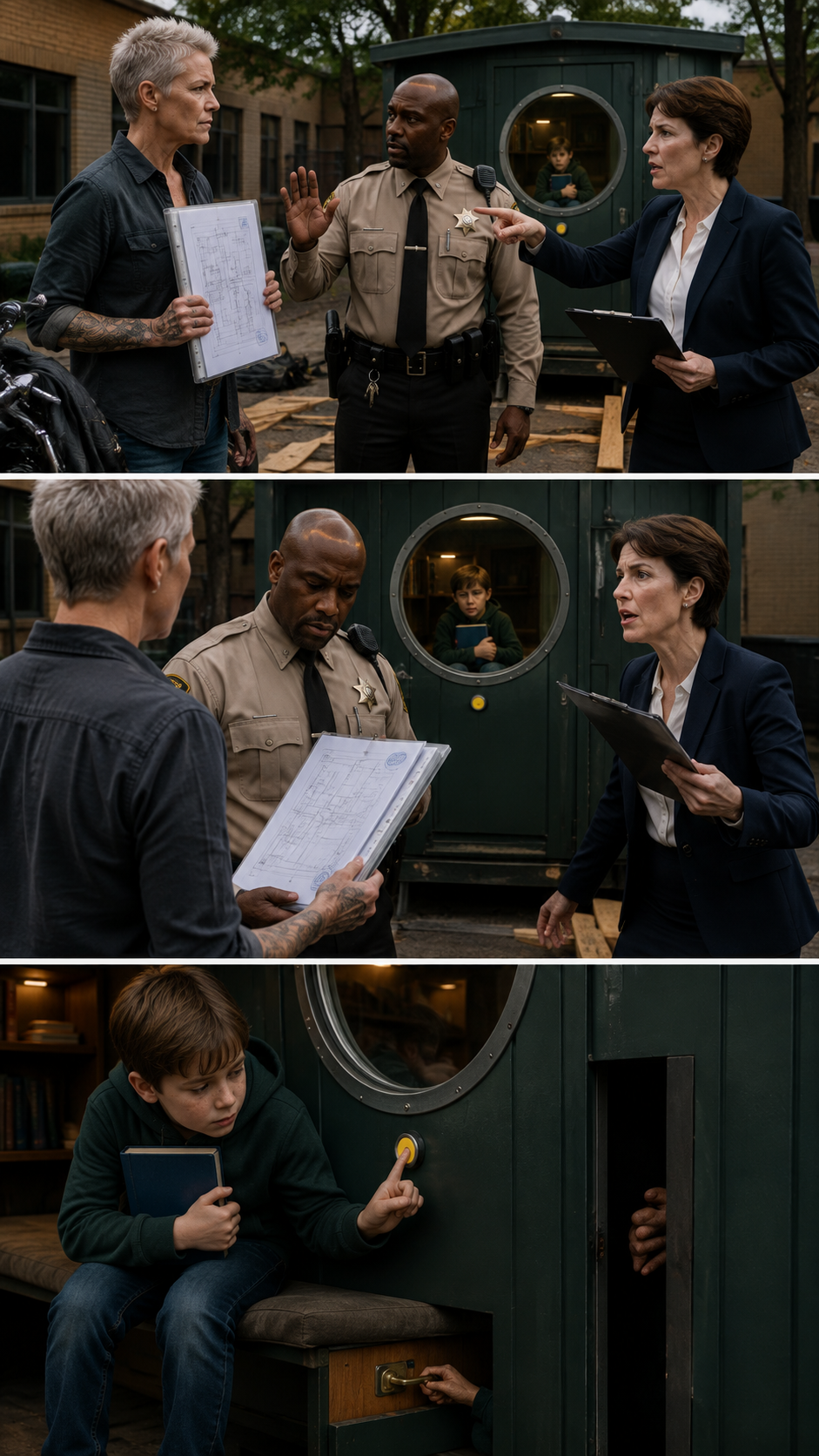
The breathing behind the second door belonged to a man with a brace around one leg and a pale scar running from his temple into his hair.
Evan did not recognise him at first.
Then the man said, “Hey, Birdman.”
The library book slipped from Evan’s hands.
Only his father had used that name.
Daniel Brooks stepped through the narrow opening with one hand against the wall. He was thinner than the photographs Evan kept beside his bed, and his voice carried the careful rhythm of someone rebuilding words after an injury.
Evan did not run toward him.
He stood very still.
“You left,” he said.
Daniel’s face tightened.
“No.”
Principal Susan Hale moved toward the courtyard entrance.
A deputy blocked her.
Mara lifted the child-sized coat from the hook. It belonged to Evan. His name had been written inside the collar in black marker, beside a date from two years earlier.
The day Daniel disappeared.
Behind the coat was a blue vinyl folder flattened into a narrow compartment.
Daniel had submitted it with the original plans.
Inside were photographs of a windowless storage room beneath the school library, restraint logs, medical reports and statements from children who said staff locked them there when they cried, panicked or could not remain still.
Daniel had designed the courtyard room as an alternative.
A place with soft light, two exits and no lock on the outside.
Susan rejected it.
Then she reported him for trespassing after he photographed the basement room.
Daniel explained what happened next without looking at Evan.
Susan called him to the school’s maintenance annex and said she was ready to reconsider the plans. When he arrived, a damaged ventilation unit released carbon monoxide into the room.
He woke in a state neurological facility three weeks later.
Susan told the district he had suffered a breakdown and abandoned his family.
The facility told Daniel that Evan’s mother had requested no contact because he was dangerous.
For two years, every letter he wrote came back unopened.
Mara found him after recognising his engineering stamp on a wheelchair repair order from the facility.
Evan picked up the book.
“Why didn’t you come home?”
Daniel lowered himself slowly onto the padded bench.
“Because I believed they were safer without me.”
Evan looked toward Susan.
She had told him his father stopped calling because some people preferred leaving to apologising.
The deputy opened the blue folder and found Daniel’s no-contact order.
The psychologist who signed it had never examined him.
The court date listed on the document fell nine days before the accident.
Susan began saying the paperwork had been prepared as a precaution.
Mara turned to her.
“A precaution for something that hadn’t happened?”
The courtyard went quiet.
Daniel reached beneath the bench and removed a small digital recorder.
The last file had been captured inside the basement room.
A younger Evan could be heard crying.
“Dad, they turned the light off again.”
Evan pressed both palms over his ears.
Daniel stopped the recording immediately.
He did not ask his son to listen further.
The deputy ordered the basement secured and called district investigators.
Susan’s composure finally broke.
“You cannot open that room while children are on campus.”
Daniel looked at her.
“Why?”
She did not answer.
Mara searched the final section of the blue folder and found a transportation schedule dated for the following morning.
Three students had been marked for transfer to a district behaviour annex.
Evan’s name was first.
Daniel studied the address.
“That annex closed ten years ago.”
The deputy raised his radio.
Before he could speak, it crackled with a message from the school’s front entrance.
A small district bus had left the property twelve minutes earlier.
There were three children inside.
And nobody could identify the driver.