
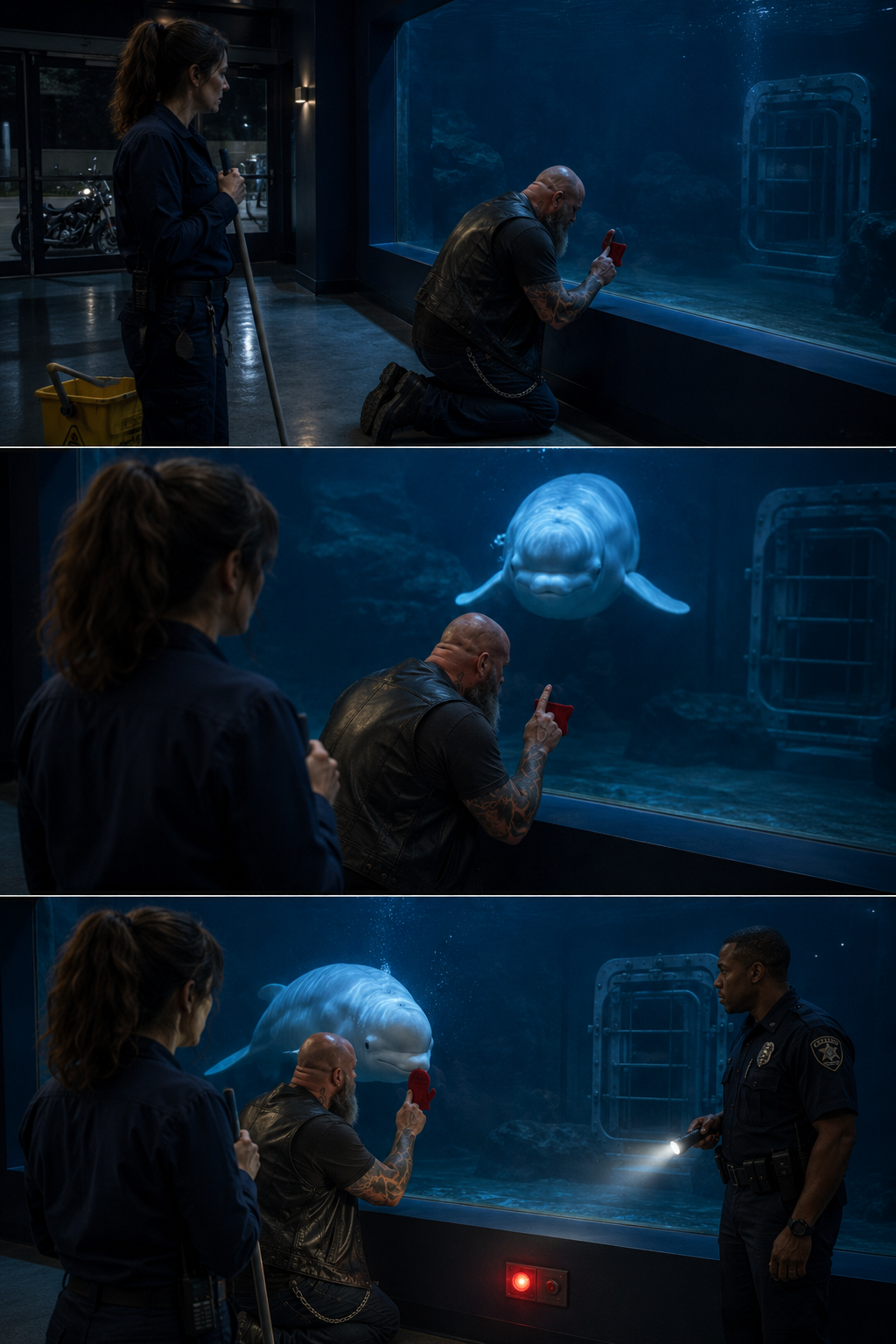
The first surge of water struck our knees.
Amos carried Rose toward the stairs while I reached the oxygen panel beside the orca’s crate. Most of the controls were unlabeled. One valve fed the animal’s sling. Another fed the chamber vents.
Director Malcolm Voss watched through the observation window.
“You cannot save both,” he said through the intercom.
Rose twisted in Amos’s arms.
“He’s lying. The pumps have a manual bypass.”
She pointed toward a red wheel beneath the flooding water.
Amos set her on the highest stair.
“Stay where I can see you.”
He waded back down.
The maintenance worker emerged behind Voss with blood running from his forehead. Len appeared moments later and forced him against the corridor wall. Voss reached for the control panel, but Len struck the emergency release with his baton.
The chamber door unlocked.
It did not open.
Water pressure held it shut.
Amos found the bypass wheel and pulled. It would not turn.
I joined him.
Together, we forced it a quarter rotation.
The flood slowed.
Not enough.
Rose climbed down despite Amos shouting at her. She reached through the side of the orca’s crate and pressed her palm against the animal’s skin.
The young whale released a weak breath.
“Nia,” Rose whispered. “You have to move.”
Amos looked at the crate’s transport rails.
They led directly toward the sealed chamber door.
The same water trapping us could help push the crate.
We released the wheel and opened the lower gate beneath the sling. Water rushed under the platform, lifting it just enough for the rails to carry its weight.
Amos pushed.
I pulled.
Rose stayed beside Nia’s head, speaking softly.
At the observation window, Voss tried to flee.
He found eleven aquarium security officers and two federal wildlife agents entering the service corridor.
The anonymous person who mailed Amos the mitten had also sent copies of the shipping records to federal investigators. She was a veterinary technician named Elena Ruiz, one of the five people Rose had counted inside the facility.
Elena had delayed Nia’s transport, preserved the records, and programmed the medical gate to unlock when Rose’s device touched the junction box.
She had not been able to rescue Rose alone.
So she created a path for someone who would come.
The pressure dropped enough for Len and the agents to force the chamber door inward.
They pulled Rose out first.
Amos refused to leave until Nia’s crate crossed the threshold.
By dawn, officers had recovered three seals and two dolphins from an offshore warehouse. Shipping manifests connected Voss to private collectors, falsified death reports and illegal transports spanning seven years.
The maintenance worker cooperated.
Voss did not.
It made no difference.
Rose’s photographs, Elena’s records and the animals themselves were enough.
Nia survived.
She was transferred to a coastal rehabilitation centre and eventually released under federal monitoring.
Rose returned home to a mother who had spent six months being told her daughter was dead.
Her recovery was slower than the rescue.
She feared locked doors, dark corridors and the sound of pumps. Amos attended every appointment she allowed him to attend, but he never stood between her and an exit.
The aquarium reopened under new leadership.
The hidden facility was demolished.
Nuka remained in care until she was moved to a protected marine sanctuary.
On the day she left, Rose stood beside the transport pool wearing both red mittens.
She tapped the rail twice.
Nuka answered with three clicks.
Amos looked away, pretending the water in his eyes came from the salt air.
Months later, I asked Rose why she trusted him to understand the signal.
She shrugged.
“Because he always listened before deciding what I meant.”
That was the truth beneath everything.
Rose survived because people finally believed the pattern she had been repeating all along.
Not every rescue begins with a siren.
Sometimes it begins with a frightened child teaching a whale how to call the one person she knows will come.