
For years, people walked past the house without knowing what was happening inside.
Cars passed along the street. Neighbors went about their lives. Children played nearby. From the outside, there was little to suggest that one ordinary-looking home in Cleveland, Ohio, concealed a nightmare that had lasted for more than a decade.
Then, on May 6, 2013, everything changed.
A woman escaped.
She ran to a neighbor and desperately asked for help. Moments later, she was speaking to a 911 operator and saying words that stunned the city:
She was Amanda Berry.
She had been missing for approximately ten years.
And she was finally free.
Police rushed to the address expecting to investigate an extraordinary missing-person discovery. What they found instead revealed one of the most horrifying kidnapping cases in modern American history.
Amanda was not alone.
Two other women were still inside.
And their survival would expose a story of captivity, abuse, fear, and resilience that almost seemed too horrific to be real.
It Began With Michelle Knight
The first woman taken was Michelle Knight.
In August 2002, Knight was 21 years old and struggling through a difficult period in her life. She was a young mother who had lost custody of her son and was trying to attend a court appointment connected to regaining access to him.
On the way, she encountered Ariel Castro, a man she knew through the neighborhood.
He offered her a ride.
Knight accepted.
It was the beginning of nearly eleven years of captivity.
Castro took her to his home on Seymour Avenue and prevented her from leaving.
For Knight, the world outside effectively disappeared.
Her family did not know where she was.
There was no dramatic ransom demand.
No obvious clue showing where she had gone.
And unlike some missing-person cases that generate continuous national attention, Knight’s disappearance gradually faded from public focus.
Inside the house, however, she was still alive.
And eventually, another young woman arrived.
Amanda Berry Disappears
In April 2003, 16-year-old Amanda Berry was walking home after finishing a shift at Burger King.
She disappeared before reaching home.
Her case received significant attention in Cleveland.
Family members searched.
Posters appeared.
Police investigated.
Years passed without an answer.
But Amanda had not vanished from the city.
She had been taken to the same Seymour Avenue house where Michelle Knight was already being held.
Berry later recalled that Castro used a connection to his daughter to make her feel safe enough to enter the home. Once inside, she realized she was trapped.
She became the second captive.
For the women already imprisoned there, the arrival of another victim created a terrible contradiction.
It meant the nightmare was expanding.
But it also meant they were no longer entirely alone.
Then a third girl disappeared.
Gina DeJesus Becomes the Third Victim
In April 2004, 14-year-old Gina DeJesus vanished while walking home from school.
Her disappearance devastated her family and became another high-profile Cleveland missing-person case.
Once again, searches produced no answer.
Once again, the truth was horrifyingly close.
Gina had also been taken to Castro’s house.
The three women would remain imprisoned there for years.
Michelle Knight, Amanda Berry, and Gina DeJesus were abducted separately between 2002 and 2004 and remained captive until 2013.
What happened inside the house included sustained violence and abuse, but the story is also defined by the ways the women tried to help one another survive.
They developed bonds under circumstances almost impossible for outsiders to imagine.
Their lives had been reduced to confinement, fear, and uncertainty.
Yet they continued looking for ways to endure.
And one of the most extraordinary moments involved the birth of a child.
A Baby Is Born Inside the House
During her captivity, Amanda Berry became pregnant and gave birth to a daughter.
Michelle Knight helped deliver the baby.
The situation was terrifying.
According to accounts incorporated into the film, Knight was forced to assist during the birth with virtually none of the medical resources that would normally be available.
When the newborn appeared to stop breathing, Michelle performed CPR.
The baby survived.
For the women, the child became a source of emotional connection inside an environment built around control and isolation.
The years continued.
Outside, their families still wondered whether they would ever return.
Inside, the women had no way of knowing whether freedom would ever come.
Until Amanda saw an opportunity.
One Open Door Changed Everything
On May 6, 2013, Castro left the house.
Amanda realized that part of the door was not secured in the usual way.
She began screaming.
A neighbor, Charles Ramsey, heard her and came to help.
Amanda managed to get outside with her daughter.
Then she called 911.
The recording would become one of the defining moments of the case.
Amanda told the operator who she was and explained that she had been kidnapped.
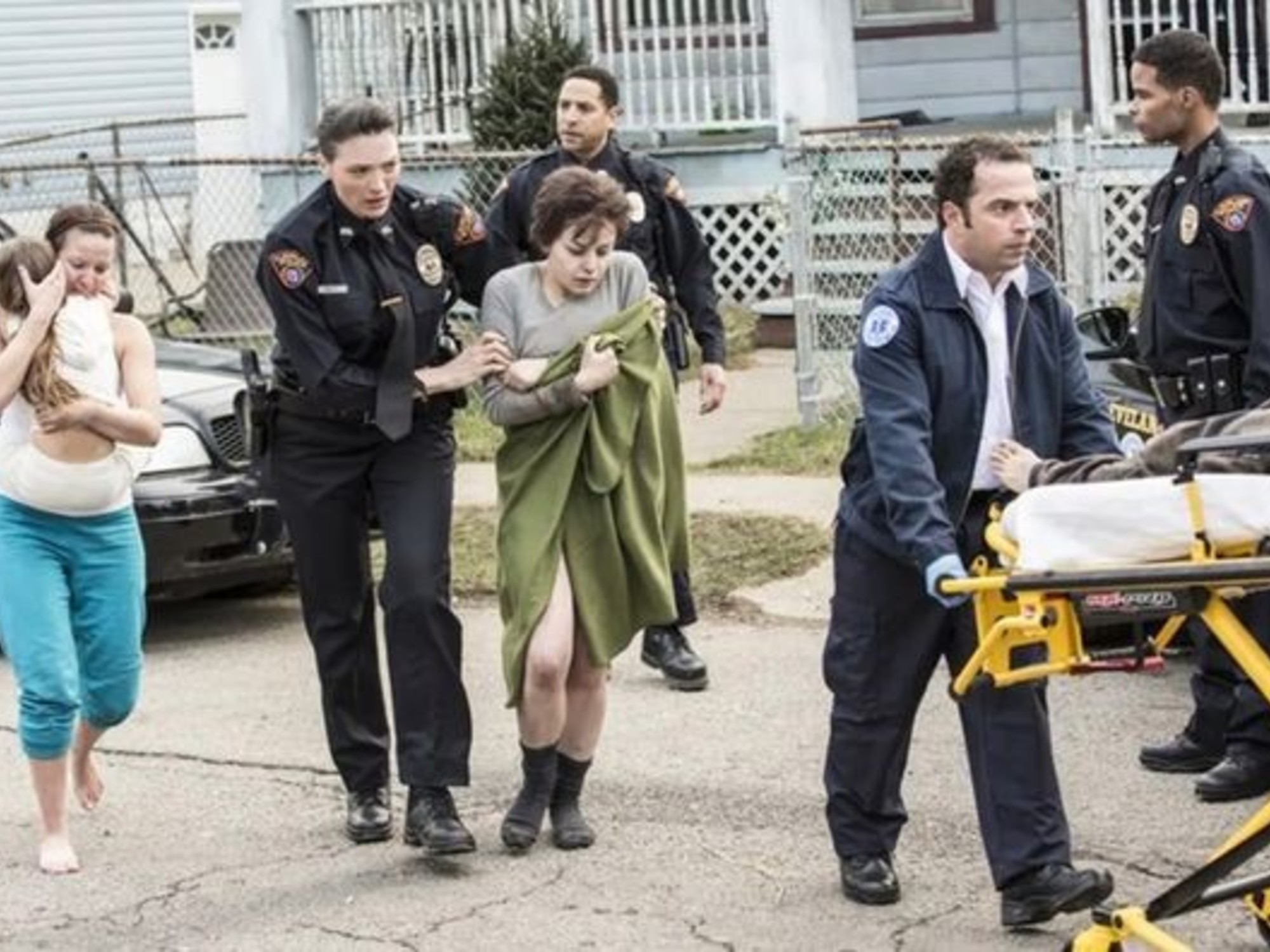
Police officers arrived rapidly.
What they initially understood as the rescue of one long-missing woman became something even more extraordinary when they entered the house.
They found Gina DeJesus.
Then they found Michelle Knight.
Three women who had disappeared years earlier were suddenly alive and free.
Officers who participated in the rescue later described the discovery as overwhelming because they had entered the home after learning Amanda Berry had escaped, only to realize that two other missing women were also there.
The case shocked the United States.
But for Michelle Knight, freedom was only the beginning of another difficult journey.
The Film Is Cleveland Abduction
The dramatization of this story is Cleveland Abduction, a 2015 Lifetime television movie directed by Alex Kalymnios.
The film is primarily told from Michelle Knight’s perspective and is based on her memoir, Finding Me: A Decade of Darkness, a Life Reclaimed.
Taryn Manning delivers the central performance as Michelle.
Raymond Cruz portrays Ariel Castro.
Katie Sarife plays Gina DeJesus, while Samantha Droke plays Amanda Berry.
Joe Morton and Pam Grier also appear in supporting roles.
The movie premiered on Lifetime on May 2, 2015, and runs approximately 88 minutes.
Rather than presenting the case as a conventional police procedural, the film keeps much of its attention on Michelle’s experience inside the house.
That perspective makes the story less about investigators solving a mystery and more about one woman’s determination to survive long enough to reclaim her life.
Taryn Manning Carries the Emotional Weight
Much of the movie depends on Taryn Manning’s performance.
Michelle is introduced as a vulnerable young mother already dealing with major personal hardship before her kidnapping.
Once imprisoned, however, survival becomes the only objective that matters.
The film follows her through years in which circumstances repeatedly attempt to strip away her hope.
Her desire to see her son again becomes an emotional anchor.
Even when escape appears impossible, the possibility of someday returning to him gives her something outside the house to hold onto.
Manning plays Michelle not as an invincible heroine but as someone enduring an unbearable situation one day at a time.
That distinction matters.
The film’s power comes from the fact that survival is not presented as effortless courage.
It is exhausting.
It is frightening.
And sometimes it simply means making it through another day.
The Real Michelle Knight Eventually Faced Her Captor
After the women were rescued, Ariel Castro was arrested.
He ultimately pleaded guilty to hundreds of criminal counts and was sentenced to life in prison without parole plus an additional 1,000 years.
At his sentencing hearing, Michelle Knight confronted him directly.
She described the years taken from her and made clear that her life would no longer belong to the man who had imprisoned her.
Her statement became one of the most powerful public moments following the rescue.
Knight acknowledged the enormous damage inflicted upon her but also insisted that she intended to live beyond it.
That determination is central to the film’s final message.
The story does not end simply because a door opens.
Freedom does not erase trauma.
Rescue does not restore eleven missing years.
But it gives survivors the opportunity to decide what happens next.
Why the Story Still Feels Impossible
Perhaps the most disturbing element of the Cleveland kidnappings is not simply how long the women were held.
It is where they were held.
Not in an isolated bunker hundreds of miles from civilization.
Not somewhere completely removed from society.
They were inside a residential house in Cleveland.
People lived nearby.
Life continued around them.
Families searched for them while they remained only miles away.
That reality gives Cleveland Abduction its most unsettling quality.
The film does not need an elaborate fictional villain or an impossible conspiracy.
The facts are already horrifying enough.
Three women disappeared.
For years, their families had no answers.
Then one of them reached a door.
One neighbor heard her scream.
One 911 call brought police to Seymour Avenue.
And within minutes, three cases that had haunted Cleveland for years became one extraordinary story of survival.
The film is Cleveland Abduction.
But unlike most kidnapping thrillers, the most unbelievable part is also the simplest:
This nightmare did not come from a screenwriter’s imagination.
Michelle Knight, Amanda Berry, and Gina DeJesus were real women.
The house was real.
The years they lost were real.
And against circumstances designed to make them believe they would never see freedom again, all three survived.