
Imagine living in a village where everyone has already decided exactly who you are.
You are the strange woman.
The unpleasant one.
The woman people laugh at when you walk past.
You smell of fish because that is how you make your living. You have no husband, no respectable place in society, and apparently very little chance of changing either.
Eventually, you become tired of waiting for the world to accept you.
So you do something extraordinary.
You ask someone to make you a husband.
Not find one.
Make one.
That wildly eccentric idea sits at the center of Olivia Colman’s unusual new fantasy romance, a film that begins like a surreal fairy tale before gradually revealing something much sharper about loneliness, marriage, jealousy, desire, and the expectations society places on women.
And the husband in question is not metaphorical.
He is literally woven from wicker.
A Woman the Village Has Already Rejected
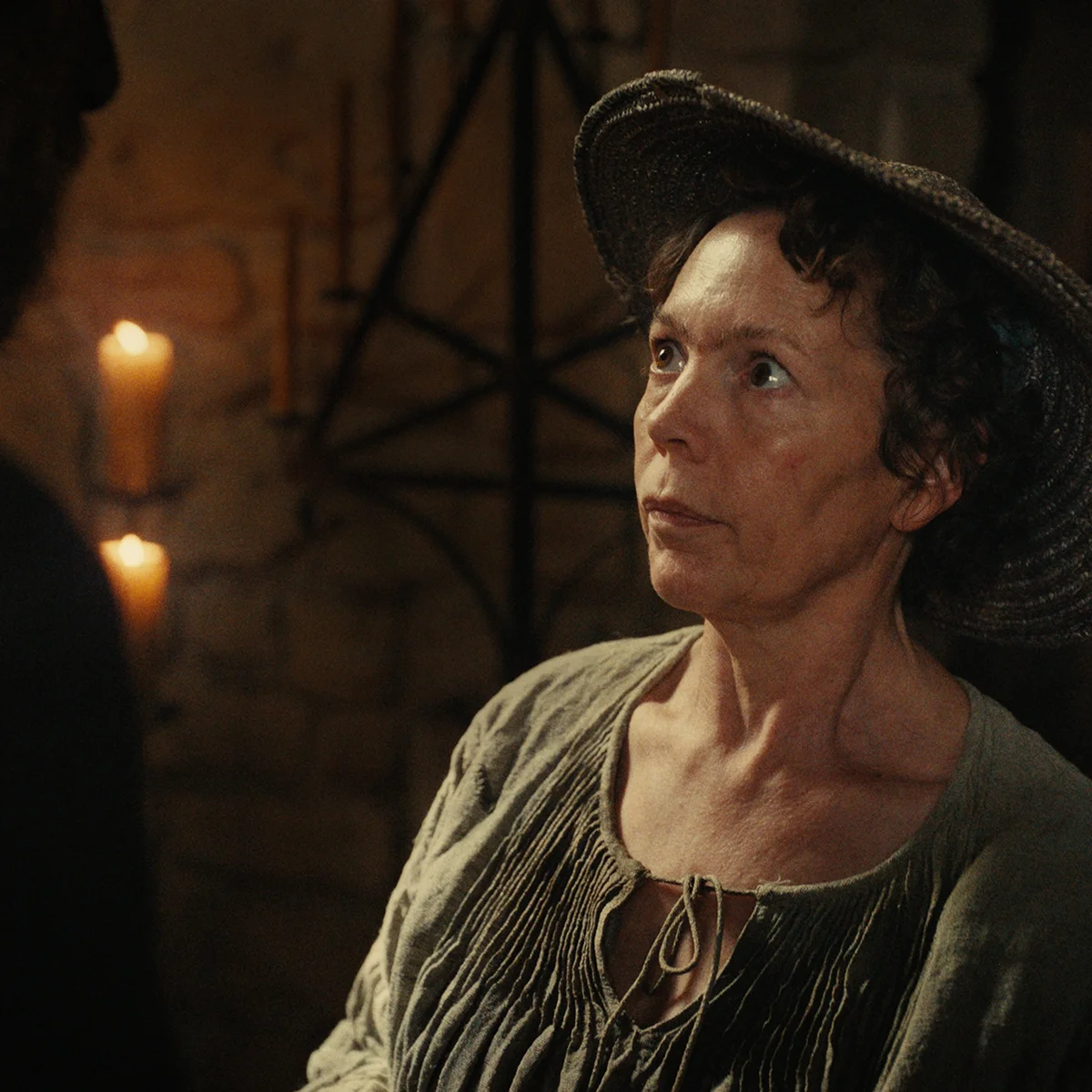
Colman plays a character known simply as the Fisherwoman.
She lives on the outskirts of a fictional seaside village where social rules appear rigid and judgment comes easily.
The Fisherwoman does not fit comfortably into this world.
She is unmarried, isolated, and routinely mocked by the people around her.
Rather than transforming herself into the kind of woman the village might approve of, she eventually decides the problem lies somewhere else.
If society insists that she needs a husband, perhaps she will simply acquire one on her own terms.
She approaches the local Basketmaker and makes an extraordinary request.
Build me a man.
The Basketmaker, played by Peter Dinklage, accepts the challenge.
Using wicker, craftsmanship, and more than a little fairy-tale magic, he creates the companion she asked for.
And somehow, impossibly, the creation lives.
Alexander Skarsgård Becomes the Perfect Husband
The finished man is played by Alexander Skarsgård.
He is tall, handsome, attentive, good-hearted and utterly devoted to the Fisherwoman.
There is only one obvious difference between him and every other man in the village.
He is made from woven reeds and willow.
Yet the strangeness of his physical appearance quickly becomes less important than the way he behaves.
The Wicker Husband treats the Fisherwoman with tenderness.
He listens to her.
He respects her.
He appears genuinely satisfied simply being with her.
In a conventional fairy tale, this might be where the story reaches its happy ending.
The lonely woman finally receives the love she has always wanted.
Instead, her happiness creates an entirely new problem.
Everyone else can see it.
And they do not like what they see.
The Fisherwoman was acceptable to the village when she was miserable.
She becomes much more threatening once she is happy.
The Perfect Relationship Starts Making Everyone Else Uncomfortable
The arrival of the Wicker Husband disrupts the social balance of the community.
People who once ridiculed the Fisherwoman now watch her with curiosity.
Then envy.
Then something darker.
Her unconventional marriage forces the villagers to examine their own relationships.
If a woman everyone considered undesirable can suddenly have a husband who treats her better than many “real” husbands treat their wives, what does that say about everyone else?
The fantasy therefore becomes a social experiment.
The Fisherwoman has not merely commissioned a companion.
She has accidentally introduced a new standard into a conservative community.
Sundance described the film as a fable in which the unusual marriage sparks revelations about the villagers themselves, exposing hidden desires and darker sides of human nature.
The more people observe the couple, the more cracks begin appearing in their own lives.
Jealousy spreads.
Desire surfaces.
Resentment grows.
And suddenly the ridiculous-looking wicker man may be the most emotionally functional husband in the entire village.
Elizabeth Debicki Represents Another Side of the Story
Elizabeth Debicki appears as the Tailor’s Wife, one of the villagers particularly affected by the Fisherwoman’s unconventional relationship.
Her character helps expand the story beyond one lonely woman finding companionship.
The existence of the Wicker Husband raises uncomfortable questions for other women.
What if dissatisfaction is not something they simply have to tolerate?
What if love could look different?
What if the rules surrounding marriage exist mainly because everyone has agreed not to challenge them?
Debicki has described the story as partly concerned with a woman discovering that she has the right to choose the direction of her own life.
That makes the film’s bizarre premise more purposeful than it initially appears.
A husband made of wicker is funny.
A woman realizing she does not need society’s permission to decide what makes her happy is much more disruptive.
And Now the Film Has a Name
The movie is Wicker, a 2026 fantasy romance written and directed by Eleanor Wilson and Alex Huston Fischer.
It stars Olivia Colman as the Fisherwoman, Alexander Skarsgård as her Wicker Husband, Peter Dinklage as the Basketmaker, and Elizabeth Debicki among the ensemble of villagers.
The film is adapted from Ursula Wills-Jones’ short story The Wicker Husband and had its world premiere at the 2026 Sundance Film Festival. The British Council lists the finished feature at 105 minutes and categorizes it as a fantasy romance.
But calling Wicker a simple romance does not quite capture what it is doing.
It is part fairy tale.
Part comedy.
Part relationship satire.
And part examination of why other people’s happiness can sometimes feel personally threatening.
Olivia Colman Is Almost Perfect Casting
The premise requires an actress capable of making absurdity feel emotionally real.
Olivia Colman is unusually well suited to that challenge.
She has spent much of her career moving between comedy and devastating drama, often within the same performance.
Her Fisherwoman can therefore be ridiculous without becoming a joke.
The audience can laugh at the situation while still understanding why she wants companionship.
That balance is essential.
If the movie treated her desire purely as comedy, the story would become cruel.
If it treated the wicker husband with complete seriousness, the concept could become unbearably self-important.
Instead, the filmmakers lean into the absurdity.
At Sundance, the directors openly joked about the surprisingly detailed wicker costume, while Skarsgård himself discussed the challenge of playing a genuinely sweet and morally decent character rather than the darker figures he often portrays.
The result appears intentionally strange, sensual, funny, and sincere at the same time.
Yes, Alexander Skarsgård Is Actually Covered in Wicker
One of the most visually unusual elements of the film is Skarsgård’s transformation.
Rather than simply suggesting that his character is made from wicker, the production commits completely to the idea.
The costume incorporates elaborate woven textures created with practical effects, giving the character a physical presence that is both human and unmistakably artificial.
Wētā Workshop contributed to the intricate design, and the production even had to solve the unexpected challenge of making intimate scenes between Colman and a man covered in wicker feel convincing.
That commitment matters because the film’s central joke cannot work if the husband simply looks like a handsome actor wearing a vaguely rustic costume.
He has to look impossible.
Everyone around him has to recognize that he should not exist.
And then, gradually, the audience has to stop caring.
Because his emotional humanity begins to matter more than the material from which he is constructed.
The Real Fantasy Is Not the Wicker Man
That may be the film’s cleverest reversal.
At first, viewers are invited to believe that the fantastical element is obvious:
A basketmaker builds a husband, and the husband comes alive.
But the deeper fantasy may be the idea of a relationship in which someone is genuinely seen, accepted, and loved without being forced to become more socially acceptable first.
The Fisherwoman has spent much of her life being told indirectly — and sometimes directly — that she is not worthy of love.
Her new husband does not ask her to change.
That acceptance destabilizes everyone around them.
Sundance characterized the story as a surreal meditation on desire and loneliness, with love eventually exposing hidden impulses and the darker parts of human nature.
In that sense, the wicker body is almost a distraction.
The truly uncomfortable idea is that the artificial man may understand love better than many of the humans surrounding him.
A Fairy Tale for Adults
The filmmakers have described the world as a fictional medieval-like village shaped by folklore rather than a historically precise setting.
That gives Wicker freedom to behave more like an adult fable than a conventional period piece.
Its characters can represent recognizable social attitudes without the movie being tied to one exact historical moment.
The villagers believe in hierarchy.
They believe in appearances.
They believe certain people deserve happiness and others should accept their place.
Then one woman refuses.
Her rebellion does not begin with a political speech.
It begins with wanting someone to love her.
And that seemingly private desire becomes revolutionary because it exposes how much of the village’s social order depends on people quietly accepting dissatisfaction.
The Movie Has Already Generated Attention for Exactly the Reason You Would Expect
A movie starring Olivia Colman opposite Alexander Skarsgård as a handwoven husband was unlikely to pass unnoticed.
Following its Sundance premiere, the unusual premise and images of Skarsgård in the full wicker design quickly attracted attention.
Even IKEA joined the conversation after promotional footage began circulating, joking about furniture made from “husband material.”
But beneath the obvious meme potential is a story the cast and filmmakers appear to have taken seriously.
The absurdity is the invitation.
The emotional questions are what remain once audiences enter the story.
How much of our idea of a successful relationship comes from what we actually want?
How much comes from what other people expect us to want?
And why does seeing someone reject those expectations make others so uncomfortable?
The Strangest Love Story of the Year May Also Be One of the Most Familiar
By the time the Fisherwoman gets what she asked for, Wicker has already turned the traditional fairy-tale structure upside down.
She does not wait for a prince.
She commissions one.
She does not become beautiful enough to deserve love.
She finds love while remaining exactly the woman the village rejected.
And instead of her unconventional relationship being the thing that needs fixing, it is everyone else who begins revealing how dysfunctional they really are.
That is what makes the premise more than an eccentric gimmick.
The film is Wicker.
It stars Olivia Colman, Alexander Skarsgård, Peter Dinklage, and Elizabeth Debicki, and after premiering at Sundance earlier this year, it is scheduled for a limited theatrical release on October 23, 2026, followed by a wider release on October 30.
So no, it is not currently a Netflix release.
But the premise alone explains why people are already talking about it.
A lonely fisherwoman asks a basketmaker to build her the perfect husband.
He does.
And the moment she finally becomes happy, everyone around her begins falling apart.