
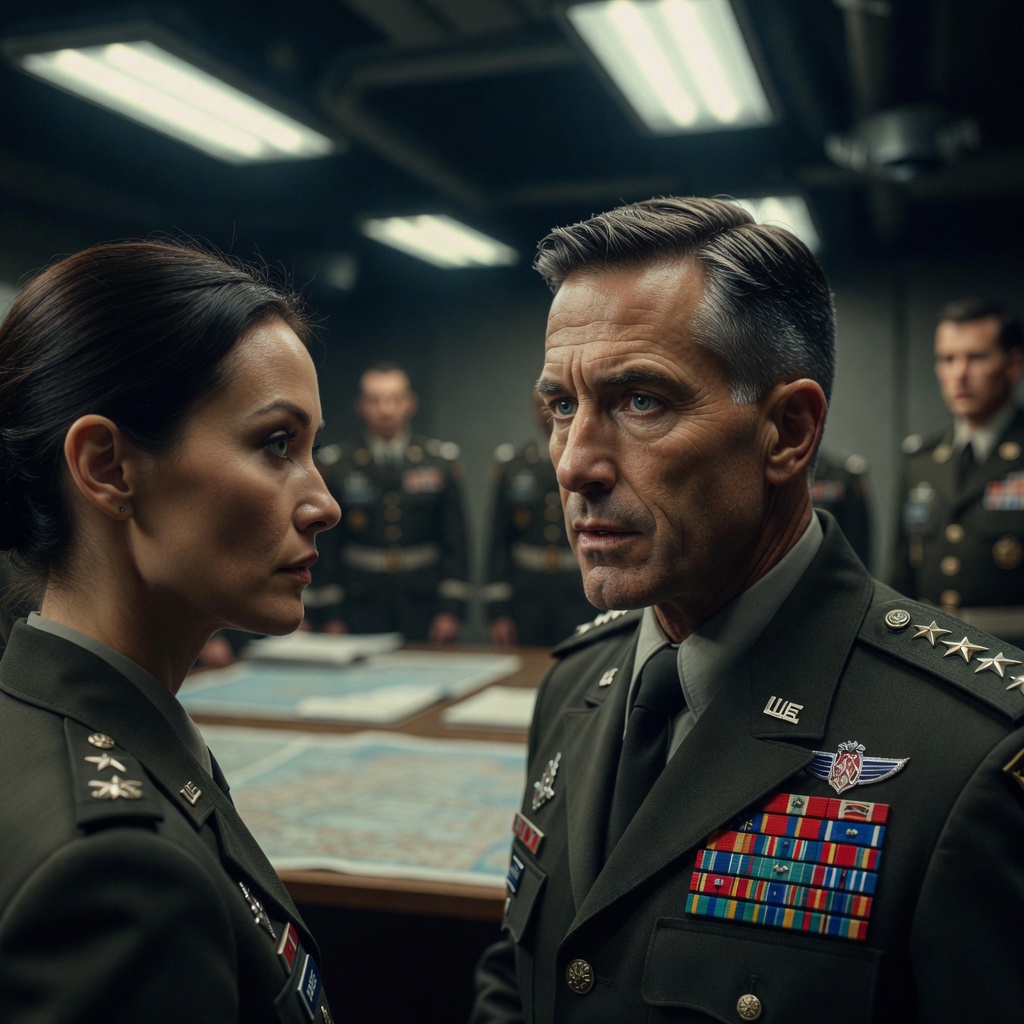
The Shadow in the Ranks Casts a Long Silhouette. The Arrogance of Command Falls Before the Truth of the Field.
The dust of Fort Ravenwood didn’t just coat the boots of the soldiers; it seemed to permeate the very soul of the base, a fine, grit-filled reminder that out here, in the high desert of the frontier, reality was often obscured by the haze. The woman in the standard field uniform stepped through the checkpoint with a plain ID badge clipped to her chest and a battered notebook tucked under her arm, appearing so unremarkable that she was practically invisible. She was the ghost in the machine, a silent observer in a world built on the deafening roar of authority.
Colonel Gideon Briggs was pacing at the front of the briefing room like the carpet owed him rent, his boots striking the floor with the rhythmic, aggressive tempo of a man who believed the earth itself should tremble at his approach. Briggs was the king of Ravenwood, a man whose ego was as polished as the silver eagles on his shoulders. To him, leadership was a performance, and today was the opening night of his greatest act: the Command Review.
“Where is our visitor?” Briggs barked, his voice bouncing off the sterile walls of Conference B. He didn’t look for an answer; he expected the air to provide one.
“She’s here, sir,” a captain murmured, nodding toward the back of the room.
Briggs turned, his eyes narrowing as they landed on the woman. She had taken a seat in the far corner, her battered notebook open, a cheap ballpoint pen poised over the paper. She looked like a clerk, or perhaps a junior analyst sent to fetch coffee and transcribe the brilliance of superior men. Briggs felt a surge of dismissive contempt; he had prepared a feast of tactical jargon and bravado, and he was being served a side dish of mediocrity.
“A bit late, aren’t we, Captain…?” Briggs trailed off, waiting for a name.
“Miller,” she said. Her voice was low, steady, and lacked the tremulous edge of someone intimidated by his rank. “And I’ve been here for ten minutes, Colonel. Please, continue. Don’t let my presence disrupt your rhythm.”
Briggs let out a short, sharp bark of a laugh. “Rhythm? This is a command review, Miller, not a dance recital. You’re here to observe the operational excellence of the 4th Division. Try to keep up.”
The next three hours were a masterclass in theatre over substance. Briggs moved through digital slides with the grace of a predator, highlighting inflated recruitment numbers, glossing over supply chain hemorrhages, and painting a picture of a base that was a shining beacon of military efficiency. He spoke of “synergy,” “kinetic dominance,” and “asymmetrical superiority.” The other officers in the room took notes feverishly, their eyes darting to Briggs to ensure they were nodding at the correct intervals.
The woman in the corner wrote nothing but single words every ten minutes.
“Any questions from the peanut gallery?” Briggs asked, leaning over the table, his knuckles white against the mahogany. He was sweating now, the heat of his own performance radiating off him.
Miller looked up from her notebook. “I noticed on slide fourteen that you cited a ninety-two percent readiness rate for the armored transport wing.”
“Correct,” Briggs said, his chest puffing out.
“Then why,” Miller asked, her voice cutting through the room like a cold front, “did I count forty-seven vehicles with red-tagged engine blocks in the East Motor Pool on my walk in? By my math, that puts your actual readiness at roughly sixty-four percent. Unless, of course, the 4th Division plans on pushing those trucks into battle.”
The room went so silent you could hear the hum of the air conditioning. Briggs’s face transitioned from a smug bronze to a deep, dangerous purple. “Listen here, Captain. You walked past a staging area. You don’t know the maintenance cycles of this base. You’re a rookie looking at a snapshot and calling it a film.”
“I also noticed,” she continued, ignoring his outburst, “that the cafeteria is serving Grade-D surplus meat, yet your budget filings show a contract for premium local sourcing. There’s a discrepancy of forty thousand dollars a month. Where is that money, Colonel?”
Briggs slammed his hand onto the table. The water glasses rattled. “This review is over! I will not be interrogated by a junior officer who doesn’t even have enough ribbons to cover a postage stamp! Get out of my briefing room!”
Miller didn’t move. She didn’t even blink. “You’re right about one thing, Colonel. I don’t have many ribbons on this uniform. I find they tend to snag on things in the field.”
“I said get out!” Briggs roared, stepping toward her. He was a foot taller, a wall of muscle and anger, but she stood her ground until he was inches from her face.
“Colonel Briggs,” she said, her voice dropping into a register that made the hair on the back of the other officers’ necks stand up. “I am not here to observe your excellence. I am here to perform your autopsy.”
She reached into the pocket of her field jacket and pulled out a small, laminated card. She didn’t hand it to him; she laid it on the table. It wasn’t an ID badge. It was a Warrant of Command.
“I am Major General Elena Vance, Inspector General of the Armed Forces,” she said.
The silence that followed was different than before. It wasn’t the silence of tension; it was the silence of a vacuum. The air had been sucked out of the room by the revelation of her rank. Briggs stumbled back, his heel catching on the carpet. The silver eagles on his shoulders suddenly looked like cheap tin.
“General… I… there must be a mistake,” Briggs stammered, his bravado dissolving into a pathetic, watery panic. “The notification said a junior liaison was coming. I thought you were a rookie.”
“I know what you thought,” Vance said, stepping into the center of the room. She looked at the other officers, who were now standing so straight they looked like statues. “You thought you could dazzle a ‘rookie’ with jargon while you bled this base dry to fund your retirement. You thought the uniform made the man, rather than the man honoring the uniform.”
She walked to the front of the room, standing where Briggs had stood just minutes before. “Fort Ravenwood isn’t a stage, Colonel. It’s a defense. And you’ve left the gates wide open.”
Vance spent the next hour dismantling the 4th Division with the precision of a surgeon. She knew about the ghost payrolls. She knew about the fuel siphoning. She knew about the way Briggs had bullied his junior officers into silence. She had spent three weeks on the base under a dozen different aliases—a kitchen worker, a mechanic’s assistant, a lowly clerk—before she ever set foot in Conference B.
“You’re relieved of command, effective immediately,” Vance said, her voice ringing with finality. “Military Police are waiting outside to escort you to the brig pending a full court-martial.”
As the MPs entered the room and stripped Briggs of his sidearm, the disgraced Colonel looked at Vance with a mixture of awe and hatred. “How did I miss it?” he whispered. “I looked right at you for three weeks. I saw you in the motor pool. I saw you in the mess. How did I not see the General?”
“Because you were looking for a rank, Gideon,” Vance said, closing her battered notebook. “I was looking for a soldier. Neither of us found what we were looking for.”
Briggs was led away in handcuffs, his head bowed. The remaining officers waited in terrified anticipation, expecting the hammer to fall on them next. But Vance simply looked at them, her expression softening into something resembling weary hope.
“The 4th Division has a lot of work to do,” she said. “We start tomorrow at 0500. And I expect to see every one of you in the motor pool with a wrench in your hand.”
She walked out of the room, her boots making the same quiet, efficient sound as when she arrived. She didn’t need an entourage. She didn’t need ribbons. She was the Major General, and the shadow she cast over Fort Ravenwood was finally long enough to cover the truth.
Vance returned to the small, cramped office she had used during her undercover stint. She sat at the desk and pulled out her notebook. But she didn’t write about the court-martial. She didn’t write about the budget. She pulled out a small, crumpled photograph from the back of the notebook.
It was a picture of a young man, barely twenty, in a uniform that looked three sizes too big for him. He was smiling, a wide, gap-toothed grin, standing in front of a transport truck in a desert that looked remarkably like Ravenwood.
“I got him, Tommy,” she whispered, her voice finally breaking.
The twist wasn’t that she was a General. The twist was why she was there. Tommy Vance had been a mechanic at Fort Ravenwood two years ago. He was the one who had first noticed the red-tagged engines. He was the one who had tried to report the diverted fuel funds. And he was the one who had been killed in a “training accident” when one of those faulty transport trucks had rolled over on a mountain pass.
The Army had called it a tragedy. Elena Vance had called it murder.
She had spent two years climbing the bureaucratic ladder, taking the Inspector General post specifically so she could have the authority to tear Ravenwood apart. She hadn’t just come to fix a base; she had come to avenge a son.
She tucked the photo back into the notebook and stood up. The desert wind was howling outside, rattling the windows of the office. To anyone watching, she was just a lone officer walking across the parade ground in the dark. But as she disappeared into the night, the grit of Ravenwood felt a little less heavy, and the air felt a little more like justice.
The next morning at 0500, the officers of the 4th Division were at the East Motor Pool. They were covered in grease, their hands bruised and bleeding as they worked on the red-tagged engines. And in the middle of them, wearing a grease-stained field uniform with no insignia, was the Major General.
She wasn’t barking orders. She was holding a flashlight for a young private, showing him exactly how to fix a fuel line that had been rigged to leak.
“You’re a natural at this, ma’am,” the private said, wiping sweat from his brow. “Did you learn this at the Academy?”
Vance smiled, a sad, quiet expression that didn’t reach her eyes. “No, Private. I learned it from the best soldier I ever knew.”
The legacy of Gideon Briggs was scrubbed from the base within a month. The fancy chandeliers in the officer’s club were sold to pay for new barracks. The “Grade-D” meat was replaced with fresh supplies. And the readiness rate of the armored transport wing finally climbed to a genuine, hard-earned ninety percent.
Fort Ravenwood was no longer a stage. It was a fortress again.
And every year on the anniversary of the Command Review, a single bouquet of desert wildflowers would appear at the mountain pass where a transport truck had once rolled over. No one ever saw who left them. They just appeared in the quiet hours of the dawn, a small, vibrant burst of color against the gray grit of the desert.
Major General Vance eventually moved on to other bases, other reviews, other autopsies of corruption. But she never forgot the lessons of the desert. She never forgot that the most dangerous weapon in the military wasn’t a tank or a missile—it was a woman with a notebook and a reason to remember.
Years later, when she finally retired, she was asked what her proudest achievement was. The interviewer expected her to talk about her stars, or her commendations, or the high-level policy changes she had enacted at the Pentagon.
She simply pulled out a battered notebook and showed him a picture of a mechanic.
“I made sure the trucks worked,” she said. “So the boys could come home.”
The world remembers the Major General for the ranks she broke and the colonels she crushed. But in the quiet corners of Fort Ravenwood, the soldiers tell a different story. They tell the story of the “Ghost Mechanic”—the woman who walked into a Den of Lions and made them all remember what it meant to serve.
She thought he was a tyrant. He thought she was a rookie. But in the end, the only thing that mattered was the truth left in the dust.