
PART 1
The first lie my mother-in-law ever told about me was that I was dangerous because I was quiet.
She said it with that polished little smile of hers, the one she wore at church luncheons and charity auctions and Christmas dinners where everyone pretended not to notice the way she controlled a room with one raised eyebrow. Eleanor Anderson never shouted when a whisper could poison the air more efficiently. She did not need to throw plates or slam doors. She simply tilted her chin, touched the pearls at her throat, and made people believe whatever version of the truth benefited her most.
For six years, I had been her favorite mystery.
My name is Stephanie Hamilton Anderson, though in certain rooms, under certain lights, my name was attached to things I could never explain at dinner tables. I was thirty-seven years old, an officer in the United States Air Force, and I had spent nearly sixteen years serving in places and roles my family was never fully allowed to understand.
To Eleanor, my silence was not discipline.
It was guilt.
At first, the comments came wrapped in sugar.
“Stephanie is so private,” she would say, passing mashed potatoes across her gleaming dining table. “Almost secretive, really.”
Then came the sharper version.
“Most wives are proud to talk about their work. Unless, of course, there’s something they can’t be proud of.”
My husband, Daniel, would shift uncomfortably beside me, always looking down at his plate, never quite defending me strongly enough to start a war, never quite betraying me loudly enough to end one.
“Mom,” he would mutter. “Leave it alone.”
But Eleanor never left anything alone once she had decided it belonged to her.
She disliked that I did not explain myself. She hated that I did not beg to be understood. Most of all, she hated that her son looked at me with a kind of respect she could not command with money, guilt, or tradition.
Daniel and I met at a veterans’ fundraiser in Atlanta. He was a civil engineer then, kind, handsome in a tired, honest way, with the sort of gentle laugh that made strangers trust him. He admired my discipline. I admired his steadiness. We married two years later under a white arbor behind his parents’ house, while Eleanor watched me walk toward her son like I was a document she had not approved.
The marriage was not perfect, but few marriages are. Daniel loved peace more than truth, and I had been raised to respect truth even when it arrived carrying a weapon. Still, I loved him. And for a while, that was enough.
Until our son, Caleb, was born.
Caleb came into the world during a thunderstorm, fists clenched, lungs furious, as if he had already decided he would not be ignored. He had Daniel’s dark eyes and my father’s quiet stare. From the moment I held him, something ancient and protective locked into place inside me.
Eleanor adored him immediately.
And then she began trying to claim him.
It started with small things. She criticized how I held him, how I fed him, how often I traveled, how I disciplined him, how I spoke to him. When duty called me away, she told Caleb, “Mommy has secrets again.” When I came home, she asked him whether he was scared of me.
He was four the first time he repeated it.
“Grandma says you do scary work,” he whispered one night while I tucked him in.
I sat very still beside his bed, my hand resting on his dinosaur blanket.
“What do you think?” I asked.
He studied my face with the seriousness only children possess.
“I think you come home tired. But you always come home.”
I kissed his forehead and said, “That’s right.”
But Eleanor was patient. Poison, when given in tiny doses, does not look like poison until the body starts failing.
By the time Caleb turned six, Eleanor had convinced herself that my work had damaged me, that my calm was unnatural, that my refusals to answer her questions were proof of instability. She began writing things down. Dates. Phrases. Half-remembered moments twisted into accusations.
Stephanie refuses to discuss deployments.
Stephanie becomes silent when questioned.
Stephanie keeps classified documents locked in her office.
Stephanie’s son appears afraid when she enters the room.
That last one nearly broke me.
Caleb was not afraid of me. He was afraid of conflict. He hated when adults raised their voices. He hid behind me when Eleanor and Daniel argued. He clung to my sleeve when his grandmother questioned him like a witness.
But Eleanor saw only what she wanted.
The morning she filed for a restraining order, I was at home making coffee.
Daniel had already left for work. Caleb was upstairs building a spaceship out of plastic blocks. The knock came at 7:12 a.m., firm and official.
Two deputies stood on my porch.
“Stephanie Hamilton Anderson?”
“Yes.”
One of them looked apologetic.
“You’ve been served, ma’am.”
I read the first page without blinking.
Petition for Temporary Protective Order. Allegations of emotional intimidation. Unstable military-related behavior. Child safety concerns.
At the bottom was Eleanor’s signature.
For one moment, the world narrowed to paper, ink, and the sound of Caleb laughing upstairs, unaware that his grandmother had just tried to turn his mother into a threat.
Daniel called me sixteen times that day.
I answered on the seventeenth.
“Steph,” he said, voice cracking. “I didn’t know she was going to do this.”
“But you knew she was building toward something.”
Silence.
That was his answer.
Court was scheduled nine days later.
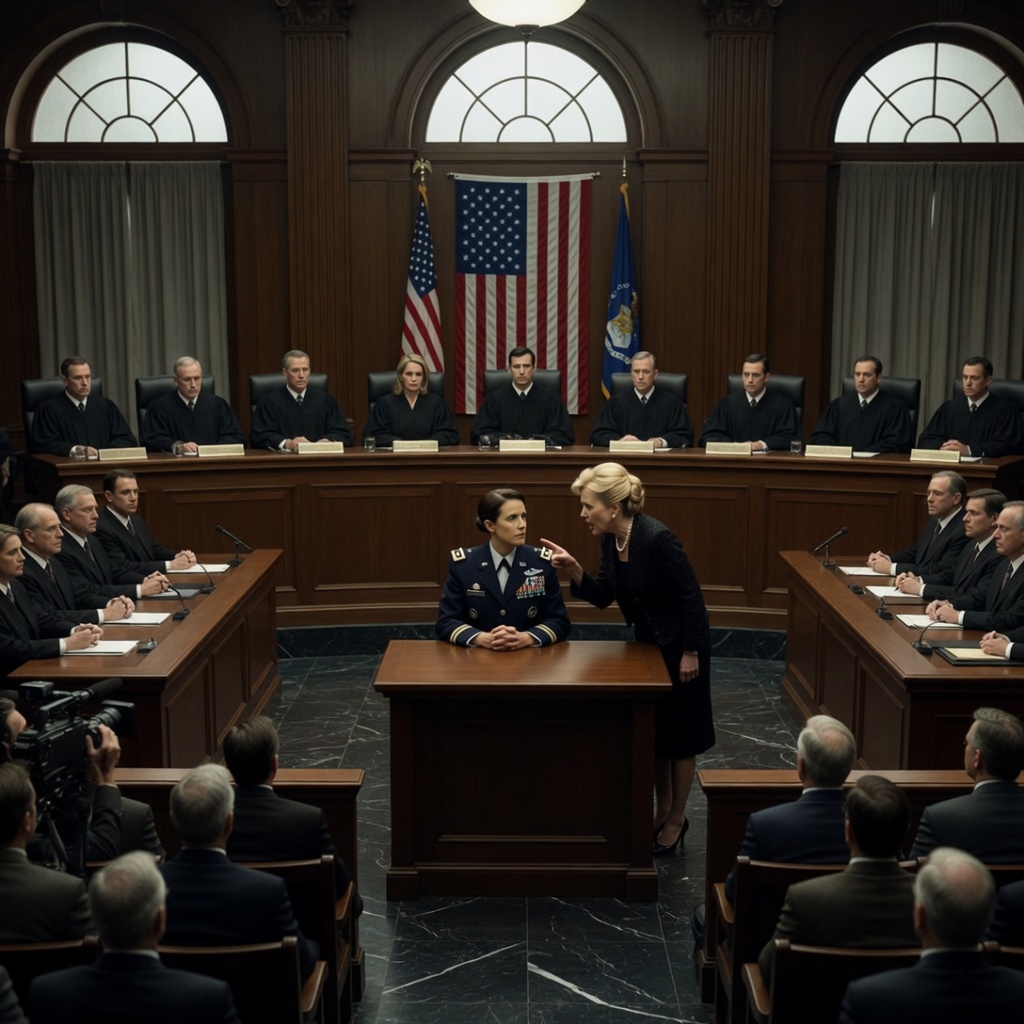
Eleanor arrived dressed like a grieving widow at a trial she had already won. Daniel sat behind her, pale and miserable. Caleb was not present, thank God. My attorney, Marcus Reed, a former JAG officer with silver at his temples and a voice like gravel, sat beside me.
“You understand what may happen if they introduce your service record?” he murmured.
“Yes.”
“We can object.”
“No.”
Marcus looked at me carefully.
“Stephanie, once the judge reviews it, this room changes.”
I folded my hands on the table.
“Then let it change.”
Across the aisle, Eleanor dabbed at perfectly dry eyes.
When the judge entered, everyone stood.
Judge Whitaker was in his late sixties, sharp-eyed, federal bench posture, the kind of man who had seen enough lies to know they often came dressed as concern.
Eleanor testified first.
Her voice trembled with practiced sorrow.
“She frightens my grandson,” she said. “She keeps things hidden. She disappears for weeks. Months. She won’t say where she has been. My son is afraid to confront her. Caleb is becoming withdrawn.”
My attorney objected twice. The judge allowed most of it.
Then Eleanor turned her face toward me.
“You’re making my son afraid of you,” she said, voice suddenly hard beneath the softness. “And you’ve made that child afraid too.”
Something in my chest went cold.
Not angry.
Cold.
Judge Whitaker looked toward me.
“Mrs. Anderson, do you wish to respond?”
I looked at Eleanor. Then at Daniel. Then at the judge.
“No, Your Honor.”
A ripple moved through the courtroom.
Eleanor’s mouth twitched, satisfied. She thought silence was surrender.
Then her attorney stood.
“Your Honor, we have requested review of Mrs. Anderson’s military service history, as we believe it is relevant to her psychological state and pattern of secrecy.”
Marcus leaned toward me.
“This is the moment,” he whispered.
I nodded once.
The sealed file was brought forward.
Judge Whitaker accepted it.
The courtroom seemed to inhale.
He opened the first page.
At first, his face remained neutral. Then his eyes slowed. His fingers stopped moving. He turned another page. Then another.
He paused.
Set down his glasses.
Looked at the bailiff.
And the entire atmosphere in the room changed before Eleanor even understood what had happened.
PART 2
The bailiff, a tall man with a military haircut and shoulders like a locked door, straightened as if pulled by a wire.
Judge Whitaker did not speak for almost twenty seconds.
In a courtroom, twenty seconds is not silence. It is pressure.
Eleanor shifted in her seat.
“Your Honor?” her attorney asked carefully.
The judge raised one hand without looking up.
He continued reading.
I kept my eyes forward, breathing evenly through my nose. Marcus sat very still beside me. He knew enough to understand what the judge was seeing, but not enough to know all of it. Almost no one did.
The file did not contain everything. It could not. But it contained enough.
Enough dates.
Enough commendations.
Enough redactions.
Enough phrases like mission-critical intelligence support, hostile extraction coordination, civilian casualty prevention, and actions directly contributing to preservation of allied lives.
Enough to make a federal judge understand that Eleanor had mistaken silence for emptiness.
Judge Whitaker finally closed the folder, not completely, just enough to rest his hand on top of it.
“Mrs. Anderson,” he said.
Eleanor lifted her chin.
“Yes, Your Honor.”
“Do you understand what this record is?”
She blinked.
“It is my daughter-in-law’s military file.”
“No,” he said, voice flat. “It is a record of service under conditions most citizens will never be asked to imagine.”
The courtroom went still.
Daniel’s head lowered.
Eleanor’s attorney swallowed.
Judge Whitaker looked at me now, and the expression in his eyes had changed. Not pity. Not admiration exactly. Recognition.
“Lieutenant Colonel Anderson,” he said, using my rank for the first time, “you declined to answer these accusations directly. Why?”
I felt every person in the room turn toward me.
I stood.
The chair made a small scraping sound against the floor.
“Because, Your Honor, I have spent my career learning that not every accusation deserves classified information as a defense.”
A murmur passed through the benches.
Eleanor’s face tightened.
Judge Whitaker leaned back.
“And yet Mrs. Eleanor Anderson interpreted your silence as evidence against you.”
“Yes, sir.”
“Has your son ever been harmed by you?”
“No, sir.”
“Has your son ever expressed fear of you in your presence?”
“No, sir. He has expressed fear when adults around him argue.”
The judge’s gaze moved to Daniel.
Daniel looked like a man being slowly crushed by the weight of every cowardly silence he had ever chosen.
“Mr. Anderson,” the judge said. “Stand.”
Daniel stood.
“Did you support this petition?”
Daniel opened his mouth, closed it, then opened it again.
“I didn’t file it.”
“That was not my question.”
Daniel’s hands trembled.
“I knew my mother was concerned.”
“Were you concerned?”
He looked at me then. His eyes were wet.
“No, Your Honor.”
Eleanor turned sharply.
“Daniel.”
He flinched at her voice, and that tiny movement said more than any testimony could have.
Judge Whitaker saw it.
So did I.
So did the bailiff.
Eleanor realized too late that control, once visible, becomes evidence.
“Mr. Anderson,” the judge continued, “did your wife ever threaten you?”
“No.”
“Did she ever threaten your son?”
“No.”
“Did she ever use her military status to intimidate your family?”
Daniel swallowed hard.
“No. She barely talks about it.”
Eleanor whispered, “Because she’s hiding something.”
Judge Whitaker’s eyes snapped to her.
“Mrs. Anderson, another interruption and I will hold you in contempt.”
Her mouth shut.
For the first time since I had known her, Eleanor Anderson looked small.
But not defeated.
People like Eleanor do not surrender when truth appears. They simply search for a new angle.
Her attorney requested permission to question me.
The judge allowed it, with warning.
The attorney approached carefully.
“Lieutenant Colonel Anderson, is it fair to say your work has exposed you to stressful environments?”
“Yes.”
“Violent environments?”
“Yes.”
“Traumatic events?”
“Yes.”
He paced slowly, gaining confidence.
“And is it possible that such events affected your emotional responses at home?”
“Yes.”
Eleanor’s eyes lit faintly.
Marcus looked ready to object, but I raised one finger slightly beneath the table.
Let him continue.
“So you admit,” the attorney said, “that your military service may have affected your emotional behavior around your family?”
“Of course.”
He turned toward the judge as if he had drawn blood.
Then I added, “It made me more patient. More careful. Less likely to react impulsively. More aware of what fear looks like in a child.”
The attorney stopped.
I looked directly at Eleanor.
“And it made me very familiar with coercive behavior disguised as concern.”
Her face hardened.
“Objection,” her attorney said weakly.
“Sustained,” the judge said. But he did not sound displeased.
The attorney tried again.
“Lieutenant Colonel, why keep a locked office in your home?”
“Because some materials related to my work must be secured.”
“From your own family?”
“From everyone without authorization.”
“Even your husband?”
“Yes.”
Daniel looked down again.
The attorney smiled thinly.
“Doesn’t that create distrust?”
“No,” I said. “It creates compliance with federal law.”
Someone in the back coughed to hide a laugh.
The judge did not smile, but the corner of his mouth moved.
Then came the question Eleanor had been waiting for.
“Lieutenant Colonel Anderson,” the attorney said, “is it true that on March 3rd of this year, your son Caleb hid behind a chair when you entered the room?”
I remembered that day immediately.
Eleanor’s birthday dinner.
Caleb had hidden, yes.
Not from me.
From the argument Eleanor had started because Daniel had refused to let Caleb stay overnight at her house on a school night.
“Yes,” I said. “He hid behind a chair.”
“And you admit that?”
“I do.”
“Why?”
I looked at Daniel.
He covered his face with one hand.
“Because his grandmother had just told him that if he came home with me, he might not be safe.”
Eleanor gasped.
“That is not what I said.”
I turned toward her.
“You said, ‘Sometimes people who go to war bring the war home with them.’ He was six.”
The courtroom froze.
The attorney had no next question.
Judge Whitaker folded his hands.
“Mrs. Anderson,” he said to Eleanor, “did you say that to the child?”
“I was worried.”
“That is not an answer.”
“I may have said something similar.”
Daniel sat down heavily, though no one had told him he could.
My heart hurt then, not for Eleanor, but for the years I had spent trying to keep peace in a house where peace had only meant letting one woman sharpen knives in the dark.
Judge Whitaker turned to Marcus.
“Mr. Reed?”
Marcus stood, buttoning his jacket.
“Your Honor, we move for immediate dismissal of the petition and request the court consider sanctions for misuse of protective proceedings. We also request temporary limitations on Mrs. Eleanor Anderson’s contact with the minor child pending family court review.”
Eleanor made a small, strangled sound.
“You can’t keep me from my grandson.”
I finally looked at her fully.
“You tried to teach him I was something to fear.”
Her eyes burned.
“You took my son from me.”
“No,” I said quietly. “You trained him to be afraid of disappointing you. That is not the same as love.”
For a moment, the mask slipped completely.
The grief in Eleanor’s face was real, but so was the rage beneath it. She loved Daniel the way some people love heirlooms: as something precious because it belongs to them.
Judge Whitaker dismissed the petition.
But he did not stop there.
He ordered a transcript forwarded for review. He warned Eleanor about false statements and emotional manipulation of a child. He granted a temporary no-contact provision regarding Caleb until family court could evaluate the situation.
Then he looked at me.
“Lieutenant Colonel Anderson, this court thanks you for your service.”
The words were simple.
I had heard versions of them before.
But in that room, after years of being treated like my silence was dirt under a rug, they landed differently.
I nodded.
“Thank you, Your Honor.”
Court adjourned.
People stood. Benches creaked. Voices rose cautiously.
Eleanor remained seated, stunned, as if reality had struck her across the face.
Daniel came toward me.
“Steph,” he said.
I held up my hand.
He stopped.
Not because I commanded him.
Because he finally understood he had lost the right to step closer without permission.
Outside the courtroom, cameras waited. Someone had tipped off a local reporter, probably Eleanor, expecting a story about an unstable military mother.
Instead, they got nothing.
Marcus guided me through a side exit.
But just before I left, Eleanor’s voice cracked behind me.
“You think this is over?”
I turned.
She stood at the end of the hallway, pearls trembling against her throat.
Her eyes were no longer polished.
They were desperate.
“I know you,” she whispered. “Women like you always have something buried.”
I looked at her for a long moment.
Then I said, “So do women like you.”
And for the first time, she looked afraid.
PART 3
The call came three days later.
Not from Daniel.
Not from Eleanor.
From my father’s old friend, retired Colonel James Arlen, a man who had served with my dad in Vietnam and later worked in federal investigations. He was eighty-one, smoked too much, trusted almost no one, and remembered everything.
“Stephanie,” he said, without greeting, “what the hell did your mother-in-law just set in motion?”
I stood in my kitchen, looking out at Caleb chasing bubbles in the backyard.
“What do you mean?”
“I got a call asking about your father.”
My hand tightened around the phone.
“My father has been dead eleven years.”
“Dead men still have records.”
The air changed.
My father, Thomas Hamilton, had come home from Vietnam in 1972 with quiet hands and haunted eyes. He had taught me silence, discipline, and the sacred difference between privacy and shame. He had never spoken much about his service, and I had never pushed.
“What kind of call?” I asked.
“Someone wanted to know whether Thomas Hamilton ever served under an alias.”
A cold line moved down my spine.
“Who asked?”
“That’s the problem,” Arlen said. “The request was routed through a private investigator.”
Eleanor.
Of course.
Humiliated in court, barred from Caleb, exposed in front of Daniel, she had gone digging for revenge.
“What did you tell them?” I asked.
“I told them to die curious.”
Despite myself, I almost smiled.
Then Arlen’s voice softened.
“But Stephanie… your father did have something buried.”
The world seemed to tilt.
He continued carefully.
“Not shame. Protection.”
That evening, I opened the old cedar chest in my garage. My mother had given it to me after Dad died, full of photographs, medals, letters, and a folded flag. I had gone through it once, crying too hard to understand half of what I held, then locked it away.
At the bottom, beneath a stack of yellowed newspapers, I found an envelope sealed with brittle tape.
My name was written across it in my father’s handwriting.
Stephanie — when silence stops protecting you.
My hands shook.
Inside was a letter, three photographs, and a birth certificate that did not belong to anyone I recognized.
The letter was short.
My dear Steph,
If you are reading this, someone has mistaken our silence for weakness. I hoped that would never happen. During the war, I helped extract a young woman who had been used by men with power. She was pregnant. She had no family left and no safe country to return to. We gave her a name, a life, and protection. Years later, that child grew up under another name. You know her now as Eleanor Anderson.
She does not know the truth. Or perhaps she buried it so deep she became cruel to anything that reminded her of it.
Be careful. Pity her if you can. But do not let her near your child if she chooses control over truth.
Love, Dad.
I read it three times before I could breathe.
Eleanor.
My mother-in-law.
The woman who had spent years accusing me of hiding shameful secrets had been protected by my father’s silence her entire life.
The birth certificate listed another name. Another country. Another beginning.
The photographs showed a young woman holding a baby outside a military transport plane. On the back of one photo, my father had written: Evacuation complete. Child safe.
I sat on the garage floor until the light disappeared.
Daniel came over the next morning.
He looked terrible.
“I moved out of Mom’s house,” he said.
I stood in the doorway, arms crossed.
“That’s not enough.”
“I know.”
He looked past me toward the hall, where Caleb’s drawings covered the wall.
“I should have protected you.”
“Yes.”
He flinched, but he did not argue.
“I thought keeping peace was protecting everyone,” he said.
“No. It was protecting yourself from choosing.”
Tears filled his eyes.
“I know.”
I almost softened. Almost. But love without accountability is just another trap with prettier walls.
“There’s something you need to see,” I said.
I showed him the letter.
Daniel read it standing at my kitchen counter.
By the end, his face had gone white.
“No,” he whispered.
“Yes.”
“My mother knows?”
“I don’t know.”
“She always said her parents were distant cousins from Savannah. She had stories.”
“Maybe they were given to her. Maybe she made them up. Maybe she needed them.”
Daniel pressed both hands to the counter.
“What are you going to do?”
That was the question.
I could destroy Eleanor with this. Publicly. Completely. After what she had done, part of me wanted to.
But my father’s letter had not said punish her.
It had said be careful.
The family court hearing happened two weeks later.
Eleanor arrived diminished but still armored, wearing navy silk and pearls. Daniel sat beside me this time, not her. That alone seemed to age her ten years.
The judge reviewed the federal transcript, the dismissed restraining order, the statements made to Caleb, and the recommendation from the child psychologist, who concluded that Caleb had been exposed to adult manipulation and should have no unsupervised contact with Eleanor.
Eleanor’s attorney argued weakly.
Then Eleanor stood.
“I love my grandson,” she said, voice trembling.
I believed her.
That was the tragedy.
She loved him. But love twisted by fear can still wound.
The judge asked if there was anything further.
I stood.
Daniel looked at me, terrified.
Eleanor stared with suspicion.
I did not reveal the birth certificate. I did not expose the photographs. I did not turn her hidden life into a weapon.
Instead, I held only my father’s letter.
“There are family histories,” I said, “that are built on silence. Sometimes that silence protects people. Sometimes it imprisons them. I will not use private pain to humiliate anyone in this room.”
Eleanor’s expression flickered.
For one impossible second, I saw not the cruel matriarch, but a frightened child defending a story she could not afford to question.
I looked directly at her.
“But I will protect my son from being taught that secrecy is always shame, that service is sickness, or that love means ownership.”
Her lips parted.
She knew.
Maybe not everything.
But enough.
The judge granted supervised visitation only, pending therapy and review.
Eleanor did not protest.
Afterward, in the hallway, she approached me alone.
No pearls touched. No chin lifted.
Just an old woman standing before the daughter-in-law she had tried to ruin.
“What do you know?” she whispered.
I could have lied.
Instead, I said, “Enough to understand why silence frightens you.”
Her eyes filled, but no tears fell.
“My whole life,” she said, barely audible, “I felt like something was missing. My mother—my adoptive mother—used to say questions were ungrateful.”
I said nothing.
She looked toward Daniel, who stood at the far end of the hall with Caleb’s stuffed backpack in his hand.
“I thought if I controlled the story,” she whispered, “nothing could be taken from me.”
“You tried to take my son’s trust in me.”
Her face collapsed.
“I know.”
There was no dramatic apology. No instant forgiveness. Real life rarely gives clean endings wrapped in music.
But then Eleanor did something I never expected.
She removed the pearls from her neck.
Her hands shook as she held them out to me.
“These were never mine,” she said.
I did not take them.
“Keep them,” I said. “But stop wearing them like armor.”
Six months later, Daniel and I were separated but rebuilding carefully, slowly, honestly. Caleb was brighter. Lighter. He still saw his grandmother, but only with supervision, and Eleanor began therapy with a woman who specialized in adoption trauma and generational fear.
One afternoon, she asked to meet me at my father’s grave.
I agreed.
She stood before the stone for a long time, holding the photograph of the evacuation.
The wind moved through the cemetery grass.
Finally, she whispered, “He saved me.”
“Yes.”
“And I tried to destroy his daughter.”
I looked at the grave, at my father’s name carved into stone, at the man who had taught me that silence was not weakness.
“You didn’t destroy me.”
Eleanor nodded slowly, tears finally slipping down her face.
“No,” she said. “I suppose that was my mistake.”
Then she placed the pearls at the base of my father’s headstone.
Not as payment.
Not as performance.
As surrender.
A year later, Caleb asked me why Grandma Eleanor cried whenever we visited Grandpa Thomas.
I thought carefully before answering.
“Because sometimes,” I said, “people spend their whole lives being afraid of the truth. And then one day, the truth turns out to be the only thing that can set them free.”
Caleb considered this, then leaned against my side.
“Were you afraid in court?”
I looked across the yard, where Daniel was helping Eleanor plant flowers under Caleb’s very serious supervision.
“Yes,” I said. “But being afraid doesn’t mean you run.”
“What do you do?”
I smiled faintly.
“You stand still. You tell the truth you’re allowed to tell. And when the time comes…”
Caleb looked up.
I finished softly.
“You let the record speak.”