
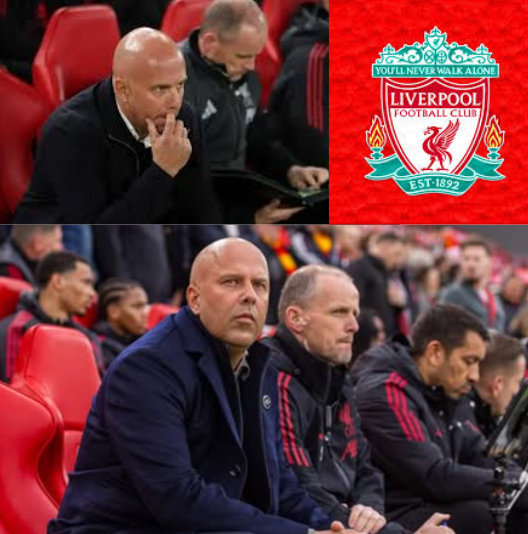
In the pressurized vacuum of elite European football, a single syllable can carry the weight of a sledgehammer. For Arne Slot, the man tasked with the unenviable job of succeeding Jürgen Klopp at Liverpool FC, a subtle shift in linguistic phrasing has managed to do what rival strikers have struggled to achieve this season: rattle the foundations of Anfield.
Recent reports suggesting that Slot has been reviewing his backroom staff and scouting protocols “in the event of him staying” have ignited a firestorm of speculation. To the casual observer, it is standard corporate due diligence. To the Anfield faithful, conditioned by decades of high-stakes drama, it sounds like the first crack in a glass ceiling.
I. The Linguistic Landmine: Decoding the Phrase
The phrase “in the event of staying” is technically a conditional clause, but in the context of a multi-million-pound managerial contract, it feels like an existential question.
Modern football management is no longer just about tactics and transfers; it is about optics. When Slot’s predecessors spoke, they often used the language of “when” and “we.” The shift to “if” and “him” suggests a detachment—or perhaps a realism—that fans aren’t used to.
As noted in our initial coverage, this could simply be standard contingency planning. In a data-driven club like Liverpool, every scenario is modeled, from winning the quadruple to a mid-season managerial transition. However, the wording instantly caught attention because it hints at a vulnerability that results on the pitch haven’t yet justified.
II. The Shadow of Klopp and the Burden of Excellence
To understand why the Liverpool fanbase is so sensitive to Slot’s phrasing, one must look at the ghost that still haunts the touchline. Jürgen Klopp wasn’t just a manager; he was a cultural institution. His commitment was never phrased in the conditional.
Arne Slot entered a club that was fundamentally rebuilt in Klopp’s image. While Slot has maintained a respectable win percentage and implemented a more controlled, possession-based style, he lacks the “Heads of State” aura that Klopp possessed. Consequently, any hint that Slot is “evaluating his position” or that the club is “evaluating his fit” is magnified tenfold.
III. The Backroom Shake-up: Strategy or Survival?
The reports indicate that Slot is taking a hard look at the medical department, the analytical wing, and the coaching staff. On the surface, this is what any elite leader does—they optimize.
Why the review matters:
-
Performance Metrics: Liverpool’s injury record over the last three seasons has been a point of contention. Slot’s desire to overhaul this area shows he is planning for the long term.
-
Structural Alignment: With the return of Michael Edwards and the appointment of Richard Hughes, the “power triangle” at Liverpool is still finding its equilibrium.
-
Contingency as Culture: Under FSG (Fenway Sports Group), Liverpool has always operated like a blue-chip corporation. Managers are assessed quarterly, not just annually.
If Slot is reviewing staff “in the event of staying,” it may be a sign of mutual assessment. The club is watching him, and he is watching the club. This isn’t necessarily a sign of instability; it’s a sign of a high-performance environment where no one is “safe” by default.
IV. The Speculation Engine: Is There Smoke or Just Mirrors?
The sports media cycle thrives on “The Narrative.” Currently, there is no concrete indication from the boardroom that Slot’s job is in jeopardy. Yet, the “If He Stays” narrative persists because it fills the void left by the mid-season international breaks and the quiet periods of the transfer window.
Critics argue that if the results were perfect, these words would be ignored. But football is a game of margins. A few draws and a dip in the “heavy metal” intensity have led some to wonder if Slot is a “transitional” figure rather than a “generational” one.
“In football, even the smallest detail can quickly become a major talking point,” the report notes. “This is a curious choice of words—one that fuels debate, but doesn’t necessarily confirm instability.”
V. The FSG Factor: Data over Sentiment
Liverpool’s owners, FSG, are notoriously unsentimental. They famously parted ways with club legend Kenny Dalglish and replaced Brendan Rodgers the moment the data suggested a plateau.
If Slot is using conditional language, it might be a reflection of the contractual reality at Anfield. In the modern era, the “three-year cycle” is becoming the industry standard. Slot, being a pragmatist, may simply be acknowledging the reality that in football, “forever” usually means “until the next bad run of form.”
VI. Conclusion: A Storm in a Teacup or a Warning Sign?
So, is Arne Slot going anywhere? Likely not. His tactical integration has been largely successful, and the players seem to have bought into his more measured approach to the game.
However, the “If He Stays” saga serves as a vital reminder: The Liverpool job is the most scrutinized position in British sport. Every press conference is a deposition; every leaked report is a piece of evidence.
Arne Slot’s choice of words might have been a slip of the tongue or a deliberate piece of corporate jargon. Regardless, it has reminded the world that at Anfield, the ghost of the past is always watching, and the future is never guaranteed. For now, Slot is the man in charge—conditionally or otherwise.