
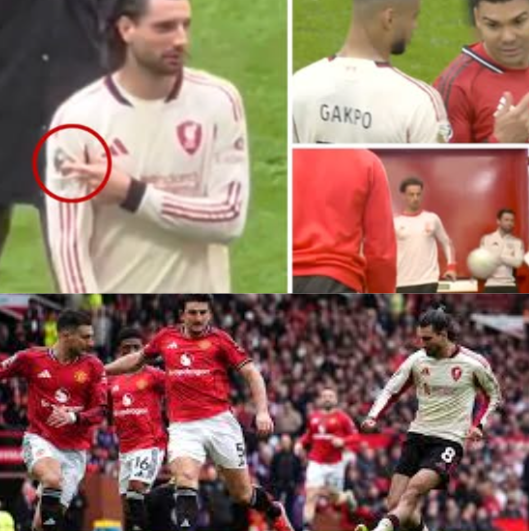
There was a time, not so long ago, when the journey down the M62 from Liverpool to Manchester was treated with the solemnity of a crusading army entering enemy territory. To wear the Liverbird at Old Trafford was to carry the weight of a city’s pride, a century of rivalry, and a burning, mutual animosity that fueled the greatest spectacle in English football.
But on Sunday evening, as the final whistle blew on a demoralizing defeat for the visitors, a scene unfolded that would have made Bill Shankly shudder and Bob Paisley turn in his grave. Before the echoes of the home crowd’s gloating had even subsided, two Liverpool players were seen laughing with their Manchester United counterparts, clutching swapped jerseys and—most gallingly—pointing toward the Champions patches on their sleeves as if a past trophy could somehow camouflage a present surrender.
The verdict among the traveling faithful and stunned pundits alike was swift: Liverpool is no longer a serious football club.
I. The Optics of Surrender
Football is a game of symbols. For ninety minutes, the shirt you wear is a sacred garment. For the fans who spend their week’s wages to sit in the rain at the Stretford End, that shirt represents an unbreakable pact: we give everything, and you defend the honor of the badge.
Swapping shirts on the pitch—rather than in the privacy of the tunnel—immediately after a loss to your fiercest rival is a visual betrayal of that pact. It suggests that for the modern player, the result is merely a “bad day at the office,” while the opponent is simply a “colleague” with whom to network.
“I don’t want to see you smiling. I don’t want to see you hugging,” fumed former Liverpool captain Graeme Souness in the post-match studio. “You’ve just been beaten by your biggest rival. You should be down that tunnel, hurting, and thinking about how you fix it. Swapping shirts? It’s a joke.”
II. The “Champions” Badge: A Shield for the Mediocre?
Perhaps the most frustrating element of the post-match antics was the “badge pointing.” Captured by pitch-side cameras, one Liverpool defender was seen gesturing toward the sleeve of his shirt—referencing the club’s European pedigree—while engaging in a light-hearted debate with a United striker.
This “Look at what we’ve won” defense is the hallmark of a club in decline. It is a psychological crutch used by players who can no longer dominate the present, so they take refuge in the past.
Why this signals a lack of “Seriousness”:
-
The Entitlement Trap: Relying on history breeds complacency. If the players believe the club’s stature alone makes them superior, they lose the “hungry underdog” mentality that defined the Klopp era.
-
Disrespect to the Fans: Fans live in the now. Telling a supporter who just watched a 2-0 defeat that “we won the Champions League years ago” isn’t a flex; it’s an insult.
-
Competitive Rot: A serious club views every loss as an existential crisis. A non-serious club views a loss as a minor setback in a lucrative branding exercise.
III. The Culture Shift: From Warriors to Influencers
The root of the problem lies in the shifting culture of the dressing room. We are entering an era where many players prioritize their “personal brand” over club tribalism.
To a player with 20 million Instagram followers, a shirt swap with another superstar is “content.” It’s a sign of mutual respect in a global elite circle. But football isn’t a global elite circle; it’s a regional, passionate, and often bitter rivalry. When players forget that, the club loses its soul.
The image of a Liverpool player laughing while holding a red Manchester United jersey—the same jersey worn by those who spent 90 minutes mocking the city of Liverpool—is a PR disaster that reveals a deep disconnect between the pitch and the terrace.
IV. What “Serious” Clubs Used to Do
History is littered with examples of the “Serious Club” mentality. Under Sir Alex Ferguson, United players were famously forbidden from swapping shirts with Manchester City or Liverpool players on the pitch. It wasn’t about being “sore losers”; it was about maintaining a standard of professional enmity that drove performance.
When Liverpool was at its peak, the dressing room was a fortress. Defeat felt like a funeral. The idea of asking for an opponent’s shirt after a loss at Old Trafford wouldn’t have just been frowned upon—it would have been grounds for a transfer listing.
V. The Path Back to Seriousness
If Liverpool is to regain its status as a terrifying force in European football, the change must come from the top.
-
Reinstating Tribalism: The coaching staff must instill an understanding of what the North-West Derby actually means. It is not “just another game.”
-
Accountability for Optics: Players need to understand that their actions post-match are part of their professional duty. If you lose, you show the fans that you feel the pain they feel.
-
Ending the “Past Glory” Defense: The Champions League trophies in the museum stay in the museum. They do not earn you the right to play poorly today.
VI. Conclusion: A Club at a Crossroads
Liverpool Football Club is currently a commercial behemoth. It has a global reach, a massive balance sheet, and world-class facilities. But on the pitch, and in the hearts of the fans, it is flirting with irrelevance.
A “serious” club is defined by its intolerance for failure and its respect for the weight of the jersey. By laughing, swapping shirts, and pointing at old badges after a defeat at Old Trafford, this squad has shown that they are comfortable with losing as long as they remain part of the elite furniture.
The fans don’t want a “brand.” They don’t want “mutual respect” between rivals. They want a team that hates losing as much as they do. Until Liverpool rediscovers that fire, the “Serious Club” tag will remain a thing of the past.