
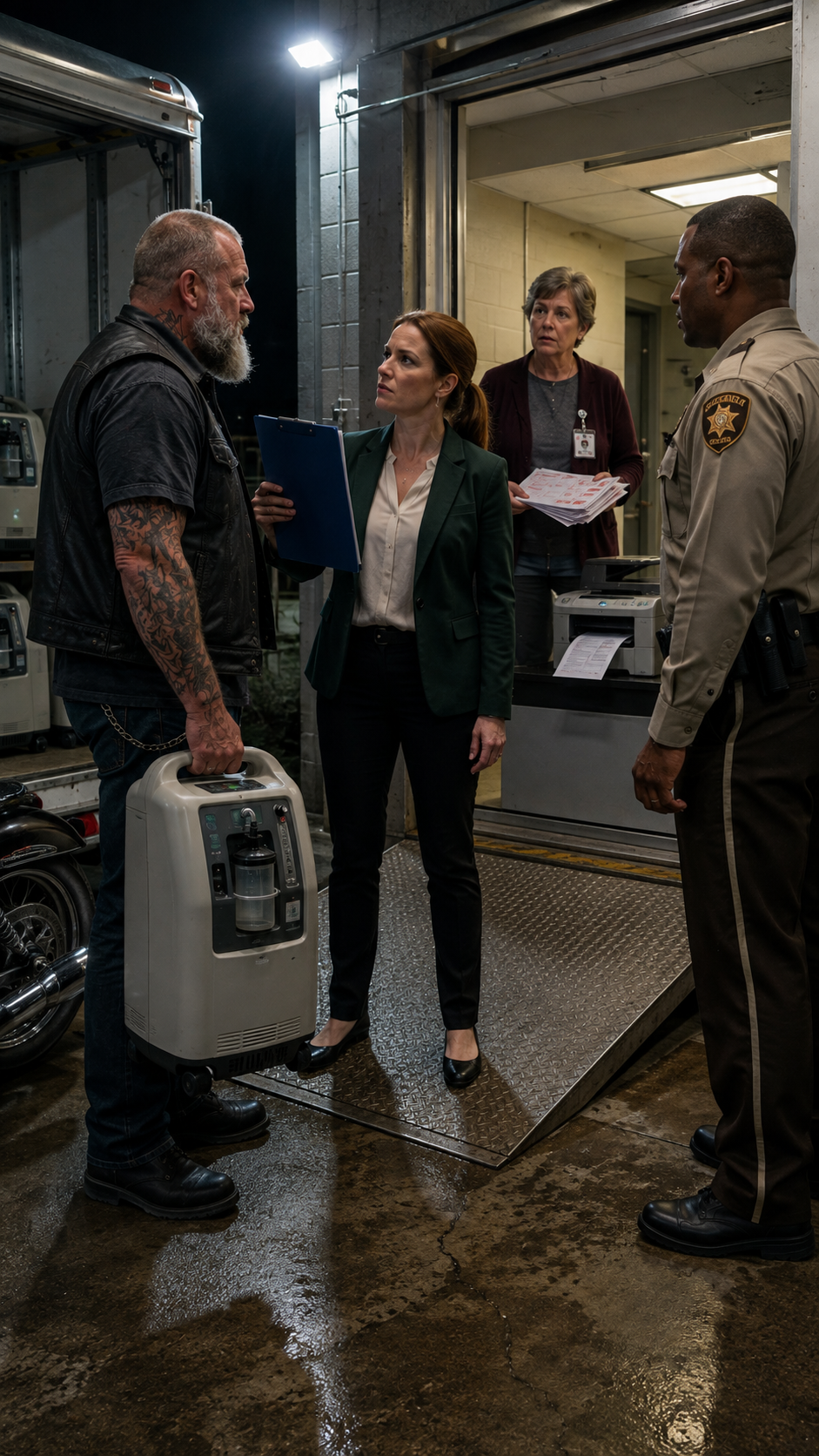
The certificates carried the same time.
8:12 a.m.
More than five hours in the future.
I gathered the pages from the floor while the printer continued feeding them out. Each listed one of the patients on Mast’s delivery route. Each carried the same physician’s electronic signature and the same cause of death: respiratory failure at home.
The deputy read the first three, then looked at Janet.
“Who is Dr. Crane?”
“He was Willow Ridge’s medical director.”
“Was?”
“He died last winter.”
The loading bay went quiet.
Janet took off her administrator badge and placed it on the desk beside the certificates.
“I found the batch file yesterday,” she said. “I reported it to corporate compliance.”
“What did they do?”
“They disabled my access and moved the building closure forward by forty-eight hours.”
That explained the motorcycles arriving before dawn.
It did not explain why she had stamped every machine DESTROYED.
Janet saw me looking at the red forms.
“The bankruptcy contractor takes possession at sunrise. Once a device enters their inventory, nobody can remove it without a court order. Destroyed equipment is excluded.”
“You falsified the records.”
“Yes.”
The word came without pride or apology.
“I falsified an asset status to return machines to people who already paid for them.”
Mast was still holding the phone beside the concentrator.
The elderly woman remained on the line.
“My husband is turning blue,” she said.
He looked at the deputy.
“You can arrest us now, or escort us.”
The deputy stared at the future-dated death certificates.
Then he called his supervisor.
No one answered.
He tried the state fraud unit.
Voicemail.
At three in the morning, institutions had many ways to appear unavailable.
People without oxygen did not.
The deputy introduced himself as Aaron Bell, ordered Janet to preserve every computer and told me to photograph the certificates before the system could erase them. Then he opened the loading door.
“Deliver the machines,” he said. “I’m coming with the first route.”
Mast’s riders divided the equipment according to Janet’s list. Nobody cheered. They moved carefully, checking serial numbers and battery levels before securing each device inside padded trailers.
Mast kept the concentrator with the hidden phone.
Its patient was Walter Price, eleven miles away.
I rode in Deputy Bell’s cruiser while Mast followed on his motorcycle.
Walter’s wife met us outside a small brick house in Kanawha City. She wore slippers and a winter coat over her nightgown despite the July heat.
“He’s in the bedroom,” she said. “The emergency company said they couldn’t replace the unit until insurance approved it.”
“When did Willow Ridge collect the old one?” I asked.
“Monday. They said it needed a safety inspection.”
Walter lay propped against three pillows, pulling air through parted lips. His chest rose too quickly. A portable oxygen cylinder beside the bed had reached the bottom of its gauge.
Mast carried the concentrator inside alone.
The machine weighed nearly fifty pounds, but he set it down as gently as a sleeping child. He connected the tubing, checked the flow and waited until Walter’s breathing began to slow.
Walter opened his eyes.
“You the repairman?”
Mast looked at the tattoos across his hands.
“Something like that.”
Mrs. Price pressed both palms over her mouth.
For a moment, the certificates at the clinic felt impossible.
There was a living man in the bed.
His wife was touching his shoulder.
A machine bearing his name was humming beside him.
Then the concentrator chimed.
One soft tone.
A green light blinked beneath the battery cover.
Mast’s head turned.
“That light wasn’t there at the clinic.”
He removed the cover.
A black cellular module had been wired between the battery and the control board. It was newer than the machine, secured with fresh adhesive and a printed circuit board small enough to hide beneath two fingers.
Deputy Bell leaned closer.
“Tracker?”
Mast followed the wire.
“Tracker and remote switch.”
Mrs. Price looked at him.
“Switch for what?”
He did not answer until he found it.
A tiny relay had been installed across the machine’s power supply. Someone with access to the cellular module could shut the concentrator down from anywhere.
The green light blinked again.
Mast pulled the module free.
Too late.
Headlights crossed the bedroom wall.
A white medical transport van stopped outside the house.
Two employees in gray uniforms walked toward the porch carrying a folded stretcher and a black document case.
Mrs. Price stared through the window.
“I didn’t call anyone.”
Deputy Bell met them at the door.
The older employee smiled professionally.
“We received a terminal transport request for Walter Price.”
“He’s not being transported.”
“We have an electronic authorization from his spouse.”
Mrs. Price stepped into the hallway.
“No, you don’t.”
The employee opened the document case.
Inside was a signed consent form bearing her name.
The signature looked convincing.
She had not written it.
Mast joined us at the doorway.
The younger transport worker saw him and stopped smiling.
“You were not supposed to return that unit.”
Mast looked at the stretcher.
“You were expecting him without it.”
The older employee tried to close the case.
Deputy Bell took it before the lid came down.
Beneath Walter’s paperwork were twenty-two more transfer packets.
The same names printed on the death certificates.
Each packet contained a medical transport order, a comfort-care directive and a copy of a death notification scheduled for 8:12 a.m.
The transport workers claimed they knew nothing. They had received an automated route and had been told the patients were entering a private hospice after home-care services ended.
The destination appeared only as a billing code.
No address.
Deputy Bell detained both men and called for another unit.
Mast returned to the bedroom.
Walter’s breathing had steadied.
“Did they come because you turned this on?” Mrs. Price asked.
Mast looked at the disabled cellular module in his palm.
“Yes.”
My stomach tightened.
The other riders had already left Willow Ridge.
Some had probably reached their addresses.
I called Janet.
She answered on the first ring.
“The clinic network just woke up,” she said. “I can see equipment reconnecting.”
“How many?”
“Eight.”
Mast heard her through the speaker.
“Tell them to cut the modules.”
“I’m trying. The riders aren’t answering.”
“They’re on motorcycles.”
“No, Mast. The calls connect. Nobody speaks.”
He took the phone from me.
“Which routes are active?”
Janet read the names.
Mack.
Boone.
Ruth.
Cal.
Preacher.
Three others.
Mast called Preacher directly.
The line opened.
We heard a machine humming, a television playing somewhere in another room and a woman asking whether someone had found her husband’s glasses.
Then a man’s voice spoke close to the phone.
“Eight devices returned.”
Mast became very still.
“Who is this?”
“You should have let the contractor collect them.”
“Where are my riders?”
The man ignored the question.
“The certificates are not the fraud, Mr. Cole. They are the cleanup.”
Mast looked toward Walter.
“What are you cleaning?”
“Patients whose identities have become expensive.”
The call ended.
Deputy Bell examined the transport packets again.
One page carried a barcode corresponding to the hidden cellular module. When the concentrator powered on inside Walter’s home, it confirmed three things at once: the patient was alive, the home address was current, and someone had interfered with the recall.
The machines had not merely been stored for resale.
They had been modified and left where Janet would find them.
Someone expected her to arrange their return.
Someone expected Mast to help.
The rescue had been built into the plan.
Janet called again.
Her voice had changed.
“I found a second inventory.”
“More devices?” I asked.
“No. People.”
She sent a photograph from the clinic computer.
Twenty-three names appeared in one column.
Beside each was a second name, a new date of birth and a private insurance number.
Walter Price’s identity had already been assigned to another man.
The company was not only declaring vulnerable patients dead.
It was transferring their medical histories and coverage to people inside an unknown facility.
Deputy Bell looked toward the detained transport workers.
“Where were you taking him?”
The younger man began shaking his head.
The older one answered.
“Continuity House.”
“Where is that?”
“I’ve never been there.”
Mast’s phone rang.
Preacher’s number.
He answered without speaking.
For several seconds, there was only wind.
Then Preacher whispered, “Mast, we got to Mrs. Talbot’s house.”
“Is she breathing?”
“She isn’t here.”
“What about Cal?”
A long pause.
“His motorcycle is in the driveway.”
Behind Preacher, a door creaked.
A woman’s voice said calmly, “Bring the concentrator inside.”
Preacher’s breathing stopped.
Mast gripped the phone.
“Do not enter that house.”
The line went dead.
Janet shouted through my phone from the clinic.
“Mast, the other identities just changed status.”
On the photograph she had sent, eight names turned green.
The patients were marked DELIVERED.
The riders were listed beneath them as attendants.
And beside Preacher’s name, a new death certificate began generating.