
The bus was found thirty miles east of the school at an abandoned district training centre.
Police reached it before the driver could move the children into the building.
All three were unharmed, though one boy had been given a sedative that did not appear anywhere in his medical file. The driver was a former school aide named Paul Mercer, dismissed years earlier after complaints about restraining students during behavioural incidents.
Susan Hale had continued paying him through a maintenance account.
The closed annex was not empty.
Inside were folding cots, locked cabinets, expired medication, and folders prepared for children whose families had resisted transfers into private behavioural programmes. The records described panic attacks, sensory overload and speech difficulties as violent conduct.
Several reports were written before the incidents they described.
Evan’s transfer file stated that he had attacked a teacher during morning assembly.
The assembly had not happened yet.
Susan was arrested that afternoon.
The investigation showed that Daniel had uncovered a network of unofficial placements used to remove children who required accommodations the school did not want to provide. Once transferred, the children generated additional state funding while families were told they needed intensive treatment.
The basement room beneath the library had been used to frighten children into compliance.
The annex existed to make their absence permanent.
Daniel’s accident had not been planned as murder, but Susan knew the ventilation system was unsafe and arranged the meeting there because she believed exposure would leave him confused and discredited.
When he survived, she used the injury to separate him from his family.
The district superintendent resigned.
Several administrators were charged with fraud, unlawful confinement and falsifying records. The behavioural contracts were cancelled, and every family involved received an independent review.
None of that repaired the first evening Daniel came home.
Evan sat at the kitchen table while his father stood near the doorway holding a small overnight bag.
His mother had spent two years believing Daniel chose to leave. Daniel had spent those same years believing she considered him dangerous.
There was no sentence large enough to bridge that immediately.
Evan looked at him and asked, “Are you staying?”
Daniel answered carefully.
“If you want me to.”
“That isn’t what I asked.”
Daniel placed the bag on the floor.
“Yes.”
Trust returned through ordinary things.
Daniel attended therapy with Evan. He learned which sounds made the boy cover his ears and which questions required time instead of repetition. Evan learned that his father’s pauses came from the injury, not from anger.
Mara remained close without becoming the centre of the family she had helped reunite.
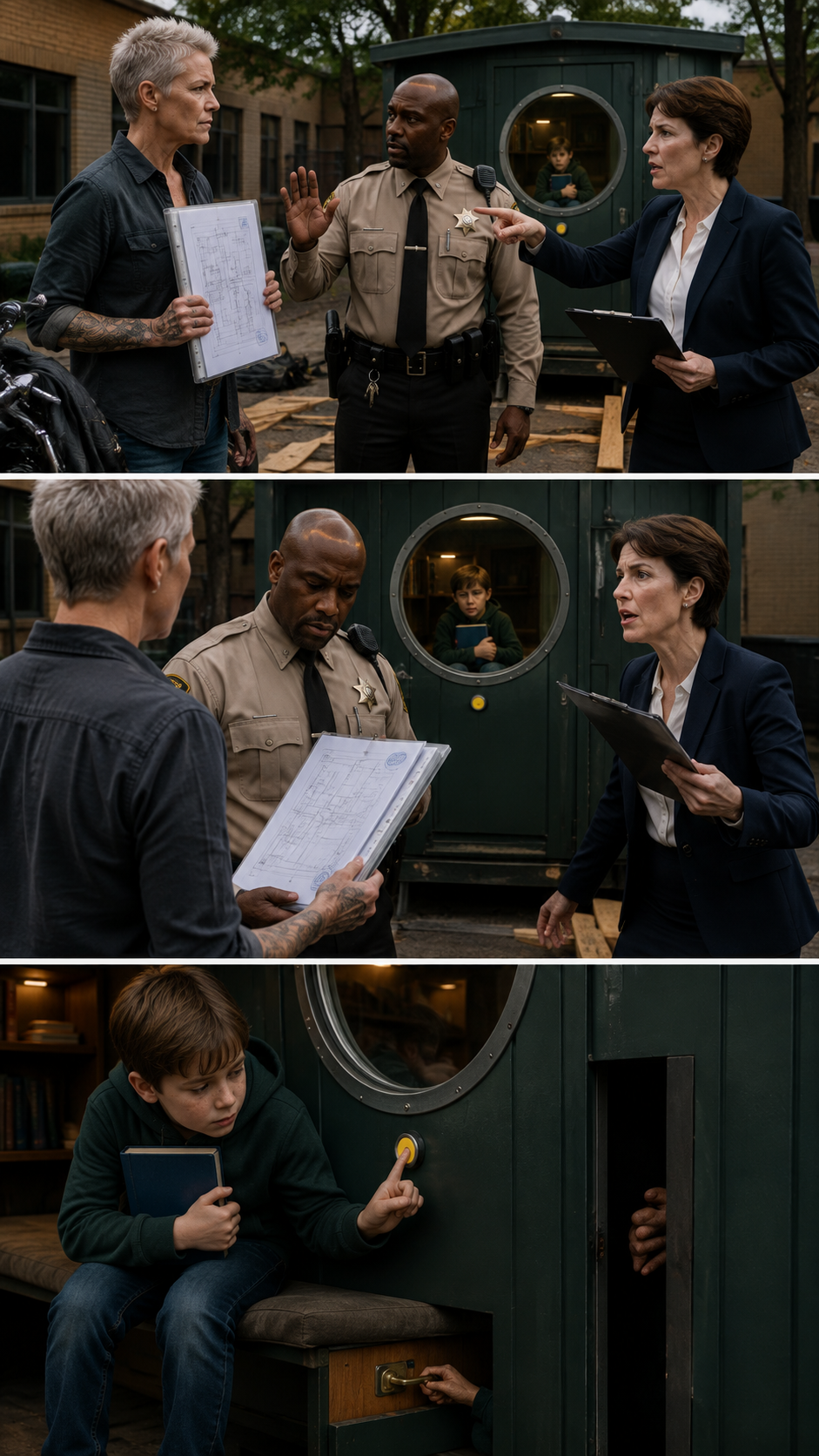
The quiet room opened three months later under independent supervision. Every child could enter or leave freely. The second door remained unlocked, and the hidden compartment was removed.
Evan asked to keep the yellow button.
He mounted it beneath the round window.
Pressing it played Daniel’s original message.
“If Evan is hearing this, Rivet kept her promise.”
On the first morning, Evan sat inside with a book while noise from the cafeteria moved through the courtyard.
Daniel waited outside.
Not because the room was meant to separate them.
Because Evan had asked for ten minutes alone.
When the door opened, Daniel looked up.
Evan stood in the frame, calmer now.
“You can come in.”
Daniel entered and sat beside him beneath the maple trees.
For two years, adults had treated Evan’s need for quiet as evidence that something was wrong with him.
The room proved the opposite.
Sometimes a child does not need to be corrected, transferred or made easier to manage.
Sometimes he only needs a door he controls—and someone trustworthy waiting on the other side.