
PART 2: WHAT HE COULD AFFORD TO GIVE
Emily folded her arms.
“You still can’t keep doing this.”
Noah understood why.
His sister hated owing people.
Especially him.
Growing up, Emily had always been the independent one.
She got her first job at sixteen.
Paid for her own college books.
Rarely asked their parents for money.
Then her marriage ended.
Suddenly one income had to cover everything.
Rent.
Food.
Utilities.
Childcare.
School expenses.
The car.
Noah had watched her adapt.
She cut unnecessary expenses.
Took extra hours.
Learned to repair things around the apartment.
Bought secondhand whenever possible.
She wasn’t waiting for someone to rescue her.
She was working.
Hard.
But the sedan kept threatening the entire system.
If the car failed, Emily couldn’t reliably get to work.
If she couldn’t get to work, every other problem became bigger.
Noah knew he couldn’t buy her a new vehicle.
He was a young soldier with his own bills.
He didn’t have thousands of dollars sitting in the bank.
But their father had taught him how to work on cars.
And Noah had Saturdays.
So he gave her Saturdays.
The first repair had been simple.
A battery.
Then brake pads.
Then a belt.
Then another problem.
Soon Noah had a routine.
Friday night, Emily texted him anything strange she’d noticed.
A sound.
A warning light.
A vibration.
Saturday morning, Noah checked it.
Sometimes the repair cost twenty dollars.
Sometimes two hundred.
Sometimes the car needed nothing more than an hour of Noah swearing at a stubborn bolt.
Mike began noticing something else.
Noah never complained.
Not seriously.
One Saturday, Mike walked across the street carrying his toolbox.
Noah looked at him.
“What are you doing?”
Mike shrugged.
“That car isn’t worth what you’re putting into it.”
“You’ve mentioned that.”
“Yeah.”
Mike opened the toolbox.
“But apparently we’re doing it anyway.”
Noah laughed.
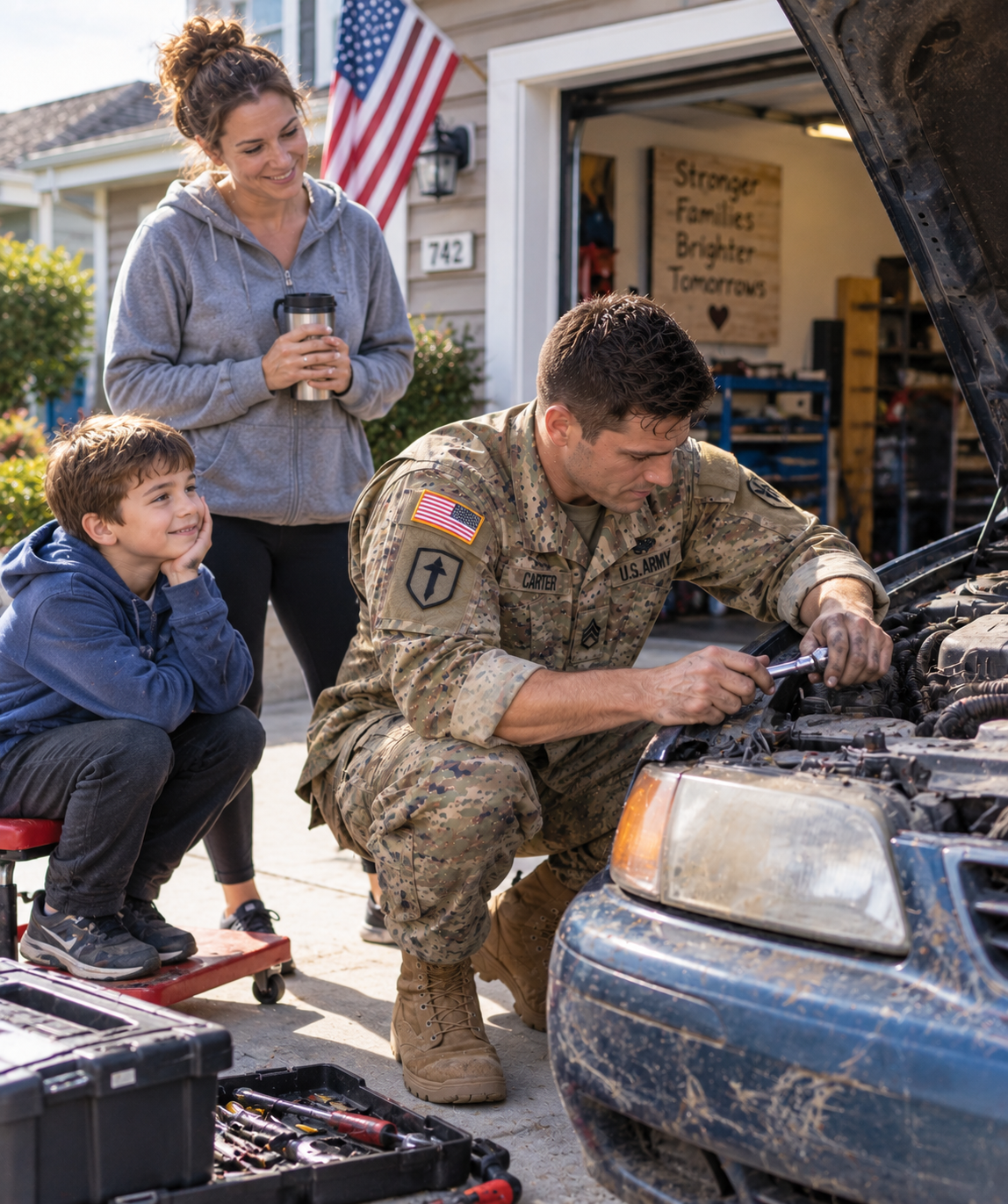
The two men spent three hours replacing a worn component.
At noon, Emily arrived with sandwiches.
Tyler sat on the driveway drawing with sidewalk chalk.
For the first time, what had looked like a miserable weekly repair started feeling different.
It became Saturday.
Just Saturday.
Two guys under a hood.
A kid drawing dinosaurs.
Emily handing out sandwiches.
Music playing from Noah’s garage.
A bad car surrounded by good people.
Weeks later, the sedan failed again.
This time the repair was bigger.
Noah stared at the estimate for parts.
Emily saw his face.
“No.”
“I didn’t say anything.”
“You made the face.”
“What face?”
“The ‘I’m about to spend money I shouldn’t spend’ face.”
Noah sighed.
Emily sat beside him on the porch.
“I’ve saved some.”
“For what?”
“A different car.”
Noah looked at her.
“How much?”
“Not enough yet.”
“Then we keep this one moving.”
She shook her head.
“I don’t want you carrying me.”
Noah looked surprised.
“Emily.”
“What?”
“I’m not carrying you.”
He pointed toward the sedan.
“You go to work.”
“You raise Tyler.”
“You pay your bills.”
“You’ve been saving money.”
“You’re doing all of it.”
He tapped the estimate.
“I’m just keeping four tires underneath you while you do.”
Emily looked away.
That distinction mattered.
Noah wasn’t trying to take control of her life.
He wasn’t paying her rent.
He wasn’t making her decisions.
He was helping preserve the independence she was fighting so hard to rebuild.
So they repaired the car again.
Seven months after Noah first opened its hood, Emily called him on a Thursday evening.
“I need you Saturday.”
Noah laughed.
“What broke now?”
“Nothing.”
Silence.
Then:
“I bought a car.”
Noah stood up.
“What?”
“Used. Nothing fancy.”
She had saved enough for a reliable five-year-old sedan.
She’d researched it carefully.
Had a mechanic inspect it.
Worked out a payment she could manage.
Saturday morning, Emily pulled into Noah’s driveway.
The car wasn’t beautiful.
But it started immediately.
The windows worked.
No warning lights.
No mysterious noises.
Noah walked around it like an inspector.
Emily became nervous.
“Well?”
He opened the hood.
Checked a few things.
Then closed it.
“Not bad.”
“That’s all I get?”
“It’s no twenty-year-old blue masterpiece.”
Emily laughed.
Tyler jumped from the back seat.
“Uncle Noah! Mom says we’re selling the old car!”
Noah looked toward the blue sedan.
For months, he’d wanted that moment.
Now it felt strangely emotional.
Emily noticed.
“You’re going to miss it.”
“Absolutely not.”
“You’re looking at it like a dog we’re sending away.”
“That car has personally insulted me every Saturday for seven months.”
They sold it a week later.
Not for much.
Enough.
Before the buyer drove away, Noah stood in the driveway with his arms folded.
Mike came over.
“There goes your hobby.”
“Good.”
“What are you doing next Saturday?”
Noah smiled.
“Sleeping.”
He didn’t.
Saturday morning at 8:30, there was a knock at his door.
Emily and Tyler stood outside.
Tyler carried a fishing pole.
Emily held coffee.
Noah frowned.
“What broke?”
“Nothing.”
“Then why are you here?”
Emily handed him the coffee.
“You’ve given us almost every Saturday for seven months.”
She smiled.
“We thought maybe you should get one back.”
They went fishing.
Tyler caught nothing.
Noah caught a branch.
Emily laughed harder than necessary.
And for the first time in months, nobody talked about cars.
Years later, Tyler barely remembered the old blue sedan.
But he remembered Saturdays with Uncle Noah.
He remembered tools spread across the driveway.
Grease on Noah’s hands.
His mother bringing sandwiches.
Mike complaining about bolts.
He remembered feeling that when something broke, people showed up.
That became the real legacy of the car.
Noah had originally believed he was keeping an old machine alive.
What he was actually doing was buying his sister time.
Time to work.
Time to save.
Time to rebuild.
He couldn’t afford to give her a new car.
He couldn’t solve every problem that came after her divorce.
But Noah had one thing he could give without taking away her independence.
His Saturdays.
And sometimes the most valuable thing you can give somebody isn’t the thing they can’t afford.
It’s your time while they work toward affording it themselves.