
PART 2: THIRTY SECONDS FROM THE GROUND
Lieutenant Cole didn’t ask again.
“Everybody move! Higher ground!”
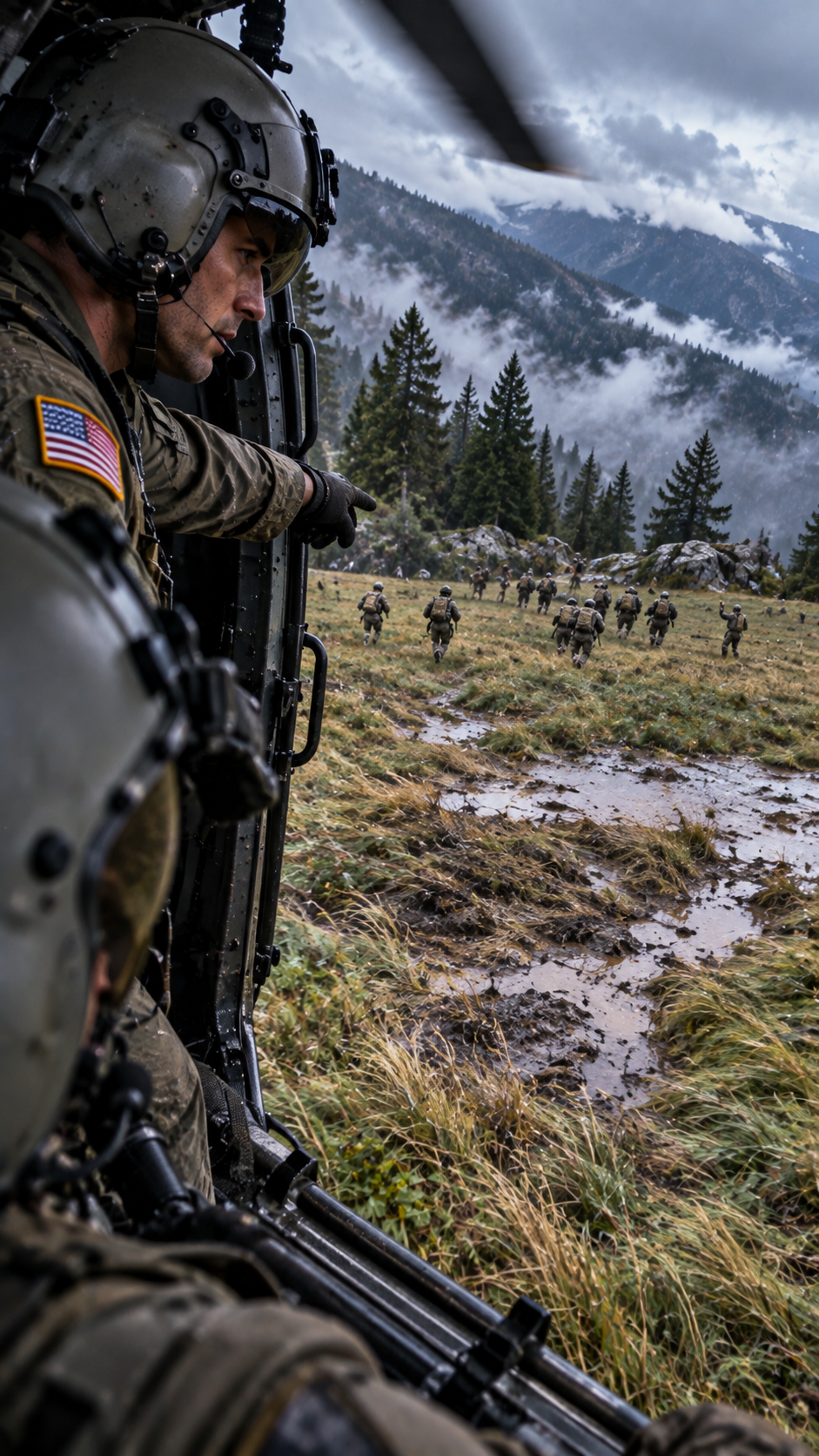
The twelve soldiers immediately left the center of the clearing and headed toward a rocky rise near the tree line.
Jake kept the helicopter circling.
From above, the pattern became easier to see.
Several narrow streams of muddy water were spreading underneath the grass.
Brooks pointed toward the upper slope.
“Water’s coming from there.”
Days of heavy rain had saturated the mountain.
The clearing wasn’t simply wet.
Water was moving underneath the surface.
That explained the grass.
Wind was pushing everything east.
But water moving beneath the roots was dragging one section of grass in the opposite direction.
The apparently solid landing zone had become unstable.
Jake radioed Cole.
“Stay on the rock. Don’t return to the clearing.”
“Copy.”
Less than a minute later, the first section gave way.
There was no explosion.
No enemy.
Just earth suddenly behaving like something other than solid ground.
A section near the center sagged and filled with muddy water.
Cole stared from the rocky edge.
“That was our landing point.”
Jake didn’t respond.
He was already looking for another option.
Several hundred yards west, beyond a line of trees, was a smaller patch of exposed ground beside an old service track.
It wasn’t as convenient.
But unlike the clearing, much of it appeared rocky and elevated.
Jake remained overhead while the ground team assessed the alternate location from a safe position.
Minutes later, they confirmed it was suitable.
The helicopter approached again.
This time Jake watched everything.
The trees.
The grass.
The surface water.
The terrain.
Nothing contradicted anything else.
He brought the aircraft down.
One by one, the twelve soldiers boarded.
Cole climbed in last.
As the helicopter lifted away, he looked through the open side toward the original clearing.
A broad section was now covered in brown water and churned mud.
Cole turned toward Jake.
“You saw that from the air?”
Jake nodded.
“The grass.”
Cole looked confused.
“The grass stopped you?”
“It was moving the wrong way.”
For several seconds, Cole said nothing.
Then he looked back toward the disappearing valley.
Thirty seconds.
That was roughly how close they had been to committing the helicopter to the original landing.
Later, during the mission review, nobody described Jake’s decision as extraordinary instinct.
Jake refused to let them.
“It wasn’t instinct,” he said.
“The picture didn’t match.”
He explained it simply.
The trees said the wind was moving one way.
The smoke said the same thing.
But the grass said something different.
When three pieces of information should agree and one doesn’t, the strange one deserves another look.
That sentence eventually became part of the squadron’s training discussions.
Not as a rule about grass.
As a rule about attention.
Months later, Brooks flew with Jake again.
During their approach to another remote landing zone, Brooks carefully studied the terrain below.
Jake noticed.
“What are you looking for?”
Brooks smiled.
“Anything that doesn’t belong.”
Jake said nothing.
He simply nodded.
Because sometimes the most important warning isn’t loud.
Sometimes it doesn’t appear on a screen.
Sometimes twelve people are waiting below, everyone is telling you the landing zone is clear, and the only thing saying otherwise—
is a patch of grass moving the wrong way.