
PART 2: THE FIVE-DOLLAR RULE
Mason looked through the office window again.
Tyler Evans was sitting by himself.
Twenty-one years old.
Quiet.
Reliable.
Never late.
Never asked for anything.
On paper, Tyler was doing fine.
Lucas knew differently.
They had arrived at the unit within weeks of each other.
At first, Tyler had eaten with everyone else.
Then slowly, he started disappearing.
He stopped joining weekend plans.
Stopped sitting with the group after work.
If someone offered him a ride, he said no.
If someone offered him food, he already ate.
If someone asked whether he needed help, his answer was always identical.
“I’m good.”
Lucas recognized it because he’d grown up saying the same thing.
“My dad hated that phrase,” Lucas told Mason.
His father, David Bennett, had spent years teaching his son an unusual lesson.
Independence was useful.
Isolation wasn’t.
When Lucas was sixteen, his father once asked him to borrow five dollars.
Lucas laughed because he’d watched his father withdraw cash that morning.
“You already have money.”
David smiled.
“I know.”
“Then why borrow mine?”
“Because someday you might need something from me.”
Lucas had stared at him.
His father explained:
“People are more comfortable accepting help after they’ve been allowed to give it.”
Monday morning, David returned the five dollars.
Years later, Lucas finally understood.
So when Tyler began isolating himself, Lucas tried everything.
“Want to grab lunch?”
“No, thanks.”
“Need a ride?”
“I’m good.”
“Coming with us Saturday?”
“Got plans.”
Lucas knew he didn’t.
Then one Friday Lucas tried something different.
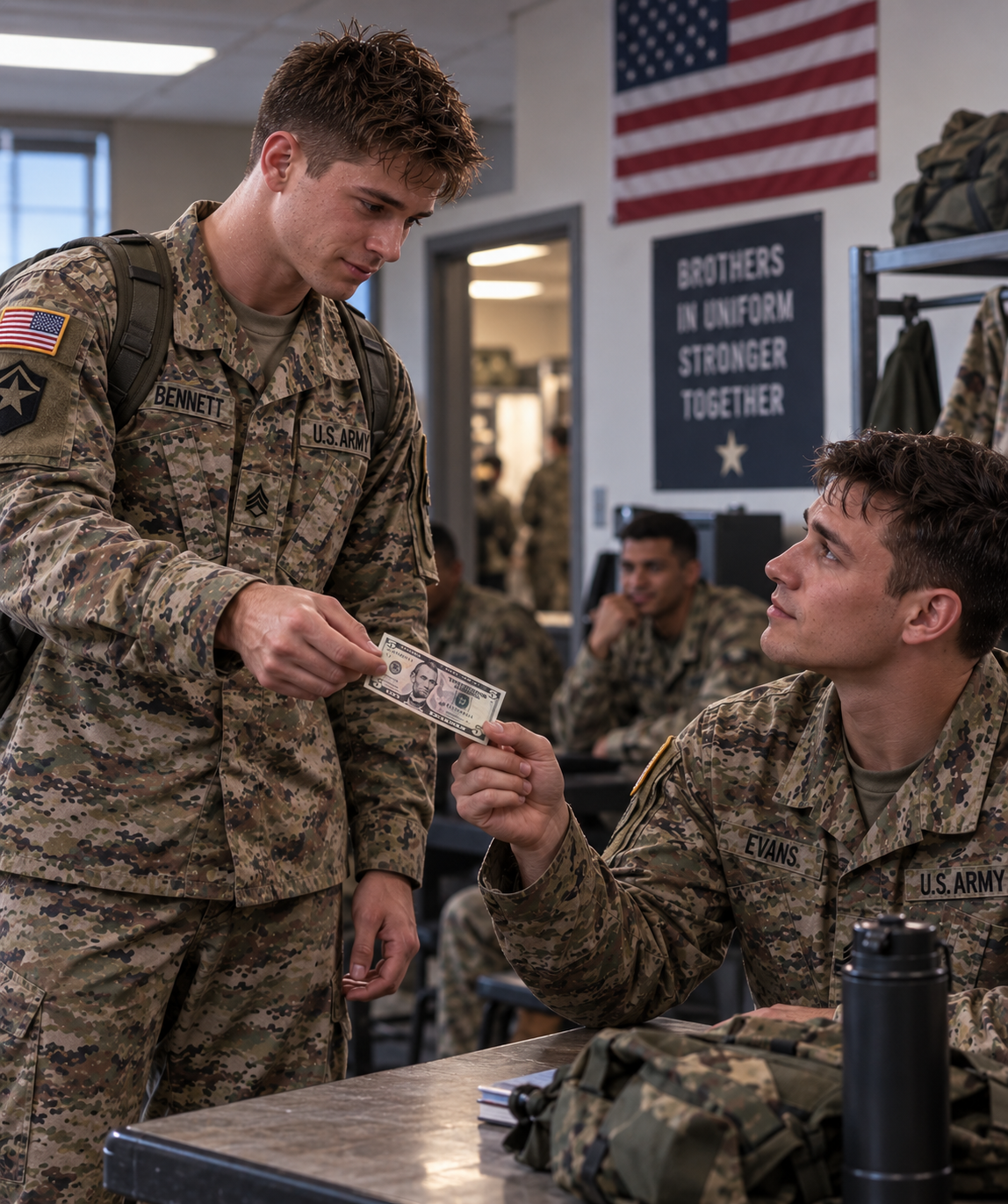
“Evans, can I borrow five bucks?”
Tyler looked surprised.
“You need money?”
“Until Monday.”
Tyler handed it over.
Lucas returned it Monday morning.
The next week, he borrowed five dollars from Ethan.
Then Cole.
Then another soldier.
Lucas wanted asking for a small favor to become normal around the group.
No embarrassment.
No interrogation.
No debt hanging over anyone.
Just:
Can you help me?
Sure.
Thanks.
Then one Friday, Lucas approached Tyler again.
“Five bucks?”
Tyler laughed.
“You’re terrible with money.”
“Apparently.”
Tyler handed him the bill.
Lucas returned it Monday.
Two days later, Tyler stood beside Lucas’s desk.
For several seconds, he said nothing.
Lucas looked up.
“You okay?”
Tyler shoved his hands into his pockets.
“Can I ask you something?”
“Sure.”
Tyler hesitated.
Then:
“Could you give me a ride somewhere after work?”
Lucas didn’t make a big deal of it.
“Yep.”
That evening, Lucas learned what had been happening.
Tyler’s car had stopped running weeks earlier.
He’d been spending money on rides when necessary and walking whenever possible.
But that wasn’t the real problem.
His mother back home had recently lost her job.
Tyler had been sending part of his money to help with household expenses.
He wasn’t broke.
He wasn’t starving.
He was simply stretched thin and determined that nobody in his new unit would think he couldn’t manage his own life.
“Why didn’t you tell somebody?” Lucas asked.
Tyler stared through the windshield.
“I don’t want people taking care of me.”
Lucas smiled.
“Good.”
Tyler frowned.
“Good?”
“Because nobody asked to take care of you.”
Lucas started the car.
“You asked for a ride.”
That was all.
No lecture.
No pity.
No announcement to the unit.
The next week, Tyler asked Ethan whether he could ride with him to the grocery store.
Later, he asked Mason where to find legitimate financial guidance available to service members.
Mason pointed him toward the appropriate resources.
Tyler handled the rest himself.
A month later, his car was running again.
His mother found another job.
Things stabilized.
But something else had changed.
Tyler no longer disappeared whenever life became difficult.
One Friday afternoon, Mason walked through the workspace and heard a familiar sentence.
“Hey, Evans.”
Tyler looked up.
A newly arrived Private stood nearby.
He looked embarrassed.
“My card isn’t working at the vending machine. Can I borrow five bucks?”
Tyler smiled.
“Sure.”
He handed him the bill.
Lucas, sitting across the room, heard it.
Their eyes met.
Neither said anything.
Monday morning, the new Private returned the five dollars.
Mason watched the exchange.
Later he found Lucas outside.
“So your father’s five-dollar theory worked.”
Lucas laughed.
“It wasn’t really about five dollars.”
“I figured that out.”
Mason looked back toward the building.
“What was it about?”
Lucas thought for a moment.
“Making it normal to need somebody once in a while.”
Mason nodded.
Then Lucas added:
“My dad always said the strongest person in the room can become the loneliest if everyone believes he never needs anything.”
Years passed.
Lucas eventually became a Sergeant himself.
One afternoon, he noticed a young soldier eating alone.
Quiet.
Polite.
Always saying:
“I’m good.”
Lucas didn’t immediately ask what was wrong.
He didn’t corner him.
He didn’t embarrass him.
Instead, Friday afternoon, Lucas walked over holding an empty coffee cup.
“Hey.”
The young soldier looked up.
“Yes, Sergeant?”
Lucas reached into his pocket.
Then stopped.
He smiled.
Actually, he didn’t need money.
But that had never been the point.
“Can you do me a favor?”
The soldier straightened.
“Of course.”
Lucas handed him the cup.
“I’m stuck here for ten minutes. Grab me a coffee?”
The young soldier looked surprised.
“Sure.”
Lucas handed him cash.
As the soldier walked away, Lucas remembered his father.
Then Tyler.
Then seven Fridays of borrowed five-dollar bills.
His father had been right.
Sometimes people don’t need to be rescued.
Sometimes they don’t even need advice.
They simply need to learn that in a good team, asking and giving can move in both directions.
And sometimes the first crack in a wall built from pride and loneliness—
costs exactly five dollars.