
STREAMING NOW ON NETFLIX: STEPHEN GRAHAM IN AN INTENSE MASTERCLASS OF DARK MANIPULATION AND PSYCHOLOGICAL TERROR

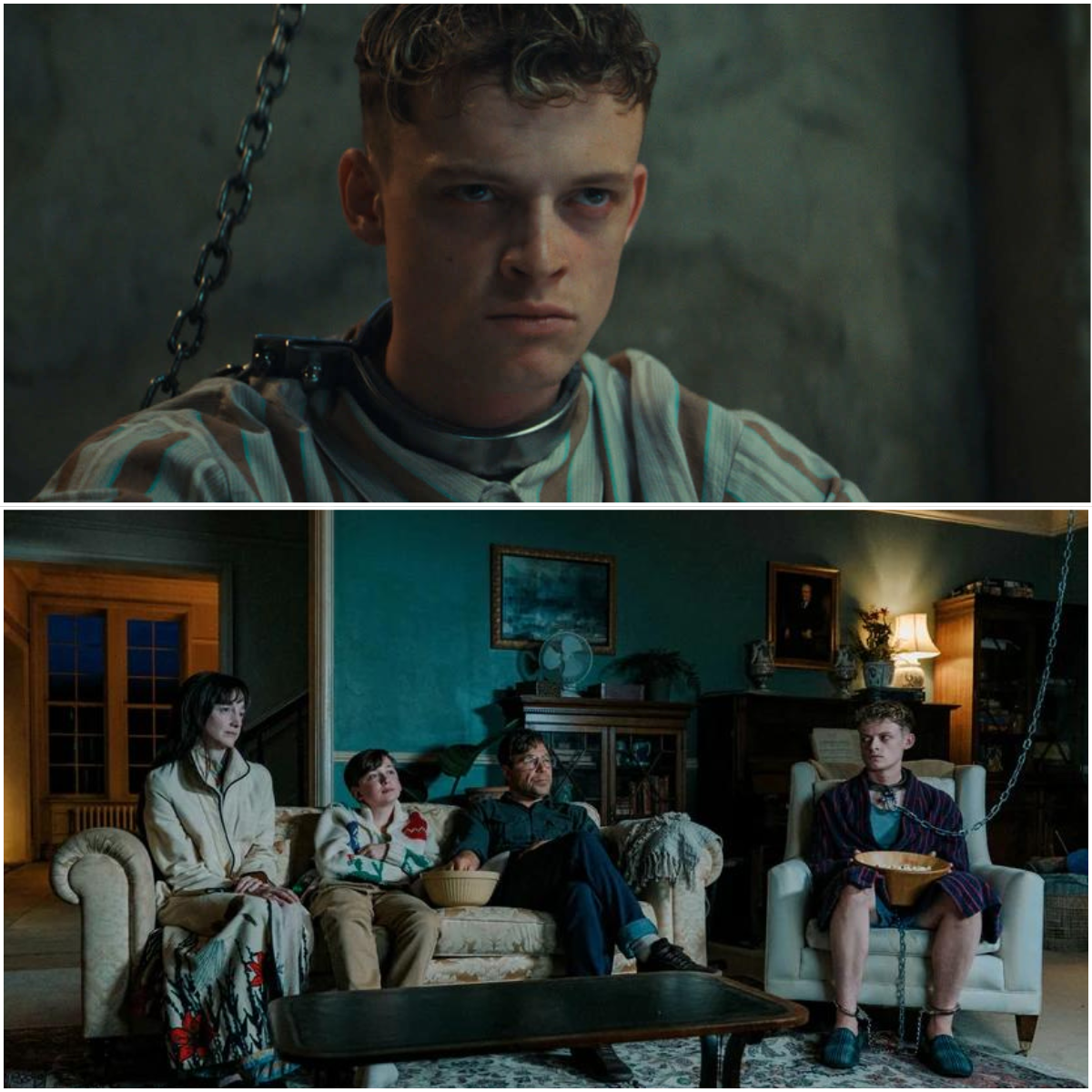
When a 19-year-old wakes up kidnapped and chained inside a stranger’s home for a terrifying “rehabilitation” ritual, the first shock is not the chain. It is the politeness. On Netflix and other platforms where Jan Komasa’s 2025 thriller has circulated—also released as The Good Boy and, in the United States, as Heel—Stephen Graham captures horrifying courtesy, calculated cruelty, and the absolute control of captors who force a victim into fake domestic harmony. In Good Boy, every kindness masks a threat. As the young captive sits frozen in front of the screen, holding his breath so as not to provoke the room, the realization after that frame is simple and sickening. The living room is not a sanctuary. It is a classroom. And the lesson is obedience.
Komasa, the Polish director of Corpus Christi, makes his English-language debut with a script by Bartek Bartosik and Naqqash Khalid, produced with Jeremy Thomas and Jerzy Skolimowski. The setting shifted from Warsaw to a handsome Yorkshire house, isolated enough that a scream can become furniture. Anson Boon is Tommy, a foul-mouthed 19-year-old who films his own cruelty for social media: theft, humiliation, nights that look like content and feel like harm. After a bender, he is taken. He wakes in the cellar of Chris and Kathryn, a married couple who speak as if they are doing him a favor.
Graham’s Chris is the film’s most unsettling instrument. After Adolescence, in which he played a father shattered by a child the world had already rewritten, he turns the paternal instinct inside out. Chris lectures. He brings food. He talks about becoming a better person. He also enforces the house rules with sudden, practical violence when Tommy resists. Andrea Riseborough’s Kathryn is almost spectral: grief worn as silence, a woman who seems barely tethered to the rooms she occupies. Kit Rakusen, as their young son Jonathan, smiles with the desperate brightness of a child who has already learned which emotions are allowed. The family wants a good boy. They are prepared to manufacture one.
Good Boy is not interested in conventional torture-chamber spectacle. Komasa is interested in the manners of captivity. Tommy is made to watch his own videos. He is given books. Privileges lengthen when he complies: a longer chain, a proper toilet instead of a bcket, a seat in front of the television with the people who own him. Fake domestic harmony is the method and the joke. Dinner. A birthday picnic. Movies on the sofa. The chain still exists. The combination locks still exist. The smile on Jonathan’s face still looks like a warning. Boon plays Tommy’s arc without begging for sympathy. He begins as someone you would cross the street to avoid. He becomes someone whose fear is specific: not death, but the next punishment for the wrong word.
That is the frozen-in-front-of-the-screen image the caption isolates. Holding still is survival. Breathing too loud is a risk. The television offers the illusion of an ordinary evening while the house remains a behavioral lab. Critics at Toronto and London called the film a black comedy, a fable, an absurdist nightmare with a Kubrickian chill in the architecture. Some found it provocative and methodical. Others found the characters too abstract, the second half less sharp than the premise. Almost no one argued that Graham is miscast. He makes niceness feel like a blade laid on the table beside the plate.
The film keeps asking an ugly question and refusing a clean answer. Can a violent young man be changed? Should anyone who answers that question with a cellar be believed? Chris talks like a campaigner for order, a man who has decided the state is too slow and the culture too rotten. Kathryn’s catatonic grief hints at a missing son, an earlier failure, a previous “project” the house will not name. Graham has said the kidnapping is, in his reading, a deranged attempt to put light back in his wife’s eyes. The movie does not print that explanation on the wall. It lets the audience sit in the ambiguity until hospitality and horror occupy the same armchair.
Riseborough is extraordinary in near-stillness. She can look like a victim of the same regime and like its quiet author. Jonathan’s politeness is the film’s most haunting special effect: a child performing wellness in a house that trains people like animals. When Tommy is allowed upstairs, still leashed to a track, Good Boy becomes a satire of the English country home as moral factory. Tasteful rooms. Improving literature. A family that wants you to be grateful for the chain.
Boon, coming off MobLand, holds the center by refusing to become only a symbol. Tommy is awful. Tommy is terrified. Tommy learns the exchange rate of good behavior. The film’s most disturbing suggestion is not that pain breaks him. It is that belonging might. Once the house starts to feel like the only place that has ever paid him sustained attention, escape stops being a simple good. That psychological turn is why the movie belongs next to Graham’s recent work on damaged masculinity even though the roles are opposites. In Adolescence, the father cannot reach the boy. In Good Boy, a father-shaped man reaches a boy with a lock.
Viewers looking for a standard home-invasion or serial-killer picture will be frustrated. The violence is present as threat and correction rather than as a tour of wounds. The real terror is pedagogical. Sit up. Watch yourself on the screen. Say thank you. Do not spoil the evening. The shocking realization after the held breath is that the ritual is working on more than one person in the room. Captor and captive are rehearsing a family. The rehearsal requires a prisoner.
Whether you find the film on Netflix, Prime Video, or under its American title, Good Boy is a hit of a particular kind: too odd to be comfort horror, too acted to dismiss. It leaves you with the aftertaste of politeness used as a weapon. Graham does not play a ranting zealot. He plays a man who believes the country would be safer if more young men were taught—firmly—to sit still in front of the television and be grateful. The young man in the frame knows what the lesson costs. He also knows what happens if he ruins the picture.
That is the masterclass. Dark manipulation does not always shout. Sometimes it passes the remote, smiles, and waits to see whether you have become the good boy yet.