
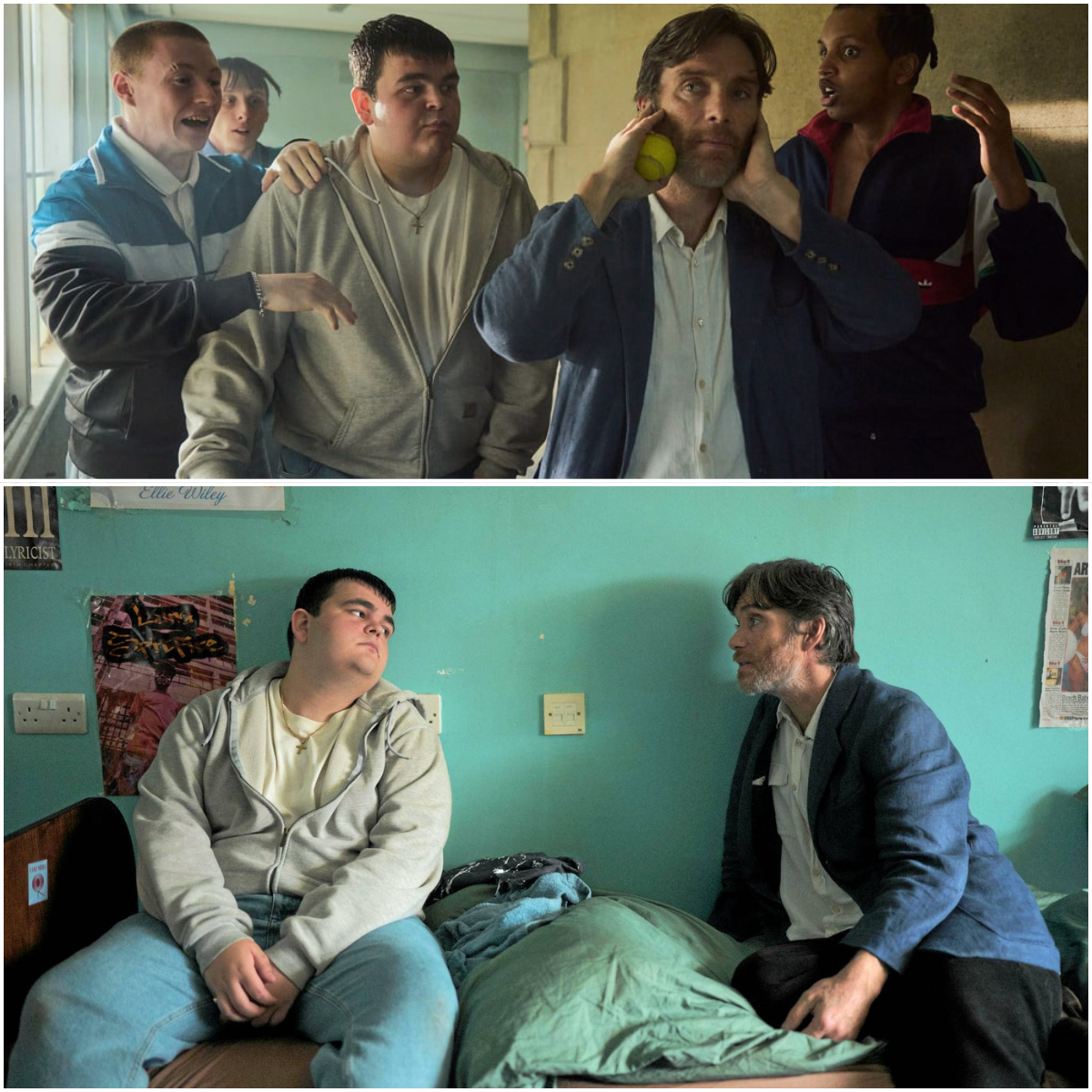
STREAMING NOW ON NETFLIX: CILLIAN MURPHY IN AN INTENSE CINEMATIC MASTERCLASS OF UNFILTERED DEVOTION AND EMOTIONAL TURMOIL!

A compassionate educator faces the ultimate test of endurance inside a last-chance reformatory school. The day will not hold still. Boys fight in corridors. A camera crew has come to film the institution as if it were already a relic. Funding is dying. The headteacher’s own body and mind are not far behind. On Netflix, Cillian Murphy captures the raw vulnerability, unvarnished exhaustion, and profound empathy of a man fighting an uphill battle against systemic neglect. In Steve, every passing second in the quiet open air — a breath between crises — heightens the emotional reality waiting inside the classroom walls. When he pauses to process the day’s wreckage, the heart-wrenching sequence that follows is not a twist. It is the job, continuing.
Directed by Tim Mielants and written by Max Porter, Steve premiered at Toronto in September 2025, played a short theatrical window, and arrived on Netflix on 3 October. It is a reimagining of Porter’s 2023 novella Shy, which originally lived inside a troubled student’s head. Porter and Murphy — who also produced under Big Things Films with Alan Moloney — flipped the axis. The shadowy headteacher at the edge of the book becomes the title. Jay Lycurgo remains as Shy, the boy whose fragility and violence run in parallel with the man trying to keep him alive. The result is a 92-minute day-in-the-life that Variety called one of the streamer’s strongest dramas, and that lives or dies on Murphy’s willingness to look wrecked in public.
The setting is mid-1990s England: Stanton Wood, a converted country house operating as a residential school for adolescent boys the rest of the system has already written off. Aggression, mental-health crisis, “behavioural difficulties” — the language of policy. The reality is bedlam with a timetable. Tracey Ullman is Amanda, the deputy who mothers and polices in the same breath. Emily Watson is Jenny, the counsellor trying to hold therapy in a building that keeps getting smashed. Simbi Ajikawo (Little Simz) is Shola, a new teacher walking into the storm; she also contributes a period-true song that cuts through the noise. Roger Allam drops in as the sort of official who visits with a smile and a sentence of death for the budget.
Murphy’s Steve is devoted in the way that looks, from a distance, like heroism and from two feet away like self-erasure. He believes these boys are not finished. He also drinks, takes what he should not take, carries chronic pain, and carries older guilt that the film lets surface without turning into a monologue about redemption. This is not the inspirational-teacher template flipped for a trailer. It is the template held under fluorescent light until the seams show. Reviews kept reaching for the same words: uninhibited, demonstrative, one of Murphy’s most unguarded performances since the early, feral work that predated Peaky Blinders and Oppenheimer. He shouts in a basement. He fails in real time. He keeps showing up.
Lycurgo’s Shy is the other half of the devotion. A phone call from a mother who is tired of him becomes its own kind of sentence. The boy’s impulse toward self-destruction and the school’s impulse toward closure arrive on the same calendar. Steve is not a true story; Decider and the filmmakers have been clear about that. It is fiction that understands how documentary crews and MPs and “last chance” branding can turn a child’s life into content. The mock-doc texture — cameras in the halls, the performance of care for an audience that will not stay — gives the film its gonzo edge and its black humour. The boys talk like a rap battle without the beat. The staff improvise civilization.
Mielants, who previously directed Murphy in Small Things Like These and on Peaky Blinders, keeps the camera close enough to feel the lack of oxygen. Ben Salisbury and Geoff Barrow’s score does not soothe. The running time is tight; the pileup of crises is not. Some critics argued the day is too loaded to be wholly credible. Most agreed Murphy grounds what could have been a stack of social-issue index cards. Systemic neglect here is not an abstract. It is a locked gate, a missing specialist, a boy who will be sent back to the street if the house closes, a teacher who cannot afford to fall apart and is falling apart anyway.
The “quiet open air” of the caption is the film’s rare mercy: the seconds when Steve is not being hit by the next demand. Those seconds do not last. What waits inside the walls is the question the movie will not decorate. If the state has already given up, what does it mean for one exhausted man to refuse? If empathy is the only tool left, what happens when the empath is also an addict? Steve does not answer with a speech on graduation day. It answers with the next hour, and the hour after that.
As a Netflix original, the film streams worldwide on Netflix and Netflix Standard with Ads. That is not a talking point; it is the distribution fact. After the brief cinema release in the UK, Ireland, and selected U.S. houses, the service is the place the movie was built to live. There is no rival-subscription patchwork to hunt. If you have Netflix, you have Steve. If you do not, the title is not scattered across free ad tiers the way older library films sometimes are.
What the pause after the day’s crisis reveals is the cost of staying. Devotion, in this film, is not a warm glow. It is a man walking back into a classroom that will not thank him, toward a boy who may not make the night, inside a building the ledger has already condemned. Murphy lets you see the turmoil without asking you to call it noble. On Netflix, the cameras are still rolling on Stanton Wood. The boys are still too loud. The headteacher is still too tired. And Steve is still the name of the person who has not left yet — which, in this story, is the only victory the system has not found a way to cut.