
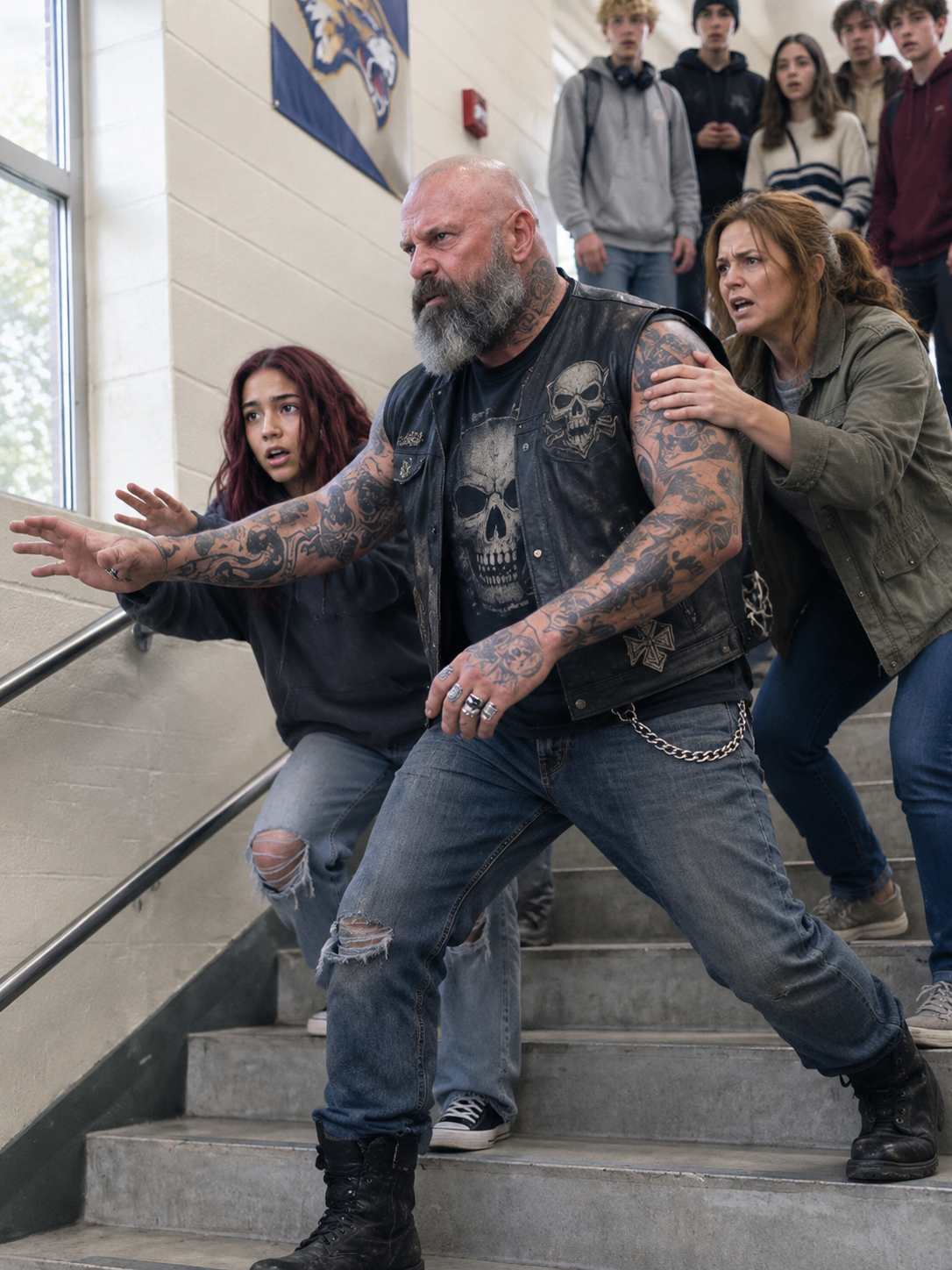
Part 4 — The Motorcycle Nobody Was Allowed to Touch
Daniel’s garage stood behind Hammer’s house near County Road 6. Dust covered its only window, and vines had begun pulling at the roof shingles.
Hammer paid the electricity every month.
He never opened the door.
After Daniel’s funeral, club members placed the blue Harley inside exactly as it returned from the highway. Mud remained beneath the fenders, and a scrape crossed the crash bar.
The handlebars were unharmed.
Bishop objected to using them because the motorcycle had become a memorial, even if nobody could see it.
“Build the kid new crutches from stock,” he said. “We’ve got chromoly tubing at the shop.”
“Not the same.”
“That’s why we shouldn’t cut it.”
Hammer picked up the brass key.
“Daniel built that bike to move.”
“He also built it for himself.”
“Yeah.”
“You don’t get to turn his memory into whatever hurts today.”
The sentence landed hard because Hammer feared the same thing. He had sometimes used Daniel’s story as permission to intervene, confusing recognition with ownership.
Sophie had not asked for memorial crutches.
She had asked for equipment people would not throw down stairs.
Hammer left the meeting without opening the garage.
The next morning, he called Sophie.
He did not mention Daniel’s Harley. He asked what she disliked about standard crutches.
She listed everything.
Underarm pads trapped heat. Handgrips were too narrow. Adjustment buttons pinched her fingers. Aluminum rattled on tile, and gray medical equipment made every hallway feel like a clinic.
Most importantly, standard crutches were designed as temporary tools.
Sophie’s body did not follow temporary schedules.
She wanted equipment built for repetition rather than recovery theater.
Hammer took notes.
He contacted an adaptive-equipment engineer named Dr. Priya Shah, who warned that motorcycle handlebars alone could not safely serve as load-bearing crutch shafts.
Their shape, heat treatment, and wall thickness were not certified for that purpose. Cutting them carelessly might weaken the metal further.
Hammer refused to build decorative danger.
Dr. Shah proposed another design. Medical-grade carbon-fiber shafts would carry the load, while sections of Daniel’s chromoly handlebars could become reinforced handgrip cores and upper support braces.
The completed crutches would undergo static and fatigue testing before Sophie received them.
Hammer agreed.
The cost exceeded three thousand dollars.
The Iron Lantern treasury could cover it, but Bishop would not authorize dismantling Daniel’s motorcycle without a club vote and Sophie’s consent.
Hammer asked me to bring her to the clubhouse.
I expected a dark room filled with beer signs and suspicious men. Instead, we found welding tables, donated wheelchairs, children’s bicycles, and shelves of medical equipment awaiting repair.
Hammer placed Daniel’s photograph before Sophie.
He explained the Harley, the accident, and the untouched garage. Then he described Dr. Shah’s design.
“You can say no,” he said. “I can build something else.”
Sophie studied the photograph.
“Would cutting the bars stop the motorcycle from working?”
“Until we replace them.”
“Are you planning to replace them?”
Hammer looked toward Bishop.
“Don’t know.”
“Then I don’t want them.”
His disappointment appeared for only a moment.
Sophie continued.
“I don’t want crutches made by killing the last thing he built.”
The room remained quiet.
Bishop lowered his eyes, perhaps ashamed that a seventeen-year-old had explained what neither side of their argument could.
Sophie rolled closer to the workbench.
“Make the bike work again first. Then if there are parts left, ask me.”
That condition transformed the project.
The Iron Lanterns would not dismantle Daniel’s memorial. They would restore his motorcycle and return it to the purpose he gave it.
The handlebars still carried Daniel’s exact hand position, but inspection revealed surface corrosion near one clamp. They were safe for display and salvage components, not continued road use.
Dr. Shah documented the findings.
A new set could be fabricated from Daniel’s original drawings, preserving his adapted geometry. The old bars could then supply certified non-load-bearing grip cores for Sophie’s crutches without disabling the Harley.
The club voted again.
Twenty-six approved.
Four opposed cutting any original part.
Twelve abstained.
Bishop cast the deciding vote in favor only after Hammer surrendered the right to choose who would ride Daniel’s restored motorcycle.
“It can’t become your tomb on wheels,” Bishop said.
Hammer nodded.
“Then who rides it?”
“Sophie decides.”
She stared at them.
“I don’t even ride.”
“Exactly,” Bishop answered. “No ghosts voting.”
For seven days, the clubhouse became a fabrication shop.
Dr. Shah measured Sophie’s arm length, grip angle, shoulder width, and preferred wrist position. Cody created adjustable cuffs lined with teal silicone.
Moose machined the handlebar sections into oval grip cores, leaving the shallow grooves formed by Daniel’s damaged right hand.
Inside one sealed grip, they placed Daniel’s Army identification tag.
Inside the other, Sophie chose a small purple strip cut from the tape that had hidden her cracked crutch.
One side carried what had survived service.
The other carried what had almost failed in silence.
Hammer performed no ceremonial cutting. He clamped the old handlebars, checked the measurement three times, and switched on the saw.
The blade touched metal.
He stopped.
His hands began shaking.
For nine years, he had preserved Daniel’s motorcycle because motion might admit that his son was not returning to claim it.
Cutting the bars made absence permanent.
Bishop placed one hand beside the saw without touching Hammer.
“Your call, brother.”
Hammer looked at Sophie.
She did not encourage him. She did not tell him Daniel would want this.
The dead should not become ventriloquists for the living.
Hammer started the saw again.
This time, he completed the cut.
The sound was high, mechanical, and brief.
When the first section fell into his gloved hand, Hammer did not cry. He held it against his chest until the metal stopped vibrating.
Then he measured the second.
Part 5 — The Pair Built to Carry Weight
The school district concluded its investigation before the crutches were finished. Officials acknowledged that Hammer prevented a likely injury but criticized his decision to throw the defective device.
Principal Hargrove offered a compromise.
Hammer could return to campus if he completed a volunteer conduct agreement and allowed staff to present the replacement equipment.
He declined the second condition.
“The kid decides who hands it over.”
Sophie chose Hammer.
The principal worried the presentation would appear to reward dangerous behavior. Sophie answered that pretending the rescue had been gentle would teach students the wrong lesson.
Hammer’s action had frightened and humiliated her.
It had also protected her hand.
She wanted both facts stated.
One week after the stairwell incident, forty Iron Lanterns rode to Beckford High. Their V-twin engines rolled across the parking lot, then shut down together before classes changed.
Hammer arrived last on the restored blue Harley.
The motorcycle carried new handlebars shaped from Daniel’s drawings. Its old blue paint remained scratched, and the crooked white line Daniel painted near the tank was untouched.
Sophie waited near the accessible entrance in her wheelchair.
Hammer stopped the engine.
For several seconds, his calloused hands remained around the new grips. He had not ridden Daniel’s motorcycle since the restoration.
Then he removed the key and placed it in Sophie’s palm.
“I thought I was deciding who rides it,” she said.
“You are.”
“Who rode it here?”
“Delivery driver.”
A few bikers laughed.
Hammer lifted a long wooden case from the sidecar. It bore no club emblem, student name, or inspirational slogan.
He set it across a table and opened the latches.
Inside lay two matte-black carbon-fiber crutches with teal cuffs, quiet rubber tips, and polished steel handgrips shaped from Daniel’s original Harley handlebars.
They did not resemble hospital equipment.
They resembled tools built for someone expected to keep moving.
Dr. Shah explained the design before Sophie touched them. The handlebars were not carrying the primary load; certified shafts and reinforced joints handled that function.
Every component had been tested beyond Sophie’s weight requirements. Replacement parts were documented, and future adjustments would not require another fundraiser.
Hammer had learned from the staircase.
Meaning could not replace safety.
Sophie transferred from the wheelchair and placed the first crutch beneath her arm. Her fingers closed around the worn groove in Daniel’s handgrip.
The fit felt strange.
Not uncomfortable.
Present.
She tested the second, shifted her weight slowly, and listened.
No rattle.
The rubber tips touched concrete with a muted, steady sound.
Tap. Step. Tap.
Hammer watched her hands.
“Anything sharp?”
“Your personality.”
“Can’t machine that out.”
Sophie crossed the landing, turned, and approached the same staircase where the old crutch broke.
Teachers stiffened.
Hammer did not tell her to stop.
She climbed the first step, then the second, learning the new grip angle. At the fourth, she paused and looked toward him.
“You coming?”
Hammer followed one step behind, close enough to help and far enough to let the choice remain hers.
They reached the top.
Students applauded, but Sophie raised one hand until they stopped. She did not want the staircase turned into a finish line.
“This isn’t a miracle,” she said. “They’re crutches. Good ones.”
Then she glanced at Hammer.
“And he didn’t fix me.”
Hammer nodded.
“Kid wasn’t broken.”
The sentence traveled through the hallway without a microphone.
Afterward, Sophie asked about the objects sealed inside the grips. Hammer explained Daniel’s identification tag and the purple tape.
She had expected a photograph or engraved message.
Instead, one hand held a man she never met, while the other held evidence of the danger she survived.
The objects could not be removed without damaging the grips.
They were not decorations.
They were weight carried inside support, hidden but present.
The restored Harley remained at school for the afternoon, guarded by Iron Lanterns who pretended not to worry whenever students approached.
Sophie examined its adapted controls and asked whether Daniel had returned to riding immediately after losing his leg.
“No,” Hammer said.
“How long?”
“Fourteen months.”
“Did he fall?”
“A lot.”
“Did you help him up?”
“Too much at first.”
Sophie looked toward me.
“He learns slowly.”
Hammer accepted the verdict.
Before the club left, Bishop handed Sophie a document naming her temporary custodian of Daniel’s Harley for community events. She could choose qualified riders for charity escorts, veteran rides, and accessibility fundraisers.
The bike no longer belonged to grief alone.
Its first official rider would be Allison Dawson, Hammer’s daughter and Daniel’s older sister, who had avoided the garage since the funeral.
That choice surprised Hammer.
Sophie explained that a family motorcycle should move first beneath a family member.
Allison arrived two days later wearing Daniel’s old gloves. Hammer showed her the controls but did not correct her grip or follow with instructions.
She started the engine.
The low rumble filled the garage where silence had lived for nine years.
Hammer stood beside Sophie, one hand resting near her new crutch without touching it.
The motorcycle rolled into daylight.
The handlebars were new.
The old ones were already carrying someone else.
Part 6 — What the Broken Crutch Exposed at Beckford High
The district’s equipment review uncovered fourteen additional mobility aids without documented inspection histories. Three walkers had loose joints, one wheelchair brake failed under load, and two crutches belonged to the same recalled production lot as Sophie’s.
None had injured anyone yet.
That word mattered.
Yet.
Beckford High created a quarterly inspection program led by licensed professionals, not teachers armed with tape and good intentions. Students could report equipment concerns without fearing bills, embarrassment, or confiscation.
The Iron Lanterns funded emergency loaner devices.
Hammer insisted every replacement be commercially certified. He understood metal, but he had learned that skill did not authorize him to improvise medical equipment beyond professional standards.
Dr. Shah became the program’s technical adviser.
Sophie named it The Quiet Crack Project, because the sound beneath her tape had nearly disappeared inside an ordinary school day.
She refused to use photographs of herself falling, crying, or standing beside Hammer. The project’s image showed only a broken piece of aluminum under magnification.
Attention belonged to the hazard.
The student who posted the misleading video issued an apology. Hammer asked him to leave the original clip online beside the corrected version.
“Why preserve the lie?” I asked.
“So people see how easy it was.”
The two videos became part of the school’s media-literacy course. Students watched the first without context, recorded their conclusions, then saw the complete footage and inspected the crutch.
Most disliked discovering how quickly they had chosen a villain.
Hammer disliked being called a hero almost as much.
He said he heard damaged metal and reacted. The harder work belonged to Sophie, who returned to the same staircase while classmates remembered her frightened face.
She continued using the custom crutches even after her pressure wound healed. Sometimes she wore her prosthetic leg, sometimes she used the wheelchair, and sometimes she chose Daniel’s handlebars.
No tool became proof of progress.
Choice remained progress.
Every Thursday afternoon, Sophie visited the Iron Lantern clubhouse to learn metalwork. Hammer began with files, measurements, and scrap tubing before allowing her near powered equipment.
She designed quieter crutch-tip inserts for school floors. Cody helped manufacture the first batch, while Dr. Shah reviewed the material.
They donated two hundred pairs.
Sophie kept the original purple tape inside her workbench drawer.
Hammer kept the broken crutch above his welding table. He mounted it horizontally, with the curled metal exposed beneath a clear shield.
No plaque explained it.
Whenever someone asked, Hammer answered with four words.
“Listen before it breaks.”
The blue Harley returned to the road each October during Daniel’s memorial ride. Allison usually rode it, although Sophie chose a different qualified veteran each year.
Hammer rode beside them on his black Road King.
He never led.
At the final mile, the group passed Beckford High. Sophie waited near the repaired ramp, her polished grips catching ordinary morning light.
The V-twin rumble reached her first.
Then came the riders.
Then Hammer, exactly one position behind his son’s motorcycle.
Part 7 — The Last Step Never Became the Point
Three years later, Sophie graduated from Beckford High and entered an industrial-design program focused on adaptive equipment.
She crossed the commencement stage using the custom crutches.
The school offered to install a temporary ramp, but she chose the three shallow steps after testing them during rehearsal. Hammer inspected the railing and remained in the audience.
He did not follow her.
That mattered.
After receiving her diploma, Sophie paused near the podium and looked toward the Iron Lanterns seated across the back row.
Hammer wore Daniel’s brass garage key around his neck. His leather cut carried a new patch designed by Sophie—a plain broken line repaired without hiding the fracture.
No words appeared beneath it.
Sophie tapped one chrome handgrip against the stage.
The small sound reached Hammer.
He lifted two fingers.
That was all.
Outside, Allison waited beside Daniel’s blue Harley. The motorcycle had accumulated new scratches, replacement tires, and thousands of miles carrying veterans during recovery rides.
It no longer looked preserved.
It looked used.
Sophie gave the key to a young Marine who had recently lost his right leg and believed motorcycles belonged entirely to his past.
She did not promise the ride would heal him.
She only offered a machine, an instructor, and time.
Hammer watched without stepping closer.
He had finally learned that support was not the hand taking control. Sometimes it was the person who inspected the equipment, opened the garage, and remained nearby while someone else decided whether to move.
My daughter later designed a production version of her crutches without Daniel’s steel grips. Those belonged only to her pair.
The commercial model used tested recycled chromoly cores, replaceable ergonomic handles, visible stress indicators, and adjustment holes designed to resist cracking.
Its first prototype returned to Beckford High.
Sophie placed it beside the broken crutch above Hammer’s workbench.
Old failure.
New answer.
On the anniversary of the stairwell incident, Hammer still checks the grips on Sophie’s original pair. He measures every joint, replaces the tips, and asks before changing anything.
She complains that he worries too much.
He tells her she tapes too much.
Then the garage door rises, Daniel’s Harley starts, and the sound moves across County Road 6 while Sophie’s crutches wait against the workbench.
The old handlebars still carry weight.
Leave “HANDLEBARS” below for another chapter, and follow the page for more biker stories about brotherhood, sacrifice, and the quiet people who notice danger first.