
Part 1
“Remove that decoration.”
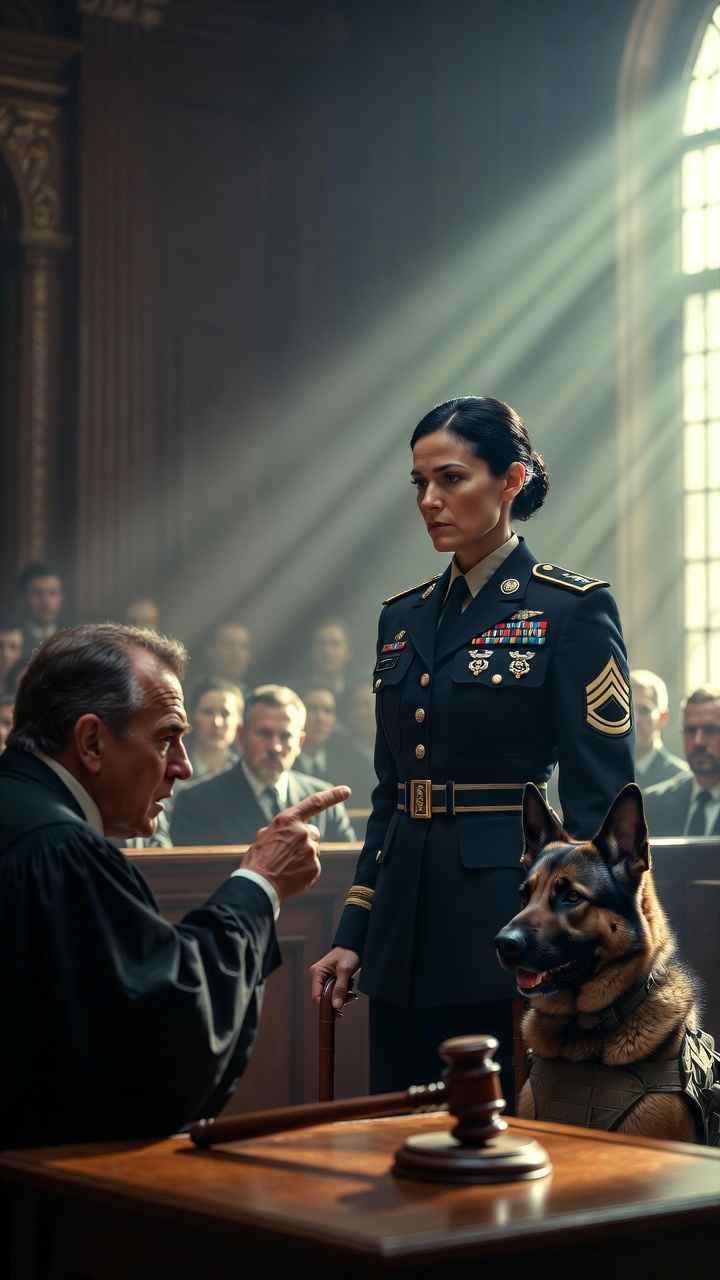
Judge Roland Keller’s voice cracked across the courtroom like a whip, sharp enough to silence every breath in the gallery. His finger remained pointed at the medal pinned to Captain Mara Donovan’s dress uniform, the bronze cross resting over her heart as if it had been placed there by ghosts who refused to leave her side.
Mara did not flinch.
She stood beside the witness stand with one hand wrapped around the carved handle of her cane, the other resting lightly against the side of Atlas, her German Shepherd service dog. The dog’s ears were forward, his dark eyes fixed on the judge with a stillness that seemed almost human.
The courtroom had been warm minutes ago, crowded with reporters, veterans, city officials, and curious spectators. Now it felt cold. The kind of cold that does not come from weather, but from humiliation.
Judge Keller leaned back in his chair, satisfied by the silence he had created.
“This is a court of law,” he said, each word dripping with contempt, “not a parade ground.”
A murmur rose from the gallery.
Mara slowly lifted her hand to the Navy Cross. Her fingers touched it once, gently, almost like she was checking the pulse of something sacred.
Across the aisle, her attorney, Caroline Reeves, rose halfway from her chair. “Your Honor—”
“Sit down, Counselor,” Keller snapped.
Caroline remained standing. “Captain Donovan is wearing regulation dress uniform. The medal is relevant to her record of service and—”
“It is irrelevant to a civil negligence hearing,” Keller cut in. “And it is clearly intended to influence this court emotionally.”
Mara’s jaw tightened.
She had survived a burning convoy outside Fallujah. She had dragged three Marines from wreckage while shrapnel tore through her legs. She had listened to a nineteen-year-old corporal whisper for his mother while she pressed both hands into his wound and promised he would not die alone.
But standing in that courtroom, under the stare of a judge who looked at her medal like it was costume jewelry, she felt a pain sharper than metal.
Keller smiled thinly.
“Remove it,” he said again.
Atlas shifted closer to Mara’s left knee.
Mara’s voice was quiet, but it carried.
“I earned this in blood, Your Honor.”
The room went still.
Keller’s smile vanished.
For one second, something ugly flashed behind his eyes. Not anger. Fear. Then it was gone.
“You will not lecture this court,” he said. “Remove the medal or I will hold you in contempt.”
Mara looked at him, her face pale but steady. “Contempt,” she repeated softly, “is exactly what this feels like.”
Gasps rippled through the benches.
Keller slammed his gavel. “Captain Donovan, one more word and—”
The heavy courtroom doors opened behind her.
Not loudly.
Not dramatically.
Just enough for the sound of hinges to cut through the silence.
Every head turned except Mara’s.
Judge Keller looked past her.
The color drained from his face.
Standing in the doorway was an elderly Black man in a dark Marine dress uniform, his chest covered in ribbons, his posture impossibly straight despite his age. Beside him stood two federal marshals and a woman in a navy suit carrying a sealed folder.
The old Marine removed his cap.
“Judge Keller,” he said, voice calm as a loaded weapon, “you just ordered my daughter to remove the medal I recommended her for.”
Mara closed her eyes.
“Dad,” she whispered.
But the old Marine was not looking at her.
He was looking at the judge.
And Judge Keller looked like he had seen a dead man return.
Part 2
General Isaiah Donovan walked down the center aisle with the slow precision of a man who had spent fifty years making fear obey him. His silver hair caught the window light, and every veteran in the gallery instinctively stood.
Mara stayed frozen.
She had not known he was coming.
Their last conversation had ended with her saying, “I don’t need you to rescue me anymore,” and him answering, “No, sweetheart. You never did.”
But now he was here.
Judge Keller swallowed hard. “General Donovan,” he said, voice suddenly thinner. “This is highly irregular.”
“So was the phone call you made last night,” the woman in the navy suit said.
Keller’s eyes snapped to her.
She stepped forward. “Special Agent Lena Brooks, Department of Justice, Public Integrity Section.”
The courtroom erupted.
Keller struck the gavel again. “Order!”
But his hand shook.
Agent Brooks opened the sealed folder. “Your Honor, before this hearing continues, the court should be informed that Judge Roland Keller is under federal investigation for obstruction, witness intimidation, and unlawful coordination with defense counsel in Donovan v. Halpern Medical Systems.”
Mara’s breath caught.
Halpern Medical Systems.
The company she had sued after their experimental prosthetic implant malfunctioned during rehabilitation, causing nerve damage that nearly destroyed what remained of her mobility. They had denied everything. Their lawyers had painted her as unstable, bitter, exaggerating. Keller had allowed every insult, every delay, every cruel question.
Caroline Reeves turned slowly toward the defense table.
The lead defense attorney, Malcolm Pierce, had gone gray.
Judge Keller forced a laugh. “This is absurd.”
General Donovan stopped at Mara’s side. Atlas rose, sniffed once, then relaxed. The general placed a gentle hand on the dog’s head before turning to the bench.
“Roland,” he said quietly, using the judge’s first name, “don’t make this worse.”
The judge’s lips parted.
The gallery sensed blood in the water.
Mara stared at her father. “You know him?”
General Donovan did not look away from Keller.
“I knew him before he wore a robe,” he said. “Back when he wore a captain’s bars and left six Marines pinned under fire because he was afraid.”
The courtroom fell into stunned silence.
Keller stood so suddenly his chair rolled back. “That is a lie.”
General Donovan’s voice hardened. “No. The lie was the report that protected you.”
Mara’s hand tightened around her cane.
Agent Brooks held up a small recorder. “Judge Keller, yesterday evening, you were recorded telling Mr. Pierce that Captain Donovan’s military record made her ‘too sympathetic’ and that you intended to ‘break the uniform before it broke the jury.’”
Malcolm Pierce lowered his head.
Keller stared at the recorder as if it were a snake.
Mara heard the words, but they seemed to come from underwater.
Break the uniform.
Break her.
For months she had wondered if she was imagining the cruelty. If pain had made her sensitive. If people were right when they whispered that she wanted special treatment.
Now the truth stood in front of everyone.
Keller had not been careless.
He had been hunting her dignity on purpose.
Caroline Reeves stepped forward, voice shaking with fury. “Your Honor—no, Judge Keller—you knowingly compromised this proceeding.”
Keller pointed at her. “Sit down.”
Nobody moved.
Then Mara spoke.
Not loudly.
Not angrily.
Just enough.
“Why?”
Keller looked at her.
Mara took one painful step forward. Atlas matched her. Her cane struck the floor with a sound like a verdict.
“Why did my medal bother you so much?”
Keller’s face twisted.
For a moment, all the polish fell away. What remained was not a judge. It was a frightened man who had spent decades hiding under titles.
“Because people like you walk into rooms and everyone forgets the rest of us,” he hissed. “You get medals. Parades. Sympathy. You fail, and they call it sacrifice. Men like me survive, and no one applauds.”
General Donovan’s face darkened.
Mara stared at Keller with something almost like pity.
Then she slowly unpinned the Navy Cross.
The room recoiled.
Her father whispered, “Mara…”
She held the medal in her palm and looked at Keller.
“You think this is applause?” she said. “This is weight. Every ribbon is a name. Every medal is someone who didn’t come home. I don’t wear it so people look at me.”
Her eyes filled, but her voice did not break.
“I wear it because they can’t.”
No one breathed.
Then a sound came from the gallery.
One veteran stood.
Then another.
Then another.
Within seconds, half the courtroom was standing, not clapping, not cheering, just standing in absolute respect.
Keller looked around, trapped by the silence he had created.
Agent Brooks stepped toward the bench. “Judge Keller, federal marshals are prepared to escort you from this courtroom.”
Keller gripped the bench. “You can’t do this.”
The general’s voice was quiet.
“Roland, it’s already done.”
But then Mara noticed something.
Malcolm Pierce, the defense attorney, was not looking at Keller anymore.
He was looking at her cane.
And he was smiling.
Part 3
Mara felt the change before she understood it.
Atlas felt it too.
The German Shepherd’s body went rigid, ears snapping forward, a low growl rolling from his chest.
Caroline turned. “Mara?”
Mara looked down at her cane.
The carved Marine Corps insignia on the handle — the one her father had given her after her first surgery — seemed slightly raised.
Too raised.
Her fingers went cold.
“Dad,” she whispered. “Did you repair my cane?”
General Donovan frowned. “No.”
Atlas barked once, sharp and violent.
Agent Brooks moved fast. “Everyone step back.”
But Mara already knew.
The cane had been taken from her during security screening that morning. Returned by a bailiff. A friendly young bailiff who had smiled too much and said, “Thank you for your service, ma’am.”
Her stomach dropped.
She loosened her grip and set the cane carefully on the floor.
Malcolm Pierce bolted.
A marshal tackled him before he reached the side exit.
The courtroom exploded into screams.
Agent Brooks knelt beside the cane, examined the handle, and looked up with horror.
“There’s a device inside.”
Keller’s face collapsed.
“No,” he said. “No, that wasn’t supposed to—”
The words died in his mouth.
Every eye turned to him.
Mara stared. “What wasn’t supposed to happen?”
Keller shook his head, sweating. “I didn’t know. I didn’t know they would put it in the cane.”
General Donovan’s voice became lethal. “Who is they?”
Pierce struggled under the marshal’s knee, laughing breathlessly. “You still don’t get it, do you? The lawsuit was never about money.”
Agent Brooks stood. “Clear the courtroom.”
But Pierce shouted over the chaos.
“Halpern built more than medical implants. They built battlefield control tech. Donovan’s failed prosthetic didn’t malfunction. It worked exactly as designed.”
Mara’s blood turned to ice.
Pierce grinned at her.
“You were their test subject, Captain. And when your body rejected the system, they needed your case buried before discovery exposed the program.”
Keller sank into his chair as if his bones had disappeared.
Mara could barely hear the shouting around her.
The surgeries. The nerve storms. The nights she woke screaming because her legs felt like they were burning again. The doctors saying they could not explain it. The company saying it was trauma.
It had not been trauma.
It had been evidence.
Agent Brooks grabbed Pierce by the collar. “What is the device?”
Pierce’s grin widened.
“A transmitter. It activates the implant fragments still inside her spine.”
Mara staggered.
Atlas pressed hard against her legs, bracing her.
General Donovan caught her arm. “Mara.”
For the first time that day, fear broke through her face.
“Dad,” she whispered, “I can feel it.”
A faint vibration pulsed deep in her lower back.
Agent Brooks shouted for medics.
But Mara looked across the courtroom at Keller — the judge who had tried to strip her medal, not knowing the real weapon was hidden in her cane.
And suddenly she understood the final cruelty.
They had wanted her to collapse in court.
To make her look unstable.
To destroy her case forever.
Instead, they had revealed everything.
Pierce began laughing harder. “You think this ends with me? You think one judge and one lawyer are the story?”
Mara’s breathing slowed.
The vibration grew stronger.
Pain flashed white-hot through her spine, but she stayed standing.
She picked up the Navy Cross from her palm and pinned it back onto her uniform with trembling fingers.
Then she looked at the cameras in the courtroom.
Every reporter had them raised.
Every lens was recording.
Mara straightened.
Her voice came out raw, but clear.
“My name is Captain Mara Donovan. I served my country. Then a corporation used my body as a weapon, a judge tried to silence me, and a coward hid behind a robe to shame what he could never earn.”
She turned to Pierce.
“You wanted me to fall.”
Then to Keller.
“You wanted me erased.”
Her hand rested on Atlas’s head.
“But you made one mistake.”
The courtroom went still again.
Mara looked directly into the nearest camera.
“You did it in front of witnesses.”
Hours later, Judge Keller was removed from the bench in handcuffs. Malcolm Pierce signed a confession before midnight. Halpern Medical Systems collapsed within seventy-two hours as federal raids exposed illegal human trials, buried military contracts, and a list of disabled veterans marked as “expendable variables.”
But the part no one saw coming came three months later.
Mara returned to court, not as a plaintiff.
As the first witness before a Senate committee.
She walked slowly to the table with Atlas at her side and her father behind her. Her cane was new now, plain black titanium, scanned twice by federal agents.
A senator leaned into the microphone.
“Captain Donovan, what do you want from this country?”
Mara looked down at the Navy Cross.
Then at the rows of veterans behind her.
Her answer was not angry.
It was worse.
It was calm.
“I want every hidden file opened. Every stolen body named. Every person who profited from our pain brought into the light.”
The senator nodded solemnly.
“And if they refuse?”
Mara’s eyes lifted.
For the first time since the courtroom, she smiled.
“Then I’ll bring Atlas.”