
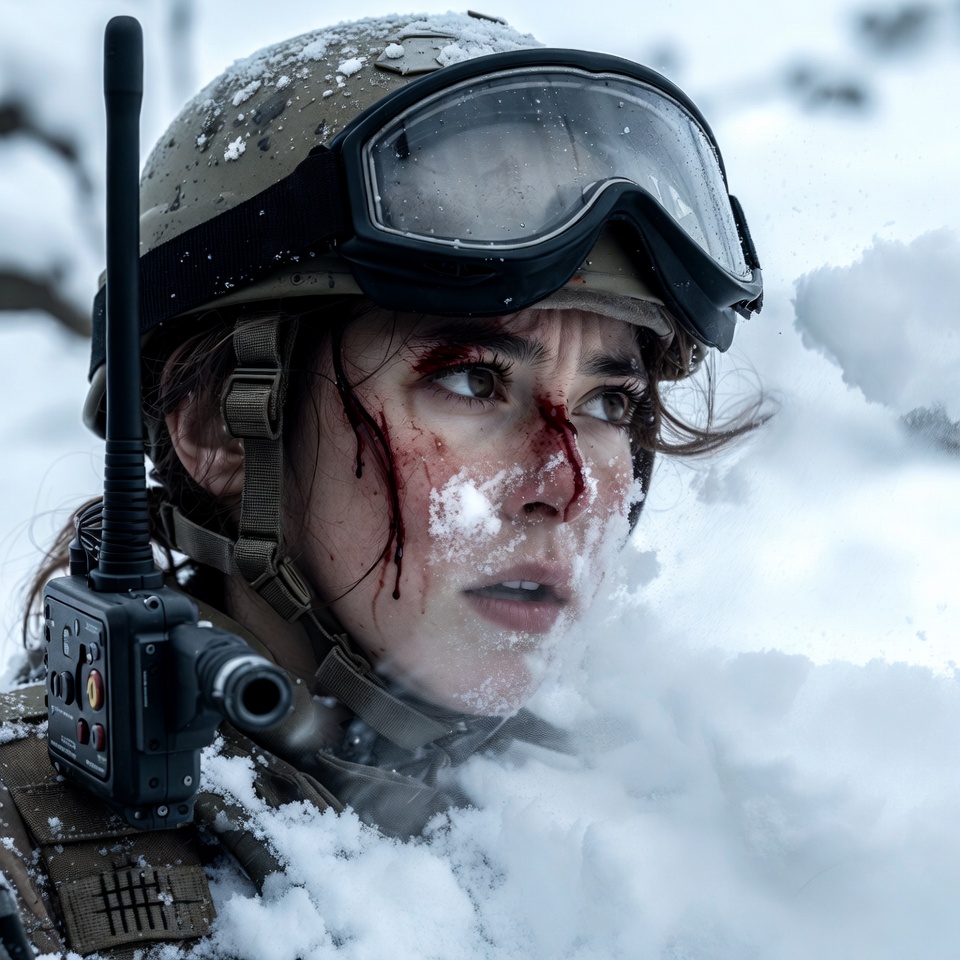
Part 1
They were already corpses. They just hadn’t realized it yet.
That was the thought that came to me in the frozen valley, somewhere no GPS wanted to admit existed. Snow pressed against my cheek. Blood from the cut above my eyebrow kept sliding into my left eye and freezing in my lashes. My radio hissed in my ear like an angry snake.
“Talon Six, do you copy?”
I pressed my thumb to the transmit button. “Any station, this is Sergeant Cole Vance. We are under heavy contact at grid Tango Whiskey Seven. Taking casualties. Need immediate extraction.”
Static answered.
The valley had no official name. On our map it was just a gray fold between two knife-edged ridges. The locals called it Teller’s Gap, but they said the name like they were apologizing to God for saying it out loud.
We had come in with eight men.
By the time the snow turned pink around us, I was counting six.
Corporal Reigns was behind a boulder ten yards to my right, firing controlled bursts at movement in the eastern tree line. Private Lou was beside him, her jaw clenched so hard I could see the muscle jumping in her cheek. Mendes was behind me with Carter, both hands buried in Carter’s thigh, trying to hold the kid’s blood inside his body.
“Carter?” I yelled.
Mendes didn’t look up. “Bad, Sarge.”
That was all he said, and it told me everything.
A shot cracked across the valley.
Specialist Ortega’s helmet snapped backward. For one clean second he was standing there, rifle up, body still obeying orders. Then he folded into the snow without making a sound.
Nobody moved.
The shot had come from nowhere. Not from the tree line. Not from the rocks. Not from any ridge I could see. Whoever fired it owned this valley, and they had just made sure we understood that.
“Shepherd, stay down!” I barked.
Too late.
Shepherd lifted his head half an inch, eyes huge behind scratched goggles.
Another shot.
He screamed and dropped, clutching his shoulder. Not dead. The sniper had chosen not to kill him. That scared me worse than Ortega’s body.
The enemy wasn’t rushing us. They weren’t panicking. They were taking us apart by inches.
Then came the drone.
Lou spotted it first. “Eleven o’clock. Small UAV.”
I saw it through the blowing snow. Black, quiet, steady. Too steady. It hovered above the valley like an insect made of bad news, its camera pointed straight at us.
“Shoot it down,” I said.
Reigns fired. Missed.
The drone dipped, slid sideways, and rose again. Smart movement. Military-grade. Not some toy from a hobby store.
A mortar landed thirty yards behind us.
The blast threw dirt, ice, and frozen bits of pine across my back. My ears rang. My teeth clicked together. Carter cried out once, then went quiet.
“They’re walking fire in,” Mendes shouted. “Next one’s closer.”
He was right. Whoever was watching through that drone was feeding corrections to the mortar team.
The next round hit twenty yards out.
I looked at my men, then at the cliffs around us. Sheer walls. Ice-glazed rock. No route out. No radio. No air support. No miracle.
And then something moved on the western cliff.
At first, I thought it was falling.
A dark shape slid down a wall of ice and stone that no sane climber would touch. No rope. No harness. Bare hands finding holds that shouldn’t exist. It moved too fast to be safe and too smooth to be panic.
“What the hell is that?” Reigns breathed.
The figure dropped the last fifteen feet and landed in a crouch.
It was a woman.
Young. Small. Asian. Dark hair whipping across her face. Cargo pants. Worn thermal jacket. No gloves, even in that killing cold.
And both her arms were covered in black tattoos.
Not flowers. Not skulls. Tally marks.
Groups of five. Crossed lines. A count.
She walked through the snow toward us like bullets were only weather.
I raised my rifle because training is stronger than confusion.
She glanced at me once, calm as a person checking the time.
“How many shooters?” she asked.
I stared at her. “Who are you?”
“How many?”
“Six, maybe eight. One sniper. Mortar team. Drone operator.”
She looked toward the northeast ridge without needing me to point. “Sniper’s been there twenty minutes.”
My mouth went dry.
Another mortar landed closer.
She unslung an old bolt-action rifle from her back, settled behind a rock, and looked up at the drone.
“You have about thirty seconds before the next round kills you,” she said.
Then she breathed out, squeezed the trigger, and shot the drone out of the sky.
The explosion was small, sharp, beautiful.
For three seconds, the whole valley went silent.
Then she worked the bolt and turned her rifle toward the ridge.
I saw the tally marks on her wrist again and felt something colder than the wind crawl under my skin.
She wasn’t counting shots.
She was counting people.
And I had no idea whether we were next.
Part 2
When she fired at the ridge, I didn’t hear the impact.
I felt it.
The battlefield changed shape. The invisible hand squeezing our throats loosened. The sniper’s rifle went quiet, and the men who had been pinning us from the tree line suddenly fired like they were guessing instead of aiming.
“Move!” I shouted.
I ran for Ortega’s body.
Every step through that snow felt too loud. His comms pack was half buried under his shoulder. I tried not to look at his face, but I looked anyway, and for one awful second I saw the photo taped inside his helmet: a woman smiling beside a Christmas tree.
I ripped the emergency radio free and dove back behind cover as bullets chased me into the rocks.
The pack was cracked. One antenna bent. I slapped it hard enough to sting my palm and keyed the mic.
“Any station, this is Talon Six. Emergency contact. Heavy casualties. Need QRF. How copy?”
Static.
Then a voice, thin and broken. “Talon Six… say again…”
“We are under attack at Tango Whiskey Seven. One KIA confirmed, multiple wounded. Need extraction now.”
“Copy… QRF inbound… ETA forty…”
The signal died.
Forty what? Minutes? Hours? Carter didn’t have either.
The woman had already moved.
One second she was near me. The next she was crossing open ground, low and fast, her rifle slung and a worn 1911 pistol in her hand. She knew where the rocks dipped, where the snow crust would hold, where the shadows hid movement. She wasn’t reacting to the valley.
She was reading it.
Two enemy fighters tried to rush our left side.
She fired twice.
Both dropped.
A third came from behind a split pine. Reigns shot him only because she shouted, “Tree line, blue scarf!” before the man even cleared cover.
For the next ten minutes, we survived because she made the impossible practical.
“Lou, shift right!”
Lou shifted.
A burst tore through the space where her head had been.
“Mendes, Carter goes now!”
Mendes dragged Carter behind a stone shelf just before another mortar round hit their old position.
I wanted to ask how she knew. I wanted to ask why she was here. I wanted to ask about the marks on her arms.
Instead, I kept shooting.
The enemy broke first.
That was the strangest part. They had us outnumbered, outpositioned, half-dead. But after she killed their drone, silenced their sniper, and cut down their flank team, their fire turned ragged. Controlled men became frightened men.
“They’re pulling back,” Lou said, disbelief cracking through her voice.
“Don’t chase,” the woman said.
Nobody had given her command, but everyone obeyed.
She appeared beside Carter and looked at the blood-soaked bandage on his thigh. Her expression didn’t change, but something tightened around her eyes.
“He has minutes if you stay,” she said.
“We’ve got extraction coming,” I told her.
“Then reach the clearing alive.”
She turned away.
“Wait,” I said. “What’s your name?”
She looked at me like names were things other people needed.
“Move south. Stay low. Don’t use the creek bed. It’s watched.”
“How do you know?”
She didn’t answer.
We made a stretcher from jackets and rifle slings. Reigns and Lou took point. Mendes and I carried Carter. Shepherd stumbled along behind us, his shoulder taped so tight his fingers had turned pale.
The woman disappeared and reappeared along our edges. A shadow on a ridge. A shape near a pine. A muzzle flash from an angle that shouldn’t exist.
Twice, enemy rounds snapped near us.
Twice, she answered.
Twice, the shooting stopped.
At the extraction clearing, the Blackhawks came in low, rotors whipping snow into a white storm. Medics jumped out before the skids settled. We loaded Carter first. He was still breathing, barely.
I looked back.
She stood on a ridge three hundred yards away.
Wind tore at her hair. Her rifle hung at her side. She looked less like a rescuer than a warning carved into the mountain.
I raised a hand.
She didn’t wave back.
Then she turned and walked into the snow.
“Sir!” the crew chief shouted. “Get in!”
I climbed aboard.
As we lifted away, the valley dropped beneath us, white and silent and hungry. I kept seeing her arms. Tally marks. Seventeen of them, maybe more. Groups of five like a prison wall.
Carter died three minutes before we reached the field hospital.
Mendes held his hand the whole way, talking about Tennessee, summer rain, and his mama’s biscuits, even after Carter stopped breathing.
That night, after the debrief, after the bandage on my leg, after the coffee that tasted like burnt pennies, I wrote my report.
Female civilian asset. Unknown affiliation. Provided tactical support.
I left out the cliff. The impossible shots. The way every enemy seemed afraid of her.
And I left out the tally marks.
Because I had the sick feeling that if I wrote them down, someone would come asking why she was counting bodies.
Three weeks later, someone did.
Part 3
The call came at 2:13 in the morning.
I know because I was staring at the clock, not sleeping. Since the valley, sleep came in pieces. Ten minutes here. Twenty there. Always ending with snow in my mouth and Carter’s blood on my gloves.
My phone buzzed on the nightstand.
Unknown number.
I answered without saying anything.
A filtered voice came through, mechanical and low. “Sergeant Vance.”
I sat up. “Who is this?”
“The woman you saw in Teller’s Gap. We need to talk.”
My bedroom felt suddenly too small. “I don’t know what you’re talking about.”
“You left her out of the official report.”
I stood, crossed to the window, and looked down at the empty parking lot outside my apartment. Sodium lights buzzed over wet asphalt. Nothing moved.
“I reported everything relevant.”
“You didn’t report the marks on her arms.”
I said nothing.
The voice continued. “Mabel’s Diner. Route 40. Eight tomorrow morning. Come alone.”
“And if I don’t?”
“Then more soldiers go into that valley blind.”
The line went dead.
Mabel’s looked like every roadside diner in America that had survived on coffee, pie, and truckers who didn’t ask for much. Chrome stools. Cracked red booths. A bell over the door that rang tiredly.
I took the back booth.
At 8:03, a woman in a gray suit sat across from me without asking.
She was older than the voice sounded. Forty-five, maybe fifty. Government posture. Flat eyes. The kind of face designed to be forgotten.
“Sergeant Vance.”
“You have me at a disadvantage.”
“That’s usually intentional.”
The waitress came. The woman ordered black coffee. I kept mine untouched.
She slid a folder across the table.
I didn’t open it.
“What do you want?” I asked.
“To stop you from digging.”
“I’m not digging.”
She smiled slightly. “You searched unidentified female operators in Central Command records. You requested old incident files for Tango Whiskey Seven. You contacted a retired cartographer about pre-classification maps of the region.”
I leaned back. “You watching me?”
“We watch everyone who becomes interested in that valley.”
That got under my skin.
I opened the folder.
The first photo showed twelve soldiers in a desert staging area, all sunburn and confidence. One of them was her. Younger. Softer. Still sharp, but not hollowed out yet. Her name was printed below the image.
Specialist Cara Chen.
“Eighteen months ago,” the woman said, “Chen’s reconnaissance team entered Teller’s Gap to verify reports of hostile logistics activity. Twelve went in. One came out.”
I turned the page.
Eleven body bags.
The coffee smell turned sour in my throat.
“Chen was the survivor,” the woman said. “After extraction, she refused to debrief. She barely ate. Didn’t sleep. Nurses heard her counting at night. Same numbers over and over. One through eleven.”
“The marks,” I said.
“Her team.”
I turned another page.
Another unit. Another ambush. One survivor. Statement mentioning an unidentified woman with tattoos.
“How many marks?” I asked.
“Twelve.”
My stomach sank.
Another report. Another ambush. Another survivor.
“Fourteen marks,” the woman said.
I kept turning pages. Every few months, another unit went into the valley. Every time most died. Every time one or two survived. Every time, they reported a woman who appeared from nowhere and fought like the terrain belonged to her.
By the time my unit was hit, she had seventeen marks.
“She’s not counting bodies she killed,” I said.
“No.”
“She’s counting people she couldn’t save.”
The woman’s mouth tightened. “Or people she believes she owns.”
I looked up. “That’s a hell of a thing to say about someone who saved American lives.”
“She’s unstable.”
“She’s effective.”
“Those aren’t opposites.”
Outside, a semi rolled by, rattling the diner windows. Inside, the waitress laughed at something the cook said. Normal sounds. Normal life. They felt obscene.
“Who keeps sending units into that valley?” I asked.
Her eyes sharpened.
“There it is.”
“What?”
“The right question.”
She closed the folder with two fingers. “Forget Chen. Forget Teller’s Gap. Forget the marks. You survived. Most people don’t.”
“Who are you?”
“Someone who knows what happens to people who pull at this thread.”
“That a threat?”
“A warning.”
She stood, dropped a twenty on the table, and walked toward the door.
I called after her, “If you wanted me to stop, you shouldn’t have shown me the folder.”
She paused with one hand on the door.
Without turning around, she said, “I know.”
Then she left.
I sat there for a long time, staring at the closed folder she had not taken back.
Inside were dead soldiers, one woman who refused to stay rescued, and a pattern nobody wanted named.
My phone buzzed.
Unknown number again.
One text.
The valley does not give people back.
I looked out the window at the gray highway and felt the first real fear I’d had since the sniper shot Shepherd.
Because the message wasn’t a warning.
It was a confession.
Part 4
For the next week, I lived like a man with two lives.
During the day, I went to physical therapy, filled out forms, attended mandatory “combat stress reintegration sessions,” and nodded while a captain with kind eyes told me trauma could distort memory.
At night, I dug.
Not through official systems. Those were watched. I went old-school. Local archives. County libraries. Scanned newspapers. Obituary databases. Grainy maps with coffee stains and handwritten notes.
Teller’s Gap had been killing people long before the military fenced it in.
A prospector vanished there in 1847. Two surveyors in 1912. A geology professor in 1968. Hunters, hikers, a state rescue team that lost three men trying to find one missing camper.
The reports always sounded ordinary if you read them fast. Bad weather. Rockslide. Exposure. Animal attack.
But the numbers were wrong.
Too many disappearances. Too many bodies never recovered. Too many witnesses who mentioned radio failure, strange lights on Marker Ridge, voices in the snow.
Marker Ridge.
That name kept showing up like a bruise.
On current maps, it didn’t exist. On old ones, it sat in the valley’s center, a rocky spine overlooking every approach.
I found a satellite image from five years ago. Blurry, but clear enough.
There was a structure on the ridge.
Small. Square. Man-made.
My phone rang.
Reigns.
“You alone?” he asked.
“That’s a friendly greeting.”
“I’m serious, Sarge.”
I stood and closed my blinds. “Yeah. Why?”
“Intelligence just questioned me about the woman.”
“What did you tell them?”
“That she saved us. That I didn’t know who she was. That she was terrifying in a helpful way.”
Despite everything, I almost smiled.
“Then they asked if I’d seen her again,” Reigns said.
My smile died.
“Have you?”
“No. But why would they think I had?”
“Because they think someone has.”
Silence stretched between us.
Then Reigns said, “You’re doing something stupid, aren’t you?”
“Probably.”
“Want company?”
“No.”
“Too bad. Lou’s already suspicious, and Mendes is worse than both of us.”
“Stay clear of this,” I said. “That’s an order.”
“You’re not currently my commanding officer.”
“I’m still your sergeant.”
“And you’re still bad at lying. Good night, Sarge.”
He hung up.
Five minutes later, my laptop screen went black.
Green text appeared.
STOP DIGGING.
I didn’t touch the keyboard.
More text.
CARA CHEN IS NOT THE ONLY ONE COUNTING.
My heartbeat moved into my throat.
I typed, “Who are you?”
A pause.
SOMEONE WHO HELPED HER SURVIVE.
“Why?”
BECAUSE HER TEAM WAS SOLD OUT.
There it was. The thought I’d been avoiding. Not bad luck. Not superior enemy planning. Betrayal.
“By who?”
The cursor blinked.
COMMAND.
Then the screen died.
I tried rebooting. Nothing. Completely bricked.
I sat in the dark with the dead laptop glowing faintly from streetlight reflection. Rain tapped against the window. Somewhere outside, a car alarm chirped once and went quiet.
My phone rang.
Unknown number.
I answered.
The wind came through first. Harsh, open, cold.
Then her voice.
“Sergeant Vance.”
I knew it immediately. “Chen.”
“You need to stop.”
“You called me to say that?”
“I called because they’re watching you, and you’re not as careful as you think.”
“Who is they?”
A gust of wind hit the phone.
“People who make sure the wrong soldiers die in the right places.”
I closed my eyes. “Your team was betrayed.”
“Yes.”
“By command.”
A pause.
“By someone wearing command like a costume.”
“What’s on Marker Ridge?”
“The reason they killed my team.”
“Tell me.”
“No.”
“Chen—”
“No,” she said again, harder. “If you know too much, they’ll send you back here.”
The words landed wrong.
“Back?”
She went quiet.
I felt the room tilt.
“They already have orders drafted, don’t they?”
She didn’t answer.
“Chen.”
“When they send you,” she said, “do not come.”
“That’s not how orders work.”
“That’s exactly how graves work.”
The line crackled. For a second, I heard something behind her. Metal tapping. A distant engine. Maybe voices.
“You’re close to the ridge,” I said.
“I’m where I need to be.”
“How many marks now?”
The silence changed. It got heavier.
“Twenty-three.”
My hand tightened around the phone.
“You saved six more.”
“I failed more than that.”
“That’s not what I asked.”
“It’s the answer.”
I heard a faint sound. Not wind. Not static.
A gunshot.
Far from her, but real.
“Chen?”
“They found a patrol trail,” she said, voice flat now, all business. “I have to go.”
“Wait. Who betrayed you?”
She breathed once.
“Colonel Robert Marks.”
The name hit me like a punch.
I knew that name. Not personally, but from the orders routing system. High enough to move units. Quiet enough not to be noticed.
“Don’t come looking for me,” she said.
Then the call ended.
Two days later, my new orders arrived.
Reconnaissance element. Tango Whiskey Seven. Depart 0600.
Signed by Colonel Robert Marks.
I stared at the paper until the letters blurred.
The valley was calling me back.
This time, I knew it had my name.
Part 5
The briefing lasted nine minutes.
That bothered me more than if it had lasted an hour.
Colonel Marks sat behind a metal desk in a windowless operations room, his uniform sharp enough to cut paper. He had silver hair, calm hands, and the kind of voice officers use when they want bad orders to sound reasonable.
“Intelligence suggests renewed hostile movement inside Tango Whiskey Seven,” he said. “You’ve operated there before. You’ll lead a six-person reconnaissance element. Seventy-two hours. Observe, report, extract.”
“With respect, sir,” I said, “that valley is a prepared kill zone.”
Marks looked at me like I had reported bad weather. “Your prior report credited survival to tactical withdrawal and emergency extraction.”
“My report was incomplete.”
“Then perhaps you should have written a better one.”
The room went still.
I stared at him. He stared back.
“Dismissed, Sergeant.”
In the hallway, Reigns was waiting.
“You look like you just got handed a coffin,” he said.
“0600. We’re going back.”
His face hardened. “Figured.”
“You’re not assigned.”
“I volunteered.”
I swore under my breath.
“Lou too,” he said. “Mendes also. Torres and Kim filled the rest.”
“This is not loyalty. This is stupidity.”
“Most good loyalty is.”
I wanted to order him out of it. I wanted to protect all of them. But the truth was uglier: I needed people I trusted. The valley killed strangers faster.
We inserted at dawn.
The helicopters dropped us at the southern edge and lifted off before my boots settled in the snow. The pilots didn’t idle. Didn’t joke. Didn’t look back.
Bad sign.
The valley smelled the same as before: pine sap, old ice, cold stone, and that faint metallic scent snow gets when blood is coming.
We moved in staggered formation. Lou on point. Reigns left. Mendes right. Torres and Kim behind. I kept us away from the creek bed because Chen had warned me it was watched.
An hour in, Lou raised a fist.
Body.
Not American.
The man lay half covered in drift snow, face gray, beard rimmed with frost. His uniform had no patches. His rifle was gone. Radio smashed. Pockets empty.
“Enemy?” Torres asked.
“Maybe,” I said.
“Dead how?”
Reigns knelt. “Rifle shot. Clean.”
The second body was farther in.
Then the third.
By noon, we had counted eleven.
All foreign fighters. All killed within the last month. All positioned like they had retreated toward Marker Ridge and lost.
Lou looked at me. “This her?”
I didn’t answer.
The bodies formed a trail.
We followed it because some decisions look stupid only if you forget someone forced the board.
The valley narrowed near dusk. Cliffs pinched in from both sides. Wind funneled through hard enough to sting exposed skin. Perfect ambush ground.
I called a halt.
“Hassan would hate this,” Reigns muttered.
“Hassan hates paperwork,” Lou said. “He’d hate this less.”
Kim laughed once.
The shot hit him in the neck.
He dropped with a wet sound that did not belong in the cold.
“Contact!” I yelled.
Gunfire opened from both ridges.
We were in the pocket. Same tactics as before, but tighter. Better. No probing shots. No wasted rounds. They knew exactly where we were.
Torres dragged Kim behind a rock, but one look told me Kim was gone.
Mendes fired uphill. Lou crawled toward a broken pine for better angle. Reigns threw smoke that lasted three seconds before the wind tore it apart.
A round snapped past my jaw close enough to burn.
“They boxed us,” Reigns shouted.
I knew.
I also knew why.
Marks didn’t send us here to observe. He sent us here to flush her out.
And it worked.
She appeared on the ridge above us, descending through snow and rock like a dark line cut into the mountain.
Cara Chen hit the ground, rolled, came up firing.
Three shots.
Three enemies fell.
The enemy fire shifted toward her with a speed that proved they had been waiting for exactly this.
She reached us in under a minute, sliding behind cover beside me.
Up close, she looked thinner than before. Her cheeks were sharper. Her eyes darker. And her arms—
Twenty-three marks.
No.
Twenty-four.
Fresh ink, still dark against her skin.
“You shouldn’t be here,” she said.
“Tell that to Marks.”
For the first time, emotion broke through her face.
Not surprise.
Confirmation.
“He sent you.”
“Bait?”
“Yes.”
A bullet sparked off the rock between us.
Chen leaned out, fired, vanished back behind cover.
“Can you get us out?” I asked.
“Maybe.”
“That’s better than no.”
She pulled a marker from her pocket and drew a quick line across the inside of her wrist.
Another tally.
“What are you doing?” I asked.
“Counting.”
My throat tightened. “Who?”
She looked at me with eyes that had lived too long in winter.
“You.”
Before I could answer, a radio crackled from one of the dead fighters nearby.
A calm American voice came through.
“Specialist Chen. I wondered how long before you took the bait.”
Chen went perfectly still.
I knew that voice from a windowless briefing room.
Colonel Marks was on the ridge.
And he was smiling.
Part 6
Chen picked up the enemy radio like it might bite her.
“Marks,” she said.
“Cara,” he replied, almost warmly. “You look tired.”
I watched her face shut down piece by piece. No fear. No anger. Just a door closing.
“You sold my team,” she said.
“I made a strategic decision.”
“You gave hostile forces our route, our timeline, our extraction codes.”
“And yet one of you survived. Operational plans are never perfect.”
My finger tightened on my rifle.
Reigns whispered, “I’m going to kill him.”
Chen heard him. “Get in line.”
Marks chuckled through the radio. “Sergeant Vance, I assume you’re there. I apologize for the deception, but you were useful.”
“You sent my men to die,” I said.
“I sent you to bring me Chen.”
Chen keyed the radio. “You got me.”
“Yes. Come to Marker Ridge. Alone. We finish this. If you bring the others, I bury them with your old team.”
The radio clicked dead.
For a moment, the only sound was wind scraping over stone.
Then Chen stood.
I grabbed her arm.
It was the wrong move.
She twisted, swept my leg, and put me flat on my back with her pistol against my cheek before I could inhale.
Her hand was steady. Her eyes were not.
“Don’t,” she said.
“I’m not letting you go alone.”
“You don’t get to let me do anything.”
“You think dying fixes this?”
Her jaw worked.
“Dying is not the goal.”
“But you’ve made peace with it.”
“That’s different.”
“Not to the people standing behind you.”
Reigns stepped closer. Lou too. Mendes, face pale from the cold, kept watch on the ridge but said, “We’re going.”
Chen didn’t look away from me. “You’ll slow me down.”
“Probably.”
“You’ll die.”
“Maybe.”
“You don’t even know what’s on that ridge.”
“Then tell us.”
She held the silence long enough that I thought she’d walk away.
Instead, she lowered the gun.
“My team was sent to verify a logistics hub,” she said. “Weapons. encrypted comms. payment channels. We found all of it. We also found American routing codes. Mission packets. Deployment schedules. Proof someone in our chain was feeding hostile contractors and foreign intelligence.”
“Marks,” Lou said.
“Marks and others.”
Mendes looked toward the ridge. “So we take the proof.”
Chen laughed once, dry and humorless. “Twenty hostiles. Prepared positions. High ground. Sensors. Mines. One concrete bunker wired for demolition.”
“That your way of saying impossible?” Reigns asked.
“That’s my way of saying accurate.”
Torres, who had been quiet beside Kim’s covered body, looked up. “Kim died because Marks sent us here. I’m going.”
Nobody argued after that.
Chen pulled out a small notebook, its pages worn soft from cold and use. Inside were sketches of Marker Ridge. Firing lanes. Patrol paths. Blind spots. Bunker entrances.
“You’ve been planning this,” I said.
“Sixteen months.”
“For revenge?”
She looked at her arms. The marks crawled over her skin like a sentence she couldn’t appeal.
“At first, yes. Then I realized killing Marks wasn’t enough. Dead men don’t testify. Dead traitors become classified mistakes. I needed proof.”
“And the people you saved?”
“Witnesses,” she said too quickly.
I heard the lie.
“Only witnesses?”
Her mouth tightened.
“Every one of them was also someone my team didn’t get to become.”
That hit harder.
She pointed to the map. “South approach is weakest. We hit it after midnight. Vance, you and Torres with me. Lou, Reigns, Mendes provide covering fire from the lower rocks. We move fast. If I say fall back, you fall back.”
“No,” I said.
Her eyes cut to mine.
“If you say fall back because the mission is done, we fall back,” I said. “If you say it because you’re trying to die alone, we don’t.”
Something flickered in her face. A memory maybe.
“You remind me of my team leader,” she said.
“Good man?”
“Best I knew.”
“What happened to him?”
“He ordered me to run.” She closed the notebook. “I didn’t forgive him for saving me.”
Nobody spoke.
The sun sank behind the cliffs, and the valley turned blue with cold. We checked ammunition. Too little. Medical supplies. Less. Courage. Questionable, but present.
At 2300, we started climbing.
Chen led us through cracks in the rock I would have missed in daylight. Twice she froze and raised a fist. Once, she disarmed a tripwire under three inches of snow. Another time, she pointed at a rock face and whispered, “Camera,” before putting a single round through a black lens smaller than a dime.
Marker Ridge came into view just after midnight.
The bunker sat on the crest, half buried in stone, its lights glowing weakly through reinforced slits. Men moved around it in pairs. Contractors, not regular soldiers. Expensive gear. Smooth discipline.
Chen studied them.
Then she looked at us.
“No forgiveness,” she said quietly. “Not for Marks. Not for anyone who helped him.”
“Good,” I said.
She raised her rifle.
Her first shot dropped the southern guard before he heard the crack.
The ridge woke up screaming.
And somewhere inside that bunker, Colonel Marks finally learned that bait can bite back.
Part 7
The first minute belonged to Chen.
Her rifle cracked once, twice, three times, each shot spaced by the rhythm of her breathing. Men fell before their rifles cleared their shoulders. She moved between muzzle flashes like darkness had taught her manners.
Then the ridge belonged to everyone.
Alarms shrieked from the bunker. White floodlights snapped on, turning snow into powdered glass. Automatic fire hammered the rocks above us. The smell of cordite and hot metal cut through the cold.
“Left nest!” Chen shouted.
Torres and I fired at the same muzzle flash. The shooter vanished backward.
“Reigns, suppress west!”
Reigns answered with a long burst and a curse loud enough to carry over gunfire.
Lou’s rifle barked from lower cover, steady as a metronome. Mendes dragged a wounded contractor behind a rock and kicked his weapon away instead of shooting him. Even in the middle of hell, Mendes stayed Mendes.
We crossed the last twenty yards under fire.
A round hit my plate hard enough to knock air out of me. I stumbled. Chen grabbed my vest and yanked me behind a concrete lip.
“You hit?” she asked.
“Pride.”
“Dangerous wound.”
She pushed forward.
The south position collapsed in less than three minutes.
That was the good news.
The bad news was the east and west positions were now turning toward us, and the bunker door was closing.
Torres saw it first. “Door!”
Chen ran.
No hesitation. No cover. Just speed.
I ran after her because apparently survival had become a habit I was trying to quit.
A contractor stepped from behind a fuel drum. Chen shot him in the knee, then the shoulder, leaving him alive and screaming. She didn’t slow down.
We reached the bunker as the steel door slid inward.
I shoved my rifle barrel into the gap. Chen jammed a rock into the lower track. The motor ground, whined, and froze.
Torres tossed a flashbang through the opening.
White light. Thunder.
We entered.
Inside, the bunker smelled like dust, plastic insulation, and men who had been sweating fear for hours. Computer racks lined one wall. Filing cabinets lined another. A bank of radios blinked under green lights.
And there, behind a metal desk, stood Colonel Robert Marks.
He looked smaller without the desk from base. Still polished, still calm, but smaller.
In his left hand was a detonator.
“Specialist Chen,” he said. “You always were difficult to kill.”
Chen aimed at his face. “Put it down.”
“No.”
“Then die holding it.”
“If I release the trigger, this entire bunker vaporizes. Evidence, servers, paper files, all of us.”
I glanced around and saw the charges. C4 wired along beams. Enough to erase the ridge.
Marks smiled at me. “Sergeant, I hope you appreciate irony. She wanted proof. I gave her a tomb.”
Chen didn’t blink. “Why?”
Marks sighed, like she had asked a childish question. “Money. Influence. Strategic access. Pick whichever motive helps you sleep. Our enemies paid well for deployment information. I provided it.”
“My team trusted you.”
“Your team became inconvenient.”
Her rifle dipped half an inch, then steadied.
“You watched them die,” she said.
“I listened.”
The room went quiet.
For the first time, I saw not grief in Chen’s face, not guilt.
Murder.
Marks saw it too.
“You kill me,” he said, “and the others disappear. You spare me, maybe I name them. Maybe.”
“No deals,” Chen said.
“Cara,” I warned softly.
She didn’t look at me.
Marks lifted the detonator slightly. “You need me.”
A voice came from behind the radio racks.
“No, she doesn’t.”
Lou stepped out, holding a bundle of wires and two blasting caps.
Reigns followed with three more.
Mendes had a laptop bag slung over his shoulder.
Lou smiled without warmth. “You should hire better bomb techs.”
Marks stared.
That was the first time he looked afraid.
He dropped the detonator and went for his sidearm.
Chen fired.
The bullet struck his shoulder and spun him into the desk. The pistol clattered across the floor. Marks gasped, clutching blood with one hand.
Chen crossed the room and kicked the weapon away.
I thought she would kill him.
Maybe part of me wanted her to.
Instead, she knelt beside him and pressed the muzzle under his jaw.
“You don’t get my forgiveness,” she whispered. “You don’t get a clean death either.”
Marks swallowed.
“You are going to confess,” she said. “Every name. Every account. Every route you sold. And when the families ask why their sons and daughters died, you can look them in the eye like I had to.”
He smiled weakly. “They’ll bury this.”
Chen reached over and keyed the main transmitter.
“This is Specialist Cara Chen broadcasting on all emergency military frequencies from Marker Ridge, grid Tango Whiskey Seven. Colonel Robert Marks is in custody. Evidence of treason, hostile coordination, and illegal intelligence transfer secured. Multiple witnesses present. Request immediate QRF and command oversight.”
Static filled the room.
Then a new voice answered.
“Specialist Chen, this is Colonel Diaz, Joint Special Operations Command. Confirm you said Colonel Robert Marks.”
Marks closed his eyes.
Chen looked at me, and for the first time since I’d met her, she seemed young.
“Confirmed,” she said. “And he is not the only one.”
The radio stayed silent for two beats.
Then Diaz said, “Hold position. QRF inbound. Twenty minutes.”
Chen lowered the radio.
Her hands shook.
Not from fear. From release.
Outside, the shooting had stopped. The ridge lights hummed. Wind dragged snow against the bunker walls.
Chen looked down at Marks, bleeding and beaten on the floor.
“Eleven,” she said.
Marks frowned through pain. “What?”
“My team. Eleven people you stole from the world.”
She pulled the marker from her pocket.
For one awful second, I thought she was adding another tally.
Instead, she wrote eleven names on the bunker wall, one under another, beside the evidence table.
Then she sat on the floor, rifle across her knees, and waited for justice to arrive.
But when the helicopters came, they brought handcuffs for her too.
Part 8
The debriefing room was warm, but it felt colder than the valley.
Fluorescent lights hummed overhead. A clock ticked too loudly. Cara Chen sat three chairs away from me with her wrists cuffed in front of her, her tattooed arms resting on the metal table like evidence.
Across from us sat three officers, one military lawyer, and a civilian woman from whatever agency pretends not to exist until it does.
Colonel Diaz stood near the wall, arms folded. He had the exhausted look of a man whose war had just expanded from mountains to paperwork.
General Reeves leaned forward. “Specialist Chen, you deserted your post eighteen months ago.”
“No, sir,” she said. “I continued mission objectives.”
“Without orders.”
“With compromised orders.”
“You killed forty-seven hostile combatants.”
“Yes, sir.”
“You interfered with classified operations.”
“I exposed a treason network.”
“You tattooed marks on your arms after each incident.”
Chen glanced down at them. “After each survivor.”
The military lawyer looked up. “Not each survivor. Some marks correspond to engagements where soldiers died.”
Her jaw tightened.
“They all correspond to people I carried,” she said. “Living or dead.”
That landed.
Nobody wrote for a second.
Then the civilian woman spoke. “You understand how this appears. A traumatized soldier operating alone, selecting units to intervene with, creating a personal myth around survival.”
Chen looked at her. “I didn’t select them. Marks did. I followed the pattern he made.”
“And decided you alone could fix it.”
“I decided waiting would kill more people.”
The woman’s expression didn’t change. “Systems exist for a reason.”
“So do graves.”
I heard Lou shift behind me. Reigns sat two rows back, jaw set. Mendes was beside him, one hand still bandaged from the ridge fight. Torres stared at the table like he could burn holes through it.
General Reeves turned to me. “Sergeant Vance, when did you first learn Specialist Chen’s identity?”
“Three weeks after the first ambush.”
“Did you report that?”
“No, sir.”
“Why?”
“Because the only people asking questions about her were also hiding information about the valley.”
“That is not an answer.”
“It is the honest one.”
His eyes narrowed. “Did Specialist Chen influence your actions before the second deployment?”
“She warned me not to go.”
“But you went.”
“I had orders.”
“From Colonel Marks.”
“Yes, sir.”
“And once there, you followed Chen into an unauthorized assault on Marker Ridge.”
“Yes, sir.”
“Why?”
I looked at Chen. She wasn’t looking at me. She was staring at her own arms.
“Because she was right,” I said. “And because Colonel Marks sent my men there to die.”
The room went quiet again.
The hearing lasted six hours.
They asked Chen about every mark. She knew every name. Not just rank and surname. Full names. Hometowns. Last words when she had them. Injuries. Extraction times. Family details if she had learned them later.
By mark nineteen, the civilian woman stopped looking skeptical.
By mark twenty-six, General Reeves removed his glasses and rubbed his eyes.
Finally, he asked, “Do you believe you were responsible for your team’s deaths?”
Chen was quiet for so long the clock filled the room.
“I was the only one who lived,” she said.
“That is not responsibility.”
“It feels like it.”
“Feelings are not facts, Specialist.”
“No, sir. But they are heavy.”
Something in Reeves softened.
Not enough to save her from charges.
Enough to see her as human.
Two months later, the court-martial began.
The courtroom was closed to the public, but every seat was filled with military personnel. Survivors came. Families came. Men and women with scars, canes, braces, empty sleeves, quiet spouses, trembling hands.
The prosecution called Chen reckless.
The defense called her necessary.
Chen called herself neither.
When she took the stand, she wore dress uniform with no decorations except the ones they couldn’t take from her skin.
“I made a choice,” she said. “Follow broken channels and watch more soldiers die, or step outside them and save who I could. I accept whatever punishment comes from that. But I will not apologize for saving lives.”
The prosecutor tried to bait her.
“You believed you were judge, jury, and executioner?”
“No,” Chen said. “I believed I was the only person close enough to pull a trigger between soldiers and the men sent to kill them.”
“You wanted revenge.”
“Yes.”
A murmur moved through the room.
Chen did not flinch.
“I wanted revenge,” she repeated. “Then I wanted proof. Then I wanted the truth public enough that no one could bury my team twice.”
That was the moment the trial changed.
Not because she sounded heroic.
Because she sounded honest.
On the fifth day, the verdict came.
Guilty of unauthorized absence.
Not guilty of desertion.
Not guilty of conduct unbecoming.
Sentence: time served, reduction in rank, formal reprimand, supervised release until discharge.
No prison.
No dishonorable discharge.
The room exhaled.
Chen stood still as stone.
Outside the courtroom, survivors crowded around her. Some shook her hand. One hugged her before she could brace for it. Another simply said, “My daughter starts kindergarten next month because of you.”
Chen’s face crumpled for half a second.
Then she held herself together.
When the crowd thinned, I found her near the steps.
“How do you feel?” I asked.
“Like I walked out of one valley into another.”
“But you walked out.”
She looked at her arms. Twenty-six tallies. Twenty-six burdens. Twenty-six proofs that death had not gotten everything it wanted.
“I’m tired of counting bodies,” she said.
“Then stop.”
“I don’t know how.”
Behind us, Colonel Diaz came down the steps with a folder under his arm.
“Private Chen,” he said.
She turned.
He handed her one sheet of paper.
I saw the title.
Witness List — Federal Treason Proceedings.
Marks had talked.
And the names went higher than any of us expected.
Part 9
Colonel Marks did not get forgiven.
Not by Chen. Not by me. Not by the families. Not by the country he had sold one mission packet at a time.
He tried everything first.
He claimed operational necessity. Then classified strategy. Then mental strain. Then that he had been following instructions from people above him. That last part was true, which did not make him less guilty. It only made the hole deeper.
The federal trials took months.
I testified three times. Lou twice. Reigns once, badly dressed and furious. Mendes cried on the stand when they showed Carter’s photo, then apologized to the judge for crying, which made half the courtroom cry with him.
Chen testified for two full days.
The defense tried to paint her as unstable.
“Private Chen,” one attorney asked, “isn’t it true you tattooed a body count on your arms?”
She looked at the jury.
“No,” she said. “I tattooed a promise.”
“A promise to whom?”
“To the people I failed. And the people I refused to fail.”
They had no good answer for that.
Marks received life without parole.
Three other officers were convicted. Two contractors flipped. One general resigned before indictment, then got indicted anyway. The network cracked slowly, then all at once. Accounts frozen. Files seized. Quiet arrests at dawn.
There were still names we never learned, doors that never opened, secrets sealed behind classification stamps.
But the main rot was cut out.
Chen watched Marks sentenced from the second row.
When the judge asked whether any victim wanted to speak, she stood.
The courtroom went silent.
She faced Marks.
“You killed my team,” she said. “You killed soldiers you were sworn to protect. You used duty as camouflage for greed. I spent eighteen months thinking if I saved enough people, I could balance what you took.”
Marks stared straight ahead.
Chen’s voice stayed calm.
“I was wrong. There is no balance. There is only truth, memory, and consequence. You get the consequence. My team gets the memory. And I get the truth that I survived you.”
She paused.
“I do not forgive you.”
Marks finally looked at her.
There was something like pleading in his eyes. Maybe fear. Maybe regret. Maybe just a man realizing the story would not be written in his favor.
Chen gave him nothing.
Not hatred.
Not mercy.
Nothing.
After the sentencing, she walked out into bright afternoon sunlight and stood on the courthouse steps like she wasn’t sure what weather was anymore.
“What now?” I asked.
She laughed softly. “That question keeps finding me.”
“You have an answer yet?”
“School.”
“Really?”
“Psychology program. Combat trauma focus.”
I smiled. “You?”
“Don’t sound so surprised.”
“I’m not. I’m impressed.”
She looked down at her arms. After the trial, she had added something beside each tally.
Names.
Not all at once. Slowly. Carefully. Her team first. Then the survivors. Then the ones she couldn’t save but refused to let vanish into numbers.
The marks looked different now. Less like a prison wall. More like a memorial.
“What about you?” she asked.
“My contract ends in three months.”
“You staying in?”
I thought of the valley. Carter. Ortega. Kim. Marks. The cold metal of the witness stand under my palms.
“No,” I said. “I’ve given enough.”
She nodded like she understood more than the words.
Three months later, I signed my discharge papers.
No ceremony. No brass band. Just a stack of forms, a firm handshake, and the strange feeling of stepping out of one uniform before knowing what skin came next.
Reigns bought a house outside Denver. Lou and I started an outdoor survival company. Mendes came on as an instructor after his leg healed enough. We taught hikers how not to die, kids how to read weather, veterans how to breathe outside walls again.
We called it Forward March Adventures.
It sounded cheesy.
We kept it anyway.
Chen started school in Tennessee. She sent occasional texts.
First exam passed. Didn’t shoot anyone. Progress.
Met nephew. He asked if tattoos hurt. Told him yes but less than math.
Going to therapy. Hate it. Going back next week.
Then came a message about Marcus Webb, one of her twenty-six.
He was getting married.
He wanted all of us there.
So we went.
The chapel sat on a hill surrounded by dogwoods. American small-town pretty. White paint. Bell tower. Folding chairs in the reception hall. The smell of cut grass, perfume, baked ham, and coffee.
Chen wore a blue dress and looked uncomfortable until Webb saw her.
He crossed the room, hugged her hard, and whispered something I couldn’t hear.
Whatever it was, she closed her eyes.
During his toast, Webb lifted his glass toward her.
“Some people give you advice,” he said. “Some give you money. Some give you a second chance without ever asking what you’ll do with it. Cara gave me tomorrow. So every day after this is partly hers too.”
Chen cried silently into a napkin and threatened me with physical harm if I mentioned it.
Later, she showed me the inside of her wrist.
Not a new tally.
A date.
Webb’s wedding date, written small beneath his name.
“I’m still counting,” she said.
I frowned.
She smiled. “Not bodies. Tomorrows.”
Across the hall, Webb danced with his bride under cheap string lights. Lou laughed with Reigns near the cake table. Mendes was flirting badly with a nurse who somehow seemed charmed.
For once, nobody was bleeding.
Nobody was running.
Nobody was waiting for mortars.
Chen looked around the room like she was seeing a foreign country.
“I didn’t know life could feel this loud,” she said.
I understood.
Music played. People clapped. The bride spun, dress flashing white under warm lights.
And for the first time since Teller’s Gap, the count meant something other than loss.
Part 10
One year after the valley, I drove back.
Not into Teller’s Gap. I wasn’t that poetic or that stupid.
I stopped at a public overlook thirty miles away, where tourists took pictures of mountains without knowing how many ghosts could fit between them. The path was paved. The railing was painted green. A family nearby argued cheerfully about snacks.
The valley lay far beyond the nearer ridges, hidden in folds of blue-gray rock.
Still there.
Still cold.
But smaller from a distance.
I stood with my hands in my jacket pockets and let the wind hit my face. It smelled like pine needles and rain instead of blood. That helped.
I thought about Ortega’s photo in his helmet. Carter’s hand in Mendes’s. Kim falling before he knew he had been shot. Chen descending the cliff like judgment with a rifle.
Then I thought about Webb’s wedding. Shepherd’s baby, born healthy in March. Lou’s engagement. Reigns’s ugly little house with the big backyard. Mendes marrying the nurse who liked his terrible jokes. Torres teaching high school history and somehow making teenagers care about Reconstruction.
Life had kept going.
Not politely. Not easily.
But stubbornly.
My phone buzzed.
A photo from Chen.
She was standing outside a university building with a backpack over one shoulder, looking mildly annoyed, which for her counted as happy. Under the photo she wrote:
First semester done. No bodies counted. Six papers survived. I hate statistics.
I laughed out loud.
A tourist glanced at me.
I typed back:
Proud of you.
Her reply came fast.
Don’t make it weird.
Then another.
Are you at the overlook?
I looked around like she might be hiding behind a pine.
How did you know?
Because today is today.
She was right.
One year.
I took a picture of the distant mountains and sent it.
Made peace with it, I wrote.
Her answer took longer this time.
Good. Now let it go.
I looked out again.
For months, I’d believed healing meant forgetting. It didn’t. The mountains were still there. The dead were still dead. Betrayal had still happened. No sentence, no trial, no wedding toast could undo any of that.
But healing meant the past stopped driving.
It could ride in the back seat. It could speak sometimes. It could ask to be remembered.
It did not get to hold the wheel.
I turned away from the railing.
Forward March Adventures opened its second location six months later. Lou ran operations better than I ever could. Reigns taught navigation with terrifying enthusiasm. Mendes became our best wilderness medic instructor, mostly because he could scare people into packing tourniquets without sounding dramatic.
I taught survival basics every Saturday.
Fire building. Map reading. Staying calm when lost.
That last one mattered most.
“Panic narrows the world,” I told a group of college kids one morning. “Your job is to make the world big again. Look. Listen. Breathe. Decide.”
I didn’t tell them I had learned that lying in bloody snow.
Chen graduated two years later.
I attended with Reigns, Lou, Mendes, Torres, Webb, Shepherd, and half the scattered tribe she pretended not to need. When her name was called, she walked across the stage in a black gown, tattoos visible beneath the sleeves.
Twenty-six marks.
Twenty-six names.
And beneath them now, dozens of dates.
Weddings. Births. Graduations. Sobriety anniversaries. First homes. Last chemo treatments. Ordinary miracles.
She became a counselor for veterans.
Not the soft, pastel office kind people imagine. Her office had black coffee, practical chairs, a box of tissues, and a wall map of hiking trails. She did not tell people everything would be okay. She told them staying alive was a skill, and skills could be practiced.
They believed her.
Of course they did.
Years passed.
The valley became a classified case study, then a warning in training rooms, then a place new soldiers heard about from older ones in careful voices. Marks died in prison without a friend beside him. Chen did not visit. She did not send a letter. She owed him nothing, not even closure.
On the fifth anniversary of the ambush, we gathered in Tennessee.
Not at a memorial. At Webb’s backyard barbecue.
His daughter Cara ran through the grass with cake on her face and a plastic sword in her hand, terrorizing adults with heroic confidence.
Chen watched her from the porch.
“She’s fierce,” I said.
“She’s four.”
“Both can be true.”
Chen smiled.
The sunset painted her arms gold. The marks were still there, but they no longer looked like wounds. They looked like part of the map that had brought her here.
“Do you still count?” I asked.
She watched little Cara swing her plastic sword at Reigns, who performed a dramatic death fall into the grass.
“Sometimes,” she said. “But not like before.”
“How now?”
She thought about it.
“I count who came home. Who kept going. Who learned to sleep again. Who had children. Who planted gardens. Who forgave themselves. Who didn’t forgive the people who hurt them but stopped letting those people live rent-free in their bones.”
She looked at me.
“I count proof that survival can become life if you keep choosing it.”
“That sounds healthier than tally marks.”
“It took me a while.”
“Most things worth doing do.”
She leaned against the porch rail. “You ever miss it?”
“The military?”
“The clarity. Mission. Orders. Objective.”
I looked across the yard. Lou was laughing with her wife. Mendes was holding his baby like the child was made of glass and sunlight. Torres was arguing history with Shepherd, who had absolutely no chance of winning.
“No,” I said. “I miss the people. Not the war.”
Chen nodded.
“Me too.”
Little Cara ran up to us then, breathless and sticky.
“Aunt Cara,” she demanded, “tell the mountain story.”
Chen’s face softened.
“One day,” she said, “there was a woman who got lost in a very cold place.”
“Was she scared?”
“Yes.”
“But she won?”
Chen looked at me, then back at the child.
“She didn’t win by fighting forever,” she said. “She won when she found her way home.”
Little Cara considered that, then nodded like it made perfect sense and ran back into the yard.
The evening settled around us. Warm air. Grilled meat. Cut grass. Children laughing. No gunfire. No static. No snow drinking blood.
Just life, loud and messy and undeserved in the best way.
Chen touched the marks on her arm once, then let her hand fall.
The counting had stopped being a cage.
It had become a witness.
And when the sun went down, none of us stood facing the past.
We turned toward the lights of the house, toward music, toward people calling our names, toward the days we had been given after the bodies were counted.
For once, that was enough.
THE END!