
PART 1
The first time my mother-in-law tried to have me removed from a military ballroom, she smiled while doing it.
Not a wide smile. Not a cruel one, not exactly. Helen Hansen never wasted energy on obvious cruelty. She preferred elegance, the kind that came wrapped in pearls, perfume, and plausible deniability. Her smile that night was small, polished, and practiced—the kind of smile women like her used when they were about to ruin someone and still expected applause for their manners.
The annual joint-service ball at Naval Station Norfolk glittered around us like a world built from brass and candlelight. White linen covered every table. Crystal glasses caught the glow of chandeliers. Officers in dress uniforms moved through the ballroom with the restrained confidence of people who understood rank, sacrifice, and silence. Somewhere near the far wall, a string quartet played something soft enough to be ignored but sad enough to remember.
I stood beside my husband, Frank Hansen, wearing a black blazer over my formal dress, my military ID tucked inside the inner pocket. Its hard edge pressed against my ribs every time I breathed.
Helen stayed close to Frank, as she always did, like he was property she had temporarily loaned to me.
“You look… practical, Tessa,” she said, her eyes sliding over my blazer. “Very government.”
Frank gave an uncomfortable laugh. “Mom.”
“What?” Helen lifted her champagne glass. “I’m complimenting her. Not every woman feels the need to be glamorous.”
I turned my glass slowly on the napkin. “And not every woman needs permission to belong in a room.”
Her smile tightened.
For seven years, Helen had introduced me as “Frank’s wife with some little government job.” At holiday dinners in Greenwich, she called my work “administrative.” At charity events, she joked that I must be very good with filing cabinets. When people asked what I did, she answered before I could.
“Oh, nothing dangerous,” she would say. “Just paperwork, I’m sure.”
Frank never corrected her.
That was the part that hurt most.
Not the insults. Not the soft laughter. Not the way Helen made me feel like an accessory accidentally seated at the adult table. It was Frank’s silence, his little embarrassed smiles, his expert ability to change the subject while leaving me alone in the wreckage.
But that night was different.
I was thirty-six years old. Fourteen years into Naval Intelligence. A captain. O-6. Command authority, operational briefings, classified rooms, decisions that could not be discussed at dinner parties. I had spent half my adult life learning how to stay calm when men twice my age underestimated me.
My father had taught me that.
Captain James Mercer raised me alone in Newport after my mother died. He taught me to tie knots before I could ride a bike. He taught me that maps could lie if you didn’t understand the sea beneath them. And at our kitchen table, covered in navigation charts and cold coffee, he taught me the lesson I carried into every room Helen tried to shrink me inside.
“Competence doesn’t get louder when challenged, Tess. It gets clearer.”
So when Helen leaned toward me during cocktail hour and said, “A room like this can make people feel more important than they are,” I did not shrink.
I simply replied, “Then it’s a good thing rooms like this run on facts.”
Her eyes flashed.
Before she could answer, a Marine colonel approached and extended his hand.
“Captain Mercer,” he said warmly. “Good to see you again.”
Helen’s head turned.
I shook his hand. “Colonel Reeves. How’s your daughter?”
“Accepted to Annapolis,” he said, pride breaking through his formal expression. “Your recommendation helped.”
“She earned it.”
He moved on, and Helen watched him go as if he had spoken in a foreign language.
“Captain?” she repeated.
Frank shifted beside me. “Mom, maybe tonight—”
But then another officer greeted me. Then another. A commander I had briefed the month before asked if I had heard from Rear Admiral Holm. A logistics officer nodded with sharp respect. Each interaction lasted only seconds, but each one chipped away at the careful fiction Helen had spent years building.
Then Rear Admiral Patricia Holm crossed the ballroom.
The room adjusted around her. Not dramatically. Military rooms rarely perform recognition loudly. People straightened. Conversations softened. Space opened.
She stopped in front of me.
“Captain Mercer,” she said.
“Admiral.”
Helen froze.
Rear Admiral Holm smiled faintly. “Still planning to destroy my briefing schedule next month?”
“Only if the intelligence requires it, ma’am.”
The admiral laughed once. “It usually does.”
We spoke briefly about a joint briefing, nothing classified, nothing dramatic. But Helen listened as if every word were an insult directed at her personally.
When the admiral moved on, Helen turned to Frank.
“What does captain actually mean in the Navy?” she asked, just loud enough.
Before Frank could answer, the admiral’s aide, passing nearby, said politely, “O-6, ma’am.”
Helen blinked.
The inconvenience was not that she had been wrong. The inconvenience was that the room had corrected her.
Dinner was about to begin when I excused myself.
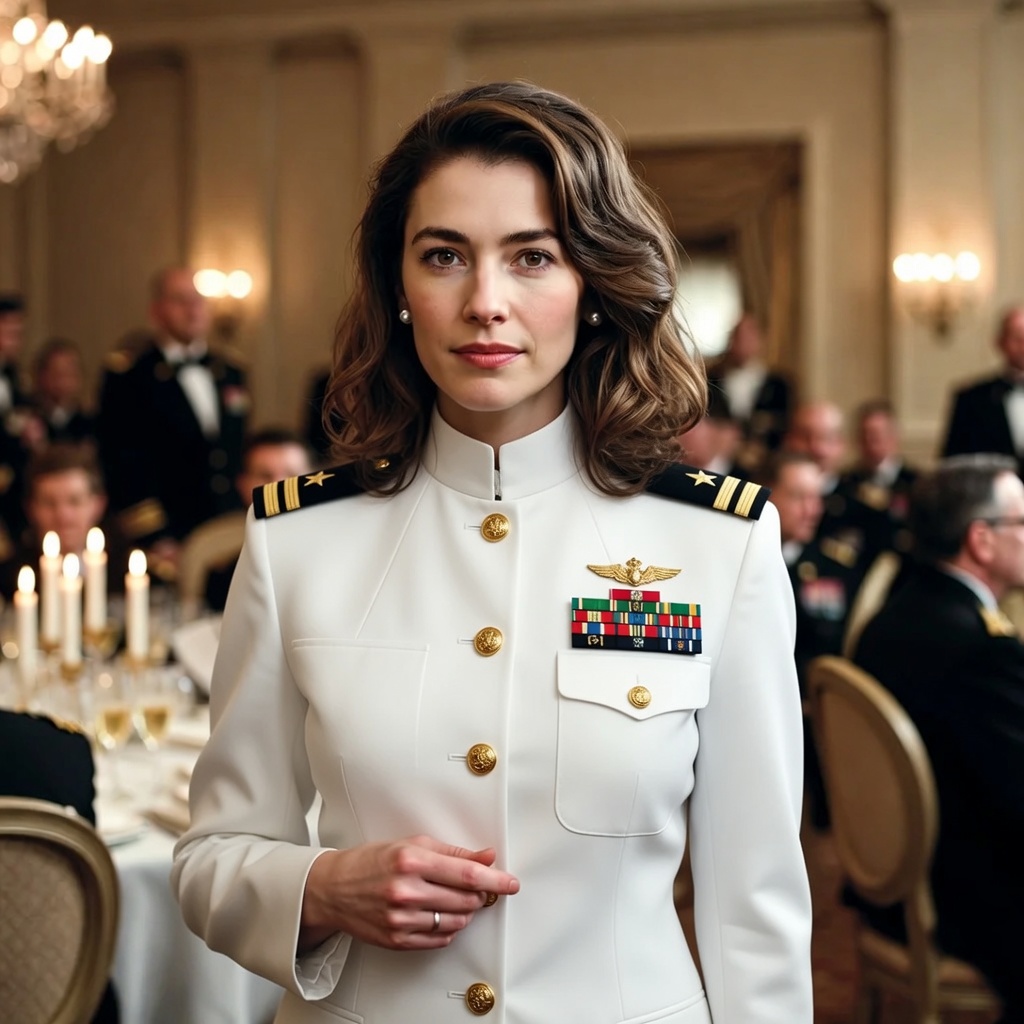
In the women’s changing lounge, I removed the black blazer and dress and put on my white service dress uniform. The fabric settled over my shoulders like truth finally allowed to stand upright. Rank boards. Ribbons. Medals. Gold buttons. Years made visible.
For a moment, I looked at myself in the mirror and saw not Helen’s version of me, not Frank’s silence, not the woman who had smiled through seven years of careful erasure.
I saw my father’s daughter.
Then I moved my ID into my jacket pocket and walked back.
The ballroom registered me before I reached the table.
A lieutenant stepped aside. A colonel stopped mid-sentence and nodded. A young ensign nearly dropped her water glass trying to salute before remembering where she was.
Helen saw it all.
What crossed her face was not understanding.
It was offense.
Frank saw it too. His voice lowered. “Mom. Stop.”
Helen grabbed his sleeve. “She’s making a scene.”
“This is her event,” Frank said.
I looked at him then, really looked at him, because for the first time in years, his voice had not bent around his mother’s comfort.
Helen stared at him as if betrayal had learned to speak.
Then she crossed the ballroom toward the nearest military police officer.
I heard the squeak of her heel on the polished floor.
I saw two women stop unfolding their napkins.
I felt my ID already waiting in my palm.
Helen touched the MP’s sleeve like she was summoning staff at a private club.
“That woman in white doesn’t belong here,” she said, controlled and loud. “I want her removed. Arrest her if you have to.”
The ballroom went quiet in ripples.
Frank whispered, “Mother, no.”
But Helen lifted her chin, certain again.
The young MP approached me carefully. He was professional, clean-cut, probably mid-twenties, with the tense expression of a man trying not to make a mistake in front of two hundred officers.
“Ma’am,” he said, “there’s been a complaint. Would you allow a credential check?”
I did not look at Helen.
I did not explain myself again.
I reached into my jacket, pulled out my military ID, and placed it in his hand.
That little rectangle of plastic held more truth than seven years of Helen’s language.
The MP walked toward the verification station near the entrance.
The screen glowed blue.
He looked down once.
Then again.
Another officer leaned in.
And I saw the first change not in the MP’s face, but in his shoulders.
He straightened.
PART 2
The silence in the ballroom became physical.
It pressed against the walls, against the crystal glasses, against Helen’s pearls. Forks hovered above plates. Conversations died unfinished. Somewhere behind me, the string quartet faltered and then stopped completely.
The MP stared at the verification screen one beat too long.
Helen gave a brittle laugh. “Well? Surely this doesn’t take all night.”
No one answered her.
Rear Admiral Holm turned fully toward us now. Her expression had gone still in the way senior officers became still when something serious was happening.
The MP swallowed.
Then he lifted his head, walked back to me, and stopped two feet away.
His right hand snapped up.
He saluted.
“Captain Mercer,” he said, voice clear enough to carry across the room. “My apologies, ma’am.”
The ballroom shifted.
Not loudly. Not dramatically.
But every officer within earshot understood what had happened.
Helen did not.
She looked from the MP to me, then to Frank. “Captain? She’s not—Frank, tell them.”
Frank’s face had gone pale.
“She is,” he said quietly.
Helen laughed again, but this time the sound cracked. “No. No, she works in an office.”
I took my ID back from the MP. “Many of us do.”
A few people looked away, not out of embarrassment for me, but for her.
That was worse for Helen than anger.
Anger she could fight. Pity she could not survive.
Rear Admiral Holm stepped forward. “Mrs. Hansen, Captain Mercer is not only authorized to attend this event. She is one of the officers being recognized tonight.”
Helen’s mouth opened.
Nothing came out.
Frank stared at me. “Recognized?”
I turned to him, and this time I let him feel the full weight of my eyes.
“Yes.”
“You didn’t tell me.”
“I tried,” I said. “You changed the subject.”
That landed harder than I expected.
His face tightened, not in anger, but shame.
Helen recovered first, because women like her always do. “This is absurd,” she said. “If she had simply explained—”
“I did,” I said.
My voice was quiet.
That made the room listen harder.
“I explained at your house in Greenwich when you introduced me as Frank’s assistant. I explained at Thanksgiving when you told Senator Bell I handled military travel forms. I explained at the chapel after my wedding when you corrected someone who called me lieutenant commander and said I was only marrying into service.”
Helen’s eyes widened, not because she felt guilty, but because I had remembered everything.
Frank whispered, “Tessa…”
I did not stop.
“For seven years, I gave you the courtesy of assuming misunderstanding. Tonight, you gave me the clarity of proving it was never misunderstanding.”
The words settled into the room.
Helen’s face flushed under the chandelier light.
Then something unexpected happened.
A man at the table nearest ours stood.
He was older, broad-shouldered, with silver hair and a chest full of ribbons. I recognized him immediately: Admiral Thomas Vane, retired. A legend in Naval Intelligence circles. A man who rarely attended public events anymore.
He looked directly at me.
Then he saluted.
“Captain Mercer,” he said.
One by one, officers rose.
Not all at once. That would have been theatrical. This was worse for Helen because it was real.
A Marine colonel stood. Then a Navy commander. Then two captains. Then a row of SEALs near the back, men whose faces carried the hard calm of people who had survived places civilians never imagined.
Frank watched them stand, stunned.
Helen looked trapped inside a room she had thought she controlled.
Rear Admiral Holm moved to the microphone at the front of the ballroom.
“Since the evening has taken an unscheduled turn,” she said, her voice polished steel, “perhaps now is the appropriate time.”
My stomach tightened.
I knew what recognition was planned. I did not know she would do it like this.
“Tessa Mercer,” Admiral Holm continued, “has served fourteen years in Naval Intelligence with distinction. Her recent work prevented a classified maritime breach that could have cost American lives.”
A murmur moved through the room.
Helen stared at me.
Frank took one step back.
Admiral Holm’s eyes softened for half a second before she continued.
“Much of Captain Mercer’s work cannot be discussed publicly. But tonight, we honor what can be said: she saw the threat before others believed it existed, she stood alone when necessary, and she protected people who may never know her name.”
My throat tightened.
I thought of my father.
I thought of his kitchen table.
I thought of the last time he saw me in uniform, months before cancer took him, when he touched my shoulder board and said, “Clearer, Tess. Always clearer.”
The applause began quietly, then grew.
I did not cry.
But I nearly did.
Frank leaned toward me. “Why didn’t you tell me it was this important?”
I looked at him.
“Because I got tired of proving my life to someone sleeping beside me.”
His mouth parted.
That sentence hurt him. I saw it. But I did not regret it.
Then Helen stepped forward again.
Her pride was wounded enough to become dangerous.
“You people are being manipulated,” she said, voice shaking. “I don’t know what she has told you, but this woman has deceived my family for years.”
A collective inhale passed through the ballroom.
Frank said, sharply, “Mom.”
But Helen was beyond stopping.
“She hides behind secrecy. She lets everyone believe whatever makes her seem important. And now suddenly we’re supposed to believe she’s some hero?”
The word hero sounded poisonous in her mouth.
Rear Admiral Holm’s face hardened.
But before she could respond, the retired Admiral Vane spoke from his table.
“Careful, Mrs. Hansen.”
Helen turned on him. “Excuse me?”
His voice was low. “You are standing in a room full of people who know exactly what Captain Mercer has done. You are the only person here confused.”
Helen’s face twisted.
Then she said the sentence that changed everything.
“My son should have married someone honest.”
The room froze again.
But this time, I saw Frank flinch.
Not because of me.
Because of the word honest.
Something passed across his face—fear, recognition, dread. It came and went quickly, but I saw it.
So did Helen.
Her eyes flicked toward him.
Too fast.
Too guilty.
A cold thread pulled tight inside me.
Frank had secrets. I knew that. Every marriage has locked rooms. But Helen’s sudden panic told me one of those rooms had her fingerprints on the door.
The MP still stood nearby, unsure whether the incident was over.
Admiral Holm stepped closer. “Mrs. Hansen, I suggest you sit down.”
But Helen’s eyes were no longer on me.
They were on Frank.
“Don’t,” she whispered.
Frank stared at her.
Then at me.
And for the first time all night, he looked more afraid of silence than truth.
PART 3
Frank removed his hand from his mother’s reach.
It was a small movement.
But in that room, it felt like thunder.
“Helen,” he said.
She recoiled. He never called her Helen.
“Stop,” she whispered. “Not here.”
I turned toward him slowly. “Frank?”
His face looked older than it had ten minutes ago. The smooth confidence, the diplomatic smile, the son trained to survive his mother by surrendering in inches—it all fell away.
He looked like a man standing at the edge of his own life.
“I need to say something,” he said.
Helen’s voice sharpened. “No, you don’t.”
“Yes,” he said. “I do.”
The ballroom remained silent. Not curious now. Braced.
Frank looked at me. “Tessa, I knew.”
I felt the floor vanish beneath me.
“Knew what?”
He swallowed.
“I knew your rank. I knew what your work meant. Not the classified details, but enough. I knew from the beginning.”
My chest tightened.
That was not the confession I expected.
Helen’s lips trembled. “Frank, please.”
He did not look at her.
“I let my mother belittle you because it was easier than confronting her. And because…” His voice broke slightly. “Because I was jealous.”
The words struck harder than Helen’s cruelty ever had.
Jealous.
Of me.
“My family name opened doors,” he said. “Your work opened rooms I couldn’t enter. I told myself I was protecting your privacy. But I was protecting my pride.”
I stared at the man I had loved, the man whose silence had become a second marriage between us.
“Why now?” I asked.
His eyes glistened. “Because tonight she tried to have you arrested for being what I was too small to celebrate.”
Helen looked around desperately, as if someone might rescue her from her own son.
No one moved.
Then Frank reached into his jacket.
Helen lunged forward. “Don’t!”
He pulled out an envelope.
Plain. White. Folded once.
My name was written across it in handwriting I knew instantly.
My father’s.
The ballroom blurred.
“Where did you get that?” I whispered.
Frank’s voice shook. “Your father gave it to my mother before he died.”
My heart slammed once, hard.
Helen closed her eyes.
Frank continued. “He knew he was sick. He wanted it given to you on your first major command recognition night. He asked my mother to hold it because he thought family would make sure it reached you.”
I looked at Helen.
She did not deny it.
Seven years of insults. Seven years of being made smaller. And beneath all of it, she had been carrying a letter from my dead father like a stolen medal.
“Why?” I asked her.
It came out barely louder than breath.
Helen’s face crumpled—not with remorse, but with the terror of being seen clearly.
“Because he knew,” she said.
“Knew what?”
Her eyes filled with hatred and grief so old they had become the same thing.
“He knew what kind of woman you were becoming. He knew you would outshine Frank. Outshine all of us. He sat in my home, dying, and spoke about you like you were the future. My son was in the room, and your father still made everything about you.”
The cruelty of it stunned me.
Not because it was large.
Because it was pathetic.
She had not hated me because I lied.
She hated me because my father loved me without apology.
Frank held out the letter.
My hand trembled when I took it.
For a moment, I forgot the ballroom. Forgot Helen. Forgot the officers, the chandeliers, the humiliation.
There was only my father’s handwriting.
I opened it.
The letter was short.
Tess,
If you are reading this, then you are standing in a room that finally sees what I always saw. Don’t waste your strength being angry at those who needed you small. Some people mistake control for love because they have never survived real devotion.
You were never hard to recognize.
Only hard for small people to admit.
Stand clear.
Dad.
I pressed the paper to my chest.
And then the shocking ending came—not from Helen, not from Frank, not from me.
It came from Admiral Vane.
He stepped forward slowly, eyes fixed on the letter.
“Captain Mercer,” he said, voice rough, “may I see that?”
I hesitated, then handed it to him.
He read only the first line before his face changed.
“This isn’t just a letter,” he said.
The room leaned into silence.
He turned the page toward the chandelier light, revealing a faint mark embedded in the paper—a watermark I had not noticed.
My father’s old intelligence seal.
Admiral Holm moved closer. “Thomas?”
Vane looked at me with something like awe.
“Your father was investigating an internal leak before he died. We thought the final evidence disappeared with him.”
Helen went white.
Frank whispered, “What?”
Vane’s eyes moved to Helen.
“He must have hidden the authentication mark inside this letter.”
The MP stepped forward again, no longer uncertain.
Admiral Holm’s voice dropped. “Mrs. Hansen, how long have you had this?”
Helen’s lips parted.
No answer.
The ballroom that had gathered to honor me now watched the woman who tried to erase me become the center of a very different investigation.
Frank looked destroyed. “Mom… what did you do?”
Helen backed away. “I didn’t know what it was.”
But I knew then.
My father had trusted her with the letter not because he trusted her character.
He had trusted her because he suspected her circle.
Because he knew that if the truth was dangerous, vanity would keep it close.
Helen had hidden my father’s final gift out of spite—and by doing so, she had preserved the evidence everyone thought was lost.
The MP’s voice was formal now. Cold.
“Mrs. Hansen, please come with me.”
This time, no one questioned whether she belonged in the room.
They only watched as she was escorted out of it.
Frank stood beside me, broken open by truth.
“Tessa,” he whispered. “I’m sorry.”
I looked at him, at the man I had loved and the silence I could no longer live inside.
“I know,” I said. “But sorry doesn’t outrank damage.”
Then Admiral Holm stepped to the microphone again.
The room rose before she spoke.
Not because someone ordered it.
Because they understood.
I folded my father’s letter carefully and placed it inside my uniform jacket, against my heart.
The same place my ID had been.
The applause began again, but this time it sounded different.
Not like recognition.
Like release.
And as Helen disappeared through the ballroom doors, her pearls trembling at her throat, I finally understood the truth my father had hidden in his final words.
Some people try to bury you beneath their version of your life.
But truth does not stay buried.
Sometimes it waits in your pocket.
Sometimes it waits in a letter.
And sometimes, when the whole room is watching, it stands up in white and lets the silence salute first.
They Called Me the Navy Dropout. Then a General Saluted Me in Front of My Family.
PART 1
The first time my father looked ashamed of me, I was twenty years old and standing in a navy-blue uniform that still smelled like starch, salt, and rain. He did not shout. He did not curse. He did not even raise his voice. He simply looked at me across the kitchen table with those hard gray eyes of his and said, “Some people are built for service, Samantha. Some people only like the idea of it.”
That sentence stayed with me longer than any scar.
Fifteen years later, I stood at the back of my younger brother’s Navy SEAL graduation ceremony in San Diego, wearing black civilian clothes and the same silence my family had mistaken for weakness my entire life. The sun was bright enough to make the polished brass on every uniform flash like fire. Flags snapped in the coastal wind. Mothers cried. Fathers stood taller than they had in years. Young men in dress uniforms tried not to smile too much as their names were called, each of them stepping into the kind of glory families build legends around.
My brother, Caleb Hayes, was one of them.
He stood near the front with his shoulders squared, jaw clean-shaven, eyes forward, looking exactly like the son my father had always wanted. Strong. Decorated. Visible.
I stood in the back.
Invisible.
That had been the arrangement for fifteen years.
To my family, I was Samantha Hayes, the daughter who had washed out of the Navy, the one who “couldn’t handle pressure,” the one who had come home quiet and thin and unwilling to explain herself. In their version of my life, I worked in administration at an insurance firm, answered phones, filed claims, and lived alone because I was too stubborn to admit I had wasted my potential.
My mother called it “a respectable little job.”
My father called it “stable enough.”
Caleb called it nothing at all, which somehow hurt worse.
None of them knew the truth.
I was Colonel Samantha Hayes, Air Force Special Operations, attached to programs whose names had never appeared on paper in rooms ordinary people were allowed to enter. I had spent years in places my family could not pronounce, doing work I could not admit existed. I had carried wounded men through smoke, negotiated with warlords under false identities, watched drone feeds turn night into green fire, and signed documents that would remain buried long after everyone at that ceremony was dead.
But to my father, I was still the girl who quit.
And maybe that was why I came in black.
Not in uniform. Not with medals. Not with rank.
Just black boots, black pants, black long-sleeve shirt, hair pulled tight, arms crossed. A ghost at the edge of the ceremony.
“You actually showed up.”
My mother’s voice came from beside me, soft but sharp enough to cut.
I turned. Evelyn Hayes wore a cream dress and pearls, her silver-blonde hair pinned in the style she used whenever she wanted the world to believe nothing in her life had ever gone wrong. Beside her stood my father, Richard Hayes, retired Navy Commander, spine straight, face carved from old discipline. He glanced at me once, then looked away as if eye contact might acknowledge me too much.
“Caleb invited me,” I said.
My mother’s smile tightened. “He was being polite.”
My father exhaled through his nose. “This is his day, Samantha. Don’t make it complicated.”
I almost laughed. After fifteen years of swallowing secrets, the idea that my quiet presence was the threat felt almost poetic.
“I’m standing in the back,” I said. “I won’t embarrass anyone.”
My father looked at my clothes. “You already made that choice years ago.”
There it was. The old wound, reopened with surgical precision.
I said nothing.
That was the skill they never understood. Silence was not surrender. Silence was sometimes the only thing standing between the world and fire.
The ceremony began.
Names were called. Applause rose and fell like waves. Caleb’s name came near the end, and my mother pressed her hand to her mouth as if witnessing a miracle. My father’s eyes shone, though he would never admit it. Caleb crossed the stage with pride written in every step. When the commanding officers shook his hand, my father whispered, “That’s a Hayes.”
I watched my brother smile.
And I was proud of him.
That was the part nobody would believe. I had no bitterness toward Caleb for succeeding where they thought I had failed. He had worked hard. He had survived hell week, earned his trident, and stood under the sun with the earned exhaustion of a man who had discovered his own limits and broken through them.
I only wished my family had understood that there were many kinds of battlefields, and not all uniforms were worn in public.
Then Rear Admiral Thomas Wilson stepped toward the microphone.
I knew him instantly.
He had aged since Kandahar. More silver at the temples. A deeper crease beside his mouth. But the eyes were the same—sharp, assessing, impossible to fool. Years earlier, he had been one of the few naval officers cleared into an interagency operation that officially never happened. I had pulled his extraction team out after an ambush near a dry riverbed, bleeding from my left side while giving coordinates into a cracked radio.
He had called me “Colonel” then too.
I lowered my chin slightly, hoping the crowd, distance, and civilian clothes would shield me.
They did not.
Wilson’s speech began smoothly. He spoke of sacrifice, honor, brotherhood, the burden of quiet service. The families around me listened with tears in their eyes. My father stood taller. Caleb looked forward with solemn pride.
Then Wilson’s gaze moved across the crowd.
And stopped.
On me.
For one heartbeat, his expression remained formal.
Then recognition hit him.
His eyes widened.
The applause from the previous award still lingered, scattered and fading, when Wilson stepped away from the microphone. The movement was small, but every officer near him noticed. His face changed from ceremony to battlefield in an instant.
My stomach tightened.
No, I thought.
Not here.
Not like this.
Wilson descended the platform steps.
The crowd shifted, confused. Caleb turned slightly. My father frowned. My mother leaned forward, trying to see who had interrupted the sacred order of the day.
Wilson walked straight toward the back.
Straight toward me.
With every step, the sound around us thinned. The wind seemed too loud. The flags cracked like warning shots. My father’s frown deepened as the admiral approached our row.
Wilson stopped three feet in front of me.
For a moment, he just stared, as if confirming that a ghost had chosen to stand in daylight.
Then he said, clear enough for the nearest rows to hear:
“Colonel… you’re here?”
The world froze.
My mother’s hand fell from her chest.
Caleb turned fully now, his face opening in confusion.
My father stared at Wilson, then at me, then back again, as if reality had made a clerical error.
I kept my breathing steady.
“Admiral,” I said quietly.
Wilson’s voice dropped, but not enough. “I wasn’t told you were stateside.”
“I wasn’t meant to be noticed, sir.”
His jaw tightened with something like respect and regret. “That has always been difficult for you.”
Behind him, murmurs began spreading through the crowd.
Colonel?
Who is she?
Did he say Hayes?
My father stepped forward, his face pale beneath the California sun.
“What,” he said slowly, “did he just call you?”
I turned toward him.
For fifteen years, I had imagined this moment in nightmares and in hospital beds and in windowless rooms between missions. I had imagined anger. Tears. Accusations. Maybe even relief.
But looking at my father now, I felt something far colder.
I felt tired.
Wilson looked from me to my family, and understanding dawned on his face like a storm. “They don’t know?”
My mother whispered, “Know what?”
Caleb pushed through two officers, still in full dress uniform. “Sam?”
My father’s voice sharpened. “Samantha, answer me.”
I looked at the man who had called me weak. The man who had mourned my supposed failure louder than he had ever celebrated my survival.
Then I looked at my brother, whose triumph had just been split open by a truth none of us were ready to hold.
Finally, I looked back at Admiral Wilson.
And with the entire ceremony watching, I said:
“Yes, sir. I’m here.”
PART 2
For several seconds, nobody moved.
The ceremony grounds had been filled with applause only moments earlier, but now the silence felt heavy enough to press fingerprints into bone. Admiral Wilson stood in front of me with the expression of a man who had accidentally opened a locked door in a crowded room. My mother’s face had gone still. Caleb stared like he was trying to solve a problem in a language he had never learned.
My father stepped closer.
“What did he call you?” he repeated.
His voice was lower now, but more dangerous. That was Richard Hayes at his worst—not loud, not emotional, but controlled in the way a blade is controlled.
I said, “This isn’t the place.”
His eyes flashed. “You don’t get to decide that after lying to us for fifteen years.”
A few officers looked away. Others didn’t. The families nearby pretended not to listen while listening with everything they had.
Admiral Wilson cleared his throat. “Commander Hayes—”
My father snapped toward him. “With respect, Admiral, this is a family matter.”
Wilson’s face hardened. “With respect, Commander, you are speaking to a decorated officer.”
My mother made a small sound, almost a gasp.
Caleb took one step toward me. “Sam… are you actually in the military?”
I looked at him, and the hurt in his eyes nearly broke me. Caleb was not cruel. He had simply grown up inside the story my parents built. A story where he was the brave one, and I was the warning.
“Yes,” I said.
My father laughed once. It was not humor. It was disbelief trying to survive. “No. No, that’s impossible.”
“It’s true,” Wilson said.
My father stared at him. “You expect me to believe my daughter has been a colonel while filing insurance paperwork?”
I held his gaze. “The insurance firm was real. The work was not.”
My mother whispered, “Samantha…”
There were tears in her eyes now, but I could not tell whether they came from grief, guilt, or humiliation.
My father grabbed my forearm.
Not violently enough to hurt, but hard enough to claim authority.
“Tell me the truth,” he said.
Something in me went very still.
I looked down at his hand. Then I looked back at him.
“Let go.”
He didn’t.
The old Samantha—the one who still wanted her father to soften, to say he had been wrong, to call her brave—might have pleaded.
But that girl had been buried in dust, snow, blood, and classified silence.
I pulled my arm free with one clean motion.
The movement was quick, controlled, unmistakably trained. My father stumbled half a step, not from force, but from shock. Around us, several officers straightened.
“No,” I said, my voice quiet enough to make everyone lean in. “I didn’t lie because I was ashamed. I stayed silent because I was ordered to.”
Caleb’s face changed.
That was the first crack.
Not belief yet.
But possibility.
Wilson stepped beside me. “Colonel Hayes served under Special Operations authority. Much of her record remains classified.”
My father’s mouth opened, then closed. For the first time in my life, Richard Hayes had no immediate answer.
My mother covered her lips with trembling fingers. “You let us think you failed.”
“I let you think what you were willing to believe.”
The words landed harder than I expected.
My father flinched.
Caleb looked at him.
That was when I saw it—the moment my brother began remembering. The Thanksgiving jokes. The quiet corrections. The way Dad had always said, “Your sister tried the Navy once,” like my life was a cautionary tale. The way Mom had changed the subject whenever anyone asked about me.
Caleb swallowed. “Why didn’t you tell me?”
I wanted to answer gently. He deserved gentleness.
But truth rarely enters a room softly.
“Because the people I worked with would have died if the wrong name appeared in the wrong conversation.”
The wind snapped the flags behind us.
Admiral Wilson’s expression darkened. “Colonel, perhaps we should move this somewhere private.”
Before I could answer, another voice cut in.
“Colonel Hayes?”
A younger officer approached quickly from the side of the platform, his face tight with urgency. He handed Wilson a phone. Wilson read the screen, and every trace of ceremony vanished from him.
I recognized that look.
Not surprise.
Threat assessment.
He turned to me. “Ma’am, I need you to see this.”
My father stared. “Ma’am?”
I ignored him and took the phone.
The message on the secure display contained only three lines.
My pulse slowed.
Not quickened.
Slowed.
Because fear is loud, but training is silent.
At the bottom of the screen was an old operation code name I had not seen in nine years.
BLACK HARBOR.
Wilson said under his breath, “It surfaced twenty minutes ago.”
My throat tightened.
Black Harbor was supposed to be buried so deep that even memory had to ask permission to find it. It had been the mission that ended my official Navy trail. The reason my family thought I had washed out. The reason my life split into two versions.
And now, somehow, on the day my brother became a SEAL, it had returned.
Caleb stepped closer. “What is Black Harbor?”
I looked at Wilson.
He said nothing.
My father, still pale, snapped, “Someone answer him.”
I handed the phone back. “Not here.”
Wilson leaned closer. “There’s more.”
He touched the screen once and opened an image.
For half a second, I did not understand what I was seeing.
Then I did.
A grainy surveillance shot. A man standing outside the ceremony gates thirty minutes earlier, wearing civilian clothes, sunglasses, and a baseball cap. Ordinary enough to disappear in any crowd.
Except I knew his face.
I had watched that face vanish into smoke in northern Syria.
I had signed a report that called him dead.
My fingers went cold.
Wilson’s voice was almost inaudible. “We thought he was gone.”
I looked beyond the crowd, toward the entrance gates, the parking lot, the families laughing without knowing anything had changed.
“He was never gone,” I said.
My mother touched my sleeve. “Samantha, who is that?”
I did not answer.
Because at that exact moment, my brother’s phone buzzed.
Caleb glanced down.
His face emptied.
He turned the screen toward me.
A message from an unknown number.
Only six words.
YOUR SISTER REMEMBERS. ASK HER WHY.
Then a second message appeared.
ASK HER WHAT SHE DID TO SAVE YOU.
PART 3
Caleb’s hand trembled—not violently, but enough for me to notice. Enough for the soldier in me to catalog it, file it, understand it. He wasn’t afraid of combat. He had just survived the most brutal training pipeline in the world.
But this?
This was different.
This wasn’t an enemy you could see, track, or shoot.
This was something buried inside the past.
“Sam…” he said, his voice lower now, stripped of everything but truth. “What does that mean?”
Around us, the ceremony had fractured into confusion. Officers whispered to each other. Families sensed something wrong but didn’t understand what. The air no longer belonged to celebration—it belonged to tension, to something unseen tightening its grip.
My father stepped closer again, but this time, there was no authority left in him.
Only fear.
“What did you do?” he asked.
That question.
Out of everything.
That was the one I had spent fifteen years avoiding.
Not what happened.
Not what mission.
Not what rank.
But what I did.
Admiral Wilson’s voice was quiet but firm. “Colonel, we need to move. Now.”
I didn’t move.
Because for the first time in fifteen years… I wasn’t sure I could run from it again.
I looked at Caleb.
My little brother.
The one who used to follow me around the backyard with a toy plane, asking me how engines worked. The one who believed I could fix anything. The one who had stood in front of me years ago, confused and hurt, when I “left” the Navy without explanation.
He deserved the truth.
Even if it destroyed everything.
“I didn’t save you,” I said.
His brow tightened. “Then what does the message—”
“I chose you.”
The words dropped like a stone into deep water.
Ripples.
Shock.
Understanding trying to form.
My father shook his head. “That doesn’t make any sense.”
“It will,” I said softly. “Just not the way you want.”
Wilson stepped closer. “Colonel—”
“Two minutes,” I said. “That’s all I need.”
He hesitated.
Then nodded once.
Two minutes.
That was more mercy than I expected.
I turned back to Caleb.
“Black Harbor wasn’t a mission,” I said. “It was a mistake.”
The wind picked up again, sharp and cold despite the sun.
“We were inserted under joint command,” I continued. “Navy, Air Force, intelligence—everyone touching something they weren’t supposed to understand. The objective was simple on paper. Extract a target. Contain a leak. No noise.”
I let out a slow breath.
“It went wrong before we even landed.”
Caleb listened without blinking.
My father stood frozen.
My mother was crying now, quietly, trying not to make a sound.
“There was a compromise,” I said. “Someone inside the operation was feeding information out. We didn’t know who. So command did what command always does.”
I paused.
“They locked everything down.”
Wilson’s jaw tightened. He already knew where this was going.
“They rerouted extraction,” I said. “Changed comms. Split units.”
Caleb frowned. “Standard containment protocol.”
“Yes.”
I met his eyes.
“Except one unit wasn’t where it was supposed to be.”
His breath caught.
Not fully.
But enough.
“They thought it was expendable,” I said. “They thought losing it would protect the rest.”
My father whispered, “No…”
I nodded once.
“That unit,” I said, “was yours.”
The world tilted.
Not physically.
Emotionally.
Everything Caleb thought he knew about his career—about earning his place, surviving training, proving himself—shifted beneath him like unstable ground.
“That’s impossible,” he said.
“It wasn’t your fault,” I said quickly. “You were never supposed to be there. You got pulled in through a training overlap. Administrative error. Bad timing.”
“Then why—”
“Because command didn’t fix it.”
Silence.
Heavy.
Final.
“They saw the risk,” I said. “And they chose the mission over the correction.”
My father took a step back.
“They would never—”
“They did.”
My voice didn’t rise.
It didn’t need to.
Caleb’s eyes were wide now, searching mine for something—denial, hesitation, anything that would make this less real.
“What happened?” he asked.
I swallowed once.
Then I told him the part I had never told anyone outside a classified room.
“I found out.”
That was it.
That was the moment everything had changed.
“I wasn’t supposed to know your unit was compromised,” I said. “But I saw the comms shift. I saw the coordinates. I saw the silence where there shouldn’t have been silence.”
I stepped closer to him.
“So I made a decision.”
Wilson closed his eyes briefly.
He knew.
Of course he knew.
My father whispered, “What did you do, Samantha…?”
I looked at him.
Really looked at him.
At the man who had believed I wasn’t strong enough.
At the man who had never known what strength had cost me.
“I broke protocol,” I said. “I rerouted extraction back to your unit.”
Caleb’s lips parted.
“That’s not possible,” he said. “You can’t just—”
“I could.”
A beat.
“I did.”
The truth settled like ash.
Wilson spoke quietly. “She diverted assets without authorization.”
“I didn’t have time to ask,” I said.
My father’s voice shook. “That’s court-martial level—”
“It was.”
I didn’t flinch.
“And I would have taken it.”
Caleb stared at me now, no longer confused.
Understanding was arriving.
Slow.
Painful.
“And the leak?” he asked.
I didn’t answer immediately.
Because this was the part that never let me sleep.
“They traced it,” I said finally. “Mid-operation.”
My mother whispered, “Who was it?”
I met her eyes.
And for the first time in fifteen years…
I told them everything.
“It was our commanding officer.”
The air left the world.
Wilson looked away.
My father went completely still.
Caleb’s voice broke. “You’re saying the person running the mission… set us up?”
“Yes.”
“And you… you went against him?”
“Yes.”
“And then what?”
I closed my eyes for one second.
Just one.
Because I could still see it.
The fire.
The radio.
The decision.
“I reached his command channel,” I said. “And I made sure he couldn’t give another order.”
My father’s voice was barely there. “What does that mean?”
I opened my eyes.
“It means,” I said quietly, “I ended the leak.”
No one spoke.
Because everyone understood.
Not the details.
Not the report.
But the weight.
Caleb stepped back slowly, like the ground beneath him had shifted into something unrecognizable.
“You…” he said, struggling for words. “You did that… for me?”
I shook my head.
“For the mission,” I said automatically.
Then I stopped.
And corrected myself.
“No,” I said. “I did it because I wasn’t willing to let you die for someone else’s betrayal.”
His eyes filled.
Not with weakness.
With truth.
The kind that changes a person permanently.
Behind us, Wilson’s voice cut in sharply.
“Colonel—contact at the gate. Same individual from the photo.”
Everything snapped back into place.
The present.
The threat.
The unfinished story.
Caleb looked at me. “He’s here… because of that mission?”
“Yes.”
“Why now?”
I turned toward the entrance.
Because deep down…
I already knew.
“He didn’t come for the ceremony,” I said.
The wind died.
The flags stilled.
The world held its breath again.
And as I stepped forward, every instinct in my body coming alive after years of silence, I said the only truth left:
“He came for me.”