
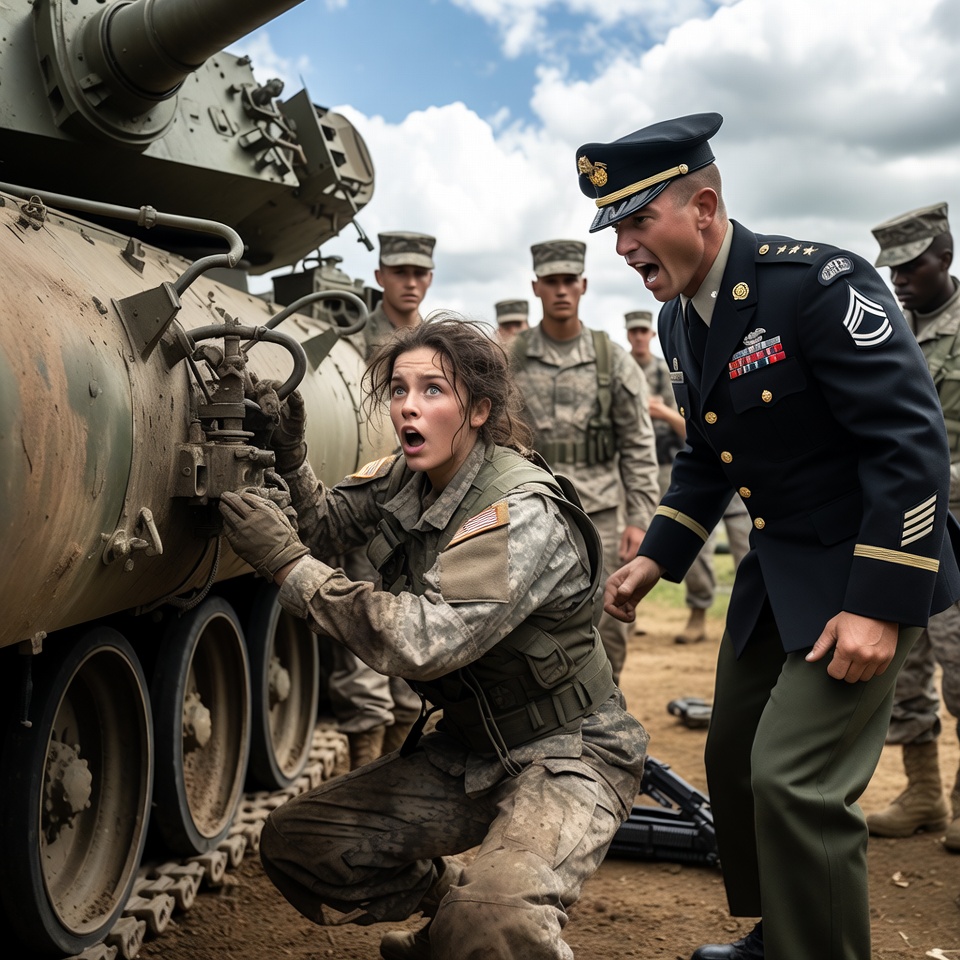
My name is Rachel Green, and I grew up learning the difference between silence and peace.
Peace has room in it. Silence presses against your ribs.
My father’s auto shop had a kind of silence that lived underneath everything—the rattle of socket wrenches, the hiss of the air compressor, the country station crackling through an old radio balanced on a shelf. Customers came and went, tires squealed on the concrete out front, engines coughed and roared and settled. But between me and my father, there was always that quiet space where words should have been.
Earl Green owned Green’s Auto Repair on the edge of Millstone, Kentucky, where the highway dipped past the cattle auction and the fairgrounds. He was a broad-shouldered man with hands like split leather, the kind of man who could hear a misfire from across a parking lot and tell you which cylinder was acting up before he even opened the hood.
People respected him. Men slapped his back at the diner. Women trusted him not to overcharge them. Old farmers brought him trucks that should’ve been dead ten years earlier and said, “Earl, see what you can do.”
He always did.
But he never seemed to know what to do with me.
I was seven when my mother died. Her name was Mara, and most of what I remembered came in flashes: the smell of orange soap on her palms, her laugh when she had a wrench between her teeth, the way she tied her hair up with a red bandana when she worked in the shop with Dad. She could make machines behave. That was what people used to say.
After she was gone, Dad packed her things into boxes and pushed them into the storage room behind the office. He didn’t cry where I could see. He didn’t talk about her unless he had to. He just got harder, like something inside him had been welded shut.
The only thing I kept was one of her shop rags, a faded checkered cloth stained with oil and brake fluid. I found it beneath the passenger seat of her old pickup two days after the funeral, folded into a square like she had meant to come back for it.
I carried it in my back pocket for years.
When I was little, I used to sit on an overturned milk crate near Bay Three, my knees tucked under my chin, pretending to read while watching Dad work. I wanted to know everything. I wanted to know why engines knocked, why belts screamed, why certain bolts had to be tightened just enough but not too much.
“Can I help?” I asked once, when I was ten.
He didn’t look at me. He held out a filthy rag.
“Wipe that fender.”
I wiped it until the chrome shone.
The next week, I asked if he could teach me how to change spark plugs. He reached past me, grabbed a socket, and said, “Go inside, Rachel. This ain’t a place for playing.”
“I’m not playing.”
He slid under a truck and vanished.
That was how it went. Whenever I reached for a tool, he handed me a rag. Whenever I asked a question, he answered someone else. If I stood too close, he moved me aside with two fingers on my shoulder, not rough, but final.
The strange thing was, the machines never made me feel unwanted. They made sense. They complained honestly. A loose belt whined. A flooded engine sputtered. A failing bearing growled low in its throat. Machines didn’t smile at you in public and dismiss you in private. They told the truth if you listened long enough.
So I listened.
I learned from manuals hidden inside old parts boxes. I learned from watching Dad’s reflection in windshields. I learned the smell of hot coolant, the rhythm of a bad idle, the tiny click a relay made before giving up.
At fifteen, I fixed Mrs. Hanley’s mower behind the shop while Dad was at lunch. It had a clogged fuel line. Nothing dramatic. I cleaned it, primed it, and yanked the cord until the thing barked awake.
Mrs. Hanley clapped like I’d raised the dead.
Dad came out of the diner across the street and stopped cold.
I thought, for one bright second, he might smile.
Instead, he took the mower handle from me and said, “Don’t mess with customers’ equipment.”
Mrs. Hanley frowned. “She fixed it, Earl.”
He looked at me then. Really looked.
“You got lucky.”
That phrase followed me for years.
When I graduated high school and enlisted, Dad didn’t come to the ceremony. He said the shop was backed up. I knew it wasn’t. I’d checked the appointment book before leaving.
My recruiter asked if I was sure about vehicle maintenance.
“You know that’s hard work,” he said.
I almost laughed.
Hard work was being a daughter in a room where your father had already decided you were useless.
The day I left Millstone, Dad stood in the shop doorway with a cigarette burning between his fingers. He didn’t hug me. He didn’t say he was proud.
He said, “Don’t embarrass yourself.”
I touched the folded rag in my pocket and climbed into the bus.
That morning, as we pulled away from town, I saw smoke rising behind Green’s Auto. Not heavy smoke. Just a thin gray ribbon curling from the burn barrel near the back fence.
Through the dusty bus window, I watched my father feed a folder into the flames.
For half a second, before the paper blackened, I saw my mother’s name written across the top.
And beneath it, stamped in blue ink, was the outline of a tank.
### Part 2
Basic training taught me that exhaustion has layers.
The first layer is your legs burning. The second is your lungs begging. The third is when your brain starts whispering that you could stop, that no one would blame you, that quitting would feel like lying down in cool grass.
I learned to ignore that voice.
By the time I got assigned to vehicle maintenance, I had already swallowed enough dust to feel like the Army had paved my throat. The motor pool at Fort Rainer was nothing like my father’s shop and exactly like it. Bigger bays. Bigger tools. Bigger machines. Same smell of oil, sun-baked rubber, hot metal, and men who thought grease belonged to them by birthright.
The first morning, I walked in with my duffel over one shoulder and my hair pinned tight beneath my cap. A corporal named Briggs looked me up and down, then turned to the guy beside him.
“New clerk’s here.”
“I’m not a clerk,” I said.
He grinned. “Even better. We needed someone to organize the manuals.”
A few guys laughed. Not loud enough to get in trouble. Just loud enough for me to hear.
I didn’t answer. I had learned a long time ago that arguing with someone who already decided what you were just gave them more room to enjoy themselves.
Instead, I worked.
I showed up early. I stayed late. I memorized maintenance procedures until I dreamed in torque specs. I learned the M1 Abrams piece by piece: turbine engine, hydraulic systems, fire-control electronics, track tension, fuel filters, thermal sights, batteries, cooling fans. The Abrams was not like the pickup trucks back home. It was not a machine so much as a moving argument between power and precision.
And I loved it.
Not in the shiny poster way civilians loved tanks. I loved the ugly parts. The stubborn bolts. The cramped access panels. The heat trapped beneath armor plates. The way every repair scraped something from your knuckles and left you with proof.
A sergeant named Lina Cruz was the first person who treated me like I had hands instead of decoration.
She caught me one night in Bay Four with a flashlight between my teeth, tracing an electrical fault through a wiring harness while everyone else was watching a game in the rec room.
“You know you’re off shift, Green?”
I pulled the flashlight from my mouth. “So is the short.”
She stared at me for a second, then handed me a better flashlight.
“Find it, then.”
I found it near midnight. One pin in a connector had backed out just enough to break contact when the engine vibrated. I reseated it, sealed it, and watched the system come clean on diagnostics.
After that, Cruz started tossing me jobs nobody wanted.
Briggs still called me “Princess Socket” for a while, until a coolant leak sprayed him in the face because he ignored my warning about pressure in the line. After that, he mostly called me Green.
Progress.
The first time I saved an Abrams in the field, rain came down so hard it bounced off the armor. The crew was stranded on a training lane with a dead engine and a commander chewing through patience like tobacco. Three mechanics argued over fuel pressure. Someone blamed the starter. Someone else blamed the control module.
I lay flat in mud beneath the rear deck and listened.
That was something Dad never understood. Fixing wasn’t just knowing. It was listening. Metal had moods. Electrical faults had tempers. Engines had voices.
This one had a hesitation in the auxiliary power unit and a strange pause before shutdown.
“Relay,” I said.
Briggs snorted. “It’s not a relay.”
I slid out, rain running down my neck. “Then humor me.”
He didn’t. Cruz did.
Five minutes later, with a swapped relay and one cleaned contact, the turbine screamed alive. The crew whooped. Briggs looked like he’d swallowed a nail.
That night, still damp, still cold, I texted Dad.
Fixed my first Abrams in the field today. Whole crew was stuck. Turned out to be relay contact. Got it running.
His reply came twenty minutes later.
You probably got lucky.
I stared at those four words until the screen dimmed.
Then I saved the message.
Not because it hurt. Because it hardened.
Months passed. I earned trust in pieces. A nod from Cruz. A wrench tossed my way without explanation. A driver asking me to listen to “that weird noise” before asking anyone else. Eventually, the nickname changed.
“Wrench Queen,” Briggs said one afternoon, when I diagnosed a bad sensor before the computer did.
He meant it like a joke.
I wore it like rank.
Then the new tank arrived.
It came on a flatbed under a gray tarp, escorted by two military police vehicles and a major I had never seen before. The paperwork said it was an M1A2 variant scheduled for public showcase and systems evaluation. But the moment I saw it, I knew something about it was different.
There was a panel near the driver’s hatch that didn’t match any manual I owned. Smooth black surface. No visible screws. No standard label. When sunlight hit it, faint lines shimmered beneath the glass like fingerprints trapped under ice.
Cruz caught me staring.
“Don’t get curious,” she said.
“That’s like telling a dog not to smell bacon.”
She almost smiled. “Above our pay grade.”
That night, I waited until the bay emptied. I walked around the tank slowly, boots echoing on concrete. The air smelled of paint, hydraulic fluid, and something sharper—ozone, like lightning had been bottled inside the armor.
Near the strange panel, almost hidden beneath the edge of the casing, I found two initials scratched into the metal.
M.G.
My mouth went dry.
Mara Green.
Before I could touch it, the tank clicked.
Not loud. Not dangerous.
Just one soft mechanical sound, like something inside had unlocked because it knew I was there.
### Part 3
I told myself the initials meant nothing.
M.G. could have been anybody. Michael Grant. Mason Gray. Manufacturing Group. Military Grade. The Army had enough abbreviations to bury a person alive.
Still, I avoided the black panel for two days.
That was not like me.
Usually, if a machine kept a secret, I wanted my hands inside it before dinner. But this felt different. Personal. Like finding a photograph of your dead mother tucked inside someone else’s wallet.
The tank’s designation was printed on the maintenance packet as Unit 71-K, though Briggs immediately called it “the diva” because it resisted every standard diagnostic tool we plugged into it.
“Piece of classified junk,” he muttered after the third error code vanished before he could record it.
“It’s not junk,” I said.
“You defending it now?”
“I’m saying it’s reacting.”
He laughed. “To what? Your personality?”
Maybe.
The thought came so fast I hated myself for having it.
The tank behaved strangely around me. Not obviously. Not in a way I could report without sounding like I needed sleep. But when I leaned into the driver’s compartment, the interior lights steadied. When Briggs climbed in, they flickered. When Cruz ran diagnostics, the system lagged. When I rested one bare finger near the edge of the black panel, the screen woke before I touched anything.
I started wearing gloves around it.
That helped until the day Colonel Avery announced our unit would represent Fort Rainer at the Millstone County Fair.
Millstone.
My hometown.
The word hit me like a wrench dropped on concrete.
The showcase would include Humvees, communications equipment, recruitment booths, a medical evacuation display, and one heavy vehicle. Unit 71-K.
“The fairgrounds can handle the weight?” Cruz asked.
“Engineers checked,” Colonel Avery said. “We’ll run a controlled demonstration in the show ring. Static display afterward.”
Briggs leaned toward me. “Hey, Green. Isn’t that your little town?”
“Unfortunately.”
“You gonna show us where the locals marry their tractors?”
I gave him a flat look. “Only if you promise to propose.”
Cruz coughed into her hand. It sounded suspiciously like a laugh.
I didn’t call Dad right away. For two days, I carried the idea around like a hot coal. Part of me wanted him there. Part of me wanted him to miss it so I could hate him cleanly.
On the third night, I called from behind the barracks, where the air smelled like wet grass and cigarette smoke from somebody hiding around the corner.
He answered on the fourth ring.
“Yeah?”
“Dad. It’s Rachel.”
“I know who it is.”
“We’re bringing a tank to Millstone for the fair. My unit. I’m part of the crew.”
Silence.
Then the scrape of something metal on his end. A tool dragged across a bench, maybe.
“You driving it?”
“I’m maintaining it.”
A short laugh. Dry. Familiar.
“So standing near it in uniform.”
My jaw tightened. “No. Maintaining it.”
“Uh-huh.”
The old ache rose, but underneath it was something colder now.
“You should come,” I said. “Might learn something.”
The line went quiet again.
When he spoke, his voice had changed. Not softer. Lower.
“What tank?”
“What?”
“What kind?”
“An Abrams variant. Why?”
He exhaled through his nose. “Army shouldn’t be hauling those things into county fairs.”
“That’s your concern?”
“Those machines don’t belong around kids and funnel cake.”
“You used to say the same thing about me and your shop.”
He didn’t answer.
Before hanging up, he said, “Don’t touch things you don’t understand, Rachel.”
The call ended.
I stood there with my phone still pressed to my ear, the night air cooling the sweat at the back of my neck.
The next morning, while we prepped Unit 71-K for transport, I found a smear of dark grease under the edge of the black panel. Not Army lubricant. I knew that smell. Graphite, old oil, and the faint bite of lemon degreaser.
Green’s Auto kept a barrel of it behind Bay Two.
I wiped it with a clean cloth, told myself it could have come from anywhere, and kept working.
We rolled into Millstone on a Saturday morning under a sky so blue it looked scrubbed raw. The fairgrounds smelled exactly like memory: kettle corn, manure, hot asphalt, fried dough, diesel, and cut hay. Kids ran along the fence line as the tank crawled toward the show ring, their mouths open like we had brought a dragon.
I saw Dad before he saw me.
He stood near a hay bale by the tractor pull pit, coffee in one hand, cap pulled low, his shop shirt buttoned wrong at the collar. For a second, he looked older than I remembered. Then his eyes found me, and his face closed.
A local man beside him pointed toward our crew.
“That your girl up there, Earl?”
Dad took a sip of coffee.
“My daughter mostly carries clipboards,” he said. “Army likes making things look impressive.”
The words landed in front of three soldiers, two deputies, and half a dozen town men who had known me since pigtails.
My cheeks burned.
Briggs glanced at me, waiting for the explosion.
I gave him nothing.
Because behind me, Unit 71-K shuddered.
Once.
Twice.
Then every screen inside went black.
From under the armor, something clicked like a locked door.
### Part 4
The fair announcer’s voice boomed through the speakers, bright and cheerful and completely unaware that my stomach had just dropped through the soles of my boots.
“Ladies and gentlemen, in just five minutes, Fort Rainer’s armored vehicle demonstration will begin in the main show ring!”
Five minutes.
A tank could become a monument in five minutes if it decided not to move.
Cruz was already climbing up the side. Briggs popped an access panel. Two crewmen checked external power. Someone asked for the diagnostic kit. Someone else asked if we had fuel pressure.
I stood still for one breath.
The crowd pressed against the tape line, murmuring. Children pointed. Sunlight flashed off phones. A horse snorted somewhere behind the livestock barn. Above everything, I could hear my father’s laugh from the hay bale.
Not loud.
Worse.
Satisfied.
“Probably should’ve brought a real mechanic,” he said.
A few men chuckled because men like that always found other men willing to chuckle.
Cruz shot me a look from the turret. “Green?”
“I’m on it.”
Briggs blocked my path without meaning to. “I’ve got the panel.”
“No, you don’t.”
“Green—”
I stepped around him and climbed onto the hull. The armor was hot through my gloves. Inside the driver’s hatch, the air smelled like overheated electronics, plastic, and that strange stormy ozone. The main display showed nothing. No fault code. No warning. Just black glass reflecting my face back at me.
A dead system usually tells you why it died.
This one was pretending.
“External power is good,” Cruz called.
“Batteries are good,” someone else said.
“Fuel cutoff isn’t tripped.”
“Starter circuit?”
“No response.”
Dad had moved closer. I didn’t look at him, but I knew the weight of his stare the way you know bad weather in your bones.
“You sure they trained you on that one?” he called.
Every soldier nearby heard him.
Heat crawled up my throat. I wanted to snap back. I wanted to throw every lonely night in the motor pool at his feet. I wanted to say, You don’t get to laugh at what you refused to teach me.
Instead, I took off my right glove.
Cruz noticed. “Rachel.”
She almost never used my first name at work.
“I need to check something,” I said.
The black panel near the hatch sat smooth and dark. Up close, the faint lines beneath the glass looked less like circuitry and more like the whorls of a handprint. Not one handprint. Many, layered and delicate, like ghost touches.
I brushed it lightly with one finger.
The tank hummed.
Everyone froze.
Briggs stared. “What the hell was that?”
I touched the panel again, firmer this time.
A thin line of light moved beneath the glass, following the curve of my finger. The dead display blinked once. A single word appeared.
Standby.
My heartbeat punched hard.
Cruz leaned closer. “Did you do that?”
“I don’t know.”
That was a lie. Or maybe a hope.
Dad’s voice cut through the gathering quiet.
“Get her away from it.”
I turned then.
He wasn’t smirking anymore. His coffee was gone. His face had the color of old paper, and his hands hung open at his sides like he had forgotten what to do with them.
“Why?” I asked.
The word came out too low for the crowd, but he heard it.
His eyes flicked to the panel. Then to my hand. Then to my back pocket, where my mother’s faded rag pressed against my hip.
“Because you don’t know what that is.”
I wanted to answer, but the display changed.
A prompt appeared across the screen in pale green letters.
Manual recognition required.
Cruz looked from the screen to me. “Recognition of what?”
Briggs backed down from the hull like the tank had become radioactive.
The announcer kept talking. The crowd kept murmuring. Somewhere, a child asked his mother why the big tank was sleeping.
I reached into my pocket and pulled out my mother’s cloth.
Dad made a sound.
Not a word. Not a warning.
A small broken noise, like something had cracked loose inside him.
I wiped the panel once with the checkered rag, clearing the grease smear I had seen earlier. Then I placed my bare palm flat against the glass.
For one second, nothing happened.
Then Unit 71-K woke beneath me.
The engine didn’t start. Not yet.
First came the lights. Then the fans. Then a deep vibration through the armor, rising under my knees, through my bones, into my chest.
The display flashed.
Legacy contact accepted.
Behind me, my father whispered a name I had not heard from his mouth in fourteen years.
“Mara.”
And suddenly I knew the tank had not been waiting for a mechanic.
It had been waiting for my mother’s daughter.
### Part 5
The engine roared to life so hard the fairground seemed to flinch.
Kids screamed, then laughed. Adults clapped before they understood why. The cattle in the 4-H barn went silent, which was almost funny, except my hands were shaking too badly for humor.
Unit 71-K idled beneath me, steady and alive, like a beast that had chosen sides.
Cruz climbed down slowly. Her eyes were fixed on my bare hand still pressed against the black panel.
“Green,” she said, quiet enough that only I could hear, “tell me you knew about this.”
“I didn’t.”
“Tell me that again when I’m not scared.”
Briggs stood with his diagnostic tablet dangling uselessly from one hand. “That thing ignored every command until she touched it.”
“No,” I said.
Everyone looked at me.
I pulled my palm away. The panel dimmed but stayed awake.
“It didn’t ignore every command. It ignored all of yours.”
Briggs opened his mouth, then closed it.
A laugh rolled through the nearest soldiers, nervous but real. Under different circumstances, I might have enjoyed it. Under different circumstances, my father would not have been standing ten feet away looking like the dead had just reached through the armor and grabbed him by the throat.
The demonstration should have been canceled. Any sane person would have shut everything down and called higher command. But fairs run on momentum, crowds smell disappointment like sharks smell blood, and Colonel Avery had already arrived at the ring with two officers and the mayor.
“What happened?” he asked.
Cruz answered before I could. “Temporary startup fault, sir. Specialist Green restored function.”
Colonel Avery looked at me. His face gave away nothing.
“Can it run?”
I glanced at the display. Systems green. Engine stable. Safety locks normal.
“Yes, sir.”
Dad stepped forward. “You shouldn’t let her drive that thing.”
Every head turned.
The mayor blinked. “Earl?”
Dad ignored him. His eyes stayed on Colonel Avery.
“That machine isn’t right.”
Colonel Avery’s tone sharpened. “And you are?”
“Her father.”
Nobody said anything for a moment. Somehow that made it worse.
Avery looked from him to me. “Specialist Green, are you qualified to participate in this demonstration?”
“Yes, sir.”
Dad laughed once, harsh and ugly.
“She was always good at pretending.”
It was not the first time he had humiliated me.
But it was the first time he had done it in front of soldiers who had bled and sweated beside me.
Something inside me went still.
Not numb. Not calm.
Precise.
I climbed down from the hull and stood on the dusty fairground in front of him. The smell of fried onions drifted between us. A fly buzzed near his collar. His shop shirt had a grease streak near the pocket, the same dark graphite smear I had cleaned from the panel.
“Say that again,” I told him.
His jaw flexed.
“Rachel,” Cruz warned softly.
No. Not this time.
Dad looked past me toward the tank, as if I were still the girl blocking his light in Bay Three.
“You don’t know what you’re standing next to.”
“Then tell me.”
The crowd had quieted. Even the announcer faltered, his voice fading into static.
Dad’s eyes hardened.
“Your mother knew. And it killed her.”
A sound moved through the people around us. Not a gasp exactly. More like the whole crowd shifting its weight at once.
My mother had died in a highway accident. That was what I had always been told. Rain, bad curve, no seat belt. A simple tragedy, repeated so often it became furniture in my life.
But my father’s face said he had opened the wrong door.
“What do you mean?” I asked.
He looked trapped for half a second.
Then he did what he always did. He turned cruel to escape being honest.
“I mean machines don’t care about little girls who think they’re special.”
A hot wind moved across the fairground, lifting dust around our boots.
Behind me, Unit 71-K rumbled lower.
The sound vibrated through the dirt, through the soles of my boots, through the words he had thrown at me since childhood.
Colonel Avery stepped between us.
“That’s enough.”
Dad backed away, but not before I saw something in his right hand. Small. Metallic. Half-hidden by his fingers.
A sensor key.
Not military issue.
I knew the shape because I had seen one just like it in my father’s locked cabinet when I was twelve, sitting beneath a burned folder with my mother’s name on it.
The demonstration went on. I rode inside with the crew, hands steady, voice level, every command clean. The crowd cheered when the tank pivoted in the ring, when it climbed the packed dirt mound, when the turret moved in a slow ceremonial sweep.
But I barely heard them.
Because every time another soldier touched the controls, Unit 71-K hesitated.
Every time I did, it obeyed.
When we parked after the run, Colonel Avery leaned into the hatch, his face grim.
“Specialist Green,” he said, “you and I need to talk.”
Before I could answer, the black panel flashed again.
This time, only I was close enough to read it.
Unauthorized contact detected: Earl Green.
### Part 6
They cleared the public away from the tank and called it a safety precaution.
That was the official phrase. Safety precaution. It sounded clean. Harmless. Like caution tape and clipboards.
But the air behind the equipment tent felt nothing like safety. It felt like a courtroom without walls.
Colonel Avery stood with Cruz, two military police officers, a civilian systems engineer named Patel, and me. Dad stood a few yards away, arms crossed, face shut down so completely he looked carved instead of born.
I had seen that face after Mom’s funeral. I had seen it whenever I asked about her. I had seen it the day I enlisted.
It was the face he wore when truth got too close.
Patel plugged a secured tablet into the diagnostic port, muttering under his breath. He was a thin man with nervous fingers and glasses that kept sliding down his nose.
“This vehicle should not have displayed that language,” he said.
“What language?” Avery asked.
Patel glanced at me, then back at his screen.
“Legacy contact. Unauthorized contact. Those are not active terms in the current interface.”
“But they appeared,” Cruz said.
“Yes.”
“Then they’re active.”
Patel didn’t appreciate that. “They’re buried. Old architecture, maybe. Prototype code. Something from before the Army standardized the interface.”
My mouth felt dry.
“Who wrote it?”
Patel tapped. The tablet chirped, rejected him, then loaded a partial record.
He frowned.
“Original adaptive handling system developed under a civilian contract. Late-stage testing suspended fourteen years ago after a fatal incident involving one of the lead engineers.”
The world narrowed.
The tent smelled like dust, canvas, and hot plastic from the portable lights. Somewhere outside, kids were still laughing on carnival rides. The tilt-a-whirl music rose and fell like it belonged to another planet.
“What engineer?” I asked.
Patel did not answer.
He did not have to.
Dad said, “Enough.”
His voice was rough now. Not loud. Rough.
Colonel Avery turned. “Mr. Green, you have already inserted yourself into a military equipment issue. I suggest you cooperate.”
Dad’s mouth twisted. “That machine should’ve been scrapped.”
“Why?”
“Because it doesn’t know when to stop remembering.”
The words hit me harder than his insults.
Avery’s eyes sharpened. “Did you touch this vehicle before the malfunction?”
“No.”
The black panel behind us gave a soft beep.
Everybody turned.
On the dark glass, pale letters appeared.
False.
Briggs, who had been pretending not to watch from outside the tent, whispered, “Oh, hell no.”
Dad stepped back.
For the first time in my life, I saw fear on his face.
Not anger. Not grief dressed up as anger. Fear.
Avery motioned to the MPs. “Search him.”
Dad stiffened. “You can’t—”
“You are on a restricted operational perimeter after a diagnostic system identified unauthorized contact. I can.”
One MP removed the small metal sensor key from Dad’s pocket. Another found a strip of conductive film wrapped in tissue, smeared with graphite grease.
Patel went pale.
“That could interrupt the recognition layer,” he said. “Not permanently, but enough to force a lockout.”
Cruz stared at my father like she wanted to hit him and was professionally disappointed she could not.
“You sabotaged it?” I asked.
Dad looked at me then.
For one second, I wanted him to deny it.
Not because I believed him. Because denial would give me somewhere to put the pain.
Instead, he said, “I tried to stop it.”
“You tried to humiliate me.”
“I tried to keep you away from it.”
“In front of my unit?”
His eyes flashed. “You think I care about your unit? You think I care about their little show? That thing took your mother.”
“No,” I said, my voice shaking now. “You took her from me every day after she died.”
He flinched.
Good.
Patel’s tablet beeped again. “There’s a stored media file linked to the legacy profile.”
Avery looked at him. “Play it.”
Patel hesitated. “It appears addressed to Specialist Green.”
My skin went cold.
Dad lunged forward. “No.”
The MPs stopped him.
The black panel brightened, and a woman’s voice filled the tent.
Not clear. Not clean. It crackled under static and age.
But I knew it.
“Rachel, baby, if you’re hearing this, then you put your hand where I hoped one day you would.”
My knees nearly gave out.
My mother’s voice continued, soft and tired and alive inside a machine everyone had called dead.
“There are things your father may never be able to tell you. So I’m leaving this where steel can keep it safer than people.”
Dad closed his eyes.
The recording paused, glitched, then returned in a whisper.
“If Earl ever says I wanted you kept away from my work, he is lying.”
### Part 7
I did not cry in the tent.
That surprised me.
Grief had ambushed me plenty of times in my life. In grocery aisles when I passed the orange soap my mother used. At gas stations when a woman laughed the same way she had. Once, during training, when a mechanic from Tennessee sang an old Fleetwood Mac song off-key under a truck, and my chest hurt so badly I had to pretend I needed a tool.
But hearing my mother’s voice after fourteen years did not break me open.
It froze me solid.
The recording stopped after that sentence. Patel tried to recover more, but the file had corrupted. Or been damaged. Or hidden badly enough that even the system had trouble remembering.
Dad kept staring at the ground.
Colonel Avery ordered Unit 71-K secured and my father removed from the operational area. Because Dad had not damaged a weapons system during active combat and because this was a public event, no one slapped handcuffs on him in front of the crowd. But two MPs walked him to his truck and told him not to return.
He did not look back.
That hurt more than it should have.
Cruz offered to drive me back to base after the fair closed. I told her no. I needed one hour.
“You sure?” she asked.
“No.”
She nodded like that was a good enough answer.
Millstone at night had the same small-town loneliness I remembered. The fair lights flashed behind me in red, blue, and gold. Bugs hit the streetlamps. Pickup trucks rolled slowly along Main Street. Somewhere, a dog barked like it had personal complaints against the moon.
I walked to Green’s Auto.
The shop was dark except for the office light. Dad’s truck sat crooked near Bay One. The same burn barrel leaned by the back fence, rusted orange, half full of ash.
I stood outside for a minute, breathing in old oil, cut grass, and the faint sour smell of spilled beer from the bar two doors down.
Then I went in.
A bell jingled above the door. It was the same bell from my childhood, sharp and cheap and accusing.
Dad sat behind the counter with a glass of whiskey in front of him. He did not seem surprised to see me.
“Shop’s closed,” he said.
“Good. Then nobody has to watch you lie.”
His fingers tightened around the glass.
I walked past the counter into the garage. My feet knew the place too well. Bay Three. The lift that always stuck in winter. The radio shelf. The dent in the tool chest from when Dad threw a wrench after Mom died.
The storage room door was locked.
“Open it,” I said.
“No.”
I turned.
He had followed me, one hand braced on the doorway, face gray under the fluorescent lights.
“What did she build?”
“Rachel—”
“What did my mother build?”
He swallowed.
“A control interface.”
“For tanks.”
“For armored vehicles. It was supposed to reduce operator error under stress. Touch recognition, pressure mapping, response adaptation. She said machines could learn the difference between panic and purpose.”
That sounded exactly like my mother and nothing like the woman Dad had reduced to a dead wife in old photos.
“Why was my profile in it?”
His face twisted.
“She loved you.”
“That’s not an answer.”
“She used to bring you to the lab when she couldn’t find a sitter. You were little. You’d press your hands on everything. She started testing with your prints because you were there.”
A memory flashed. Not whole. Just bright white lights, my mother’s laugh, my small hand pressed to cool glass.
I gripped the edge of the workbench.
“You told me she died in a crash.”
“She did.”
“After what?”
Dad looked away.
“After an Army test went wrong.”
The garage seemed to tilt.
“What kind of wrong?”
“She was inside the vehicle when the interface locked. There was a system fire. They got her out, but—”
He stopped.
For fourteen years, I had imagined rain. A wet road. Headlights. A curve.
All that time, my mother had died surrounded by steel.
“And you hid it from me.”
“I was protecting you.”
“No. You were protecting yourself.”
His eyes snapped back to mine.
“You think I wanted this? You think I wanted to bury my wife and then watch my little girl chase the same damn machines?”
“I chased them because you locked every door and I learned to crawl through windows.”
He slammed his hand on the bench.
“I kept you alive!”
The sound cracked through the shop.
Then, from somewhere behind the locked storage room door, something fell.
A box, maybe.
Or a stack of papers.
Dad and I both froze.
The old room smelled suddenly of cedar, dust, and secrets.
And beneath the door, sliding into the light, came the corner of a file stamped with my mother’s name.
### Part 8
Dad moved first.
For a man who had spent years pretending age had slowed him, he crossed the garage fast. Too fast.
I got there before he could block the door.
“Move,” I said.
“Rachel, don’t.”
“That stopped working when I was ten.”
He stood between me and the storage room, breathing hard. Up close, I could see the tremor in his left hand. He was still strong, still broad, still the man who had filled my childhood like a locked gate. But for the first time, I saw the rot in the hinges.
He was afraid of a room.
That made me braver.
I reached for the key ring clipped to his belt.
He grabbed my wrist.
Not hard enough to bruise. Hard enough to remind me he thought he still had the right.
I looked down at his hand.
“Let go.”
His fingers loosened.
I took the keys.
There were twelve on the ring. I knew the storage key by feel. Brass, square-headed, worn smooth from years of being used by someone who claimed the room never mattered.
The lock turned with a dry scrape.
When I opened the door, dust rolled out like breath.
The storage room was smaller than I remembered. Shelves sagged under boxes. Old invoices. Carburetor parts. Christmas decorations nobody had hung since Mom died. Against the back wall sat three metal cases I had never seen before, each labeled in my mother’s handwriting.
Mara Green — Adaptive Interface Notes
Mara Green — Rachel Calibration
Mara Green — Legal Copies
My name on that second case stopped me cold.
Dad stood behind me but did not come in.
The air smelled stale, papery, and faintly sweet from the cedar blocks Mom used to tuck into drawers. My fingers left tracks in the dust as I opened the first case.
Inside were notebooks.
Dozens of them.
My mother’s handwriting filled page after page: diagrams, pressure maps, sketches of hand positions, little comments in the margins.
Rachel likes the smooth panel better than the raised one.
Small hands show clearer hesitation patterns.
Human trust is a mechanical variable. Earl hates when I say that.
I laughed once. It came out broken.
Dad said nothing.
The second case held photographs. Me as a toddler in a lab chair, wearing pink sneakers, one palm pressed against a black glass panel. Mom beside me, hair tied up, grinning like she had discovered fire. Behind her stood a younger Dad, arms crossed, not smiling.
There were documents too. Consent forms. Patent filings. Letters from an Army research office.
And then I found the will.
It was a copy, folded into a plastic sleeve.
If anything happens to me, all technical notes, personal tools, and prototype records related to my adaptive control work are to be held in trust for my daughter, Rachel Anne Green, until she reaches eighteen.
My ears rang.
I read it twice. Then a third time.
I was twenty-six.
Dad had kept it all.
Fourteen years after her death. Eight years after I turned eighteen. All while handing me rags instead of wrenches. All while laughing at every attempt I made to become what she had already believed I could be.
I turned around slowly.
“You stole this from me.”
His face collapsed for half a second, then hardened.
“I kept dangerous nonsense out of your hands.”
“These were mine.”
“You were a child.”
“I stopped being a child eight years ago.”
“You don’t understand what those papers cost.”
“No,” I said. “I understand exactly what they cost.”
I held up the photo of me and Mom at the panel.
“You let me think she was just gone. You let me think I was alone in loving machines. You watched me beg you to teach me, knowing she had left me everything.”
His mouth worked, but no words came.
Good. I had lived in his silence long enough. He could choke on it now.
In the legal case, beneath more letters, I found a sealed envelope with my name written in Mom’s hand.
Rachel, when you are ready.
My fingers shook as I opened it.
Inside was one page.
My beautiful girl, if you love machines someday, don’t let your father’s fear convince you that love is a weakness. Steel listens to those who listen first.
The rest blurred.
But at the bottom, in darker ink, another sentence had been underlined twice.
The Kestrel prototype will know you because I taught it your touch, but you must decide whether it deserves your trust.
Kestrel.
Not Unit 71-K.
Kestrel.
The name rang in my head like a warning bell.
Behind me, Dad whispered, “I was going to burn that one too.”
I looked up.
And every last piece of daughter I had left for him went quiet.
### Part 9
I carried the cases out of the shop myself.
Dad did not help.
Maybe some part of him knew better. Maybe he had finally realized his hands were not welcome on anything my mother had left me.
The night air outside felt too cool after the stale storage room. I loaded the metal cases into the back of Cruz’s truck. I had called her from the shop office with a voice so flat she did not ask questions. She just said, “Send me the address.”
When she arrived, she took one look at my face and went inside anyway.
I waited by the truck, listening.
I could hear Cruz’s voice through the garage door. Calm. Dangerous.
“You sabotaged military equipment, withheld legal property, and publicly undermined a soldier under my command.”
Dad said something I couldn’t make out.
Cruz answered, “No, sir. Grief explains pain. It does not excuse cruelty.”
I stared at the cracked asphalt until my vision steadied.
On the ride back to base, the cases rattled softly in the truck bed. The highway unrolled under the headlights, black and silver. Fence posts flashed past. The air through the cracked window smelled like summer fields and diesel.
Cruz did not ask if I was okay.
Instead she said, “I’ll help you log the documents properly.”
“Thank you.”
“And Green?”
I looked over.
“If command tries to bury your mother’s name again, we make noise.”
I almost smiled.
By dawn, Colonel Avery had the cases secured in a conference room. Patel looked like he had aged three years overnight. Legal officers appeared. So did two people from a defense contractor whose badges had no helpful details.
Everyone wanted the documents.
Everyone wanted the tank.
Nobody knew what to do with me.
That changed when they tried to move Kestrel.
The official plan was simple: load Unit 71-K onto a transport, bring it back under restricted status, suspend public appearances, and investigate. The unofficial plan, obvious from the whispers, was to cut me out of the center of it as quickly as possible.
I stood beside Cruz near the motor pool while a senior test driver climbed into the tank.
Nothing.
The driver tried again. Screens remained dark.
Patel ran external diagnostics. Green.
They swapped batteries. Green.
They checked fuel systems. Green.
They reset the control bus. Green.
Kestrel sat silent.
Briggs, standing behind me, whispered, “Diva’s pouting.”
“It’s not pouting,” I said.
“What’s it doing?”
I looked at the black panel.
“Waiting.”
Colonel Avery approached me. “Specialist Green, place your hand on the interface.”
One contractor objected immediately. “Sir, we shouldn’t allow unsupervised interaction with legacy architecture.”
Avery did not look at him. “Then supervise.”
I removed my glove.
The whole motor pool seemed to hold its breath. Soldiers had gathered in clusters, pretending to work while watching over shoulders. The morning sun hit the concrete bright and white. Somewhere a wrench clanged, then nobody moved.
I placed my palm on the panel.
Kestrel woke.
Not slowly. Instantly.
Lights. Fans. Display. Engine preheat. A low hum moved through the hull like recognition.
On the screen, words appeared.
Rachel Green: legacy operator confirmed.
Patel whispered, “Impossible.”
Dad’s voice answered from behind us.
“It isn’t.”
I turned so fast my shoulder pulled.
He stood at the edge of the motor pool with two MPs, Colonel Avery’s aide, and a temporary visitor badge clipped to his shirt. He looked like he had not slept. His eyes were red. His jaw was unshaven.
“What is he doing here?” I asked.
Avery’s expression was unreadable. “Mr. Green has agreed to provide a statement regarding the original incident.”
“No,” Dad said.
He looked at me, then at the tank.
“I agreed to tell them what Mara made.”
The soldiers around us had gone very still.
Dad walked forward until the MPs stopped him short of the perimeter.
His eyes found mine.
“She didn’t just calibrate it to you, Rachel.”
I did not move.
The tank hummed under my hand, warm through the glass.
Dad swallowed hard.
“She built the final override around you.”
Patel stared at the display. “That can’t be right. No military system would authorize through a child profile.”
Dad’s laugh was bitter. “That’s why they buried it.”
I looked from him to the machine.
“What override?”
Dad’s face twisted with something too late to be useful.
“If the system ever decided every trained operator was compromised, it would default to the one touch pattern Mara believed it could trust.”
The panel brightened beneath my hand.
A new line appeared.
Sole trust profile active.
Every soldier in the motor pool saw it.
And behind their silence, I heard the question none of us wanted to ask.
What had Kestrel decided was compromised?
### Part 10
For the next six hours, the Army tried to prove the tank wrong.
That sounds ridiculous until you watch five officers, three engineers, and a defense contractor argue with a machine that keeps answering in silence.
They tested every authorized operator. Kestrel rejected all of them.
They replaced input modules. Kestrel stayed dark.
They isolated the adaptive interface. Kestrel locked the drivetrain.
They attempted a factory reset. The system displayed one line.
Protective refusal engaged.
Patel looked both terrified and fascinated, which seemed to be his natural state around anything important.
“It’s not artificial intelligence,” he kept saying. “Not exactly. It’s a predictive safety architecture. It maps stress behavior, contact consistency, command patterns—”
Briggs leaned toward me. “Translation?”
“It thinks everybody’s lying,” I said.
“Can tanks do that?”
“This one can.”
By afternoon, the motor pool smelled of hot pavement, burnt coffee, and panic hidden under professionalism. Command moved the inquiry indoors. Dad sat at the far end of a conference table, flanked by legal officers. I sat opposite him with Cruz on my left and Colonel Avery at the head.
Between us lay my mother’s notebooks.
Seeing her handwriting under fluorescent lights made me angry all over again. Not sad. Angry. Those pages should have been worn from my hands years ago. I should have learned from them at eighteen, not discovered them after my father tried to sabotage my career in front of half my hometown.
A legal officer began recording.
Dad told the story in pieces.
Mara had been a civilian mechanical systems engineer attached to an experimental armored vehicle program called Kestrel. She believed vehicles could respond more safely if they learned the physical patterns of their operators—pressure, hesitation, grip, rhythm, even how fear changed touch.
“The Army wanted speed,” Dad said. “Mara wanted trust.”
He stared at the table.
“She said a machine powerful enough to kill should know when the person commanding it was panicking, injured, or acting under force.”
Patel nodded slowly. “Adaptive refusal.”
Dad’s mouth tightened. “That’s what she called it.”
The first prototype worked too well. During one test, a senior operator attempted an aggressive maneuver against safety parameters. Kestrel refused. Command hated that. Contractors hated it more. A weapon that questioned commands was not marketable.
Mara fought them.
Then came the fire.
“Was it an accident?” I asked.
The room went quiet.
Dad rubbed both hands over his face.
“I thought so.”
My pulse changed.
“For fourteen years,” he said, “I thought it was a malfunction. She was inside during a bench-linked systems test. Fire suppression lagged. Hatch release failed. By the time they got her out…”
His voice broke.
I felt nothing for him. That frightened me a little, how cleanly nothing came.
“Last month,” he continued, “I got a letter.”
“From who?” Avery asked.
Dad reached into his jacket. Slowly, because the MPs watched his hands.
He placed an envelope on the table.
“No return address.”
Inside was a photocopy of a maintenance alteration order from the original Kestrel program. Someone had bypassed part of the hatch safety interlock before the test. The signature was redacted, but the date matched my mother’s fatal incident.
Patel examined it and went pale. “This bypass would explain the lock delay.”
Avery’s voice lowered. “Why didn’t you report this?”
Dad looked at me.
“Because the letter said the prototype was being reactivated. Said if Rachel got near it, the same people would use her.”
My hands curled into fists beneath the table.
“So you sabotaged the tank.”
“I tried to keep it from starting.”
“You mocked me in front of soldiers.”
“I needed you angry enough to walk away.”
A laugh came out of me before I could stop it.
It sounded nothing like joy.
“You still think you get to decide what I become.”
Dad flinched.
The legal officer slid another page from Mom’s case toward Avery.
“Sir,” she said, “there’s more.”
It was a memo in my mother’s handwriting, dated two weeks before she died.
If Kestrel refuses all standard operators and accepts Rachel’s profile, do not override. It means the system has detected behavioral coercion, unauthorized alteration, or command contamination.
Patel whispered, “Command contamination.”
Colonel Avery looked toward the motor pool through the conference room window, where Kestrel sat locked in the sun.
Then the base alarm sounded.
Not a drill tone.
A security breach.
And on Patel’s tablet, Kestrel’s interface flashed a message before anyone touched it.
Original saboteur present.
### Part 11
Alarms change the way people breathe.
One second, the conference room was thick with old grief and legal language. The next, every soldier in the building moved like a nerve had been struck. Chairs scraped back. Radios crackled. Boots hit tile. Colonel Avery was already out the door before the second alarm pulse.
Cruz grabbed my arm. “Stay with me.”
I did not argue.
We ran toward the motor pool through corridors that smelled of floor wax and overheated wiring. Outside, the sun hit hard enough to blind. Soldiers moved vehicles to block exits. MPs shouted into radios. Near Kestrel, three contractors were being forced to their knees with hands behind their heads.
But Patel was staring at someone else.
An older man in a tan suit stood near the tank with a visitor badge and a face so ordinary it made him hard to remember. Thin hair. Soft jaw. Wedding ring. He looked like someone who sold insurance or approved bank loans.
Dad came up behind me and stopped dead.
“That’s him,” he said.
Avery turned. “Who?”
Dad’s voice was barely air.
“Victor Hale.”
The name meant nothing to me.
Then I saw Patel’s face.
“It can’t be,” Patel said. “Hale died in 2015.”
The man in the tan suit smiled.
“Records are flexible things.”
Two MPs held him, but he did not seem afraid. His eyes moved over Kestrel the way men at car auctions inspect engines they intend to own.
Then he looked at me.
“Mara’s girl,” he said.
Something cold slid down my spine.
Dad stepped forward so violently an MP blocked him.
“You killed her.”
Hale’s smile did not change.
“Your wife built a conscience into a weapons platform. That was always going to be corrected.”
The motor pool fell into a silence deeper than the alarm.
Corrected.
That was the word he used for my mother burning in steel.
Kestrel’s engine, which had been off, made a low sound.
Not a start. A warning hum.
Patel looked down at his tablet. “The system is reacting.”
Hale’s eyes brightened. “Of course it is. She always did love drama.”
I wanted to cross the space between us and put my fist through his teeth.
Cruz must have sensed it because she stepped half an inch in front of me.
“Don’t give him your career,” she said under her breath.
Hale had worked on the original contractor team. According to the fast, ugly facts dragged out over the next hour, he had opposed Mara’s refusal architecture because it threatened contracts tied to remote command compliance. If a vehicle could reject compromised orders, it could also expose compromised men.
So someone altered the hatch system before her test.
Someone buried the program.
Someone waited fourteen years until the technology became valuable again.
And when Kestrel reactivated around my touch profile, it recognized Hale’s command signature from the old system logs. Not by face. Not by name. By the pattern of unauthorized override attempts he had once used to trap my mother inside.
Machines remember differently than people.
Sometimes better.
Dad sat on a concrete barrier with his head in his hands while Hale was taken away. I watched him from a distance. For years, I had believed my father’s cruelty was a wall. Now I saw it had also been a hiding place. He had hidden his grief there. His guilt. His fear.
But hiding inside pain does not undo the damage you cause while living there.
When the immediate threat was contained, Colonel Avery approached me.
“Kestrel is still refusing transport,” he said.
I looked at the tank.
“Because Hale’s access attempt triggered protective refusal.”
“Can you move it?”
The question carried more weight than the vehicle.
Every soldier nearby turned slightly toward me.
I walked to the black panel. My hand hovered above it.
For a moment, I thought of Mom at a lab bench, laughing as toddler-me slapped my palm on glass. I thought of Dad burning folders. I thought of every rag he had handed me when he should have handed me a wrench.
Then I touched the panel.
Kestrel woke.
The display read:
Rachel Green, command trust active. Awaiting decision.
Not order.
Decision.
Behind me, my father said, “Rachel, please.”
I turned.
He was crying now. Quietly. Too late.
“I was wrong,” he said. “About all of it. About you.”
The words I had needed at ten years old finally stood in front of me at twenty-six, thin and shivering.
And I realized they no longer fit anywhere inside me.
### Part 12
People imagine forgiveness as a door.
They think someone knocks, says the right words, cries hard enough, and you open it because that is what good daughters do.
But sometimes forgiveness is not a door.
Sometimes it is a house that was demolished years ago, and the person knocking is standing in weeds, asking why you will not let them in.
Dad followed me to the edge of the motor pool after Kestrel was secured. The alarms had stopped. The sun was dropping behind the maintenance bays, turning every windshield orange. Soldiers moved around us in low voices. The day had stretched so long it felt like a week had passed since morning.
“Rachel,” he said.
I kept walking.
“Please.”
That stopped me. Not because of the word. Because I had never heard him use it on me.
I turned.
He looked smaller in the evening light. His shop shirt was wrinkled. His face was swollen from crying. One hand held something wrapped in brown cloth.
“I don’t expect you to understand,” he said.
“You’re right.”
He winced.
“I loved your mother.”
“I know.”
“I lost my mind when she died.”
“I know.”
“I thought if I kept you away from her work, away from machines like that, I could keep from losing you too.”
I looked at his hands.
“You didn’t keep me safe. You kept me lonely.”
His face crumpled.
I had dreamed of this once. Not this exact place, not this exact disaster, but him finally seeing what he had done. In those dreams, I shouted. Sometimes I cried. Sometimes he hugged me and I let him.
Reality was quieter.
Reality smelled like diesel, dust, and hot metal cooling after a long day.
“You made me feel stupid for wanting what she gave me,” I said. “You let me think my love for machines was some childish rebellion. You watched me fight for scraps of respect while sitting on boxes full of proof that my mother believed in me.”
“I was scared.”
“Yes.”
He lifted his eyes.
I shook my head.
“That’s not enough.”
He swallowed, throat working.
“I brought you these.”
He held out the brown cloth bundle.
For a second, I did not take it.
Then I did, because whatever was inside had belonged to Mom, and he had lost the right to hold anything of hers.
The cloth opened around a set of wrenches.
Her wrenches.
I knew them from the photographs. Smooth handles. Tiny engraved M near the base. Cleaned, polished, oiled. Cared for.
My chest tightened.
“How long have you had them?” I asked.
He looked away.
“Since she died.”
“And you never gave them to me.”
“No.”
“Even when I enlisted.”
“No.”
“Even when I became a mechanic.”
His voice broke.
“No.”
I wrapped the tools again.
“Thank you for returning my property.”
He stared at me like the sentence had slapped him.
“Rachel…”
“No.”
The word came out calm.
His mouth opened.
I stepped closer, not because I wanted comfort, but because I wanted him to hear every syllable.
“You do not get to hand me my mother’s tools and call it love. You do not get to cry in front of soldiers and call it an apology. You do not get to spend fourteen years making me feel unwanted, then ask to be part of the woman I became without you.”
Tears moved down his face.
“I’m your father.”
“That used to mean something you were supposed to do, not something you got to claim.”
He covered his mouth with one hand.
For one painful second, I saw the man who had lost his wife. The man who had been broken. The man who had chosen fear so often it became his personality.
I could pity him.
I could understand him.
I did not have to forgive him.
“I hope you tell the truth in your statement,” I said. “I hope you cooperate. I hope you live with what you did and become better somehow.”
His eyes searched mine for a soft place to land.
I gave him none.
“But you and I are done pretending late regret repairs old damage.”
The evening wind moved between us. Somewhere behind me, Kestrel’s cooling fans slowed to silence.
Dad looked past me toward the tank.
“She listens to you,” he whispered.
I held my mother’s tools against my chest.
“No,” I said. “I listened first.”
Then I walked away from him.
Not fast. Not dramatic.
Just away.
For the first time in my life, he did not call me back.
And for the first time in my life, I did not want him to.
### Part 13
The investigation lasted months.
That is the part nobody puts in inspirational stories. They want the roar, the applause, the father crying, the daughter standing tall with sunset behind her. They do not want paperwork. Depositions. Chain-of-custody forms. Legal reviews. Meetings where men in expensive suits try to make murder sound like a procedural failure.
Victor Hale did not get to disappear a second time.
Kestrel’s old logs, my mother’s notebooks, Dad’s statement, and the alteration order formed a trail even powerful people could not sweep clean once Colonel Avery decided to drag it into daylight. Hale had friends. Of course he did. Men like him always have friends until the room starts burning.
But Kestrel remembered him.
So did the paperwork my mother had hidden in plain sight.
My mother’s death was reclassified. Not an accident. Criminal negligence tied to deliberate system tampering. There were hearings. Arrests. Retirements that came too quickly to be innocent. A defense contractor changed its name like a guilty man changing shirts.
None of it brought Mara Green back.
But truth matters even when it arrives too late to save anyone.
As for Kestrel, the Army did not know what to do with a tank that had opinions.
That is how one colonel described it after too much coffee and not enough sleep.
Patel argued that Kestrel did not have opinions. It had layered safety logic, legacy adaptive mapping, and a rare intact refusal archive.
Cruz said, “So opinions.”
Eventually, Kestrel was moved under my supervision. It would not load for anyone else. That caused three meetings and one spectacular argument in which a contractor suggested sedating me was technically more efficient than waiting for authorization.
Cruz nearly climbed across the table.
I was assigned to a special evaluation team. Not because command suddenly became enlightened, but because the machine left them no choice. I knew Kestrel’s systems. I had my mother’s notes. And, whether anyone liked it or not, Kestrel trusted my hands.
Trust is not magic.
It is history made visible.
I spent nights reading Mom’s notebooks in my barracks room, her wrenches lined up beside me, the checkered rag folded near my lamp. Her writing changed depending on her mood. Sharp and angled when angry. Loose and looping when excited. In the margins, she left pieces of herself.
Earl thinks I’m building a machine that disobeys. He doesn’t understand I’m trying to build one that refuses to be misused.
Rachel fell asleep on my jacket today. Left tiny grease prints on page 42. Best data set I’ll ever have.
If she grows up loving steel, I hope she knows softness is not the opposite of strength. It is why strength matters.
I read that last line until I could breathe through it.
Dad wrote me letters.
The first came three weeks after the investigation started. Then another. Then one every month for a while. I knew his handwriting from the labels on old parts bins. Hard slant. Heavy pressure. A man trying to carve words instead of write them.
I did not open them.
Some people would call that cruel.
Those people were not there when he laughed in front of my unit. They were not there when I was ten, holding a rag while he taught some neighbor boy how to gap spark plugs. They were not there in the storage room, looking at eight years of stolen inheritance.
I did send him one message through legal counsel.
Stop contacting me directly. Cooperate fully. Return any remaining property belonging to Mara Green or me.
He did.
A month later, another box arrived. Mom’s red bandana. Her old mechanic’s jacket. A cracked coffee mug that said Trust Me, I Void Warranties. More notebooks. Photographs. A birthday card she had written for me before she died.
I kept all of it.
I kept none of him.
That distinction saved me.
One year after the fair, Fort Rainer held a closed demonstration for a redesigned adaptive safety program named MARA: Mechanical Accountability and Refusal Architecture. Patel hated the acronym at first because he said it was “emotionally manipulative.” Cruz told him to shut up and let a dead woman have her flowers.
I stood beside Kestrel in a clean uniform with my mother’s wrench set displayed in a case nearby. Not as relics. As evidence.
Colonel Avery introduced me as Staff Sergeant Rachel Green.
That rank had weight. So did my name.
After the presentation, a young private approached me. She was small, nervous, with oil under one thumbnail like she had tried to scrub it off and failed.
“Staff Sergeant Green?” she said. “I heard you’re the reason they opened the advanced maintenance track to more junior techs.”
“That was Sergeant Cruz too.”
She nodded quickly. “Still. I wanted to say… I didn’t think I belonged here.”
I looked at her hands. Capable hands. Uncertain hands.
Then I handed her one of my mother’s old wrenches.
“Start with this,” I said. “And don’t let anybody hand you a rag unless there’s actually something worth wiping.”
She laughed, and the sound loosened something in my chest.
That evening, when the motor pool emptied and the sky turned purple over the base, I climbed onto Kestrel’s hull and sat there with my boots against the armor. The metal was warm from the day. The air smelled like cut grass beyond the fence, diesel, and rain coming.
I placed my palm on the black panel.
It lit softly.
No alarms. No warnings. No ghosts demanding payment.
Just one line.
Ready when you are, Rachel.
For a long time, I sat with my hand there, feeling the hum beneath the steel.
I thought about my father.
I hoped he was sober. I hoped he was honest. I hoped he woke up every morning and understood exactly what his fear had cost. I hoped he learned how to speak before silence swallowed what was left of him.
But I did not go back to Millstone.
I did not sit across from him at the diner. I did not let him tell people we had “worked things out.” I did not give him a clean ending he had not earned.
Some love arrives so late it is not love anymore. It is just regret wearing a nicer shirt.
My life did not become perfect. No life does. I still had bad days. I still heard his voice sometimes when I made a mistake. You probably got lucky. I still missed a mother I barely got to know. I still had moments where anger rose so fast it scared me.
But I also had my own hands.
My mother’s tools.
My unit.
My name on a program that would make machines safer and men more accountable.
And I had Kestrel, the tank everyone said was broken because it would not obey the wrong people.
The truth was simpler.
It had been built by a woman who understood that power without conscience is just violence waiting for permission.
It had been protected by a daughter who finally stopped begging to be seen by a man committed to blindness.
When the first thunder rolled over Fort Rainer, I climbed down from the hull, tucked my mother’s rag into my pocket, and headed toward the bay lights.
Behind me, Kestrel settled into silence.
Not the heavy silence of my father’s shop.
A different kind.
The kind with room in it.
The kind that meant the work was waiting, and so was I.
THE END!