
PART 1
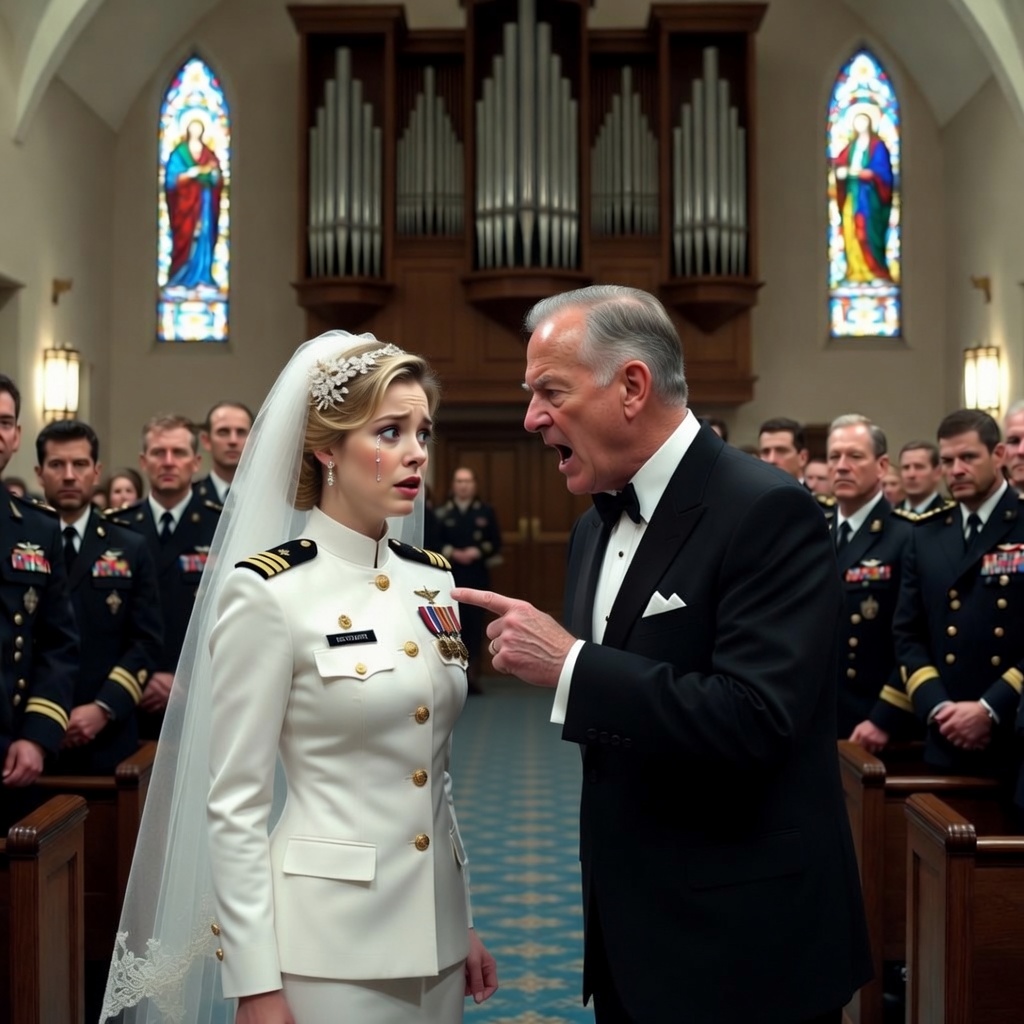
My father tried to strip me of my honor on the happiest day of my life.
He did it in front of stained-glass saints, polished pews, decorated officers, old family friends, and the man I was about to marry.
“Take that uniform off—you’re embarrassing this family!”
The words cracked through the naval chapel like a rifle shot.
For half a second, no one moved.
The organ music trembled into silence. Somewhere behind me, a woman gasped. A child began to cry and was quickly hushed. My fiancé, Commander Daniel Reyes, tightened his hand around mine, not enough to restrain me—only enough to remind me I was not alone.
But I had been alone before.
My name is Vice Admiral Evelyn Hart, and I had spent most of my life learning how not to flinch.
I had stood on carrier decks while storms tried to tear aircraft from steel. I had held dying sailors in field hospitals slick with rain and blood. I had made decisions that sent brave people into darkness and spent years wondering whether I had the right to sleep afterward.
Yet nothing had ever cut quite like my father’s voice.
Retired Army Colonel Frank Hart stood in the front pew, tall despite his age, gray hair combed back with military precision, jaw locked so tightly the muscles in his face jumped. He pointed at my chest—at the medals, at the gold stripes, at every year I had survived without his blessing.
“This is shameful,” he said. “A wedding is for a woman, not an officer pretending she’s a man.”
A wave of shock moved through the chapel.
Daniel stepped forward. “Colonel—”
“No.” My father snapped his hand up. “This is family business.”
I looked at him carefully. Not as a daughter begging for love. Not as a little girl waiting by the window for a father who never came home from training exercises in time for birthdays. I looked at him as one officer studies another before a battlefield mistake becomes fatal.
“Dad,” I said quietly. “Sit down.”
His eyes narrowed.
That was what enraged him most. Not my uniform. Not my rank. Not my medals.
My calm.
He wanted tears. He wanted apology. He wanted the old Evelyn—the girl who used to polish his boots before inspections, hoping he would smile. The girl who hid acceptance letters because the Naval Academy was not what he wanted for her. The girl who learned too late that some fathers only loved obedience and called it tradition.
He stepped into the aisle.
“Take it off,” he said again, lower this time. “Or I walk out.”
The chapel breathed in as one body.
My mother sat three pews behind him, pale and trembling. She had spent thirty years shrinking beside his anger. My younger brother Nathan looked at his shoes. Cousins stared at the floor. Old neighbors pretended not to hear.
I realized then that they had all expected me to fold.
Daniel leaned close. “Evelyn, say the word and I’ll have him removed.”
I loved him for that.
But I shook my head.
“No,” I whispered. “Let him finish.”
My father’s face twisted. “You think those medals make you better than us?”
“No,” I said.
“You think those people standing behind you are your family?”
I turned slightly.
Behind me were sailors, Marines, Navy surgeons, pilots, chiefs, commanders, widows, mothers, men with scars under their collars, women who had buried friends and kept serving anyway.
“Yes,” I said. “Some of them are.”
His hand shot out so fast the chapel erupted.
He grabbed the edge of my white dress jacket near the collar and yanked.
Not hard enough to tear it.
Hard enough to humiliate me.
Daniel moved instantly, catching my father’s wrist in a grip so controlled it was more frightening than violence.
“Sir,” Daniel said, voice flat, “let go.”
My father looked at Daniel as if he had been slapped.
Then, from somewhere in the back of the chapel, a wooden pew creaked.
One man stood.
Then another.
Then another.
Black dress uniforms rose row by row, silent and synchronized, like a tide of shadows.
My father slowly turned.
The chapel changed temperature.
Nearly two hundred Navy SEALs were standing.
No one shouted at first. No one rushed forward. They simply stood there, shoulders squared, eyes locked on the man who had just put his hands on me.
And in that terrible silence, my father finally understood something.
He had not insulted a daughter playing dress-up.
He had insulted a commander whose people had crossed oceans to honor her.
At the center aisle stood Master Chief Adrian Cole, a broad-shouldered man with silver at his temples and the kind of eyes that had seen war and never forgiven it. He did not raise his voice.
“Colonel Hart,” he said, “remove your hand.”
My father released my jacket.
The fabric settled against my chest.
My medals barely moved.
But inside me, something ancient cracked.
PART 2
Master Chief Cole took one slow step into the aisle.
Every person in the chapel watched him. Even my father, who had spent his life believing rank could protect him from shame, seemed unable to look away.
“You don’t know what you’re interrupting,” my father said, though his voice had lost some of its iron.
Cole’s expression did not change. “With respect, sir, I know exactly what I’m interrupting.”
My father scoffed. “This is a wedding.”
Cole glanced at me, and for one fleeting second his face softened. Then he looked back at Frank Hart.
“No, sir,” he said. “This is an honor ceremony you happened to be invited to.”
A murmur rolled through the chapel.
My father’s eyes flicked across the room. He saw the SEALs. He saw the officers. He saw men and women standing not out of politeness, but loyalty.
And for the first time in my life, I saw fear in his face.
Not fear of violence.
Fear of truth.
Daniel’s hand slid from my father’s wrist, but he stayed close to me.
“Evelyn,” my mother whispered from behind us, her voice breaking. “Please…”
I turned toward her.
For years, her “please” had meant don’t upset him.
This time, I wasn’t sure.
My father swallowed hard. “You planned this?”
I almost laughed. “Planned what?”
“This display.” He gestured toward the standing men. “This humiliation.”
The word struck me strangely.
Humiliation.
He had publicly called me shameful. He had tried to drag my uniform from my body. But in his mind, the humiliation belonged to him because witnesses had refused to look away.
“No,” I said. “I invited people who mattered to me.”
“That uniform mattered more than your family.”
“No,” I replied. “That uniform taught me what family should be.”
His face reddened.
Then Master Chief Cole did something I did not expect.
He reached into the inside pocket of his jacket and pulled out a folded envelope, yellowed at the edges, sealed in a clear protective sleeve. My breath caught before I understood why.
My father saw it and went still.
Completely still.
“Where did you get that?” he asked.
Cole’s jaw tightened. “From Commander Reyes.”
I turned sharply to Daniel.
Daniel looked at me with pain in his eyes. “I was going to tell you after the ceremony.”
“Tell me what?”
The chapel disappeared around me.
Daniel took a breath. “Three months ago, when your father confirmed he was coming, I received a call from a retired Army chaplain. He said there were documents you deserved to see before the wedding.”
My father’s voice dropped into something dangerous. “You had no right.”
Daniel did not look away. “She had every right.”
Cole unfolded the envelope carefully.
“Colonel Frank Hart,” he said, “served with my father in 1994.”
My father’s face drained of color.
I stared at him.
“You knew Master Chief Cole’s father?”
Frank said nothing.
Cole continued, voice controlled but edged with grief. “My father was Senior Chief Marcus Cole. He died during an extraction mission that officially never happened.”
A strange ringing filled my ears.
I had heard the name Marcus Cole before.
Not from my father.
From classified briefings. From whispered histories. From men who carried guilt like hidden shrapnel.
Cole looked at me. “Vice Admiral Hart reviewed that operation five years ago and reopened benefits for three families who had been denied recognition. Mine was one of them.”
My throat tightened.
I remembered that case. A buried mission. Missing paperwork. Families abandoned by bureaucracy.
I had signed the correction order myself.
Cole turned back to my father.
“But there was one statement missing from the file,” he said. “One witness who never came forward.”
My father’s hands curled into fists.
“Don’t,” he whispered.
The word was so small that for an instant he sounded nothing like the man who had raised me.
Cole opened the paper.
“This letter was written by Army Captain Frank Hart, dated November 17, 1994. It was never submitted.”
My mother covered her mouth.
My father stepped back as if the aisle had become fire.
Cole read, “Senior Chief Marcus Cole did not disobey orders. I gave the wrong coordinates. He entered the compound to save the medical team after my mistake exposed them. His actions saved seventeen lives, including mine. Responsibility for the failed extraction belongs to me.”
The chapel froze.
My heart slammed once.
Then again.
I looked at my father, searching for denial.
There was none.
Only shame.
Years of it.
Cole lowered the letter. “My father died branded reckless because this statement disappeared.”
My father’s lips trembled. “I was young.”
“So was he,” Cole said.
“I had a family.”
“So did he.”
The words landed harder than any shout.
My father’s eyes moved to me, and suddenly I understood the hatred.
It had never been about my uniform.
It had been about what my uniform represented.
Service. Courage. Accountability.
All the things he had demanded from everyone but himself.
My rise had forced him to look at the cowardice he buried. Every promotion, every medal, every salute I earned had been another mirror held to his face.
“You hated me,” I whispered, “because I became the officer you pretended to be.”
His mouth opened.
No sound came out.
Then my mother stood.
The entire chapel turned toward her.
She was small, elegant, silver-haired, usually quiet enough to disappear inside a crowded room. But now she walked into the aisle with tears shining on her cheeks.
“Frank,” she said, “tell her the rest.”
My father looked as if she had shot him.
“Margaret,” he warned.
She shook her head. “No. Not today.”
My pulse quickened.
“The rest?” I asked.
My mother looked at me, and I saw decades of fear collapse into grief.
“He didn’t miss your commissioning because he was busy,” she said. “He was there.”
I stopped breathing.
“He stood outside the hall,” she continued. “He watched through the doors. When they called your name, he cried.”
My father turned away.
My mother’s voice broke. “He went to every promotion ceremony he claimed to miss. Every single one. He stood at the back, left before you saw him, then came home angry because he didn’t know how to be proud without feeling exposed.”
I stared at him.
“No,” I said.
My father’s shoulders shook once.
It was almost invisible.
But I saw it.
My mother stepped closer. “When you made Vice Admiral, he bought a frame for the announcement clipping.”
She pointed at him. “He keeps it locked in his desk.”
My father shut his eyes.
The chapel was silent now in a different way.
Not tense.
Hungry.
Waiting for the final truth.
Daniel touched my back gently, grounding me.
“Why?” I asked my father. “Why punish me for making you proud?”
His face crumpled.
For the first time in my life, Colonel Frank Hart looked old.
“Because,” he said hoarsely, “you wore honor like it was easy.”
The words scraped out of him.
“And every time I saw you in uniform, I remembered the day I took mine off and became a coward.”
PART 3
No one breathed.
My father stood in the aisle of the chapel, surrounded by everything he had spent thirty years avoiding—truth, witnesses, consequence, and me.
I waited for an apology.
Instead, he reached for his jacket.
Daniel shifted instinctively, but my father only removed a small black case from the inside pocket. His hands shook as he opened it.
Inside was a medal.
Old. Tarnished slightly at the edges. Carefully preserved.
Master Chief Cole inhaled sharply.
“My father’s Navy Cross,” he said.
My father nodded.
“I was given it after the operation,” Frank said. “Unofficially. Quietly. A chaplain said Marcus had pressed it into my hand before he died.” His voice cracked. “He told me to get the others home.”
Cole’s eyes glistened.
“I did get them home,” my father whispered. “Then I let the Army blame him for my mistake.”
He turned toward Cole and held out the case.
“I have no right to ask forgiveness,” he said. “But this belongs to your family.”
Cole did not take it immediately.
His face was carved from grief.
Then, slowly, he stepped forward and accepted the medal.
The instant it left my father’s hand, something changed in him. His rigid posture collapsed. His chin lowered. His breath came unevenly, like a man who had survived a war only to lose the battle inside himself.
Then he turned to me.
“Evelyn,” he said.
My name sounded unfamiliar in his mouth without command behind it.
“I was proud of you,” he said. “I was proud from the beginning.”
The words hurt more than the insult.
Because I had needed them at twelve. At seventeen. At twenty-two. At every promotion. At every lonely airport. At every hospital corridor where I washed blood from my hands and wondered whether being strong meant being unloved.
Tears burned my eyes, but I refused to let them fall easily.
“You let me think I was your shame.”
His face folded.
“I know.”
“You let me build my whole life around proving I deserved to stand in rooms you were hiding in.”
“I know.”
“You put your hand on me today.”
His voice broke completely. “I know.”
The chapel waited.
But forgiveness is not a curtain that drops at the end of a dramatic scene.
It is not owed because someone finally tells the truth.
So I said the only honest thing I could.
“I don’t forgive you yet.”
My father nodded, tears spilling down his face.
“I know.”
“But,” I said, my voice shaking now, “you will sit down. You will watch me marry the man I love. You will not speak unless spoken to. And afterward, if you want to begin telling the truth, you can start by submitting that statement officially.”
He looked at Master Chief Cole.
Cole’s expression was unreadable.
Then Cole said, “I have the original. And witnesses.”
My father nodded. “Then I’ll sign whatever is needed.”
For the first time, I believed him.
Not because he sounded noble.
Because he sounded defeated enough to be honest.
Daniel leaned close. “Are you okay?”
I looked at the chapel, at the SEALs still standing, at my mother crying quietly, at Cole holding his father’s medal, at my father stripped of every armor except regret.
“No,” I whispered. “But I’m ready.”
Then Master Chief Cole faced the room.
Without a command, every SEAL in the chapel stood straighter.
Cole looked at me.
“Ma’am,” he said, voice thick with emotion, “permission to honor the bride.”
My throat closed.
I nodded.
Then it happened.
Two hundred Navy SEALs raised their voices—not in chaos, not in performance, but in a thunderous roar that shook the chapel rafters.
“HOOYAH!”
The sound crashed through stone and stained glass, through old shame and fresh wounds, through every lie my father had ever built around me.
Guests burst into tears. Officers saluted. My mother sobbed into both hands.
And my father—my impossible, broken, proud, cowardly, grieving father—slowly stood at attention.
Then, with trembling fingers, he saluted me.
Not perfectly.
Not steadily.
But fully.
I looked at him for a long moment.
Then I returned the salute.
The chapel erupted.
Daniel took my hand again, and we walked forward beneath the colored light. The ceremony resumed, though nothing about it was ordinary anymore. When we reached the altar, Daniel’s voice shook during his vows.
“You once told me love was not rescue,” he said. “That love was standing beside someone while they rescued themselves. Evelyn, I promise to stand beside you in every storm, every silence, every battle no one else sees.”
I nearly broke then.
But I held his hands and answered.
“You never asked me to become smaller to be loved,” I said. “So I promise you this: I will never ask you to carry the weight of my past alone. I choose you—not because you saved me, but because you never needed me to pretend I was unbroken.”
We married under stained glass while warriors cried.
After the ceremony, my father waited outside the chapel doors.
The sky over Annapolis had turned silver, heavy with rain that had not yet fallen. He stood alone near the steps, no longer towering, no longer commanding, just a man facing the ruins of himself.
I approached him.
For a moment neither of us spoke.
Then he said, “I kept every newspaper clipping.”
I looked at him.
He swallowed. “Every one.”
“That doesn’t fix it.”
“No,” he said. “It doesn’t.”
A long silence passed between us.
Then he reached into his pocket and pulled out a folded photograph.
It was old, creased at the corners.
Me at twenty-two, in uniform, at commissioning.
Taken from far away.
Through a doorway.
My breath caught.
On the back, in my father’s handwriting, were four words:
My daughter outranks me.
Not in rank.
In courage.
I closed my eyes.
The first raindrop landed on the photograph.
Then another.
My father reached to protect it, but I took it gently from his hand.
“I’ll keep this,” I said.
His face broke with gratitude so raw it almost frightened me.
Then came the twist none of us saw coming.
A black government SUV pulled up beside the chapel.
An elderly man stepped out, leaning on a cane.
Master Chief Cole went rigid.
My father turned—and all the blood left his face.
The man smiled faintly.
“Hello, Frank,” he said.
My father whispered, “That’s impossible.”
The old man looked at Cole, then at the medal in his hand.
“My name is Marcus Cole,” he said. “And I think it’s time everyone heard what really happened.”
Master Chief Cole staggered back as if struck.
His father was alive.
And my wedding day, which had begun with an insult, had just opened the door to a truth far bigger than any of us had imagined.