
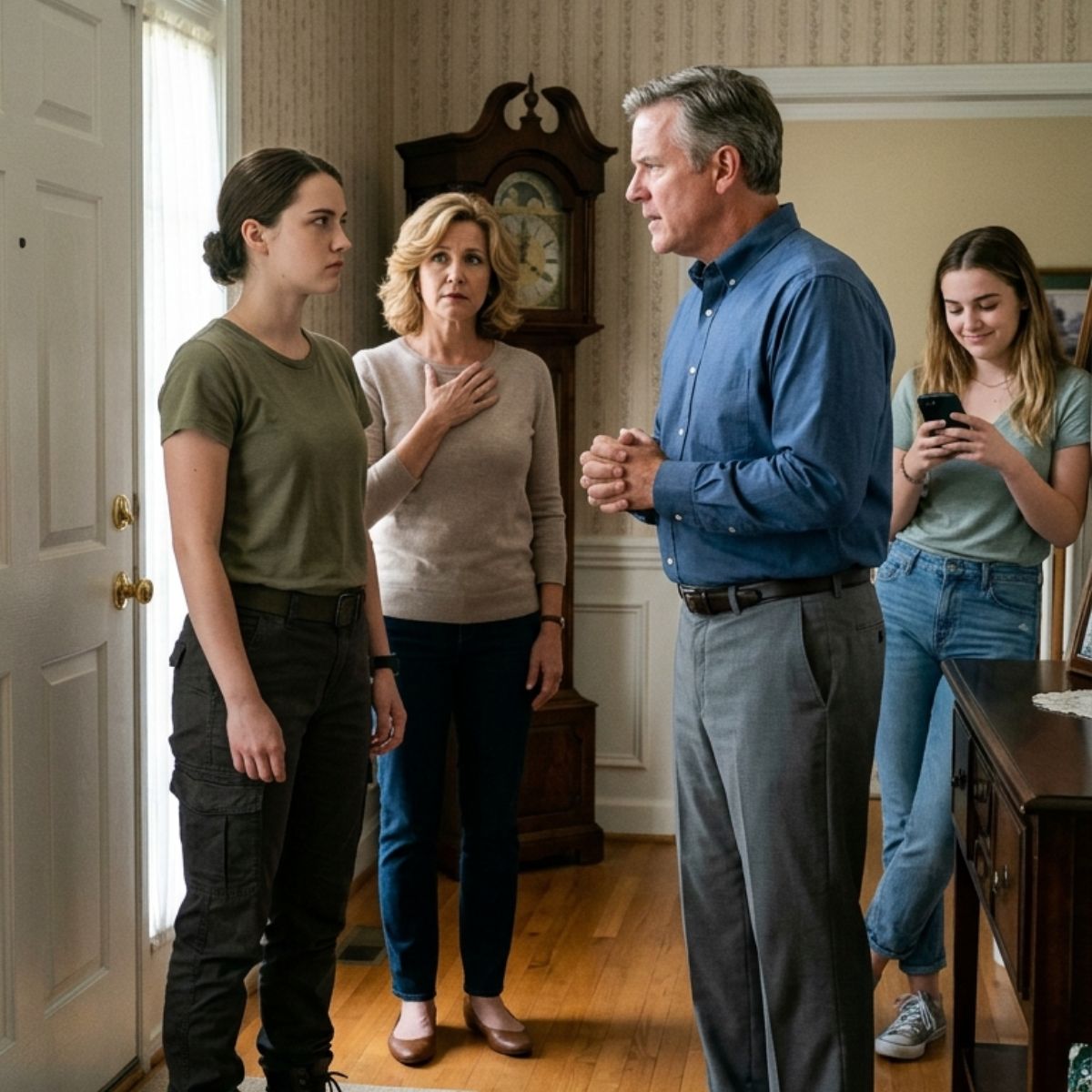
My father gave me two days to disappear from the only house that had ever truly known me.
He didn’t shout when he said it. That was the thing that made it worse. He stood in the front hall with his hands folded in front of him, his mouth set into a thin, practiced line, and delivered the sentence like he was closing a business deal instead of throwing his own daughter out.
“You have forty-eight hours, Emily,” he said. “Pack what belongs to you, leave the keys on the counter, and don’t turn this into a scene.”
I had been home for less than twenty minutes.
My duffel bag was still sitting by the door, the canvas dusty from travel, the straps cutting faint red lines into my palm. I still smelled like airport coffee, old leather seats, and the dry metallic air of a place where I had spent too many months pretending I wasn’t exhausted. My boots were still on. My uniform jacket was folded over one arm. I had not even had time to step into the kitchen before my father decided I was no longer part of the house my grandfather had built with his own hands.
Behind him, my mother stood with that soft, wounded expression she always wore when she wanted to make cruelty look like kindness. She had one hand pressed gently against her chest, as if this was hurting her more than it was hurting me. My younger sister, Chloe, leaned against the hallway table, scrolling through her phone with a little smile tugging at the corner of her mouth. She looked too comfortable. Too ready. Like she had already chosen the paint color for my room.
For a moment, I heard nothing but the grandfather clock ticking in the corner.
That clock had been there since before I was born. My grandfather used to wind it every Sunday morning before church, humming under his breath, his broad hands moving with surprising tenderness over the brass key. When I was little, I thought the sound of that clock was the heartbeat of the house.
Now it sounded like a countdown.
“Did you hear me?” my father asked.
I looked at him. Really looked at him. Not as the man who had taught me to ride a bike in the driveway when I was six, or the man who had once carried me inside after I scraped my knee open on the back steps. I looked at him the way I had learned to look at men in command tents and interrogation rooms, men who thought volume and certainty were the same thing as power.
“I heard you,” I said.
That was all.
My mother blinked. Chloe’s smile faltered. My father’s jaw tightened because he had expected something from me. Tears, maybe. Anger. A slammed door. A speech about loyalty and family and how could you do this to me? Something messy enough to justify what they had already decided.
But I had spent years learning how not to give people the reaction they were waiting for.
“Good,” he said after a pause. “Then we understand each other.”
“We do,” I said.
My mother stepped forward. “Emily, sweetheart, please don’t look at us that way. This isn’t punishment. We’re trying to be practical. This house is too much for one person, especially someone with your schedule. You’re gone all the time. And Chloe is getting married soon. She and Mark need a place to start their life.”
Chloe finally looked up from her phone. “It just makes sense,” she said lightly. “You barely live here anyway.”
There it was.
The sentence they had prepared. The one meant to slip under my ribs and force a response.
You barely live here anyway.
I glanced past them toward the staircase, toward the second-floor study, toward the wall behind my grandfather’s old bookcase where a safe had been waiting for this exact moment longer than any of them knew.
“You’re right,” I said quietly. “Maybe I don’t live here the way you do.”
My father seemed relieved. “Then this doesn’t have to be difficult.”
“No,” I said. “It doesn’t.”
I walked past him before he could answer.
The house smelled the same and different all at once. Lemon cleaner. My mother’s perfume. Old wood. Dust warmed by afternoon light. Underneath all of it, there was still the faint scent of cedar and coffee that had always belonged to my grandparents, buried beneath the newer layers like a truth someone kept trying to cover.
In the kitchen, I set my hand on the worn edge of the counter.
My grandfather had stood there every morning with the newspaper spread open in front of him, coffee growing cold beside his elbow, reading every line as if the world might make more sense if he paid close enough attention. My grandmother used to swat him with a dish towel and tell him to stop frowning at bad news before breakfast.
For one sharp second, I could almost hear them.
Then my father’s voice cut through the memory.
“Pack only what’s yours,” he said from behind me. “Furniture, antiques, documents, anything connected to the house stays here.”
I almost smiled.
“Anything connected to the house,” I repeated.
“Yes.”
I opened the cabinet and took down my old ceramic mug, the blue one with the cracked handle. I had used it since I was sixteen. My grandmother had glued the handle back together twice and told me some things became more precious after they broke because they had proven they could survive.
“Don’t worry,” I said. “I know exactly what belongs here.”
No one said anything.
That silence told me everything I needed.
They believed I was cornered. They believed grief had made me weak. They believed my grandfather had died leaving behind a house, a few accounts, some antiques, and a confused granddaughter too tired to fight. They believed the story had already been written, and all they had to do was push me out before I learned how it ended.
What they didn’t know was that my grandfather had written the ending himself.
And when that safe opened, everything they had stolen from the truth would come back to bury them.
I told them I would be gone by Friday.
My father nodded once, satisfied. My mother exhaled like a woman who had just avoided an unpleasant scene. Chloe looked disappointed, as if she had hoped I would make a fool of myself so she could feel better about taking my life apart.
That night, while they drove back to their own house feeling victorious, I sat alone at my grandfather’s desk and listened to the old floorboards settle around me.
The study was the one room my mother had never managed to change. She had replaced curtains downstairs, rearranged cabinets, donated my grandmother’s old tablecloths because she said they were “too dated,” but the study remained untouched. The books still lined the walls. The leather chair still sat angled toward the window. The brass lamp still gave off a pool of amber light on the desk where my grandfather had paid bills, written letters, and made decisions he never announced until they were already final.
I ran my fingers along the edge of the desk and remembered the first time I realized my family was waiting for him to die.
It had not happened all at once.
Cruelty rarely introduces itself honestly. It starts small. A missed phone call. A postponed visit. A sigh when someone asks for help. A joke about how old people get dramatic. A complaint about doctors, prescriptions, bills, appointments, all the little inconveniences of watching the people who raised you become fragile.
My grandmother had been the first to change.
At first, she forgot harmless things. Where she left her glasses. Whether she had watered the plants. Why she had walked into a room. She laughed it off, and we laughed with her because laughing made it less frightening.
Then she left the stove on.
Then she called me at 3:00 in the morning asking if I was coming home from school, even though I had been an officer in the Army for three years.
Then a neighbor found her two blocks away in slippers, confused and crying because she could not remember which house was hers.
I was stationed across the country then. My parents lived forty minutes away.
I was the one who flew in.
The first time, I told myself it was temporary. I bought pill organizers, labeled cabinets, scheduled doctor appointments, arranged grocery deliveries, and met with the nurse who came by three afternoons a week. Then I flew back to base and pretended my mind had returned with my body.
It hadn’t.
Every phone call made my stomach tighten.
My mother always had reasons she couldn’t help more. Charity luncheons. Client dinners. A committee meeting. A weekend away that had been planned for months. She used the word “commitment” as if caring for her own parents was not one.
My father was worse because he didn’t bother decorating his neglect.
“We can’t all drop everything every time your grandmother misplaces something,” he told me once.
“She was found outside in the rain,” I said.
“And she’s fine.”
“She was terrified.”
“She’s old, Emily. Old people get confused.”
I remember standing in a hallway outside a briefing room, still holding a folder of logistics reports, my phone pressed so hard to my ear that my fingers ached.
“Dad,” I said slowly, “this is serious.”
“It will become serious when it becomes serious,” he replied.
That sentence stayed with me.
It will become serious when it becomes serious.
To him, pain only counted when it became inconvenient for him.
Chloe came around even less. She visited once with flowers, took three photos in the garden, posted one online with a caption about cherishing family while we still have them, then left before dinner because she had reservations downtown. My grandmother was asleep in the next room. My grandfather stood by the sink and watched Chloe laugh into her phone on the porch.
“This place is depressing,” Chloe said, not bothering to lower her voice. “I don’t know how anyone stands it.”
My grandfather said nothing.
But I saw his face.
He had been a strong man all my life, not loud, not dramatic, just steady in a way that made other people feel safer. That day, something in him looked tired beyond age. Not broken. Never broken. But aware.
He knew.
Long before anyone said it aloud, he knew.
After my grandmother died, the house changed.
It did not become empty. It became watchful.
Her slippers were still beside the bed. Her handwriting still labeled jars in the pantry. Her reading glasses remained on the small table near the window where she used to sit in the mornings. My mother wanted to “clear things out” almost immediately. She said it wasn’t healthy to preserve a shrine.
My grandfather told her no.
Just one word.
No.
She didn’t bring it up again in front of him, but I heard her complain to my father in the kitchen later.
“He can’t keep living in the past,” she whispered.
My father answered, “He won’t forever.”
I was in the hallway when he said it.
He didn’t see me.
My grandfather did.
He looked up from his chair, and our eyes met across the room. Neither of us spoke, but something passed between us then. Not surprise. Confirmation.
Two weeks after the funeral, I helped him into bed after a long day of appointments. His hands had grown thinner, the veins raised beneath pale skin, but when he caught my wrist, his grip was still firm.
“They think I don’t see it,” he said.
I sat down beside him.
“I know.”
“They aren’t waiting for me to recover.”
I swallowed.
“They’re waiting for me to be finished,” he said.
There was no bitterness in his voice. That almost made it worse. It was simply a fact he had accepted.
“I’m here,” I told him.
He studied me for a long moment. “That’s what worries me.”
“I don’t understand.”
“You keep showing up for people who let you pay the cost alone.”
I looked down because I couldn’t argue with that.
He released my wrist and leaned back against the pillows. “Character,” he said, “doesn’t show itself when the room is full and everyone is clapping. It shows itself when nobody is watching and it costs you something to stay.”
I thought I understood him then.
I didn’t.
Not fully.
A week later, he asked me to drive him into town.
He said it casually over breakfast. “I need to stop by an office near the marina. Some paperwork I’ve been putting off.”
I didn’t ask what kind of paperwork. My grandfather had never been a man who liked being pushed. If he wanted me to know, he would tell me.
The office belonged to Daniel Mercer, an estate attorney with silver hair, sharp eyes, and the quiet confidence of a man who had watched families destroy themselves over money for forty years and no longer mistook politeness for decency.
“I’ll wait outside,” I said when we arrived.
My grandfather shook his head. “No. You’re coming in.”
That was when my stomach tightened.
Mercer greeted my grandfather first, then turned to me.
“So this is Emily,” he said.
My grandfather nodded. “This is the one I told you about.”
Not my granddaughter.
Not my son’s oldest.
The one.
We sat at a polished wooden table while Mercer opened a folder thick with documents. He spoke carefully, explaining the old will, the assumptions that had shaped it, the changes my grandfather now wanted made.
Years earlier, the house had been set to pass to my father.
“It was a simple plan,” Mercer said. “One built on the belief that the family would act in the best interest of the property and of one another.”
My grandfather gave a dry laugh. “That belief has expired.”
Mercer slid a document toward me. “Your grandfather wants the property placed into an irrevocable trust. He wants you named sole trustee.”
The room seemed to narrow.
“What does that mean exactly?” I asked, though some part of me already knew.
“It means the house will not pass directly into your father’s control,” Mercer said. “It means you will have legal authority over how the property is maintained, protected, or eventually sold if that ever becomes appropriate. It also makes the arrangement much harder to challenge, provided we document everything properly.”
I looked at my grandfather.
“They’ll say I manipulated you.”
“Yes,” he said.
“They’ll say you weren’t thinking clearly.”
“They can say the moon is made of paper if they like.”
“This will make them hate me.”
For the first time that day, his expression softened.
“No, sweetheart,” he said. “It will make them show you what was already there.”
I didn’t want that to be true.
But I signed where Mercer told me to sign.
Over the next several weeks, everything was done with painful precision. Medical evaluations. Witness statements. Notarized documents. Recorded confirmations. Transfer paperwork. Copies filed and secured. Mercer anticipated every attack before my family had even planned it.
“People like this count on confusion,” he told me once. “So we remove confusion.”
My grandfather recorded a message too.
I sat beside him while he did it, though he insisted the words be his alone. His voice was weaker than it had been when I was young, but there was nothing uncertain in it.
“I am making this recording so there will be no confusion,” he said into the small device on Mercer’s desk. “I know what I am doing. I am of sound mind. I am not being pressured. I am protecting this home from those who see it only as something to take. I choose the person who showed up.”
He did not look at me while he spoke.
I was grateful for that because I was crying silently by the end.
After he died, my family became exactly what he had predicted.
My mother began asking casual questions about paperwork. Had I found the will? Had Granddad mentioned anything? Did he leave instructions? My father started coming by more often than he had in years, walking through rooms with his hands behind his back like an inspector. Chloe talked about knocking down walls, opening the kitchen, turning the study into a nursery, maybe selling some of the old furniture because “dark wood makes everything feel heavy.”
I let them talk.
I let them believe.
Not because I was afraid, but because Mercer had given me one piece of advice I decided to follow.
“Do not interrupt people while they are revealing themselves.”
So I didn’t.
I prepared the safe instead.
The safe had always fascinated my father. It was hidden behind a sliding panel in the study, not impossible to find, but easy to overlook if you didn’t know the house well. My grandfather had kept old deeds in it once, along with war medals, jewelry, cash during storms, and letters my grandmother wrote him before they were married.
After the trust was completed, I placed inside it everything my family would need to understand what had happened.
A notarized copy of the trust.
A letter from Mercer confirming its validity.
A sealed envelope in my grandfather’s handwriting.
A flash drive with the recording.
And on top, a single sheet of paper with one sentence printed in plain black ink.
If you are reading this because you came looking for something to take, then you already know why you were left out.
I locked the safe.
Then I waited.
So when my father told me I had two days to leave, the deadline did not frighten me.
It wasn’t mine.
It was his.
Friday arrived cold and gray, with clouds hanging low over the water behind the house. The trees were bare enough that I could see the shoreline from the upstairs window, a dull silver line beyond the lawn. The whole house felt suspended, every room holding its breath.
I packed just enough to make it believable.
Boxes labeled books, winter clothes, kitchen. A suitcase by the door. A few shelves cleared. My duffel bag visible in the hallway. Anyone walking in would see what they expected: a woman accepting defeat.
What they would not see was the court-certified copy of the trust in my bag, Mercer’s number already pulled up on my phone, and a message scheduled to send if anything went wrong.
They arrived at 4:52.
My father came in first. Same controlled posture. Same efficient expression. My mother followed, dressed too nicely for an eviction, carrying a leather handbag and wearing pearl earrings my grandmother had once said made her look like she was auditioning for sympathy. Chloe came last, her eyes immediately scanning the house.
“Is that all?” she asked, looking at the boxes.
“It’s enough,” I said.
My father placed his keys on the entry table. “Good. Then let’s not drag this out.”
He didn’t ask where I was going.
He didn’t ask if I had enough money.
He didn’t ask if I was okay.
He looked toward the stairs.
“The safe,” he said. “We should go through it before you leave. Make sure everything is accounted for.”
There it was.
The real reason for the visit.
My mother looked down at her hands. Chloe’s face brightened before she could hide it.
“It’s in the study,” I said. “Same place it’s always been.”
My father nodded and started up the stairs.
I followed.
The study was colder than the rest of the house. My grandfather’s books watched from the shelves. Dust floated in the pale light coming through the window. The leather chair sat empty, angled toward the desk like someone had only just stood up and might return at any moment.
My father opened the top desk drawer and removed the small brass key. He looked almost pleased with himself.
“Convenient,” he said.
I said nothing.
He crossed to the bookcase, pressed the hidden panel, and slid it open.
The safe waited behind it.
For a few seconds, nobody moved.
Then he inserted the key.
The click sounded small.
But it changed everything.
He opened the door and looked inside.
At first, his expression did not change. My father was good at stillness when he needed to be. But I had been trained to notice the small things. The tightening along his jaw. The way his shoulders stopped moving. The slight pause before he reached in and lifted the top sheet of paper.
His eyes moved across the sentence.
Once.
Twice.
My mother stepped closer. “What is it?”
He didn’t answer.
She took the paper from him. I watched her read it, watched confusion become irritation, irritation become fear.
“Let me see,” Chloe said, snatching it from her hand.
Her face changed fastest.
“What is this supposed to mean?” she demanded.
My father reached into the safe again and pulled out the trust documents. His lips pressed together as he turned the pages. The room became so quiet I could hear the paper scrape beneath his fingers.
“No,” my mother whispered.
Chloe leaned over his shoulder. “What does irrevocable mean?”
No one answered.
“What does it mean?” she snapped.
“It means,” I said, “Granddad made sure none of you could force the house out from under me.”
They all turned.
My mother’s mouth opened slightly. “Emily…”
My father lifted the letter from Mercer. He read it quickly, then again more slowly.
“This isn’t valid,” he said.
“It is.”
“You don’t know that.”
“I do.”
“You were involved in this?”
“Yes.”
My mother’s hand flew to her mouth. “How could you?”
That almost made me laugh. Not because it was funny, but because the question was so perfectly wrong.
“How could I?” I repeated. “I was the one taking him to appointments. I was the one filling prescriptions. I was the one sleeping in the chair beside his bed when his breathing got bad. I was the one answering calls from nurses and neighbors while you were busy pretending old age was an inconvenience that would eventually resolve itself.”
“That is not fair,” my mother whispered.
“No,” I said. “What you did wasn’t fair. This is just documented.”
Chloe shook her head. “You manipulated him.”
My father looked up sharply, as if she had said the useful part too soon.
I turned toward the desk. “Play the flash drive.”
My mother stared at me.
“Play it,” I said again.
She moved like she didn’t want to, but couldn’t stop herself. She inserted the drive into the laptop on my grandfather’s desk. A file appeared. She clicked it.
Static filled the room.
Then my grandfather’s voice.
Old. Tired. Clear.
“I am making this recording so there will be no confusion about my decisions.”
My mother closed her eyes.
“I know what I am doing. I am of sound mind. I am not being pressured.”
Chloe stepped backward.
“I am protecting this home from those who see it only as something to take.”
My father’s face hardened, but beneath it something had cracked.
“I choose the person who showed up.”
The recording ended.
No one spoke.
My mother began to cry, quietly at first, as if hoping the sound might soften the room. Chloe’s eyes glittered with rage. My father closed the laptop with slow, deliberate care.
“This isn’t over,” he said.
“No,” I agreed. “But this part is.”
They left ten minutes later.
My mother forgot her handbag and came back for it with her face pale and wet. Chloe stared at me from the doorway like she wanted the house to catch fire around us both. My father did not look at me at all.
When the front door closed behind them, the house went silent.
Then my phone started ringing.
My mother first.
I let it ring until it stopped.
Then again.
Then again.
On the fourth call, I answered but said nothing.
“Emily,” she said immediately, breathless. “Please. Don’t do anything else. Don’t call the lawyer. Don’t file anything. We need to talk about this as a family.”
I stared out the kitchen window at the darkening yard.
“A family?” I said.
She hesitated.
That one word had trapped her.
“Sweetheart, emotions are high right now.”
“They were high when Dad gave me two days to leave too.”
“That was different.”
“How?”
Silence.
Then, softer: “We didn’t understand.”
“No,” I said. “You understood exactly what you wanted.”
I ended the call.
The messages came next.
Call me back.
You are making a mistake.
Your grandfather would never want this division.
We can work something out.
Then Chloe:
You think you won.
Then:
Dad says this can be challenged.
Then:
Everyone is going to know what you did.
I saved every message.
Mercer was not surprised when I called him.
“They opened it?” he asked.
“Yes.”
“And?”
“They’re going to fight.”
“Of course they are.”
Three days later, my father filed a petition.
It was written in clean, polished language, the kind that tries to make greed sound like concern. He claimed my grandfather had been vulnerable, that I had isolated him, that I had exerted undue influence while acting as his primary caretaker. He claimed the trust did not reflect my grandfather’s true wishes.
On paper, it looked serious.
In reality, it was panic wearing a suit.
Mercer built the response the way my grandfather built the house: carefully, beam by beam, with no wasted motion.
Medical records confirmed my grandfather’s mental clarity when the documents were signed. The home nurse gave a statement describing his awareness, his independence, and who had actually been present during his care. Pharmacy logs showed who picked up prescriptions. Flight records showed how often I returned. Bank statements showed who paid for repairs. Text messages showed who asked about selling furniture before my grandfather was even buried.
Then there was Chloe’s mistake.
She sent a message late one night, probably furious, probably careless.
If she doesn’t cooperate, tell Dad to push the dementia angle. She’ll fold if she thinks people will believe she took advantage.
She deleted it seconds later.
Not fast enough.
When Mercer read it, he removed his glasses, cleaned them with a cloth, and said, “That will be useful.”
That was the moment I learned the rest.
My father’s business was collapsing.
Credit lines tightened. Loans overdue. Personal guarantees coming due faster than he could cover them. The house was not just a house to him. It was collateral. A lifeboat. A way to survive the financial wreck he had hidden behind tailored jackets and calm speeches.
Chloe did not need the house to start her marriage.
My father needed it to save himself.
The hearing was on a Thursday morning.
The courtroom was smaller than I expected. No drama. No grand stage. Just wooden benches, fluorescent lights, a judge with tired eyes, and two tables separated by a space that felt much wider than it was.
My parents sat together. Chloe sat beside my mother in a pale blue dress, hands folded tightly in her lap. She looked almost innocent if you did not know how much effort innocence can require.
Their attorney spoke first.
He told a story about grief, confusion, military distance, and an elderly man overly dependent on one grandchild. He painted me as intense, controlling, unstable from years of service and loss. He never said those words directly. He didn’t have to. He arranged them carefully enough for the implication to stand on its own.
My mother dabbed her eyes.
My father looked solemn.
Chloe stared straight ahead.
Then Mercer stood.
He did not attack them.
That was what made him so devastating.
He simply replaced their story with facts.
Dates. Records. Signatures. Witnesses. Medical evaluations. Legal filings. Audio confirmation. He walked the judge through every step of the trust’s creation. He established my grandfather’s clarity, independence, and intent. He showed that I had not isolated my grandfather; I had been the only one consistently responding while others stayed away.
He did not say I loved him more.
He proved I showed up more.
Then he played the recording.
My grandfather’s voice filled the courtroom.
“I am not confused. I am not being pressured. I am protecting what matters.”
My mother began crying again, but this time it did not help her.
Finally, Mercer addressed motive.
He questioned my father calmly.
“Were you under financial pressure at the time you instructed your daughter to vacate the property?”
My father adjusted his cuff. “Everyone experiences pressure.”
“Were your business debts increasing?”
“My business is not relevant.”
“It becomes relevant if immediate control of the property would have allowed you to address those debts.”
My father looked at his attorney.
The pause was brief.
But everyone felt it.
Mercer continued. “Did you tell Emily she had forty-eight hours to leave before you had reviewed the trust documents?”
“Yes,” my father said tightly.
“Why?”
“Because we believed the house belonged to the family.”
“To the family,” Mercer repeated. “Or to you?”
My father’s face flushed.
“We needed cooperation,” he said. “That’s all. We needed her to cooperate so we could stabilize things.”
There it was.
The truth, said one step too far.
The judge’s expression did not change, but her pen stopped moving.
When she ruled, her voice was steady.
The trust was valid.
The petition was denied.
There was no evidence of undue influence. The documentation overwhelmingly supported my grandfather’s clear intent. The attempt to remove me from the property before legal review was inappropriate and coercive. My father was ordered to cover a portion of my legal fees. Boundaries were put in place. No access to the property. No direct contact outside legal channels unless I chose otherwise.
My mother sobbed openly.
Chloe did not move.
My father stood very slowly, like his body had aged ten years between the start of the hearing and the end.
None of them looked at me when they left.
Two weeks later, my father resigned from a board position he had held for years. No public explanation. There didn’t need to be one. People understand sudden silence better than most confessions.
Chloe’s wedding was postponed.
My mother sent one letter through Mercer. It was not an apology. Not really. It was a page and a half of polished sorrow, careful wording, and sentences that circled responsibility without touching it.
I did not respond.
Not because I hated her.
Because I had finally learned that peace sometimes begins the moment you stop explaining pain to people who benefited from denying it.
That afternoon, I drove back to the house alone.
The sky was clear. The water behind the trees flashed silver in the late sun. The porch steps creaked beneath my boots the way they always had. Inside, the air was still. Familiar. Waiting.
I set my keys on the counter.
Not because I was leaving.
Because I was home.
I walked into the kitchen and took down the blue mug with the cracked handle. I filled it with coffee, carried it out to the porch, and sat in my grandfather’s chair as the evening settled over the yard.
For a long time, I didn’t think about the hearing. Or the safe. Or the way my father’s face changed when he realized the house had never been his to take.
I thought about my grandmother sweeping the porch before sunrise.
I thought about my grandfather winding the clock every Sunday.
I thought about every flight I took half-asleep, every prescription sorted, every appointment scheduled, every night I sat awake listening for a change in breathing from the next room.
Those moments had felt small when I was living them.
Invisible.
Unrewarded.
But they had become the foundation of everything.
My family thought inheritance was about blood. My grandfather understood it was about stewardship. They thought showing up at the end should count the same as staying through the hard parts. He knew better.
I did not win because I was louder.
I did not win because I was crueler.
I won because I stayed when staying was inconvenient. I stayed when nobody praised me for it. I stayed when it cost me sleep, time, comfort, and pieces of a normal life I would never get back.
And in the end, that was the only evidence that mattered.
The grandfather clock struck six inside the house.
For the first time in months, the sound did not feel like a countdown.
It felt like a heartbeat.
Truth does not always arrive shouting. Sometimes it waits quietly behind a locked door, inside an old safe, beneath a sheet of paper no one expects to read. Sometimes it sits patiently while people lie, plan, threaten, and smile. Sometimes it lets them believe they have already won.
And then, when the door opens, truth simply stands there.
Final.
Unmoved.
Impossible to evict.