
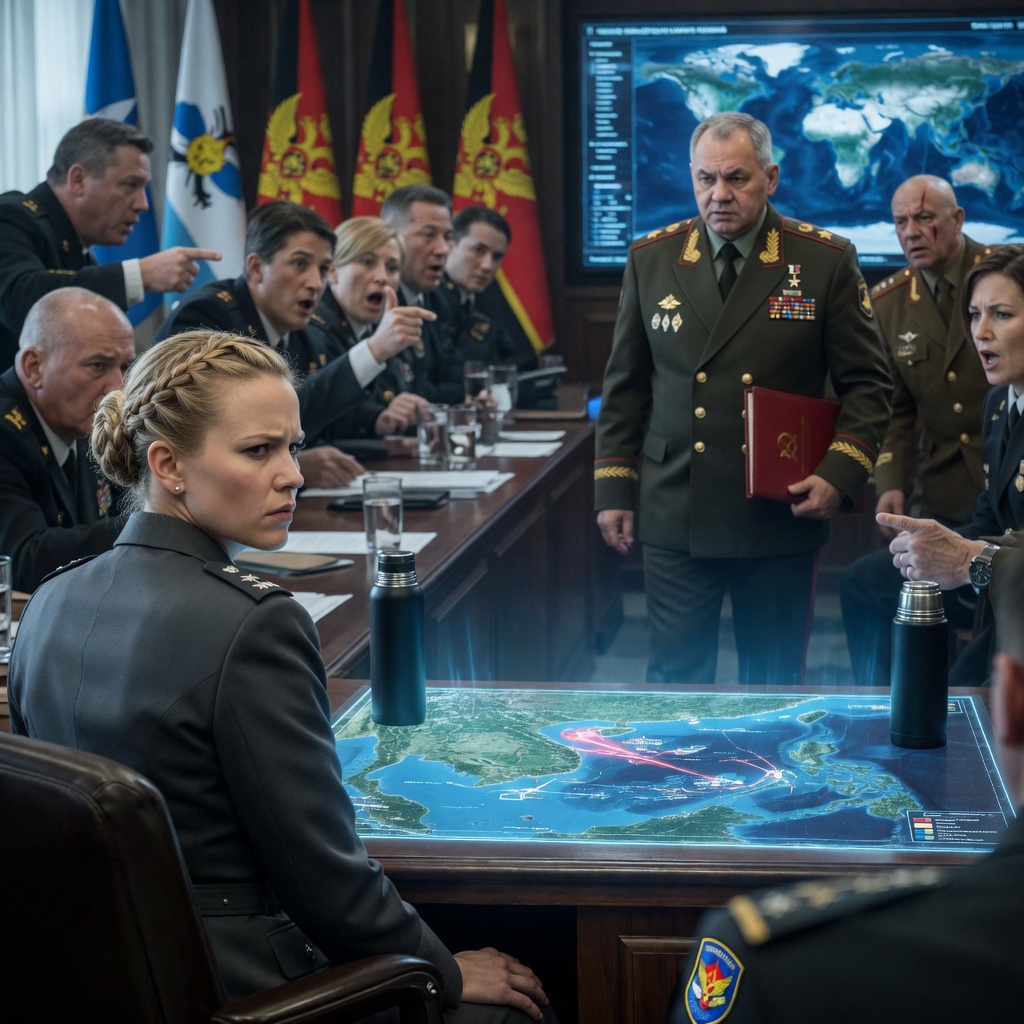
Military Hearing Room: “SHE LIED TO GET PROMOTED.” “That’s Not Even Her Real Rank.” The Colonel Stood, Took Her File… And Walked Out. She Went Pale. Froze. Said Nothing.
Part 1
My name is Rebecca Hartley, and until the morning my sister tried to end my career, I had never once been late to a hearing, a briefing, or a convoy.
That morning I got to Building 14 twelve minutes early.
The hallway outside the review room smelled like floor wax and burnt coffee. Somebody down the corridor was feeding sheets into a copier, and every few seconds the machine made that tired cough I associate with government buildings and bad news. I stood in front of the brushed metal door with my cap tucked under my arm, uniform pressed so hard the fabric made a faint crackling sound when I moved.
Twelve years in the Army. Two deployments. One drawer full of challenge coins I never displayed because I thought that looked tacky. A service record so clean it could have passed inspection on sight.
Then I walked into that room and saw my sister across the table.
Alyssa looked exactly how she always liked to look when she wanted to win before speaking. Hair slicked back. Slate-gray suit. Pearl studs. Three color-coded tabs sticking out of a binder in perfect intervals, like even her documents had learned to stand at attention around her. If I hadn’t known what she was about to say, I might have mistaken her expression for concern.
“Ms. Hartley,” Colonel Mathers said, glancing up from the folder in front of him. “You may be seated.”
I sat. The chair legs made a dry scrape against the tile.
Alyssa didn’t look at me right away. That was new. My sister had always looked directly at people when she lied, as if eye contact itself could turn performance into truth. She waited until the clerk confirmed the time and date, until the little red light on the recorder came on, and only then did she lift her eyes.
She said my name like it belonged in a report.
The first accusation came out in a voice so calm it made my skin go cold.
“In reviewing Captain Hartley’s service history,” she said, “I identified a series of discrepancies involving deployment overlap, assignment coding, and commendation attribution.”
Not “my sister.” Not “Rebecca.” Captain Hartley.
I folded my hands on the table and kept them there.
She laid it out piece by piece. An overseas deployment that appeared to overlap with stateside duty. A commendation naming me as a lead during a quarter where, according to her documents, I had not held lead authority. Movement orders with fiscal routing codes that looked inconsistent with the unit designation.
Every page she slid forward landed with a neat papery whisper.
Nobody interrupted her. The room had that military stillness I know better than church silence or hospital silence. Military silence isn’t peaceful. It’s loaded. It’s everybody pretending emotion isn’t in the room while it sits right there on the table in plain view.
I could hear the fluorescent lights buzzing overhead. I could hear one panel member tap a pen twice and force himself to stop. I could hear Alyssa’s breathing, smooth and measured.
She was good. That was the worst part.
If she’d come in angry, I could have dismissed it. If she’d come in crying, I could have hated her more easily. But she came in like a consultant. Objective. Helpful. Concerned for institutional integrity. She wore betrayal the way some people wear expensive perfume—subtle enough that strangers called it elegant.
When she finished her opening statement, the clerk looked at me.
“Captain Hartley, do you wish to respond?”
No.
I didn’t say the word. I just sat there.
Alyssa finally looked at me fully then, and I saw the smallest flicker of irritation near her mouth. She had expected something. Denial. Outrage. A crack in my voice. She had built this like a presentation, and presentations go better when the other side helps complete the drama.
But I knew what she had brought into that room.
Summaries.
Compliance snapshots. Contractor-side pulls. Neatly flattened information from systems built to make messy things look clean. The problem with my life was that it had never been clean. Not on paper.
I had lived those dates. She had only read what a summary layer chose to show.
Colonel Mathers opened my official file. He turned pages slowly, like a man checking each step before walking onto thin ice. He had a broad face, silver hair cut short, and the kind of still hands that made me trust him more than loud men ever could. He said nothing at first.
Page after page.
Then he stopped.
His eyes moved down, back up, then down again. He lifted one sheet, checked something underneath it, and I felt the temperature in the room change by a degree or two. Not enough to see. Enough to know.
He stood up with my file in his hand and walked out through the side door into his private office.
The latch clicked shut behind him.
For three full seconds, nobody moved.
Then Alyssa cleared her throat. “Is that—normal?”
The clerk kept her face neutral. “Please remain seated.”
There’s a particular kind of panic that tries to disguise itself as professionalism. I watched it start in my sister’s shoulders. A little stiffness. A little extra care in how she placed her hand on the binder. She still thought this was recoverable. She still thought rooms belonged to the person best prepared for them.
I looked at the chip in the laminate edge of the table and traced it once with my thumb.
I knew what the colonel had found.
Not innocence. Not exactly.
Confirmation.
The kind that doesn’t require a speech.
When he came back, he didn’t sit immediately. He stood behind his chair and looked at Alyssa with the patient expression of a man who had just become far less interested in appearances than origins.
“Ms. Hartley,” he said, “clarify the source of your data.”
Alyssa straightened. “Contractor compliance portals, command summaries, and archived review extracts.”
“Did you pull primary records?”
A pause.
Her answer came half a second late. “Those summaries are standard at my level of access.”
“That was not my question.”
Another pause. Small. Fatal.
“No,” she said. “Not directly.”
The clerk’s keyboard started clicking. Colonel Mathers told her to pull original deployment orders and annexed duty authorizations. While she worked, he asked Alyssa why she had treated summary-level discrepancies as proof rather than flags.
She began talking faster then. Standard industry practice. Reasonable reliance. Administrative patterns. She had clearly rehearsed confidence, but not scrutiny.
The orders appeared on the clerk’s screen. I could tell by the way Mathers leaned in that he had found the document chain he wanted. He read. One of the other board members asked for the supporting line. The clerk highlighted it.
Alyssa’s jaw tightened.
I stayed still.
Primary records told a different story. Emergency duty authorizations. Temporary acting authority during operational gaps. A sealed note cross-referenced to a deployment annex I hadn’t even seen in years. Every so-called inconsistency she had highlighted came from the same problem: she had read the flattened version of events and mistaken it for the whole truth.
Colonel Mathers closed the folder.
“The board will not advance this complaint,” he said.
Just like that.
No gavel. No dramatic speech. Just a sentence, dry as chalk, and my sister’s case collapsed in on itself.
Then he asked the question that mattered.
“Why,” he said, “was this complaint filed eleven days after Captain Hartley’s assignment to the Audit Integration Unit?”
Alyssa blinked once. “Coincidence.”
No one said anything.
“The timing will be noted in the record,” he said.
That was the moment I knew this wasn’t over. The room hadn’t decided I was clean. The room had decided Alyssa was interesting.
I walked out without looking at her.
My parents were in the hallway. My mother’s lipstick was too bright for eight in the morning. My father had that stiff look he got when he was trying to appear reasonable in public while privately preparing to be disappointed in somebody. I could tell, just from the way they were standing, that they had believed her.
My mother opened her mouth. “Rebecca—”
I kept walking.
The hallway air felt colder than the hearing room. At the far exit, sunlight flashed off the glass doors so hard it made my eyes water. Outside, the parking lot smelled like hot asphalt even though the day was barely awake.
“Captain Hartley.”
I turned.
Captain Daniel Ruiz from Audit Integration was coming toward me with a paper cup in one hand and a file envelope in the other. He looked like he hadn’t slept much. His tie was crooked, his sleeves rolled once, and there was printer toner smudged on the side of his thumb.
“You okay?” he asked.
“I’m still employed.”
His mouth twitched. “Good. Don’t leave base yet.”
He handed me the envelope. On the front was my name, block-printed in black marker.
“What is this?”
“A pull request log,” he said. “From Harrow Logistics.”
I frowned. “The contractor?”
Ruiz nodded. “Somebody at Harrow requested access to your sealed deployment annex the day before your sister filed that complaint.”
The parking lot noise faded into a dull hum.
I looked up at him. “Why would a fuel contractor want my annex?”
He exhaled slowly. “That’s what I was hoping you could tell me.”
Inside the envelope was a single line item, clean and ugly and impossible to misunderstand.
Requesting consultant: Alyssa Hartley.
And for the first time that morning, I felt something worse than anger.
I felt the shape of a question big enough to ruin my whole family.
Part 2
I drove home with the envelope on the passenger seat like it might bite me.
My apartment was ten minutes from base in a brick complex built in the nineties and never improved. The hallway always smelled faintly of carpet cleaner and somebody else’s dinner. I unlocked my door, stepped inside, and stood there longer than necessary with my keys still in my hand.
It was a small place. Couch. Bookshelf. Two framed photos I hadn’t gotten around to hanging. One was my unit in Kuwait, all of us squinting into white heat. The other was a picture of me and Alyssa on the front porch of our childhood house, maybe nine and eleven, knees dirty, popsicle stains on our T-shirts, smiling like girls who hadn’t learned the value of being believed yet.
I set the envelope on the kitchen counter and stared at that photo for a long time.
People always assumed Alyssa was the easy one because she was neat.
Neat handwriting. Neat hair. Neat opinions. She colored inside the lines and somehow managed to make the lines look like a moral achievement. Meanwhile I was the one climbing fences, skinning knees, asking inconvenient questions at dinner, joining the Army after college instead of taking the safer job our mother had already bragged about to her friends.
When we were kids, Alyssa learned early that if she stayed calm, adults called her honest.
I learned early that if I got emotional, even for a good reason, adults called me dramatic.
The first time she used that difference against me, we were both young enough to share a room with wallpaper printed with tiny blue flowers. I had a ceramic horse on the dresser, a cheap little thing from a roadside gift shop, white with one gold-painted hoof. I loved it because our grandmother gave it to me the summer before she died.
One afternoon I came home from softball practice and found it broken on the floor.
Alyssa was sitting cross-legged on her bed doing homework. “You should’ve put it farther back,” she said without looking up.
I remember the smell of pencil shavings and the whir of the box fan in the window. I remember the white shards in my hand. I remember my mother coming in when I shouted and Alyssa saying, very quietly, “I told her not to leave it where it could fall.”
It was such a small lie, and such a polished one. My mother didn’t ask how the horse had ended up two feet from the dresser. She didn’t ask why only one person in the room looked startled. She just sighed and told me to stop yelling at my sister.
That was Alyssa’s gift. She didn’t just tell stories. She arranged lighting around them.
My phone buzzed on the counter.
Ruiz.
I answered. “You enjoy ruining people’s afternoons?”
“Only when required.” Papers rustled on his end. “Can you come in?”
I looked at the clock. “It’s almost seventeen hundred.”
“I know.”
There was a beat.
“This isn’t about the hearing anymore,” he said.
I changed back into uniform and drove to the audit building just as the sky was turning the color of old pennies. The office sat in a squat concrete block near the logistics wing, no windows in front, just a keypad entry and a flickering exterior light that made everything look slightly hostile.
Ruiz met me inside. The place smelled like stale coffee, printer heat, and the dusty citrus scent of industrial cleaner. Half the overhead lights were off. Stacks of banker boxes sat along one wall with labels like Fuel Reconciliation, Emergency Routing, and Vendor Exceptions.
“Cozy,” I said.
“Don’t insult cozy.”
He led me into a conference room with a scarred wood table and a screen already glowing blue. There was a woman inside in OCPs with her hair in a tight bun and reading glasses hanging from her collar. She looked at me like she had already worked too late to waste time on comfort.
“Sergeant First Class Lena Brooks,” Ruiz said. “Best forensic logistician I know.”
“That title sounds fake,” I said.
“It is,” Brooks said. “Sit down.”
Ruiz pulled up a screen of access logs. My name appeared again and again, service number partially masked, across multiple search attempts tied to Harrow Logistics. The timestamps stretched back six weeks.
“Your sister filed her complaint eleven days ago,” he said. “These searches started a month before that.”
I leaned closer. “What exactly were they looking at?”
“Your deployment orders. Commendation routing. Emergency duty authorizations. Anything that could make a summary-level mismatch look suspicious.”
“And why does Harrow care about my service record?”
Brooks slid a folder across the table. “Because you were assigned to our vendor audit team. Specifically, the team reviewing Harrow’s fuel support contracts.”
I looked from her to Ruiz.
“No,” I said.
“It posted last month,” Ruiz said. “Internal reassignment. Your command signed off. We assumed you knew.”
“I knew I was rotating to audit support,” I said slowly. “I didn’t know which contractor.”
Brooks gave a short humorless laugh. “Somebody at Harrow did.”
The room suddenly felt smaller.
Harrow Logistics wasn’t a famous company, but anybody in supply and movement knew the name. They handled fuel and ground transport support across multiple domestic and overseas contracts. Civilian side. Big enough to be protected by layers. Small enough to do ugly things in the shadow of bigger names.
I looked back at the logs. “How is my sister connected?”
Ruiz rubbed his eyes. “Consulting compliance analyst. Third-party side, but close enough to smell the money.”
That explained the polished binder. The contractor summaries. The righteous language. It also made my stomach drop.
“She tried to get me discharged,” I said, hearing the shape of the sentence as if somebody else had spoken it.
“Or reassigned,” Brooks said. “Either would’ve worked.”
Ruiz clicked to the next screen. A chain of internal notes appeared, half redacted, half technical jargon, but one phrase jumped out anyway.
Pre-brief list: Audit Integration reviewers.
My name was on it.
Accessed by: Northline Compliance Solutions.
“That’s Alyssa’s firm,” I said.
Brooks nodded once. “Three days later, your records start getting queried. Eight days after that, the complaint goes in.”
I leaned back in the chair. The cushion wheezed under me.
You wait your whole life for betrayal to look messy. Crying in a driveway. A slammed door. A confession after too much wine. You don’t picture it in audit trails and access timestamps. You don’t picture your own sister trying to cut you out of a case before you even know what the case is.
Ruiz was watching me carefully. “You don’t have to answer tonight, but I need to ask. Is there any reason Harrow would think you’d go easy on them?”
I laughed once, sharp and tired. “You haven’t met my family.”
Brooks opened another folder. “Then maybe this will help.”
Inside were excerpts from contract support summaries tied to old operations. My operations. Phrases lifted almost verbatim from commendation language I remembered but hadn’t read in years. “Critical judgment during operational gaps.” “Stabilized fuel continuity under degraded routing conditions.” My words. My mission. Reused in contractor justifications.
The hairs on the back of my neck rose.
“Those lines came from my record.”
“Yeah,” Brooks said. “And Harrow used them to support a contract extension request.”
I looked up.
“They’re using my deployment history to sell themselves?”
Ruiz’s expression stayed flat. “Looks that way.”
There are moments when the mind reaches for denial and can’t quite grip it. Mine slid right off. Too many pieces fit too fast. Alyssa’s timing. The summary data. The sealed annex request.
This was not about family grievance.
This was business.
Brooks pushed one final page toward me. It was a user access summary, more detailed than the one in the envelope. One account had performed most of the pulls. Consultant credential. Northline affiliated. Last login before the complaint filing: 23:14.
The username sat there in black text, clean as a knife.
A.Hartley.
I stared at it until the letters stopped feeling like a name and started feeling like evidence.
Then Ruiz said, very quietly, “Rebecca, I don’t think your sister just read your file.”
I looked at him.
He tapped the screen with one ink-stained finger.
“I think she helped build the system that made it look dirty.”
And just like that, the hearing room came back to me in a different shape, every confident pause of hers lit from underneath by something meaner and much more deliberate.
Part 3
The desert always smelled like hot metal after noon.
That’s one of the things people don’t write down when they describe deployments. They write about sand and heat and tension and the taste of dust in your teeth, and all that is true, but what I remember most clearly from my first overseas base is the smell of sun-baked steel. Truck beds. Storage cages. Fuel drums. Handrails too hot to grip without gloves.
I remembered it the next morning when Ruiz took me down to records.
The archive room was cold enough to raise goosebumps under my sleeves. Metal shelving. Gray boxes. A hum from the climate system that made every conversation sound slightly guilty. Ruiz had pulled my original deployment file and a stack of related movement authorizations. He handed me latex gloves like we were about to perform surgery.
“In a way,” I said, snapping one on, “we are.”
He almost smiled. “Walk me through the mission with the weird overlap.”
I opened the file.
The papers smelled faintly of toner and old cardboard. My own name in black government font looked younger somehow, like it belonged to a version of me who still believed doing good work meant good things happened afterward.
“It wasn’t an overlap,” I said. “It was an emergency bridge.”
He waited.
I found the first order and laid it flat. “Our unit was overseas. Two officers rotated out on short notice. One got delayed because his wife was in a medevac situation back home. We had fuel movement scheduled to a forward unit, and weather had torn up the usual route. The system still showed the old command structure because the replacement officer wasn’t in theater yet.”
Ruiz leaned in.
“I wasn’t the ranking officer,” I said. “But I was the person with the route knowledge, the load plans, the actual numbers. So I stepped into the gap until command authority caught up.”
I still remembered that night with an ugly kind of clarity.
The operations tent had smelled like dust, coffee grounds, and overheated electronics. A fan clicked uselessly in the corner. Somebody had spilled powdered creamer on a folding table and it turned sticky in the humidity. I had three open manifests, one satellite phone, and a whiteboard full of route notations from the previous shift.
Outside, diesel engines idled like distant growling animals.
Inside, everybody kept looking at the clock.
We were short on people, short on patience, and about twelve hours away from a forward unit falling below comfortable fuel reserves. Not empty. Not yet. But low enough to make everybody sharper around the edges.
“I reworked the route,” I told Ruiz. “Delayed movement to avoid engine stress in the worst heat. Rebalanced loads. Called for verbal authorization from the acting commander. Documented what I could, when I could.”
“Without formal title.”
“Right.”
“Why not wait?”
I looked at him.
Because fuel doesn’t care about paperwork.
Because if you’ve ever heard a radio line go quiet for half a second too long, you stop worshiping neat process over actual outcomes.
Because somebody needed to make the call.
“I was the one there,” I said.
Ruiz nodded once like he understood that more than he needed the explanation.
We found the authorization trail two folders later. Not pretty, but real. A temporary acting-duty note attached to the movement order. Emergency operational authority. Later formalized. Exactly what the summary system would flatten into “assignment overlap” if it didn’t map the annex correctly.
“There,” I said, pointing to the signature block. “That’s what your hearing board found.”
He exhaled. “And the commendation?”
That one took longer.
The commendation file had been modified two months after the mission closed. Same language I remembered, but the title line had changed from logistics coordinator to acting logistics lead. My stomach tightened.
“For a second there,” Ruiz said, reading my face, “you thought somebody padded it.”
“I thought maybe Colonel Givens helped me too much.”
Lieutenant Colonel Marcus Givens had been my command at the time. Competent. Dry humor. Not sentimental. The kind of officer who thanked you by handing you more work because he trusted you with it. He had pulled me aside after that mission and said, “You did the job that was needed, not the job your rank gave you. Don’t get cocky about it.” Then he’d gone back to the next crisis like praise had embarrassed him.
If anyone had ever tried to smooth my record into something shinier than truth, it would’ve been out of some misguided loyalty like that.
Ruiz flipped the page.
Attached behind the amended citation was the justification memo. Command-verified role assumption during operational gap. Cross-referenced to the same annex.
Not inflated. Clarified.
My shoulders loosened a fraction.
“Okay,” I said softly. “Good.”
Ruiz kept turning pages. “Not sure ‘good’ is the word.”
He was right.
Because two pages later we found the thing that made both of us go quiet.
A contract support memo from years later. Civilian side. Historical performance justification. The operation name was mine. The rerouted fuel success metrics were mine. Even the phrasing felt skinned off my record.
And below that, in smaller font, was the name of the vendor credited with enabling the outcome.
Harrow Logistics Support, successor contract entity.
I stared.
“They weren’t even the vendor at the time,” I said.
“Not officially,” Ruiz said. “Looks like they absorbed the company that was.”
“So they inherited history and polished it into marketing.”
He gave me a look. “That’s one way to say it.”
What I didn’t say out loud was uglier: they hadn’t just inherited it. They had curated it. They had used my work, my deployment, my emergency decision under heat and pressure, as a clean little proof point for future money.
And when I got assigned to audit them, somebody panicked.
Ruiz slid over another file. “There’s more.”
This one was technical. Software notes. Data mapping tables. System migration language that made my eyes blur for a second. But halfway down the page was a familiar logo.
Northline Compliance Solutions.
Alyssa’s firm.
The note described integration support for contractor summary reporting. Translation layers between primary operational records and compliance-side extracts. Error normalization. Role attribution mapping.
I felt cold despite the archive room already being too cold.
“She didn’t just access summaries,” I said.
“No.”
“She helped design how primary records get summarized.”
Ruiz watched me carefully. “Which means she knew exactly which errors would make you look suspicious to people who never bothered going deeper.”
I set the paper down before I tore it.
There are betrayals that feel hot. This one didn’t. It felt precise. Refrigerated. Engineered.
I thought of Alyssa in that hearing room, voice smooth, binder perfect, speaking with just enough distance to sound credible. She hadn’t stumbled into false information. She had chosen the layer most likely to lie convincingly.
And suddenly the hearing wasn’t the worst thing anymore.
The worst thing was the amount of thought that had gone into it.
Ruiz closed the folder. “I’m requesting expanded scope.”
“On Harrow?”
“On Northline. On anyone who touched the mapping. On the complaint timing.”
I stared at my old deployment orders spread under the archive lights. The paper edges curled slightly with age. My own signature at the bottom looked steady, practical, alive. I remembered signing those orders in a tent with sweat drying under my collar and somebody swearing over a busted printer in the background.
Back then, the work had been simple even when it was hard. Do the math. Move the trucks. Keep people supplied. Fix what breaks.
This was different. This was my sister turning the messiest, hardest-earned parts of my life into a lever.
Ruiz stacked the folders into a neat pile. “One more thing.”
He handed me a printout of consultant affiliations tied to Harrow’s historical records.
At the top was Harrow.
Below it was Northline.
And next to lead compliance liaison, in black text sharp enough to cut skin, sat my sister’s full name.
I looked up at him.
“When did she start there?”
“Eighteen months ago.”
Which meant she had been touching those systems for a year and a half before I ever heard the company name in relation to my own work.
I thought I understood the shape of what she’d done.
Then Ruiz said, “Rebecca, the patch that created those summary mismatches was installed last month.”
A pulse started in my throat.
“Right after you got assigned to audit.”
He nodded.
I looked back at my sister’s name on the page and felt something inside me settle into a hard, clear line.
This wasn’t old jealousy dressed up in paperwork.
This was sabotage with a deadline.
Part 4
Monday morning, Audit Integration looked exactly how I imagine purgatory would look if you stocked it with filing cabinets.
The carpet was the color of old oatmeal. The coffee in the break room smelled medicinal. Somebody had brought in glazed donuts that sweated sugar onto the cardboard box. Lena Brooks was already at her desk when I came in, glasses on, scrolling through spreadsheets with the kind of concentration usually reserved for bomb disposal.
“Welcome to the glamorous side of soldiering,” she said without looking up.
“Do I at least get a better chair?”
“No.”
Ruiz handed me a badge with temporary access stamps and led me into the review room. There were four screens on one wall, a speakerphone in the center of the table, and a dry-erase board covered in arrows, dates, and contract numbers. Harrow was written in big black letters at the top.
Under it, somebody had added in red marker: Follow the old routes.
I took a seat. The plastic back of the chair was still warm from whoever had used it before me.
Ruiz started walking me through the structure. Harrow had won multiple support contracts in the last three years by leaning heavily on “historical operational performance.” That part wasn’t unusual. Contractors do it all the time. What was unusual was how often the same old operations appeared across different justifications with only the formatting changed.
One of those operations was mine.
Brooks put up the side-by-side comparison.
On the left was language from my commendation.
On the right was a Harrow extension request from eleven months ago.
Critical judgment during operational gaps.
Stabilized fuel continuity under degraded route conditions.
Maintained supply assurance without mission loss.
Same phrasing. Same cadence. My words, skinned and reused.
I leaned closer to the screen until the pixels fuzzed.
“They stole it,” I said.
Brooks shrugged one shoulder. “Legally? They called it performance lineage.”
“Morally?”
“Welcome to contractor land.”
Ruiz tapped another document open. “Here’s where it gets worse. Harrow didn’t just use your operation to make themselves look competent. They billed emergency routing premiums on later domestic support contracts by referencing a modeled scenario built off the same data set.”
I blinked. “Modeled scenario.”
“Meaning they took the old mission profile and used it to justify surge rates elsewhere.”
“Was there an actual surge?”
Brooks looked at me over the rim of her glasses. “Sometimes.”
That one word sat in the air like a smell.
I knew logistics fraud wasn’t glamorous. It was almost always boring before it was criminal. Extra billing lines. Duplicate support categories. A route marked degraded when it wasn’t. Trucks logged in two places at once. It wasn’t movie-villain behavior. It was paper mildew. But paper mildew spreads.
“And Alyssa certified compliance on this?” I asked.
Ruiz turned another page.
There it was.
Northline Compliance Solutions certifies that historical operational references have been reconciled against available records and accurately reflect contractor support relevance.
Digital signature: Alyssa Hartley.
I felt a sharp pressure behind my eyes, not tears exactly, just strain. It is one thing to know somebody betrayed you. It is another to watch their name appear in the sentence where the knife actually went in.
“She knew the history wasn’t clean,” I said.
“She knew the summary layer would blur responsibility,” Brooks said. “Which is useful when you’re trying to stretch lineage across contracts.”
“Or when you’re trying to make my service record look inflated.”
Ruiz nodded. “Exactly.”
He clicked to another set of files. “Your assignment probably scared them because you’d know which parts of the story smelled wrong.”
He wasn’t wrong. Logistics officers develop instincts the way mechanics do. You hear a rattle and already know where to look. I stared at the contract summaries and felt the same thing. Not certainty yet. But noise. Misaligned timestamps. Phrases too polished. Claims too neat for real operations.
Somebody had made the mess look prettier than mess ever looks.
Around noon I stepped into the break room for water and found my phone buzzing with six missed calls from my mother and one text that said:
Dinner tonight. We need to talk as a family.
I stared at it until the screen dimmed.
Brooks came in behind me and snagged the last donut. “That look says blood relative.”
“My mother.”
“Ouch.”
“She wants dinner.”
Brooks chewed, swallowed, and said, “You going?”
I thought of my parents standing in that hallway outside the hearing room, already arranged around disappointment. I thought of all the years Alyssa’s calm voice had gotten there first.
“Yes,” I said finally. “I think I am.”
“Good,” Brooks said. “Wear armor.”
At seventeen-thirty, Ruiz caught me on my way out and handed me a manila folder.
“What’s this?”
“Copies you’re authorized to take home. Don’t lose them.”
I opened it in the parking lot before I even reached my car.
Inside were four contract summaries, a patch note from the system update installed last month, and the compliance certification page I’d already seen.
I sat behind the wheel with the folder open in my lap and the air-conditioning blasting cold at my face.
At the bottom of the certification page, above the digital signature and below a sentence claiming accuracy, was the name I had been trying all day not to read like a stranger.
Alyssa Hartley.
Below that, in smaller print, was her title.
Lead External Compliance Advisor, Harrow Historical Reconciliation Project.
Historical Reconciliation.
That was what they called it when they took the ugliest, hardest, most complicated moments of other people’s lives and pressed them into shapes that sold better.
My phone buzzed again. Mom.
I answered this time.
“Rebecca,” she said, too quickly, as if speed could smooth guilt. “Seven o’clock. Please don’t be difficult.”
I looked at my sister’s name on the page and laughed once, with no humor in it at all.
“Mom,” I said, “I don’t think difficult is the problem anymore.”
Then I hung up, started the engine, and drove toward the house where my parents had already chosen a side—without knowing that by the time dinner was over, I might know exactly how much my sister had sold me for.
Part 5
My parents’ house always smelled like lemon polish and old rules.
It was the same split-level place we grew up in, only shinier. New shutters. Fresh mulch. Brass numbers by the door instead of the peeling black ones from when we were kids. My father retired two years ago, and retirement had apparently agreed with them. The porch light was new. The entry runner looked expensive. Somebody had painted the living room a soft gray my mother used to call “magazine neutral.”
Money had touched the house recently. That registered before anything else did.
Mom opened the door before I rang.
“You’re late.”
It was 7:02.
I stepped inside. The air held the smells of roasted chicken, white wine sauce, and the vanilla candle my mother lit whenever company came, even if the company was just us pretending not to break.
Dad stood in the dining room with his reading glasses in one hand and a folded napkin in the other. He gave me the same careful look he used at funerals and neighborhood disputes, like he had appointed himself ambassador to situations nobody else had the grace to manage.
“Rebecca,” he said.
“Dad.”
The table was set with the good plates.
That annoyed me more than it should have. Good plates meant theater. Good plates meant somebody wanted the evening remembered as civilized no matter what got said.
Alyssa wasn’t there yet.
I noticed that immediately and hated myself for noticing.
Mom poured water into my glass with a hand too steady to be innocent. “We thought it would be best to talk calmly.”
“Is that what you call signing statements against me before asking a single question?”
She flinched, barely.
Dad cleared his throat. “Your sister brought serious concerns.”
“She brought summaries.”
“That’s not the point.”
“No,” I said, taking the chair opposite him. “It really is.”
We sat. Silverware clicked softly. The kind of domestic sound that always seems obscene when the room is already bleeding.
Mom cut into her chicken before speaking, which was classic her—give your mouth a task so your face has time to compose itself.
“Alyssa wasn’t trying to hurt you,” she said. “She said there were inconsistencies, and if there was a misunderstanding, it needed to be handled the right way.”
I stared at her. “The right way?”
“She was worried.”
I laughed then. Actually laughed. It bounced strangely off the dining room walls and made all three of them look at me like I’d done something rude.
“Worried people call,” I said. “Worried people ask. Worried people don’t try to get their sister discharged through a formal complaint.”
Dad set his fork down. “Enough with that word.”
“What word?”
“Discharged. She never said that’s what she wanted.”
“She filed a complaint questioning my record less than two weeks after I got assigned to audit the contractor she works with.”
Mom’s eyes flicked up. “What contractor?”
Interesting.
I saw the lie before she finished asking the question. Not because she was good at lying—she wasn’t—but because she’d taught us both the tiny social moves people make when they want time to build one. The widened eyes. The extra breath. The fingers pinching the stem of the water glass too carefully.
“You know exactly which contractor,” I said.
The doorbell rang.
Nobody moved for half a second.
Then my mother stood too fast, chair legs scraping tile. “I’ll get it.”
Alyssa came in carrying a bottle of wine.
Of course she did.
She wore cream slacks and a dark green blouse, hair loose this time, face soft in a way I knew not to trust. She kissed our mother on the cheek, handed over the bottle, and turned to me like she’d walked into an awkward holiday, not the aftermath of attempted professional homicide.
“Rebecca.”
“Alyssa.”
She took her seat. Not next to me. At the head of the table beside Dad.
That, more than anything, told me what this was.
We ate for maybe two minutes in a silence punctuated by the clink of silverware and the low hum of the refrigerator. Then Alyssa dabbed her mouth with her napkin and said, “I didn’t expect you to understand why I did it.”
My appetite died completely.
“Try me.”
She folded her hands. Same hearing-room posture, only with nicer lighting. “Harrow is under review from three different angles, Rebecca. Finance, historical reconciliation, and support continuity. It’s a mess. People are going to look for scapegoats.”
“And?”
“And you were being placed inside that review with a personal operational connection to the records in question.”
I stared at her. “So your solution was to destroy my credibility first.”
“No.” Her voice stayed smooth. “My solution was to create distance.”
I felt something inside me go so still it almost counted as calm.
“You filed a misconduct complaint against me,” I said. “That’s not distance. That’s a weapon.”
Dad lifted a hand. “Rebecca—”
“No, let her talk.”
Alyssa did. “You’ve always been reactive when you feel cornered.”
That almost made me smile. There it was. The family version of me. Emotional. Impulsive. Strong, but inconveniently human. Hers was the polished version. Rational. Responsible. The one strangers trusted at conferences and parents defended in kitchens.
“You signed a false certification,” I said.
Her eyes changed then. Just a little. A bright hardening.
“So this is really about Harrow.”
“Wasn’t it always?”
Mom set the wine bottle down too hard on the counter. “I don’t understand what’s happening.”
“Yes, you do.”
“No, I don’t.”
“You signed a statement saying I had a history of exaggerating accomplishments.”
She looked at Dad. He looked at his plate.
“Alyssa asked us for character context,” Dad said. “That’s all.”
Character context.
The phrase was so bloodless I almost admired it.
I pushed back from the table and stood. The room smelled suddenly too rich—rosemary, butter, lemon wax, expensive lies.
That was when I saw the stack of mail on the sideboard.
Most of it was junk. Grocery circulars. A medical bill. A charity flyer. But under those was a bank envelope left half open, and on the exposed page I could read enough to understand two things at once.
Mortgage status: satisfied.
Payment source: HFS Trust Disbursement.
I went cold.
My parents should not have had a paid-off mortgage. Not this fast. Not on Dad’s pension and Mom’s substitute teaching.
Alyssa followed my gaze and stood so quickly her chair tipped back.
“Don’t,” she said.
Too late.
I pulled the paper free.
Dad moved toward me. “Rebecca, that’s private.”
“HFS?” I asked. “What is HFS?”
No one answered.
Then my phone buzzed in my pocket.
Ruiz.
I looked at the screen, then at my family, then answered.
“Tell me you found something good.”
His voice came low and urgent. “Are you home?”
“No.”
“Don’t go there yet.”
A pause opened under my ribs.
“Why?”
“Because somebody used a duplicate fob to enter your apartment twenty-six minutes ago.”
The dining room blurred around the edges.
Ruiz went on. “Security got partial camera footage. We’re pulling the rest now.”
I looked straight at Alyssa.
Her face didn’t move. That was the worst part. Not surprise. Not confusion. Just calculation.
“Who was it?” I asked.
Ruiz hesitated.
“We’re not sure yet,” he said. “But the access trail is linked to a credential registered under Ben Carter.”
The fork slipped from my mother’s hand and hit her plate.
Ben Carter.
My ex-fiancé.
The man my sister had once called “too bland for you” before smiling at him across every family barbecue for two years.
I held the bank statement in one hand and the phone in the other and looked at the three people around that table as if I had never actually seen them before.
Then Alyssa said, very softly, “Rebecca, let me explain.”
And I knew before she opened her mouth that whatever came next was going to be worse than the complaint.
Part 6
When I got to my apartment, the door was shut.
That almost made it worse.
There’s a specific kind of fear that comes from damage you can’t see yet. I stood in the stale hallway under the yellow ceiling light, listening. Somebody in another unit was watching a game show too loud. A baby cried down the hall. My own place sat silent and ordinary behind the deadbolt like it hadn’t just been entered by someone using my past as a crowbar.
Ruiz was already there with an MP at the end of the corridor. He met me at the door.
“You okay?”
“Ask me after.”
He unlocked it and let me go in first.
The apartment smelled wrong. Not wrecked. Not smashed. Just disturbed. Air moved differently when strangers touched things. I could feel it before I pinpointed anything.
The throw blanket on the couch had been folded instead of tossed. The drawer by the TV stood open an inch. A coaster sat upside down on the coffee table. Tiny things. Domestic things. The kind that tell you somebody wanted to look careful and failed because they didn’t know your habits well enough.
My bedroom was worse.
The closet door hung open. Two storage bins had been pulled halfway out. My nightstand drawer was open, and the cedar box where I kept old letters sat shifted to the left. Whoever did it had gone straight for paper.
Not jewelry. Not electronics.
Paper.
“They knew what they were looking for,” Ruiz said from the doorway.
“Or thought they did.”
I went to the shelf over my desk and felt my stomach turn over.
My black spiral field notebook was gone.
It wasn’t official documentation. Nothing classified. Just my own handwritten deployment notes from years ago—route sketches, timeline scribbles, names, the ugly practical details you keep because memory gets soft around the edges. I had held onto it mostly because it reminded me I had been good at my job when it mattered.
Now it was missing.
“Damn it.”
Ruiz stepped closer. “That the only thing?”
I checked twice. An old external drive still there. Coins. Passport. The notebook was the only obvious absence.
“Ben wouldn’t know about this,” I said quietly.
Ruiz didn’t answer right away.
I turned to him. “He’s not random. He wouldn’t know what to look for.”
“No,” Ruiz said. “Probably not.”
The MP took photos while I walked through every room trying not to imagine Ben’s hands on my drawers, my shelves, my bedframe. My relationship with Ben had ended almost a year ago, and for a long time I had told myself it was one of the cleanest breaks I’d ever had. He worked in finance. I worked in logistics. He liked plans six months out, brunch reservations, and sheets with impossibly high thread counts. I liked movement orders, bad coffee, and the ability to leave a state in under an hour if necessary.
He had once told me, in a voice full of practiced patience, “You live like someone who expects a siren at any minute.”
He wasn’t wrong.
We broke when it became obvious he didn’t actually want a woman in uniform. He wanted the idea of one. The decorated daughter who looked good in photos and eventually settled into something easier to schedule.
What I had never considered, because apparently I still had blind spots the size of buildings, was the possibility that after me, he had drifted toward the person in my family who most resembled polished certainty.
Alyssa.
The thought sat in me like swallowed glass.
By the time I got back to the audit office it was after nine. Brooks had commandeered the review room and transformed it into something between a crime lab and a caffeinated nest. Empty cups. Spreadsheet printouts. Security stills on the monitor. She looked up as I came in and handed me a bottle of water without comment.
“Found your ghost,” she said.
On screen was a grainy parking garage image.
Ben.
No doubt about it. Same shoulders. Same expensive coat. Same slightly forward-leaning posture like he was always about to apologize for something he planned to do anyway.
He wasn’t alone.
Alyssa stood beside him near a concrete pillar, face turned away from the camera, one hand on his forearm. Not affectionate exactly. Coordinated. Familiar.
My hand tightened around the water bottle until the plastic crackled.
Ruiz came in behind me. “We also pulled system logs from Harrow’s middleware environment.”
Brooks switched screens.
This time it was raw mapping data. Role fields. source-record anchors. summary translation rules. My name appeared inside a cluster of revisions tied to last month’s patch. Several attribution settings had been altered from annex-based role recognition to summary-only role compression.
“English,” I said.
Brooks pointed. “Before the patch, your emergency acting authority would resolve correctly if anyone dug even a little. After the patch, unless they pulled primary annex records, it looked like your role and dates didn’t line up.”
“So they planted ambiguity.”
“Pretty much.”
“And the same patch also helped them reuse old mission language across contract support claims.”
Ruiz nodded. “Different ends of the same screwdriver.”
I sat down hard.
My apartment felt far away suddenly. The family dinner felt farther. All of it was converging on the same ugly center: Harrow had needed a cleaner story. Alyssa had known how to build one. Ben had helped open doors. And I was standing in the middle because my old work was useful and my current assignment was dangerous.
“Who changed the patch?” I asked.
Brooks brought up the authorization trail.
The change request listed three users.
A Harrow IT admin.
A Northline consultant credential linked to Alyssa.
And one internal analyst from our side: Mason Pike.
I looked up sharply. “Mason?”
The civilian analyst from the office next door. Quiet. Efficient. Always chewing mint gum. Had once spent twenty minutes explaining fuel loss percentages to me like he was discussing weather.
Ruiz rubbed the back of his neck. “We’re verifying whether his credential was actually used by him or hijacked.”
“Do that fast.”
Brooks clicked to one last image before anyone could say more.
Parking garage camera. Different angle. Better light.
Ben handing Alyssa a folder.
The folder was black, spiral-bound, thick at the edge.
My notebook.
For a second all I could hear was the old archive-room hum in my ears, like the building itself had shifted underground.
Then Ruiz said my name, careful and low.
I kept staring at the screen.
The man in that image had once stood in my kitchen barefoot and smiling and asked me if September was too early for a vineyard wedding. The woman beside him had once crawled into my bed during thunderstorms because she hated thunder and trusted I’d stay awake if she needed me to.
There they were, side by side in fluorescent parking-garage light, carrying my history between them like stolen property.
I set the cracked water bottle on the table before I broke that too.
Then I heard myself ask the question that mattered more than either of them.
“What did they need from my notebook that wasn’t already in the records?”
And nobody in the room had an answer I was going to like.
Part 7
I met Ben in the parking lot behind a wine bar he liked because it called itself intimate instead of small.
It was raining lightly, one of those thin spring rains that slicks the asphalt without really washing anything clean. The neon sign from the bar painted the puddles red and blue. Ben stood under the awning in a navy coat, hands in his pockets, looking exactly like a man who had spent his whole life practicing concern in mirrors.
He saw me and stepped forward. “Rebecca.”
I didn’t say hello.
“You went into my apartment.”
His face tightened. “I didn’t take anything personal.”
I laughed once. “Try that sentence again.”
He looked over my shoulder like maybe somebody had come with me. Nobody had. I wanted this alone.
“I was trying to stop something from getting worse,” he said.
“By stealing my notebook?”
“You keep calling it stealing like the word settles anything.”
I took one step closer. Rain dotted his coat shoulders and darkened his hair at the temples. Up close he still smelled the same—cedar, expensive soap, and the faint metallic scent of car interiors. I hated that I noticed.
“You don’t get to play with language right now,” I said. “You broke into my apartment.”
He dragged a hand through his hair. “Alyssa said you had personal notes that could be misread if this turned into a broader inquiry.”
“Misread by whom?”
He didn’t answer.
There it was again. That polished vacuum where truth should sit.
“You’re sleeping with her,” I said.
His mouth parted, then shut.
I didn’t feel shock. Shock had already happened in stages—in the hearing room, at my parents’ table, in my own bedroom doorway. What I felt now was something colder and more efficient.
“How long?”
“Rebecca—”
“How long?”
He looked past me into the rain. “A few months.”
A few months.
Long enough that my mother had probably noticed. Long enough that Christmas dinner suddenly rearranged itself in my memory, all the tiny glances and absences and moments I’d dismissed because I hadn’t wanted to live inside that kind of cliché.
“Did my parents know?”
Ben rubbed his jaw. Silence answered before he did.
Of course they knew.
I almost thanked him for making the world simpler.
He tried again. “It wasn’t supposed to happen like this.”
“No betrayal ever is.”
He flinched. Good.
I folded my arms against the cold. “Tell me why.”
He took a breath and, maybe for the first time since I’d known him, chose the truth because the lies had become too expensive to maintain.
“Harrow has cash-flow exposure,” he said. “Too many extensions based on projected continuity, not enough clean support if someone forces a line-by-line review. Your audit assignment scared people.”
“People like Alyssa.”
“Yes.”
“And you.”
He nodded once.
I let that land.
Ben had moved into mid-level finance at Harrow six months after we ended things. I’d heard about it through mutual friends and thought nothing of it. Civilian side. Good salary. Predictable hours. Exactly the sort of life he’d wanted. I hadn’t known predictable could still be dirty.
“She thought,” he said carefully, “that if your credibility got questioned early, the Army would pull you off direct review. Quietly. No scandal. No permanent damage.”
I just looked at him.
He had the decency to drop his gaze.
“My sister filed an official complaint against my record,” I said. “You don’t get to call that no permanent damage.”
He said nothing.
Rain pinged softly against the metal dumpster behind the building. Somewhere on the street a car alarm chirped once and went silent.
“Why does my family care so much about Harrow surviving?” I asked.
His head came up.
That did it.
That tiny reflex. That tiny fear. People tell on themselves in the muscles before they do it in words.
“What,” I said, very softly, “did my parents take?”
He closed his eyes for one second.
Then he told me.
Not wages. Not bribes exactly. Something flatter and somehow worse. My father had invested a chunk of retirement money in a private support vehicle tied to Harrow after Alyssa assured him it was stable and short-term. Then the support vehicle started bleeding cash. Then Harrow started “bridging” family exposure through a trust Alyssa controlled until the contract renewal came through and everybody could quietly pretend no one had ever been underwater.
The trust disbursement I’d seen at dinner.
The paid-off mortgage.
The new shutters.
The house that smelled like lemon polish and old rules and money they hadn’t earned cleanly.
I stared at Ben while the rain traced cold lines down the back of my neck.
“They chose that over me.”
“It wasn’t supposed to be over you,” he said quickly. “That’s what none of you understand. Alyssa said you’d be fine. She said the Army protects its own. She said you always land on your feet.”
There are sentences that reveal a whole worldview in under ten words.
You always land on your feet.
Like I was some useful family myth. Durable. Functional. The one you could hurt because she’d probably survive it.
“What about the notebook?” I asked.
Ben reached into his coat pocket and pulled out a key fob instead. “She thought there was something in it tying the original mission to the historical routing model. A date. A vendor name. Something off-book.”
“And was there?”
“I don’t know. I never read it.”
He held out the fob. “I’m done, Rebecca.”
“With which part?”
He actually laughed then, bitter and tired. “All of it.”
I didn’t take the fob.
“You can give that to investigators.”
His shoulders sagged.
“I’m talking to them tomorrow,” he said. “I should’ve already done it.”
“No,” I said. “You should’ve never touched my door.”
For the first time, real shame crossed his face. Not enough to fix anything. Enough to notice.
My phone buzzed.
Ruiz.
I answered without taking my eyes off Ben.
“Yeah?”
“We got the bank trail.”
The rain suddenly felt louder.
Ruiz’s voice lowered. “Rebecca, I need you back here. Now.”
I didn’t move. “How bad?”
A pause.
“Bad enough that the board just expanded this from contractor review to fraud referral.”
Ben went very still, like he could hear through the phone from where he stood.
“What did you find?” I asked.
Ruiz exhaled once. “The disbursements didn’t just pay your parents’ mortgage.”
I swallowed.
“They paid into a family trust,” he said, “and one of the named successor beneficiaries is Alyssa.”
The rainwater running off the awning hit the pavement in a steady ticking line.
I looked at Ben, at the man who had helped my sister break into my home so she could protect money disguised as survival, and something inside me finished breaking in a way that felt almost clean.
Then Ruiz added, “Rebecca, there’s one more name on the trust paperwork.”
I tightened my grip on the phone.
“Whose?”
He answered, and for a second I honestly thought I’d misheard him.
Then I realized I hadn’t.
My mother’s name was on the trust.
And so was my father’s.
Part 8
I went to my parents’ house before I went back to base.
That was not the disciplined choice. It was not the strategic choice. It was the human choice, and I was done pretending I wasn’t still one.
The porch light was on. Through the front window I could see shadows moving in the living room. I didn’t knock gently. I hit the door hard enough that the brass knocker slapped wood.
Dad opened it in shirtsleeves, expression already defensive.
“Rebecca, this is not the time—”
“No,” I said, stepping past him. “It’s exactly the time.”
The house smelled like dish soap and cooling food. The dining room table had been cleared, but one water ring still marked the place where Alyssa’s wine bottle had sat. Mom stood in the doorway to the kitchen with a dish towel in her hands, twisting it so hard her knuckles blanched.
“Alyssa isn’t here,” she said.
“I know.”
I held up the printed bank trail Ruiz had emailed me in the car. Pages still warm from the office printer.
Dad’s eyes flicked to them and then away.
That was enough.
“So this is real,” I said. “The trust. The mortgage. The money.”
Mom took a step forward. “Rebecca, please let us explain.”
“Great. Start.”
Nobody ever looks noble under recessed kitchen lighting. It strips away ceremony. It makes every face a little tired and every lie a little thinner. My parents looked older than they had at dinner. Smaller, too. The house around them seemed suddenly overfurnished, like comfort itself had gotten tacky.
Dad sank into a chair at the table. “I made a bad investment.”
The sentence came out flat, almost relieved. Men like my father would rather confess stupidity than weakness. It makes them feel active.
“How bad?”
He rubbed a hand over his mouth. “Bad enough.”
“Numbers.”
Mom closed her eyes briefly. “Two hundred and ten thousand.”
I actually had to grip the back of a chair.
That was retirement money. Security money. The kind of money people build whole decades around.
“Into Harrow?”
“Into a support vehicle tied to one of their domestic expansion packages,” Dad said. “Alyssa said it was temporary.”
Of course she had.
“She knew the risk?”
“She said she understood the contract side,” Mom whispered.
I looked at her. “So when it started falling apart, she used a family trust to cover it.”
Dad’s face hardened. “She didn’t steal from us.”
“That isn’t the point.”
“It is to me.”
There it was. The old family instinct. Narrow the lens until only the version that hurts you personally counts.
I set the papers on the table and spread them with both hands. Transfers. Disbursements. Mortgage payoff. Bridge deposits. Every line item sterile and obscene.
“She filed against me to keep me away from the audit,” I said. “You knew that, didn’t you?”
“No,” Mom said too fast.
Dad didn’t answer.
I looked at him. “You knew.”
He stared at the papers. “We knew she was trying to keep things from spiraling.”
My laugh came out ugly. “Things? You mean money.”
“No, I mean family.”
That word did something to me.
Family.
It had been used all night like a scented candle. As if saying it often enough could cover rot.
“You signed statements against me,” I said. “You let her use my history, my reputation, my career as the thing she could spend because she thought I’d survive it. And now you want to call that family?”
Mom started crying then, quiet and furious, the way she always cried when she felt judged instead of guilty.
“She said it wouldn’t ruin you,” Mom said. “She said they would just move you. She said you were strong enough to take a hit and come back.”
I leaned my palms on the table and looked directly at her.
“That,” I said, “is what you say when you know it’s wrong and want it to sound practical.”
Silence.
The refrigerator hummed. A faucet dripped once somewhere deeper in the house. I could hear my own breathing, sharp and controlled.
Dad tried one more time. “We were trying to keep the house.”
I looked around at the gray walls, the polished wood, the tasteful lamp in the corner, the staircase banister my mother had once screamed at me for sliding down in socks.
“This house?” I asked. “You picked this house over me?”
“That’s not fair.”
“Neither was the hearing.”
Mom covered her face with the dish towel.
I wanted to feel triumph. Or righteous anger. Something cinematic. Instead I felt tired in a place deeper than muscle. Tired of being the one expected to absorb impact because I had built a life sturdy enough to survive it. Tired of watching people call that strength when what they really meant was convenience.
Dad looked up at me then, and for the first time all night the defensiveness dropped. What replaced it was smaller and meaner.
“You don’t know what it’s like to watch everything you built get threatened in one quarter,” he said.
I stared at him.
“I’ve deployed twice,” I said. “Try another sentence.”
The doorbell rang.
We all jumped.
Three quick chimes.
Mom lowered the towel from her face. Dad stood.
I didn’t need intuition to know the night had just changed shape again.
When he opened the door, two people stood on the porch in dark coats damp with rain. One man, one woman. Federal badges visible. No smiles. No hesitation.
“Mr. Hartley?” the woman asked.
Dad’s voice came out thin. “Yes?”
“We’re looking for Alyssa Hartley.”
Nobody in the house breathed for a second.
“She isn’t here,” Mom said from behind him.
The agents exchanged one brief look.
“We have questions regarding Northline Compliance Solutions, Harrow Logistics, and a family trust connected to both entities.”
I watched my parents’ faces lose color in real time.
The male agent glanced past them and saw me. Recognition flashed. “Captain Hartley?”
I nodded.
“We may need a statement from you tonight.”
Behind me, on the dining room table, the transfer records lay spread like a map of every bad choice my family had made.
Then my mother said, in a voice I had never heard from her before, “Alyssa said this wouldn’t happen.”
And I realized, with a clarity so sharp it almost felt merciful, that my sister had not just lied to me.
She had lied to all of them.
Part 9
The second board room was colder than the first.
Maybe it wasn’t actually colder. Maybe I just knew more by then.
Three days after the agents came to my parents’ house, I was back in a formal hearing space, except this time the binders were thicker, the recorder light seemed brighter, and nobody in the room was pretending this was about “misunderstandings” anymore.
The Army had finished its piece quickly. My record had been fully cleared. Not informally. Not “effectively.” Formally. Annotated. Locked down. The original complaint was now attached to a separate investigative packet as evidence of attempted interference.
That should have felt satisfying.
Mostly it felt late.
I sat on one side of the table in uniform, hands folded, spine straight. Across from me sat Alyssa, and for the first time in my life she looked like somebody the world had stopped arranging itself around.
Her suit was still expensive. Her hair was still precise. But precision isn’t the same as control. There were shadows under her eyes. A tension in her mouth. She kept wetting her lower lip, a nervous habit from childhood she’d trained out years ago and apparently couldn’t hold down now.
My parents were not in the room.
Ben was.
He sat two chairs down from Alyssa with a legal pad in front of him and the ruined posture of a man who had already agreed to cooperate and hated himself for the relief it brought.
Colonel Mathers presided again, but this wasn’t a review board in the old sense. It was part administrative, part investigative, with fraud liaison present and a contractor oversight representative patched in by video from somewhere that looked like a hotel conference room.
The air smelled like paper, stale coffee, and the faint electrical heat of too many laptops running at once.
Mathers began with me.
“Captain Hartley, for the record, your service file has been revalidated against primary documentation. There is no basis for disciplinary action. The board additionally notes evidence that summary-layer discrepancies were intentionally amplified after your assignment to Audit Integration.”
He turned a page.
“Do you wish to make any statement regarding the original complaint?”
I looked at Alyssa.
I had imagined this moment more than once in the last seventy-two hours. The dramatic version. The wounded version. The one where I finally turned all that careful silence into a blade.
In the end, I kept it simple.
“Yes,” I said. “The complaint was not a misunderstanding. It was a strategy.”
Mathers nodded once.
Then the room shifted to her.
“Alyssa Hartley,” he said, “you filed a complaint against Captain Hartley using records drawn from summary systems you helped configure. You did so shortly after learning of her role in a pending audit connected to Harrow Logistics. Do you dispute that timeline?”
Her fingers tightened around a pen. “I dispute the interpretation.”
Not the timeline.
Just the interpretation.
Of course.
The fraud liaison laid out the rest. Historical mission language pulled from military records and repurposed in contract justification packets. Billing scenarios modeled off legacy emergency operations. A last-month data patch changing how acting authority resolved in summary views. Unauthorized access to my record. Duplicate reimbursement lines. Trust disbursements tied to Harrow-associated accounts.
Then came the part I had not fully known until that morning.
The “unexpected finding,” as Mathers called it.
Not just that Alyssa had used summary data to attack me. Not just that Harrow had built contract narratives off my mission history. But that the same manipulated summary layer she leaned on in the complaint also exposed internal fraud patterns her own side had failed to fully scrub.
In trying to make me look false, she had handed the board the exact thread that unraveled everything.
The liaison explained it in dry procedural language, but the meaning was brutal. The patch Alyssa’s team installed had compressed role data and historical support tags to make my record easier to question. In doing so, it also misaligned reimbursement anchors across three quarters of Harrow billing. Once the board stopped trusting summaries and pulled the primary sources, the numbers didn’t just clear me.
They exposed her.
Ben testified next.
He spoke like a man walking barefoot through glass. He admitted to providing access credentials for my apartment complex. He admitted Alyssa told him the notebook might contain personal notes that could complicate the audit. He admitted discussions around “neutralizing Rebecca” before she could drive deeper into Harrow’s historical reconciliation.
At that phrase, Alyssa’s head whipped toward him.
“You said reassign,” she snapped. “Not neutralize.”
The whole room seemed to freeze for half a beat.
Ben shut his eyes.
Too late.
Words matter. Especially the ones people didn’t mean to say out loud.
Mathers wrote something down.
Alyssa realized what she’d done and recovered badly. “You know what I mean.”
“I do,” Mathers said. “Continue, Mr. Carter.”
Ben continued. He talked about the trust. The bridge payments. My parents’ exposure. Alyssa’s insistence that once the renewal cleared, they could cover the gaps and no one would have reason to revisit the structure. He never tried to excuse himself. That almost made him easier to listen to. Almost.
Then Mathers turned back to Alyssa.
“Did you certify compliance on historical records you knew were being used beyond their supported scope?”
Her chin lifted. “The contractor environment is more fluid than military documentation. Relevance is interpreted.”
Brooks, seated behind me as an observer, made a small sound that could have been a cough or contempt.
Mathers didn’t blink. “Did you file against Captain Hartley to prevent scrutiny of those interpretations?”
“No.”
“Then explain the timing.”
Alyssa’s eyes slid to me.
For a second, really just a second, I saw the old version of her. Not the consultant. Not the polished daughter. The little girl in our shared bedroom, furious that broken things had consequences once other people saw them clearly.
“She always gets to be the credible one,” Alyssa said.
Nobody spoke.
The room had shifted out of procedure and into truth, and truth always sounds a little childish when people finally drag it out by force.
“She does one hard thing in a uniform and suddenly every room bends around her,” Alyssa said. Her voice had gone thin. “Meanwhile I’m the one cleaning up systems, relationships, parents, bills, reality. She gets honor. I get math.”
I almost laughed at that, because it was so close to something real without ever touching it. Alyssa had always wanted credit for control, never responsibility for harm.
“You got caught,” I said.
That was the first direct thing I had said to her in any hearing room.
She looked at me like I’d slapped her.
The rest moved fast after that.
Northline suspended her. Harrow counsel requested recess. Fraud liaison entered supplemental exhibits. Mathers noted the retaliatory complaint, the access misuse, the attempt to interfere with review integrity.
When the formal portion concluded, everyone started collecting papers in that awkward hurry people get when the emotional weather in a room has gone bad.
Alyssa stood.
For a second I thought she might come toward me. Instead she gathered her binder—still tabbed, still color-coded, still ridiculous—and asked in a voice stripped almost bare, “You’re really going to let them do this?”
I looked at her.
You’re really going to let them do this.
As if consequence were a weather event. As if it had happened to her from outside.
“No,” I said. “You did this.”
Then I walked out.
In the hallway, Ruiz caught up with me holding a sealed envelope. Official. Heavy paper. My name typed on the front.
“What now?” I asked.
“Your clearance confirmation,” he said. “And something else.”
I opened it with suddenly clumsy fingers.
Inside was the formal memorandum restoring and annotating my record.
Below it was a transfer offer.
Strategic Audit Liaison. Promotion track.
I stared at the page.
After everything, after the hearing and the betrayal and the apartment and the bank trail, the Army was offering me more responsibility, not less.
Ruiz watched my face and said, “Looks like somebody noticed you can stand in a fire without catching.”
I almost smiled.
Then my phone buzzed with a voicemail notification from an unknown holding number.
I knew before I played it.
Alyssa’s voice came through thin and distorted.
“Rebecca,” she said, and for the first time in my life she sounded scared. “Please call me back. I need you to tell them I’m not a bad person.”
I stood there in the fluorescent hallway with my restored record in one hand and my sister’s fear in my ear, and I understood exactly what she still didn’t.
I was done helping people survive what they had chosen to do to me.
Part 10
Three weeks later, I stood in my apartment surrounded by boxes and decided what not forgiving looked like.
It looked like keeping the good knife wrapped in a dish towel because I hadn’t found the utensil box yet.
It looked like a stack of winter uniforms by the door and a coffee mug full of pens on the windowsill.
It looked like silence from my family after a flurry of messages I never answered, then one final email from my mother with the subject line Please, just read, which I deleted without opening.
It looked, most of all, like peace returning in practical pieces.
The Army moved fast once it committed. My transfer orders came through for Arlington. Strategic Audit Liaison. Bigger scope. Better chair, barely. More responsibility than sleep. It was the kind of job that would drag me deeper into systems I used to ignore and make me matter in ways that had nothing to do with surviving my family.
My record had been corrected down to the punctuation. Not because I asked for ceremony. Because I asked for accuracy.
Alyssa’s case moved to the civilian side with military coordination attached. Fraud. Access misconduct. Interference. Northline publicly “placed her on leave pending review,” which everyone understood to mean never coming back. Harrow started pretending it had been misled by consultants, which would have been funny if it weren’t so insulting. Ben took a cooperation deal and sent me one final message that began I’m sorry and ended with no request for forgiveness. I appreciated the restraint almost as much as I despised the content.
My parents tried harder.
Dad called twice from numbers I blocked. Mom mailed a handwritten letter to base housing, four pages long, which I skimmed only enough to find the sentence We still love you.
Still.
As if love had been continuous and I was the one challenging the timeline.
As if love not paired with loyalty was worth much.
I didn’t answer either of them.
The Friday before my move, Colonel Mathers asked me to stop by his office. He handed me the final exoneration memo and, because he was old-school in the useful way, a paper copy of the commendation citation that had once caused so much trouble.
“You earned this the first time,” he said.
The paper was thick, official, smelling faintly of toner and file room dust. My name sat at the top in clean black print. Captain Rebecca Hartley. Calm under constraint. Critical judgment during operational gaps.
Words I had once been accused of wearing dishonestly.
Words that now felt heavier and truer than they ever had.
“You didn’t have to fight for me,” I told him.
He gave me a dry look. “Captain, I fought for the records. People should try that more often.”
On my last night in town, I went for a run near the river.
The air was cool and damp, carrying the smell of wet grass and mud and somebody grilling too early on a nearby apartment balcony. My legs hurt in the good clean way. The city lights across the water shimmered and broke every time the wind moved the surface.
I ran until my anger loosened enough to become memory instead of weather.
When I slowed to a walk, my phone buzzed.
Ruiz.
I answered on the second ring. “You miss me already?”
“I’m calling strictly for professional reasons,” he said.
“Liar.”
He laughed softly. “Your transfer packet made it through. Also, Brooks says if you touch her spreadsheets without asking, she’ll bury you in fuel variance reports.”
“That’s fair.”
There was a small pause.
Then he said, “You settle in okay, let me know. I’m in D.C. twice a month. We can get coffee.”
It was not a grand declaration. Not a rescue. Not one of those late-arriving romantic gestures people use to patch over an ending. It was just an honest offer from a man who had watched me at my worst and never once asked me to be easier to understand.
I looked out over the water.
“Coffee,” I said. “That sounds good.”
After I hung up, I stood there a while longer listening to the river slap softly against the embankment. Some endings come with music. Mine came with distant traffic and the squeak of my damp running shoes when I shifted my weight.
The next morning, my parents showed up anyway.
I was loading the last box into my SUV when my mother’s car pulled up behind me. She got out first, clutching a grocery-store bouquet wrapped in cellophane. Dad followed more slowly. He looked smaller than I remembered, which I knew was partly age and partly the fact that I no longer saw him from the angle of a child.
“Rebecca,” Mom said. “Please.”
I shut the rear hatch.
The parking lot smelled like exhaust and cardboard and sun on concrete. Ordinary smells. Good ones. Real ones.
“I know we failed you,” Mom said, voice shaking. “I know we believed the wrong person. But we’re still your parents.”
Dad stood beside her, hands empty. For once he wasn’t trying to look reasonable. He just looked tired.
I thought about all the versions of this conversation I had imagined in the last month. The screaming one. The icy one. The impossible one where they said the exact perfect thing and somehow that changed the fact that when my life was on the line, they had chosen comfort, money, and Alyssa’s polished certainty over me.
None of those versions mattered.
Because forgiveness, real forgiveness, requires remorse strong enough to live beside truth. What they wanted was access. What they wanted was the old arrangement, where family survived by asking me to absorb what other people broke.
“No,” I said.
Mom blinked. “No?”
“You don’t get to have me because you’re sorry now.”
She started crying immediately. Dad put a hand on her back and looked at me with something like shock, as if he had still expected the durable daughter to do what durable daughters do and make room.
I didn’t.
“I hope you both live long enough to understand what you traded,” I said. “But you don’t get to understand it through me.”
I got into the driver’s seat.
Mom stepped toward the window with the bouquet. “Please take these.”
I started the engine.
She stopped.
For a second we all sat there inside the noise of idling cars and crying and the hot little buzz of a summer morning beginning around us.
Then I lowered the window two inches.
“This is the last time I’m saying it,” I told them. “I’m not angry because you believed her. I’m done because you never cared enough to verify me.”
Dad closed his eyes.
I rolled the window up and pulled away.
In the rearview mirror, my mother stood in the parking lot holding flowers nobody wanted while my father kept one hand on her shoulder and watched me go. They got smaller fast.
I didn’t cry.
I drove north with the boxes shifting softly behind me, my corrected record in the glove compartment, and the road opening in front of me like something finally honest.
By the time I crossed the state line, the last voicemail from Alyssa had auto-expired.
I didn’t save it.
I didn’t need it.
My name was still mine. My work was still mine. My life, for the first time in a long time, belonged entirely to me.
And that was more than enough.
THE END!