
PART 3
Rook did not speak for several seconds.
Then he looked through Harold’s front window.
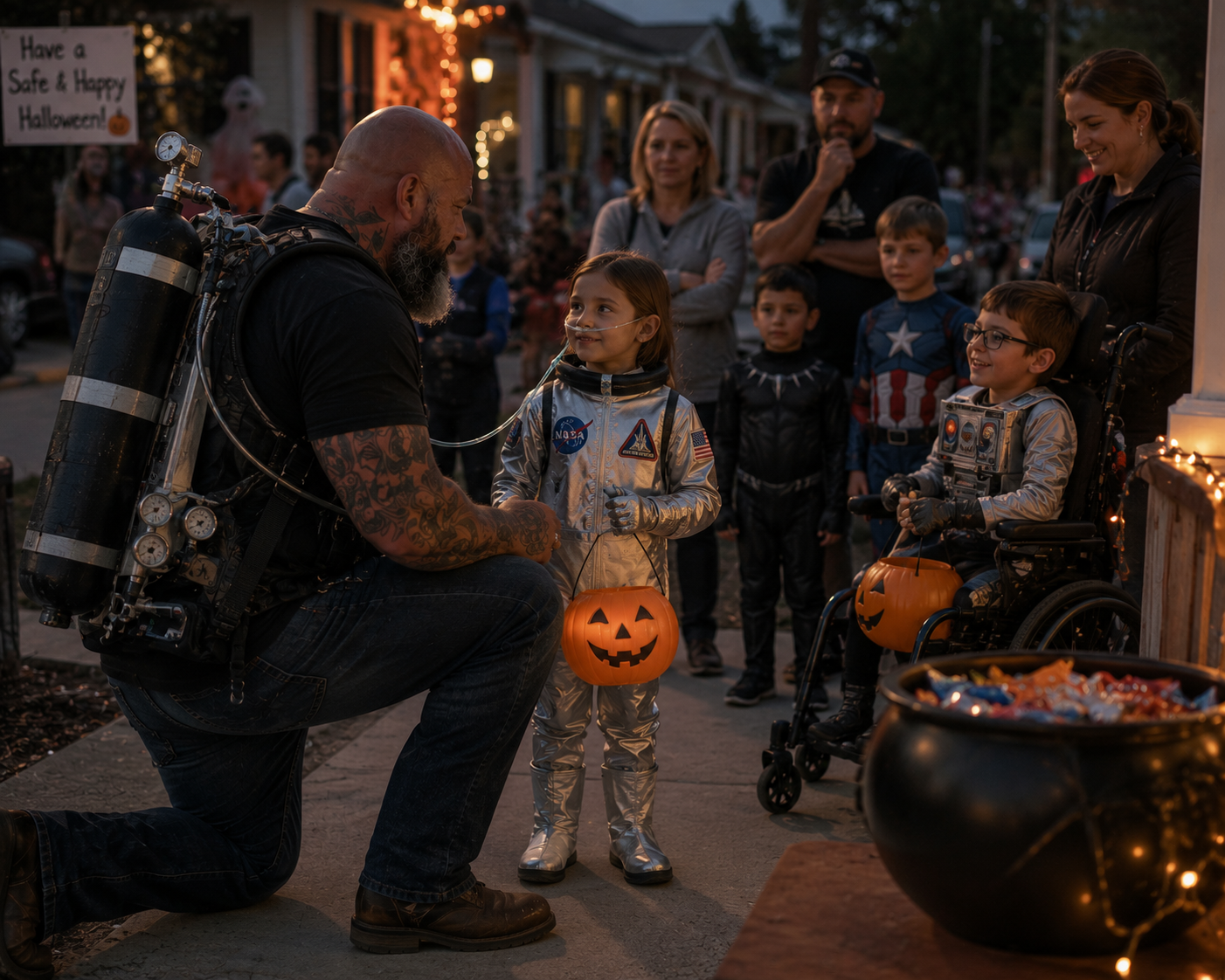
Grace sat beside Ethan in her astronaut suit, trading candy.
Laughing.
Breathing normally.
The backup oxygen system beside her worked perfectly.
Only then did Rook answer Valerie.
“What research center?”
“Blue Ridge Pediatric Respiratory Institute.”
His face changed.
That was where Grace’s equipment was serviced.
Where her specialist reviews happened.
Where Rook had taken her every three months for four years.
Valerie continued:
“The archive transfer was administrative. Old teaching materials, historical devices, retired case files.”
“And my sister’s regulator?”
“I didn’t know what it was.”
“You saw the serial number.”
“I saw thousands of inventory lines.”
Rook closed his eyes.
Fair.
Then:
“Who has access?”
“Clinical education. Biomedical engineering. Research compliance.”
“Call them.”
“I already am.”
Twenty-six minutes later, the institute’s compliance director called back.
The archive box existed.
It had not been opened since transfer.
Nobody had placed the old regulator into service.
Nobody had connected it to Grace’s equipment.
That was the first important fact.
Rook made Valerie repeat it.
“Grace has never used 061?”
“No.”
“Her current equipment?”
“Modern. Different manufacturer. Different design.”
He finally breathed.
Then asked:
“Where is the box?”
“Locked archive room.”
“Don’t touch it.”
Valerie almost laughed.
“I was going to say the same thing.”
Police were contacted because the device might be evidence in an old product-safety case.
The institute preserved access logs.
Security footage.
Transfer records.
No dramatic raid.
No alarms.
Just people finally treating twenty-three-year-old paperwork like it mattered.
Rook hated how ordinary accountability looked.
Apparently he expected truth to arrive with sirens.
Mostly it arrived in spreadsheets.
The regulator was recovered the next morning.
Serial:
B-417-061
Rebecca’s unit.
Original.
Still carrying the scratched initials Rook’s father had carved beneath the housing:
TM
Thomas Maddox.
Rook stared at the photograph investigators sent.
“My dad marked it.”
Harold nodded.
“That’s how he kept track.”
The device went to an independent forensic engineering laboratory.
Not Valerie’s institute.
Not anybody connected to Carter Respiratory Systems.
Not anyone who had worked with Martin Vale.
Two weeks later, the preliminary report arrived.
The internal spring had deformed.
Exactly as Harold described.
More importantly, the metal composition did not match the approved manufacturing specification.
Cheap substitute alloy.
The regulator could intermittently restrict oxygen flow under repeated pressure cycling.
Rook read the sentence three times.
“So Rebecca’s equipment failed.”
Valerie answered carefully.
“The engineering evidence supports that.”
“Not misuse.”
“No.”
“Not storage.”
“No.”
“Not my parents.”
“No.”
His face collapsed.
For twenty-three years, the Maddox family had carried a quiet accusation.
Maybe the tank had been left somewhere too cold.
Maybe Thomas failed to inspect it.
Maybe Rebecca’s mother missed warning signs.
Nobody said it openly anymore.
They did not have to.
Families can blame themselves without outside help.
Rook whispered:
“My father knew.”
Harold shook his head.
“He suspected.”
“He switched the unit because he knew.”
“He switched it because he didn’t trust them.”
That distinction mattered.
Thomas had not possessed proof.
He protected the physical evidence long enough for someone else to find it someday.
That someone turned out to be his son.
By accident.
On Halloween.
Martin Vale’s old locked box was opened next.
Inside were his handwritten notes.
The story became less clean than Rook wanted.
Vale had not started as part of a cover-up.
His own daughter, Valerie, experienced a frightening regulator failure years earlier.
He reported it informally to Carter engineers.
They convinced him the malfunction was isolated.
He accepted their explanation.
That was his first mistake.
Then Rebecca died.
Vale was hired as a consultant because he understood pediatric respiratory care and had prior experience with the equipment.
He should have disclosed Valerie’s earlier incident.
He did not.
That was his second mistake.
Then the company showed him engineering tests suggesting user maintenance could explain Rebecca’s failure.
Vale wrote a report leaning toward improper storage and ice formation.
Weeks later, he received eighty thousand dollars.
Valerie stared at that payment record.
“My father was paid.”
Harold said:
“Yes.”
She looked sick.
Rook asked:
“For what?”
That answer came from the contract itself.
Officially:
Extended consulting.
Training materials.
Expert review.
Not technically payment for a favorable conclusion.
But the timing was devastating.
Then another letter appeared.
Martin Vale to Carter’s legal department.
I remain concerned that the B-417 spring substitution has not been fully evaluated.
Dated two months after Rebecca died.
Rook stared.
“So he knew.”
Valerie read further.
Vale requested independent testing.
Carter refused.
Then he wrote:
If another pediatric event occurs, I will withdraw my report.
Harold looked at Rook.
“He wasn’t innocent.”
“No.”
“But he wasn’t what I thought either.”
“No.”
That was harder.
A pure villain is easy.
A respected doctor who made one compromised choice, realized too late what he had helped protect, and then spent years trying to correct it quietly?
Messier.
More human.
More dangerous.
Because systems fail through people like that all the time.
Not monsters.
People afraid to admit their first answer was wrong.
Why had Martin written:
THOMAS KEPT THE WRONG UNIT?
Investigators found the explanation in another note.
After Rebecca’s funeral, Martin believed Thomas had accidentally preserved a different regulator because Carter’s representative removed what everyone thought was the original.
Martin did not realize Thomas had intentionally swapped the units.
Years later, Carter sent Martin a sealed educational case device.
B-417-061.
The actual regulator.
Apparently someone inside the company discovered the swap during internal inventory reconciliation.
Instead of notifying the family, they transferred the unit into Vale’s possession under confidentiality.
Rook’s jaw tightened.
“They gave him the evidence.”
“Yes,” Valerie said.
“And he kept it.”
“Yes.”
“Why not call us?”
Valerie looked at the handwritten pages.
“I think he was ashamed.”
Rook laughed bitterly.
“That’s useful.”
“No.”
She did not defend him.
“It wasn’t.”
Martin eventually created a private archive.
The regulator.
Manufacturing memos.
His own correspondence.
The consulting payment record.
A draft letter addressed to Thomas Maddox.
Never sent.
Valerie read it aloud.
Mr. Maddox,
I believe I allowed certainty to replace investigation.
Rook looked away.
Your daughter’s equipment may have failed in a way I was professionally obligated to pursue more aggressively.
I accepted explanations from people whose financial interests I underestimated.
Then:
I cannot undo what my report did to your family.
Rook whispered:
“He knew.”
Valerie nodded.
The final sentence:
If I cannot correct this publicly before I die, the regulator and supporting records must remain together so someone else can.
He had kept the evidence.
But never found the courage to finish the correction himself.
The original case was formally reviewed.
Rebecca’s death certificate did not magically transform into a criminal case.
Too much time had passed.
Carter Respiratory Systems no longer existed.
Key executives were dead.
Records were incomplete.
No prosecutor promised Rook a dramatic trial.
What did happen mattered.
The medical examiner amended the contributing-cause language.
The old regulator malfunction was formally recognized as consistent with the circumstances of Rebecca’s death.
The manufacturer’s historical defect reporting was referred for federal review.
Archived device complaints from the same production batch were reevaluated.
Two surviving families were contacted.
Harold gave a sworn statement.
Valerie disclosed her father’s files voluntarily.
Then she did something harder.
She stood before the hospital system’s medical quality board and explained Martin Vale’s undisclosed conflict.
Her own childhood incident.
The consulting payment.
The report.
The unsent letter.
Rook attended.
He expected excuses.
She gave none.
“My father was a good doctor in many ways.”
Pause.
“And he made a decision that harmed another family.”
Rook looked at her.
“Both can be true.”
She nodded.
“Yes.”
He remembered hearing someone else say something like that once.
Maybe truth kept repeating itself until people finally listened.
Harold apologized too.
Not publicly.
On Rook’s porch.
“I should’ve found you fourteen years ago.”
“Yes.”
Harold nodded.
No argument.
“I told myself copies weren’t enough.”
“You were scared.”
“Yes.”
“You still should’ve called.”
“Yes.”
Rook studied him.
Then asked:
“Why did you keep the documents?”
Harold smiled sadly.
“Because being afraid and throwing them away felt like two different sins.”
Rook looked at the old machinist’s hands.
Then nodded.
Not forgiveness.
Not yet.
But understanding.
Sometimes that is the first usable thing.
Grace learned a smaller version.
Aunt Rebecca had needed oxygen too.
Part of her equipment had been defective.
Grandpa had saved evidence.
Dad found it by accident.
Adults were fixing the official record.
That was enough.
Grace asked one question.
“Did the bad machine make her die?”
Rook sat beside her.
“It probably helped cause what happened.”
“Was Grandpa’s fault?”
“No.”
“Was Rebecca’s?”
“No.”
“Was yours?”
He smiled sadly.
“I was thirty-one and thought I knew everything, so probably some things were my fault.”
Grace frowned.
“About the machine.”
“No.”
She nodded.
Then:
“Okay.”
Children sometimes release guilt faster than adults because nobody has taught them to worship it yet.
The brass regulator Rook bought from the salvage lot was removed from Grace’s Halloween rig permanently.
Not because it was proven defective.
Because it belonged to the same recalled series.
Her respiratory team replaced it with a modern certified component.
The homemade frame itself passed another safety inspection.
Valerie looked at the welds.
“You built this?”
“Yes.”
“You know medical equipment is not supposed to look like a lunar mining rig.”
Grace interrupted:
“That’s why it’s good.”
Valerie smiled.
“Fair.”
Then she looked at Rook.
“Twenty houses next year?”
Grace immediately answered:
“Thirty.”
Rook said:
“Fifteen.”
“Twenty-five.”
“Sixteen.”
“Dad.”
“Seventeen.”
Valerie laughed.
“Negotiations seem healthy.”
Ethan joined them the next Halloween.
His ramp was clear before sunset.
Not because neighbors remembered at the last minute.
Because Rook organized a sidewalk-accessibility walk with families two weeks earlier.
Nothing dramatic.
Branches trimmed.
Broken pavement reported.
Porch decorations moved away from ramps.
Several houses put candy tables at sidewalk level.
One family bought a portable ramp.
Another installed a permanent one.
People stopped calling it helping Grace.
They called it making the street usable.
That mattered.
Grace hated being somebody’s inspirational project.
She wanted candy.
Astronaut costume.
Normal arguments about how many houses counted as enough.
At house seventeen, she stopped.
Rook checked the monitor.
She rolled her eyes.
“I know.”
“What?”
“You’re going to ask numbers, breathing, legs, head.”
He smiled.
“Numbers?”
“Ninety-six.”
“Breathing?”
“Good.”
“Legs?”
“Tired.”
“Head?”
“Annoyed.”
“Excellent neurological function.”
She laughed.
Then pointed to his backpack.
The new oxygen frame had one small brass plate mounted on the back.
Not part of the regulator.
Just a memorial piece.
It read:
REBECCA MADDOX
SHE SHOULD HAVE BEEN BELIEVED
Grace had chosen the wording.
Rook originally wanted something longer.
She told him it sounded like a speech.
She was right.
Harold stood at his porch again that year.
Candy bowl ready.
When Grace reached him, he handed her one piece.
She stared.
“That’s it?”
“One per house.”
She narrowed her eyes.
“You remembered.”
“Rules are rules.”
Rook laughed.
Grace moved toward Ethan.
Then Harold stopped Rook.
“Caleb.”
He turned.
Harold nodded toward the oxygen frame.
“Your father would’ve liked that.”
Rook looked at the brass plate.
“You didn’t know him enough to say that.”
Harold considered.
“Fair.”
Then:
“But he spent twenty-three years being right without anybody officially saying so.”
Rook looked toward Grace.
“No.”
“What?”
“He spent the rest of his life being her dad.”
Harold went quiet.
Rook continued.
“The evidence was something he carried.”
He watched Grace negotiate candy trades with Ethan.
“It wasn’t the whole life.”
That was something Rook had only recently learned himself.
Rebecca was not the failed regulator.
Thomas was not the father who failed to prove a case.
Martin Vale was not only the report he got wrong.
Harold was not only the man who waited too long.
And Grace was definitely not the sick girl being dragged through Halloween.
She was an astronaut.
A difficult negotiator.
A child with strict candy ethics.
A girl who wanted to walk under her own power while her father carried the weight she could not.
That was the part strangers misunderstood the first night.
They thought Rook’s job was to protect Grace from effort.
It wasn’t.
His job was to make effort possible without pretending limits did not exist.
Carry the tank.
Watch the numbers.
Clear the path.
Know when to stop.
And when she said she could take one more step—
believe her enough to let her try.