
PART 2
Hound did not ask to see the photograph.
He asked one question.
“Where is Lily?”
The prosecutor answered immediately.
“With her mother and the victim advocate.”
“Safe?”
“Yes.”
“Police?”
“Already there.”
Only then did he ask:
“What was in the car?”
The prosecutor hesitated.
“A photograph of your daughter.”
Hound’s face emptied.
Not anger.
Not shock.
Something worse.
Recognition.
“What photograph?”
“She’s standing outside a gas station.”
His breathing changed.
I saw it.
A tiny shift in the chest.
A man who had spent years learning how not to react had just lost control of something internal.
“What gas station?”
The prosecutor told him.
Hound sat back down.
I knew the place.
Everybody in that part of Tennessee did.
An old Sunoco station near Highway 100.
Closed for years now.
Hound whispered:
“That’s where we found her backpack.”
Nobody spoke.
The prosecutor continued carefully.
“The photo appears old.”
“It is.”
“You’ve seen it?”
“No.”
He looked at me.
“But I know when it was taken.”
“How?”
Hound touched the folded note beneath his shirt.
“Because she called me from that station.”
My stomach tightened.
“Your daughter?”
He nodded.
“Her name was Kayla.”
This was the first time I had heard him say it.
Not “my daughter.”
Kayla.
The name seemed to hurt him.
The prosecutor sat opposite us.
“Hound, we need everything.”
He stared at the empty courtroom for a long moment.
Then he began.
Kayla Mercer was thirteen when she told her father that his younger brother, Travis, had been making her uncomfortable.
At first, she didn’t explain how.
Just that she didn’t want to be alone with him.
Hound—then still going by his real name, Harold Mercer—did what too many parents do when the truth threatens the architecture of a family.
He looked for a version that hurt less.
Travis was his brother.
Travis had helped raise Kayla after her mother left.
Travis coached softball.
Volunteered at church.
Fixed neighbors’ cars for free.
Nobody disliked him.
And Kayla had been struggling at school.
Arguing.
Sneaking out.
Pushing limits.
So when she said:
“I don’t want Uncle Travis picking me up anymore.”
Hound asked:
“What happened?”
She answered:
“Nothing.”
He treated that as proof.
“You told her she was overreacting?” I asked.
“Yes.”
His voice was flat.
“What happened next?”
“She tried again.”
A week later, Kayla asked if she could lock her bedroom door at night.
Hound refused.
House rule.
No locked doors.
Then she asked to stay with a friend for a month.
He said no.
Then she said:
“Dad, something is wrong.”
Hound asked for proof.
That word.
Proof.
The same word written in the note he carried.
Kayla got angry.
Hound got angrier.
He accused her of trying to destroy his relationship with his brother.
She told him he cared more about Travis than her.
He told her not to say things she couldn’t take back.
That night, she wrote the note.
Then she left.
Not far.
Just far enough.
The gas station.
She called him from a payphone.
“I almost went,” Hound said.
“Almost?”
“I was angry.”
He had already called Travis.
His brother denied everything.
Called Kayla dramatic.
Manipulative.
Said she was trying to avoid consequences for bad grades.
Hound believed him.
So when Kayla called from the gas station and said:
“Can you come get me?”
Hound asked whether she was ready to apologize.
I felt sick.
“What did she say?”
“Nothing.”
Then she hung up.
Hound waited nearly an hour before driving there.
Kayla was gone.
Her backpack remained beside the payphone.
Inside was the note.
And one purple hair tie.
Police searched.
Volunteers searched.
Hound searched every road, creek bed, parking lot, abandoned building, and field for three days.
Then they found her.
Alive.
That surprised me.
I had assumed the worst from the way he spoke earlier.
“She was alive?”
“Yes.”
“Where?”
“At a truck stop outside Dickson.”
A woman had recognized Kayla from the missing-person flyer.
Police brought her home.
She refused to speak to Hound.
Wouldn’t sleep in the house.
Wouldn’t be alone.
Eventually, during a forensic interview, she disclosed enough that Travis was investigated.
There was evidence.
Not perfect.
Enough.
Hound’s brother pleaded guilty to charges involving another child before Kayla’s case ever reached trial.
He went to prison.
Hound never saw him again.
“So Kayla survived,” I said.
“Yes.”
“Then why did you say ‘had’?”
Hound closed his eyes.
“Because she died six years later.”
I said nothing.
“Overdose.”
His voice almost disappeared.
“She got clean twice.”
Pause.
“Third time she didn’t.”
The note suddenly weighed more.
Hound had not lost Kayla on the night she ran away.
Not technically.
But he believed something in her had been lost there.
And he believed he had helped cause it by asking for proof before giving protection.
That was why he joined Safe Road Guardians.
Not redemption.
Not exactly.
A sentence.
A life built around obeying one child’s final instruction.
Believe her before you need proof.
The prosecutor asked:
“Who could have that photograph?”
Hound answered immediately.
“Travis.”
“But he’s in prison.”
“Was.”
That changed the room.
“When was he released?”
“Seven months ago.”
The prosecutor stood.
“You knew?”
“Yes.”
“You didn’t tell us?”
“It had nothing to do with Lily.”
“Apparently it does now.”
Hound’s jaw tightened.
“You think Travis is connected to Voss?”
“I think somebody placed your daughter’s photograph in Lily’s mother’s car after she testified against a man accused of abusing children.”
She didn’t soften it.
“That makes it relevant.”
Hound accepted the criticism.
“When did you last speak to your brother?” I asked.
“Nineteen years ago.”
“Does he know about the organization?”
“Everyone does.”
“Does he know Lily?”
Hound’s face hardened.
“He better not.”
Police found something else in the envelope.
A strip of notebook paper.
One sentence printed in block letters:
YOU COULDN’T SAVE KAYLA EITHER.
That did what the photograph alone had not.
It connected the message directly to Hound.
Lily had seen it.
That was why she refused to return.
Not because she understood Kayla’s story.
Because she understood one thing perfectly.
Someone had reached her mother’s car.
Someone knew who protected her.
Someone wanted her afraid.
By 6:00 p.m., the courthouse plan for the next day was changing.
Additional deputies.
Separate parking.
Restricted hallway access.
A sweep of the courtroom before Lily entered.
The judge approved remote testimony as a backup if Lily could not return physically.
The defense objected.
The prosecutor ignored the outrage.
Lily’s safety mattered more than courtroom aesthetics.
The bikers were told not to escort her from home.
That surprised them.
Hound agreed immediately.
“No convoy.”
Red frowned.
“You sure?”
“Too visible.”
Moose crossed his arms.
“We’re kind of visible people.”
“Exactly.”
They stayed away.
That decision mattered.
Because at 7:14 that evening, Lily called Hound herself.
He put the phone on speaker only after she agreed.
Her voice was tiny.
“Mountain?”
Hound looked at all of us.
“I’m here.”
“Was that your daughter?”
“Yes.”
“Did she die because you didn’t believe her?”
Nobody moved.
Hound could have softened it.
He didn’t.
“No.”
Pause.
“But I hurt her when I didn’t believe her.”
Lily was quiet.
Then:
“Did she forgive you?”
Hound’s eyes closed.
“Sometimes.”
“What does that mean?”
“It means people can love you and still be hurt by what you did.”
Another pause.
Then Lily asked:
“Are you scared tomorrow?”
Hound looked toward the courtroom doors.
“Yes.”
“Of Daniel?”
“No.”
“Of what?”
He stared at his own hands.
“Of making this about my fear instead of yours.”
Lily breathed into the phone.
Then said:
“I want all forty back.”
Hound opened his eyes.
“Okay.”
“And no angry faces.”
Behind him, Moose whispered:
“Damn it.”
Lily heard.
For the first time that day, she laughed.
Tiny.
But real.
Hound smiled.
“We’ll work on Moose.”
Then Lily said something unexpected.
“Can you bring Kayla’s note?”
He stopped.
“Why?”
“I want to see it.”
Hound looked at me.
I nodded.
“If your mom and the advocate agree.”
“They will.”
“Then yes.”
Lily whispered:
“Okay.”
Then she hung up.
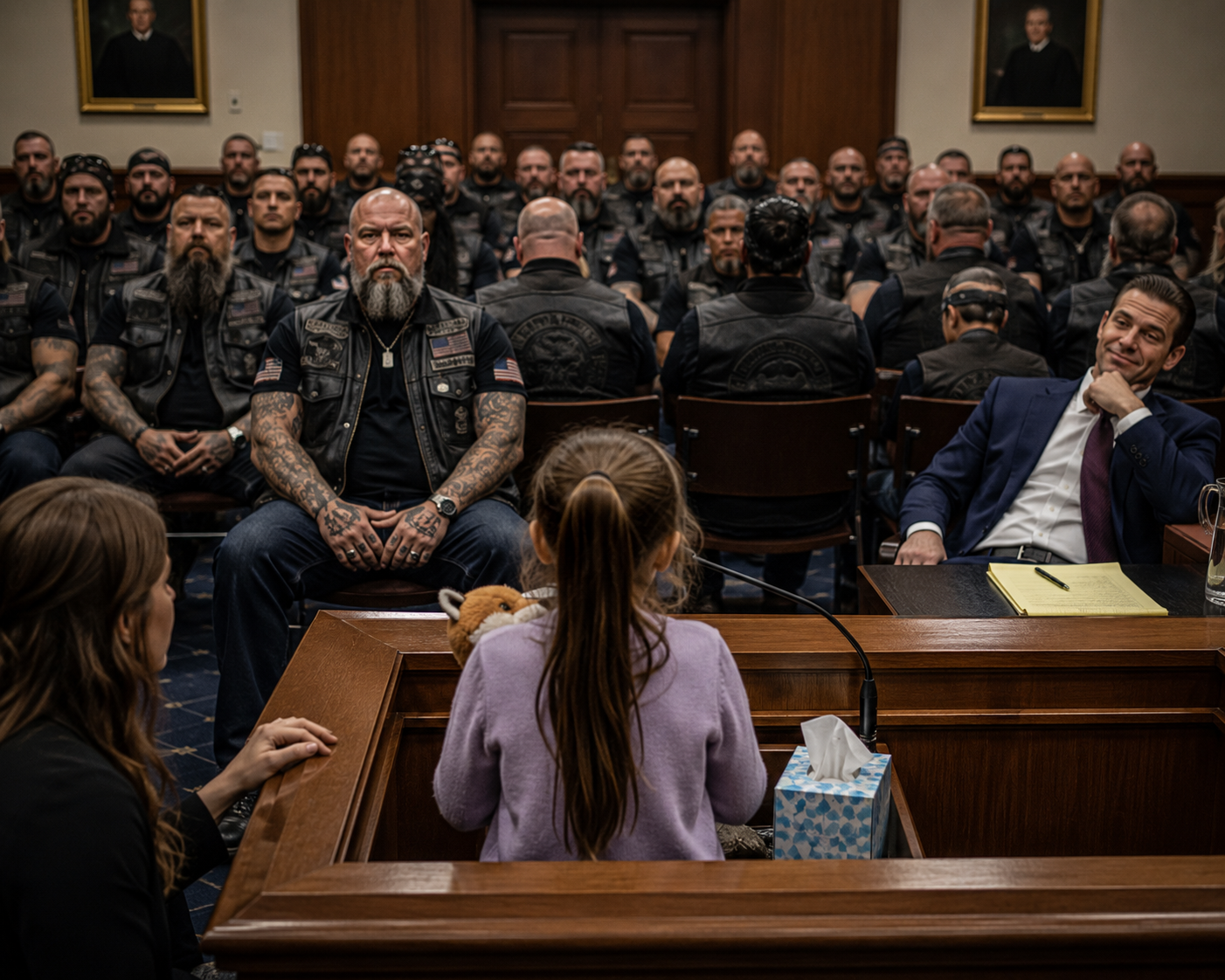
The next morning, forty bikers arrived without motorcycles.
That was Lily’s request.
No engines.
No spectacle.
They came in cars.
Some in button-down shirts.
Some in plain black T-shirts.
All without visible patches.
At 8:20, Hound sat on the courthouse steps holding Kayla’s note inside a clear protective sleeve.
I sat beside him.
“Ready?”
“No.”
“Good answer.”
He looked at me.
“You stealing my lines?”
“Maybe.”
At 9:03, Lily arrived through a secure entrance.
When she saw Hound, she didn’t hug him.
She walked straight to the note.
“Can I read it?”
He handed it to her.
Lily read the sentence.
Once.
Then again.
DAD, IF ANOTHER GIRL EVER GETS SCARED, PLEASE BELIEVE HER BEFORE YOU NEED PROOF.
She looked up.
“Did you?”
“Did I what?”
“Believe me before proof?”
Hound’s voice cracked.
“Yes.”
“Why?”
“Because Kayla taught me too late.”
Lily thought about that.
Then she gave the note back.
“Then she helped me.”
Hound turned away.
I pretended not to see him wipe his face.
Lily testified that day.
All of it.
Not perfectly.
Not dramatically.
But clearly enough.
The defense tried to suggest she had been coached by the biker group.
Lily corrected him.
“They never asked me what happened.”
“Not once?”
“No.”
“What did they ask?”
“If I wanted pizza.”
A few jurors smiled.
The attorney pressed.
“Did Mr. Mercer tell you he believed you?”
“Yes.”
“Before he knew whether your story was true?”
Lily looked toward Hound.
Then back at the attorney.
“He said scared kids get help first.”
The attorney paused.
“And questions later?”
“No.”
Lily frowned.
“He said questions still matter.”
That answer changed the prosecutor’s expression.
Because it was exactly the distinction the defense had hoped to erase.
Support was not the same as replacing evidence.
Believing a child enough to protect them was not the same as deciding a verdict before trial.
The bikers had never told Lily Daniel was guilty.
They told her she deserved to be safe while adults figured out the truth.
That afternoon, the prosecution rested.
The defense began the next morning.
Daniel Voss testified.
That surprised everyone.
He denied everything.
Calmly.
He said Lily misinterpreted ordinary contact.
He said her mother disliked him.
He said investigators had pressured her.
He said the biker group had “created a mythology of victimhood.”
Then his lawyer asked whether he had ever contacted Lily after the investigation began.
“No.”
“Her family?”
“No.”
“Mr. Mercer?”
Daniel looked at Hound for the first time.
“No.”
Hound did not look back.
Then the prosecutor began cross-examination.
She asked Daniel about the photograph.
His attorney objected.
The judge overruled after a bench conference.
Daniel said he had never seen it.
Then she placed a copy on the screen.
Kayla at the gas station.
Daniel’s face changed.
Tiny.
Almost nothing.
But I saw it.
So did Hound.
The prosecutor asked:
“Still never seen this photograph?”
“No.”
“Are you sure?”
“Yes.”
She approached the evidence table.
“Interesting.”
She picked up another document.
“Because investigators recovered a digital copy last night.”
Daniel’s lawyer stood.
“Your Honor—”
The prosecutor continued.
“From an email account registered to the defendant.”
The courtroom exploded into motion.
Objection.
Sidebar.
Jury removed.
Daniel whispering furiously to counsel.
Hound remained completely still.
I leaned toward the prosecutor.
“What happened?”
She whispered:
“The photo was emailed to Voss three months ago.”
“By who?”
She looked at Hound.
Then at the hallway.
“Travis Mercer.”
Hound heard the name.
Everything drained from his face.
The prosecutor continued:
“There were seventeen emails.”
“What did they say?”
She swallowed.
“Mostly about Lily.”
Hound stood.
The bailiff moved instantly.
“Sit down.”
Hound obeyed.
Barely.
I asked:
“Why would Travis contact Voss?”
The prosecutor looked sick.
“We don’t know yet.”
Then her phone vibrated.
She read the message.
Her eyes widened.
“What?”
She looked directly at Hound.
“Police went to Travis’s apartment.”
“And?”
“He’s gone.”
Hound’s hands closed around Kayla’s note.
The prosecutor continued.
“But they found photographs.”
“Of what?”
Her answer came slowly.
“Lily’s school.”
The room went silent.
“Her house.”
Hound stopped breathing.
“And this courthouse.”
Then she added the part that changed the case completely.
“One of the photos was taken yesterday.”
I stared at her.
“Yesterday?”
She nodded.
“Inside this building.”
Hound looked toward the courtroom door.
And for the first time since the trial began, he stopped watching Lily’s chair.
Because someone connected to his past had been close enough to photograph her from inside the courthouse.