
THE WORDS ON HIS ARM
Part Two
Rook did not ask to see the photograph again.
He stared at the sleeping baby in his arms and said only one word.
“Anna.”
Denise Hall, the hospital social worker, lowered the envelope.
“Is that the woman in the picture?”
“My daughter.”
His voice was so quiet I almost missed it.
I looked at the photograph again.
Rook was younger in it, but unmistakable.
More hair.
Shorter beard.
Fewer tattoos.
The girl beside him appeared to be about sixteen. Thin, dark-haired and unsmiling, with one hand tucked into the pocket of a denim jacket.
She had Rook’s eyes.
She also had Noah’s.
Or Eli’s.
I looked at the newborn against his chest.
“Is she his mother?”
Rook swallowed.
“If she wrote that, yes.”
Denise unfolded the letter from the envelope.
“There is more.”
Rook’s arms tightened slightly around the blanket.
“Read it.”
Denise hesitated.
“Would you rather do that privately?”
“No.”
“Silas—”
“He’s staying where he is.”
She sat beside him.
The letter was three pages long.
The handwriting changed as it continued. Neat at first. Then hurried. Some lines pressed so hard the pen had nearly torn through the paper.
Denise began.
Dad,
I don’t know whether you still volunteer at St. Catherine’s on Thursdays. I saw your picture on the hospital website last year. You were holding a baby and pretending not to smile. I saved it even though I told myself I wouldn’t.
Rook closed his eyes.
The hospital had published a small volunteer article months earlier.
There had been no surname beneath his photograph.
Only:
Rook, neonatal comfort volunteer.
Anna had recognized him anyway.
Denise continued.
I know what I said the last time we spoke. I know I told you I never wanted you near my life again. At the time, I meant it.
But I also know you listened. You stayed away. You did not follow me, call my job or send people from the club to ask questions. You respected the one boundary I gave you, even though respecting it cost you everything.
Rook’s beard trembled.
He stared down at Eli.
The baby slept through all of it.
Denise turned the page.
His name is Elijah James Mercer. I called him Eli.
His father cannot know where he is. His father’s family cannot know either.
I am not leaving Eli because I do not love him. I am leaving him because I waited too long to admit that love was not enough to keep him safe with me.
Rook looked up.
“What father?”
Denise kept reading.
His name is Caleb Voss. Do not contact him. Do not let anybody from the Steel Covenant near Eli.
I thought Caleb was different from the men you warned me about. That is probably the part you will understand best.
At the name of the motorcycle club, Rook’s entire posture changed.
The Steel Covenant was not his club.
I knew nothing about it, but Denise clearly did.
Her eyes moved toward the security doors.
Rook noticed.
“What?”
She answered carefully.
“The hospital has had issues with visitors connected to that group.”
“What issues?”
“Threats during an emergency-room admission last year.”
Rook looked toward me.
“Call security.”
Denise said:
“We do not know that anyone is coming.”
“Call them anyway.”
I picked up the unit phone.
Rook’s voice remained controlled.
“No uniforms standing over the baby. Quiet presence. Doors checked. Nobody gets access because they claim family.”
I relayed the request.
Then Denise resumed reading.
Caleb said he would change after the first time.
Then after the second.
Eventually every apology became another way of reminding me that I had stayed.
When I became pregnant, he said Eli would belong to the Covenant before he belonged to me. He has already chosen the child’s road name. He has already promised him to people I do not trust.
Rook’s jaw hardened.
I tried to leave three weeks ago. Caleb found me before I reached Indiana.
I cannot explain everything in this letter because I do not know who will read it. But I have copied evidence and given it to someone outside Dayton. If I can reach that person, Caleb may finally be stopped.
If I cannot, Eli must disappear from my life before Caleb uses him to bring me back.
Denise stopped.
Rook asked:
“Where is Anna now?”
“We don’t know.”
“You have cameras.”
“The mother entered through the emergency department wearing a hooded coat. She declined identification under the safe-haven process.”
“You know it was her now.”
“Yes.”
“What time?”
“Two sixteen yesterday morning.”
“And when did she leave?”
“Approximately eight minutes later.”
“Alone?”
Denise looked at the letter.
“We are reviewing the footage.”
“Review it faster.”
There was no threat in the sentence.
Only terror held tightly enough to resemble anger.
Denise read the final section.
I am not asking you to forgive me.
I am not even asking you to forgive yourself.
I am asking you to do one thing you were always good at before everything went wrong.
Stay.
You once told me people do not deserve second chances just because they are sorry. You said they earn them by doing the next right thing, then the next one, for as long as it takes.
You probably forgot saying that. I didn’t.
Please make sure Eli learns the difference between being abandoned and being protected.
Anna.
Nobody spoke for several seconds.
Then Rook said:
“She got the quote wrong.”
Denise looked confused.
“What?”
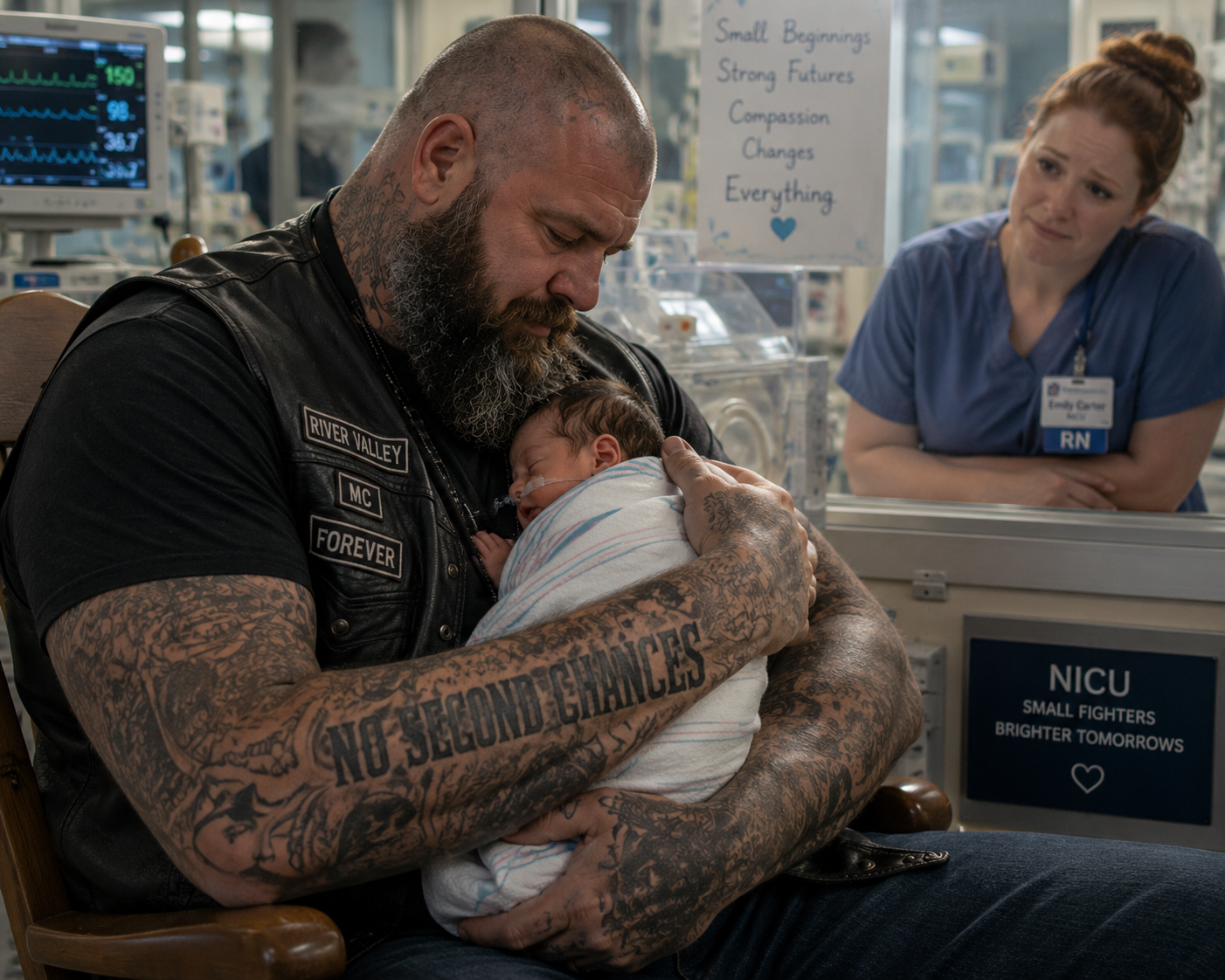
His eyes moved toward the tattoo across his forearm.
“I didn’t tell her people earn second chances.”
He looked at the black letters.
“I told her there aren’t any.”
The words suddenly looked less like a threat.
More like a sentence he had passed on himself.
I asked:
“What happened between you?”
Rook continued rocking Eli.
At first, I thought he would refuse.
Then he began.
“Anna was born April sixteenth, 1998.”
The first date on his arm.
“Her mother, Rebecca, died three years later.”
October third, 2001.
The second date.
“Car accident?”
“Drunk driver.”
He looked at me.
“Me.”
The NICU seemed to become quieter.
“You were driving?”
“Yes.”
Rook did not soften it.
Did not say he had only been slightly over the limit.
Did not blame the wet road.
“I walked away. Rebecca didn’t.”
“And Anna?”
“At her grandmother’s.”
His hand remained steady on Eli’s back.
“I got eighteen months.”
Denise asked:
“For vehicular manslaughter?”
“Yes.”
“When you were released, did Anna return to you?”
“My mother raised her while I was inside. I took over again afterward.”
He laughed bitterly.
“Or tried.”
“What does that mean?” I asked.
“I stopped drinking.”
“That matters.”
“Wasn’t enough.”
He glanced at the tattoo.
“I thought sobriety made me safe. It only made me sober.”
He still had a temper.
Still disappeared for nights with the motorcycle club.
Still treated silence as parenting because he did not know how to discuss grief with a child who looked like the woman he had killed.
“When Anna was fourteen,” he said, “I found her in a car with a nineteen-year-old man.”
His face hardened at the memory.
“I pulled him out.”
“Did you hurt him?”
“Yes.”
“How badly?”
“Hospital.”
Another arrest followed.
Probation.
Anger-management classes.
Child services placed Anna with Rook’s sister during the case.
Anna refused to return.
“She said every time I claimed I was protecting her, somebody ended up bleeding.”
His gaze settled on Eli.
“She wasn’t wrong.”
“When did she cut contact?” Denise asked.
“At eighteen.”
“What did you do?”
“First year? Everything wrong.”
Letters.
Calls.
Showing up outside her community college.
Asking friends to tell her he had changed.
“She filed for a protection order.”
He spoke the words plainly.
“I deserved it.”
Then one of the hospital chaplains helped him understand that remorse did not entitle him to access.
He stopped contacting Anna.
Sold the house where Rebecca had died.
Left his old motorcycle club.
Joined a veterans’ charity ride group with strict conduct rules.
Completed more counseling.
Began towing at night.
And eventually started volunteering.
“Why babies?” I asked.
He looked uncomfortable.
“Counselor suggested service.”
“There are many kinds of service.”
“Babies don’t need explanations.”
That was the first answer.
Then came the real one.
“And you have to be gentle before they believe you.”
Denise folded the letter.
“Silas, the note does not automatically give you custody.”
“I know.”
“Safe surrender begins a legal process. If you are the maternal grandfather, you may request kinship placement, but you will undergo evaluation.”
“Do it.”
“There will be questions about your convictions.”
“Answer them.”
“Your relationship with Anna.”
“Tell them.”
“Your home, finances, support system and ability to care for an infant.”
“Check everything.”
Denise watched him.
“What happens if Anna returns and wants her child back?”
Rook looked down at Eli.
“Then we make sure she’s safe enough to ask.”
Not give him back immediately.
Not take him away forever.
Make sure she was safe.
The answer seemed to satisfy Denise.
It did not solve anything.
Security quietly locked down the volunteer entrance.
Hospital administration contacted law enforcement.
The safe-haven case was flagged for potential domestic-violence risk.
A detective arrived within the hour.
Rook repeated the story.
Every conviction.
Every order.
Every mistake.
He gave them Anna’s old phone numbers, her last known employer and the address she had used three years earlier.
Then the security supervisor entered.
“We found the mother on video.”
Rook stood halfway before remembering Eli.
He sat again.
“Show me.”
The supervisor placed a tablet on the rolling table.
The footage showed a woman entering the emergency vestibule at 2:16 a.m.
Hood raised.
Face partially hidden.
She carried Eli in a gray infant seat.
Even with the poor image, Rook recognized her.
“Anna.”
She spoke to a triage nurse.
Signed nothing.
Left the seat.
Pressed her lips to the baby’s forehead.
Then walked toward the exit.
Rook leaned closer.
“Stop.”
The supervisor paused.
“What?”
Rook pointed toward the glass doors.
Outside, beneath the emergency canopy, stood a man in a dark motorcycle jacket.
He appeared to be looking at his phone.
But his body faced the entrance.
“Zoom.”
The image blurred.
A large patch filled the back of his jacket.
A steel-colored cross surrounded by chain links.
Rook whispered:
“Covenant.”
The video resumed.
Anna saw the man.
Her body jerked.
She turned away from the main exit and disappeared down an interior corridor.
The man entered thirty seconds later.
He walked directly to the triage desk.
Asked a question.
The nurse pointed toward the corridor.
Rook’s face went cold.
“What did he ask?”
The supervisor looked at his notes.
“He said his wife was experiencing postpartum confusion and had taken their baby.”
“Name?”
“He identified himself as Caleb Voss.”
The footage switched to another camera.
Anna moved quickly through the hospital’s ground floor.
Past radiology.
Past the cafeteria entrance.
Into a stairwell.
Caleb followed less than a minute later.
There was no camera inside.
The next image came from the parking garage.
Caleb emerged alone at 2:34 a.m.
Anna never appeared again.
Rook stopped rocking.
Eli stirred.
I put one hand on the blanket.
“Keep moving.”
Rook resumed.
The detective spoke into his radio.
Then turned to us.
“We need the stairwell searched.”
The supervisor shook his head.
“It has been used all day.”
“Search it anyway.”
Twenty minutes later, hospital security found blood beneath the lowest flight of stairs.
Not much.
A few dark drops near the wall.
Beside them lay one silver earring.
Rook identified it from the old photograph.
Anna had been wearing the pair beside him.
The detective asked:
“Would she still own earrings from twenty years ago?”
Rook stared at the small piece of silver inside the evidence bag.
“They were her mother’s.”
His phone rang.
Unknown number.
The detective told him to answer on speaker.
Rook accepted the call.
At first, there was only breathing.
Then a man spoke.
“Silas Mercer.”
Rook’s expression did not change.
“Caleb.”
“You’re holding something that belongs to me.”
Eli shifted against Rook’s chest.
His tiny mouth opened, but he did not cry.
Rook looked down at him.
“No.”
Caleb laughed.
“You haven’t changed.”
“I have.”
“Still taking other people’s family because you couldn’t keep your own.”
Rook’s jaw tightened.
The detective silently activated a recording device.
“Where’s Anna?”
Caleb ignored the question.
“You hand over my son, she comes home.”
Rook stopped breathing.
Then asked:
“Is she alive?”
A pause.
In the background, we heard a woman make a muffled sound.
Rook’s eyes closed.
Anna.
Caleb returned to the phone.
“Midnight. Come alone.”
“Where?”
“The place you got those words.”
Rook looked at the tattoo on his forearm.
NO SECOND CHANCES.
For the first time, fear entered his face.
The detective whispered:
“What place?”
Rook did not answer him.
Caleb did.
“The old Covenant clubhouse on River Road.”
Then the line went dead.
The detective immediately began issuing orders.
Rook remained in the rocking chair.
Eli’s fingers had closed around the edge of his tattooed forearm.
I asked:
“What happened at that clubhouse?”
Rook stared at the words beneath the baby’s hand.
“That’s where I got the tattoo.”
“That isn’t what I asked.”
He looked toward the police.
Then toward the newborn his daughter had entrusted to him.
“The night they gave me these words,” he said, “Caleb’s father made me choose between the club and Anna.”
Denise went still.
“What did you choose?”
Rook’s voice cracked.
“The club.”
He looked down at Eli.
“And now his son thinks I’ll make the same choice twice.”