
PART 3
Patch stared at the toxicology report.
“Because I think he gave her the pills.”
Daniel said nothing.
Neither did I.
The room had gone completely still.
Only the laptop fan moved air.
Patch read the amended report again.
Then once more.
His finger stopped beside one line.
“Collection time.”
Daniel leaned closer.
“What?”
“This sample was drawn at 9:07.”
“Okay.”
Patch shook his head.
“The final hospital record says the sedative result came from a later contaminated sample.”
“Was it?”
“No.”
“How do you know?”
“Because I was there when they drew it.”
He looked at me.
“I watched the tube leave the room.”
That mattered.
Not because Patch’s memory was automatically proof.
But because it meant there was something concrete investigators could compare.
Daniel asked:
“What kind of sedative?”
Patch named it.
A medication sometimes used for anxiety and certain neurologic conditions, but not prescribed to Maggie.
Not something he remembered seeing in her apartment.
Not something documented in her pharmacy history.
I asked:
“Could she have gotten it from someone else?”
“Yes.”
“Could she have taken it intentionally?”
“Yes.”
Patch paused.
“But the recording says somebody left a bottle.”
Daniel looked toward the laptop.
“And Kevin admits leaving it.”
“He admits something.”
That distinction mattered.
Patch hated it.
But nodded.
Daniel wanted to call police immediately.
Patch stopped him.
“Not local.”
Daniel frowned.
“Why?”
“Because the original file passed through local EMS administration.”
“You think they covered it up?”
“I think I don’t know.”
Then Patch looked at me.
“And I’m done pretending what I think is the same as what I can prove.”
That was the first real change I saw in him.
Old Patch, according to everyone who knew him, had been a man who solved emergencies by moving faster than uncertainty.
Now he sat in a kitchen with the biggest revelation of his life in front of him and refused to invent the missing pieces.
We contacted state investigators.
Then the medical examiner’s office.
Then an attorney Daniel knew through an epilepsy nonprofit.
The flash drive was copied.
The original was sealed.
The bracelet photographed.
The note preserved.
Nobody deleted anything.
Nobody called Kevin.
Patch wanted to.
You could see it in his face.
Daniel said:
“Don’t.”
Patch looked at him.
“You don’t know what I’m thinking.”
“Yes, I do.”
Patch almost smiled.
Then didn’t.
“Probably.”
The first breakthrough came from the woman on the recording.
Her voice was identified as Nurse Elena Vargas.
She had been working Maggie’s unit that night.
Retired now.
Living in Tucson.
Investigators interviewed her.
She remembered Maggie.
More importantly, she remembered the recording.
Maggie had asked Elena to use her phone because she believed Patch would blame himself if she died.
Elena recorded twenty-three minutes.
Not one.
The flash drive contained only part of it.
“What happened to the rest?” Patch asked.
Elena said Kevin Marsh took her phone after Maggie deteriorated.
He told her hospital administration needed the recording because it involved a patient safety issue.
He returned the phone later.
The audio was gone.
Elena assumed the hospital had preserved it.
They had not.
At least, not officially.
Then she said something else.
“Maggie asked me not to let Kevin near her medication.”
Patch went silent.
“Why?”
“She said he scared her.”
“How?”
“She wouldn’t say.”
“Did you report it?”
“Yes.”
“To who?”
“Charge nurse.”
“Then?”
Elena looked ashamed.
“We were told Kevin had been assisting because he knew the family.”
Patch rubbed both hands over his face.
“Of course.”
The curse of familiarity.
People stop asking why someone is present when they have seen him there before.
Kevin Marsh had been Patch’s EMS partner for eleven years.
They had worked hundreds of calls together.
Car wrecks.
House fires.
Cardiac arrests.
Children not breathing.
They trusted each other with lives.
Kevin had also been close to Maggie.
Too close, Patch now realized.
He brought groceries after seizures.
Fixed a broken porch light.
Drove her home after appointments.
Patch considered him family.
Maggie apparently did not.
Investigators found old texts recovered from a cloud backup.
Most harmless.
Then increasingly controlling.
Did you take your meds?
Your dad says you shouldn’t be alone tonight.
I can come over.
Don’t ignore me when I’m trying to help.
Maggie replied:
Stop checking on me.
Then:
You are not Dad.
Then three days before her death:
Do not come into my apartment again without asking.
Kevin answered:
You’ll thank me when something happens and I’m there.
Patch stared at that message for a long time.
Daniel asked:
“You okay?”
“No.”
Good answer.
Honest.
The apartment access record became crucial.
Maggie’s building used electronic key fobs for maintenance and staff entry.
Residents used regular keys.
Kevin had no authorized fob.
But the property manager found old records showing a master key had been checked out by a maintenance employee the afternoon before Maggie’s death.
That employee was Kevin’s cousin.
Interviewed separately, he admitted loaning Kevin the key “for an emergency.”
“What emergency?” investigators asked.
“He said Maggie’s dad wanted him checking on her.”
Patch slammed his hand onto the interview transcript.
“I never asked that.”
No one disputed him.
Then the cousin said Kevin returned the key the next morning.
After Maggie died.
The toxicology evidence took longer.
The original specimen had been stored only for a limited period.
Gone now.
But chain-of-custody logs remained.
The preliminary lab result showed the sedative.
The final report did not.
Why?
A correction request.
The request came from an administrative account used by the regional EMS medical liaison office.
Kevin did not work there.
But his brother-in-law did.
Investigators interviewed him.
He denied knowingly altering anything.
Then email archives showed Kevin contacting him the morning after Maggie’s death.
Subject:
Grady tox issue
Message:
Lab flagged an old medication that family says she no longer uses. Can you make sure it doesn’t confuse the seizure cause? Malcolm is falling apart.
The brother-in-law forwarded it to a medical administrator.
The sedative result was reclassified as potentially noncontributory and omitted from the summary narrative.
Not erased from the raw lab system.
But buried.
Patch read the email.
“He used me.”
Daniel frowned.
“How?”
“He made it look like he was protecting me.”
That was the pattern.
Kevin’s defense had been care.
Always care.
Checking on Maggie.
Entering her apartment.
Leaving medication.
Changing records.
All framed as helping.
The question remained:
What exactly had Kevin left in Maggie’s apartment?
The answer came from a storage unit.
Not dramatic.
No secret wall.
No buried body.
Just boxes.
Kevin had moved to Nevada four years earlier.
A court-authorized search of stored belongings found old EMS notebooks, photographs, and personal items.
Inside one plastic bin:
Prescription bottles.
Some empty.
Some expired.
Several belonging to patients or relatives.
One bore Maggie’s name.
Patch stared at the photograph investigators sent him.
“That’s not her pharmacy label.”
It looked close.
But not right.
The prescription number format was wrong.
The bottle listed her anti-seizure medication.
Inside investigators found residue consistent with the sedative detected in the preliminary toxicology report.
Daniel whispered:
“He switched the pills.”
Patch did not answer.
Because investigators had not yet proven when the bottle was placed there.
Then they found Kevin’s notebook.
One entry dated the day before Maggie died:
M—still refusing help. If she sleeps, maybe she stops fighting everyone.
Patch closed his eyes.
Another:
Need her calm enough to talk.
Then:
M dose low already. Bad timing.
Investigators believed Kevin knew Maggie had been missing doses.
He knew she was medically vulnerable.
He wanted to sedate her.
Why?
That part came from Elena’s missing audio.
Or rather, a copy of it.
Elena had backed up her phone automatically.
She never realized the recording still existed in an old cloud account.
Investigators recovered nineteen additional minutes.
Patch listened only after Daniel insisted he not do it alone.
Maggie’s voice was weak.
But clear.
Elena asked:
“Why don’t you want Kevin here?”
Maggie answered:
“Because he keeps telling Dad I’m worse than I am.”
Patch looked up.
Daniel said nothing.
Maggie continued:
“He wants Dad to think I need somebody checking on me all the time.”
Elena asked:
“Why?”
Maggie said:
“I think he likes being needed.”
Pause.
“He gets angry when I don’t need him.”
Patch’s hands trembled.
Then:
“He came over yesterday.”
“Did you let him in?”
“No.”
“How did he enter?”
“I don’t know.”
Then the part that made the room go cold.
“He put my pills into a different bottle.”
Elena asked:
“How do you know?”
“They looked wrong.”
“Did you take them?”
“One.”
“Today?”
“Yes.”
“Why?”
“I thought maybe the manufacturer changed.”
Then:
“After that I got sleepy.”
Patch covered his face.
Maggie continued:
“I skipped my seizure medicine because I wanted to go out with friends.”
Her voice cracked.
“That part is on me.”
Then:
“But the other pill wasn’t.”
Silence.
Elena asked:
“Do you think Kevin changed it?”
“Yes.”
“Why?”
Maggie whispered:
“Because he told me if I kept refusing help, he’d make sure Dad understood I couldn’t live alone.”
Patch stopped the recording.
“No.”
Daniel reached over.
Not touching him.
Just close.
Patch breathed.
Then pressed play again.
Maggie said:
“Dad will blame himself.”
Elena asked:
“For what?”
“For not coming sooner.”
Then Maggie laughed weakly.
“He always thinks five minutes is a moral failure.”
Patch started crying.
Not quietly.
For the first time since I met him, he stopped trying to control how grief looked.
On the recording, Maggie continued:
“If I don’t make it, tell him I was stubborn.”
Pause.
“Tell him he was annoying.”
Another pause.
“And tell him he loved me too hard sometimes.”
Patch laughed through tears.
Then Maggie said:
“But loved is still the word.”
That destroyed him.
Kevin was arrested three weeks later.
The charges were based on evidence prosecutors believed they could prove:
Tampering with medication.
Unlawful entry.
Evidence manipulation.
Obstruction.
And offenses connected to conduct that contributed to Maggie’s death.
The exact homicide classification became a legal argument.
Patch hated that ambiguity.
Then learned to live with it.
Kevin never confessed.
He insisted he only wanted Maggie to sleep.
Said he believed the substituted medication would calm her.
Said he planned to persuade her to move back in with Patch.
Said he thought he was preventing a worse seizure.
The prosecution’s answer was simple:
You do not secretly alter someone’s medication because you believe you know better.
Care does not erase consent.
Help does not become harmless because the person offering it feels righteous.
Patch attended every hearing.
No club vest.
No threats.
No dramatic confrontation.
When Kevin looked at him once in the hallway and said:
“I was trying to protect her.”
Patch stopped.
For a moment, I thought thirteen years of discipline might vanish.
Instead he answered:
“She told you no.”
Kevin stared at him.
Patch continued:
“That should’ve been enough.”
Then walked away.
Daniel later said:
“Maggie would’ve liked that.”
Patch replied:
“She would’ve told me I should’ve said less.”
Probably true.
The state medical board and EMS agencies reopened several administrative failures.
Not because every person involved was corrupt.
Most were not.
But too many people trusted informal professional relationships.
Too many corrections passed without independent review.
Too many people assumed Kevin’s familiarity with Patch and Maggie gave him legitimacy.
Policies changed.
Family acquaintances could no longer insert themselves into a patient’s medication or documentation chain without clear authority.
Toxicology amendments required stronger audit trails.
None of that brought Maggie back.
Patch still supported the changes.
“That’s the job,” he said.
“What job?”
“The part after you learn where the system failed.”
That sounded like a paramedic again.
Eight months later, Patch returned to emergency medicine.
Not full-time.
He said absolutely not when Daniel suggested it.
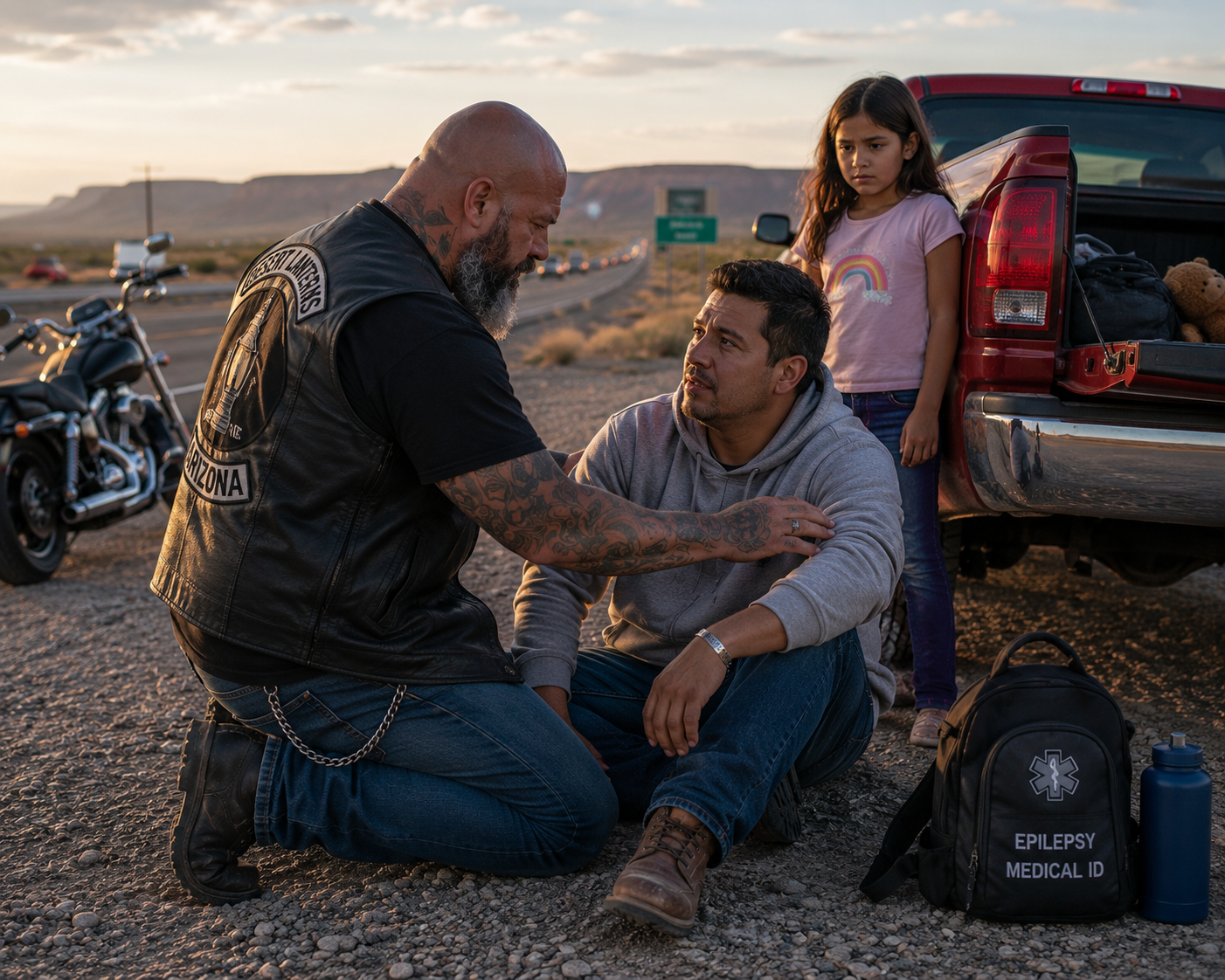
Instead, he began teaching seizure-response training to motorcycle clubs, truck stops, schools and community groups.
First class:
What to do.
What not to do.
Do not restrain.
Protect the head.
Clear nearby hazards.
Time the seizure.
Roll to the side when safe.
Call emergency services when appropriate.
Do not put anything in the person’s mouth.
And most importantly:
Do not let panic turn into control.
Daniel attended the first session.
Ava sat in the front row.
When Patch demonstrated recovery position, she raised her hand.
“You forgot something.”
Patch frowned.
“What?”
“Don’t tackle everybody.”
The room laughed.
Patch pointed at her.
“Excellent clarification.”
Daniel smiled.
The bracelet stayed with Daniel.
Patch never asked for it back.
One day Daniel offered.
“It was hers.”
Patch shook his head.
“She gave it to you.”
“But it came from you.”
Patch looked at the engraving.
STAY THROUGH THE STORM
Then at Daniel.
“She knew where she wanted it.”
Daniel kept it.
Ava later added a tiny blue thread beside the clasp.
Patch pretended not to notice.
The last time I saw him was at another roadside training event outside Flagstaff.
A trucker asked Patch why he still carried the old folded leather vest he had used under Daniel’s head.
Patch shrugged.
“Because helmets don’t make good pillows.”
The trucker laughed.
Then asked:
“Were you scared that day?”
Patch thought.
“Which part?”
“When everybody thought you were attacking him.”
“No.”
“When police almost cuffed you?”
“No.”
“When Daniel said Maggie’s name?”
Patch looked away.
“Yes.”
“Why?”
“Because I spent nine years thinking I knew the worst thing that happened.”
The trucker waited.
Patch continued:
“Turns out I knew only the part I blamed myself for.”
That was the difference.
For nine years, Patch believed Maggie died because he arrived too late.
Then he learned she had made choices.
Kevin had made worse ones.
The system had missed things.
And none of those truths fit neatly inside one person’s guilt.
Daniel’s seizure did not redeem Patch.
Maggie’s recording did not absolve every regret.
The investigation did not turn grief into closure.
It did something less dramatic.
More useful.
It separated responsibility from love.
And for a man who had spent nine years confusing the two, that was enough to let him do one thing he thought he had lost forever.
Stay when somebody needed him.
Not as a father trying to control death.
Not as a medic trying to outrun failure.
Just as a man who knew what to do when the ground suddenly disappeared beneath someone.
Protect the head.
Clear the danger.
Make room.
And stay through the storm.