
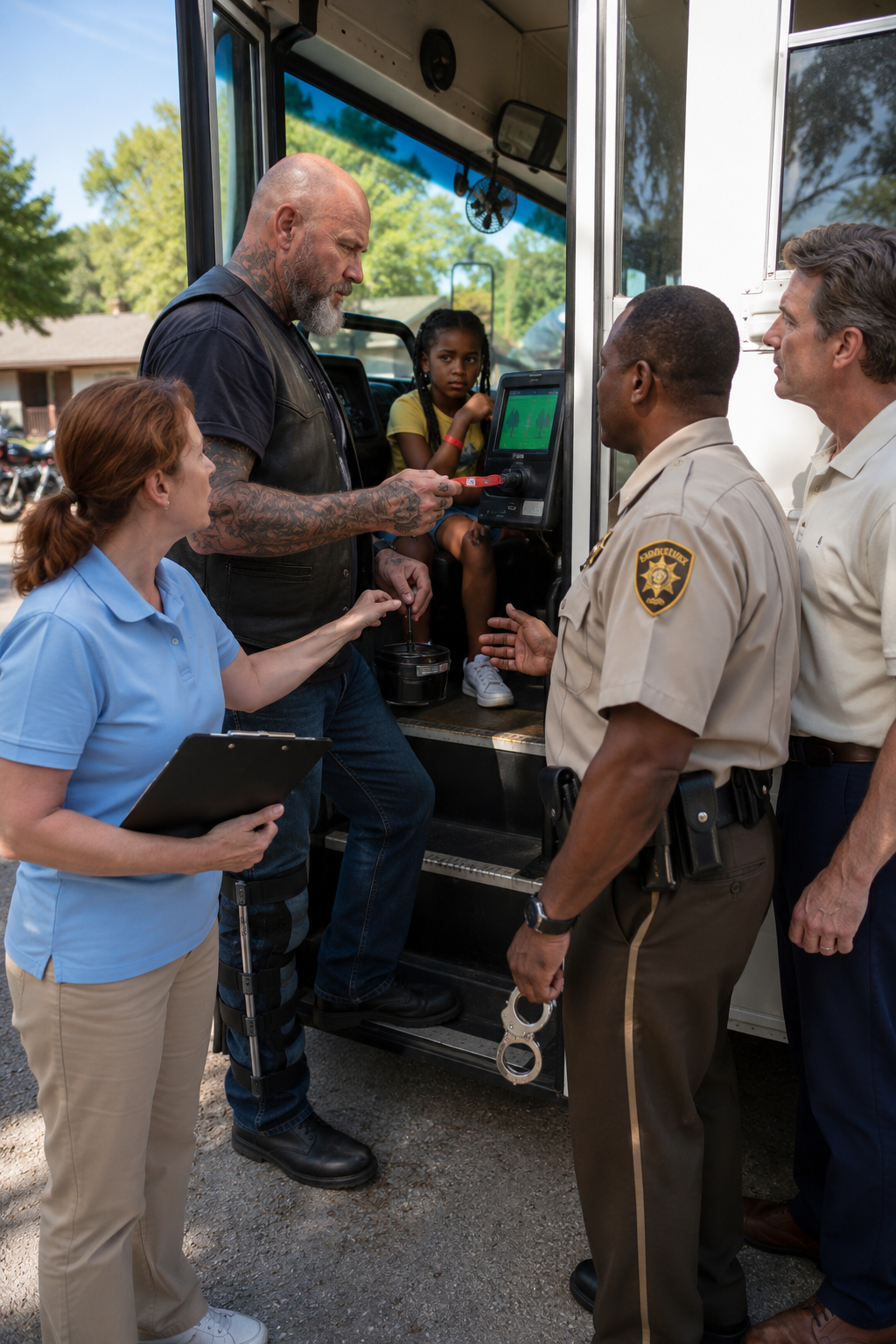
The second phone rang beneath the third row.
A twelve-year-old girl named Maya reached for it.
Amos stopped her with one raised hand.
“Leave it.”
The bus engine climbed above idle. Air hissed through the brakes, and the folding door remained locked despite the sheriff pulling the emergency handle.
Children began pressing against the windows.
Amos turned toward them.
“Stay seated. Feet in the aisle. Hands where I can see them.”
His voice was low enough that they had to quiet down to hear it.
The sheriff struck the door release again.
Nothing changed.
The programme coordinator, David Mills, stood outside the glass with one palm against the bus. His face had gone pale.
“You said the controls were mechanical,” the sheriff told him.
“They are.”
Amos looked down the aisle.
“No. They were.”
He had repaired the brakes the night before, but nobody allowed him near the dashboard electronics. David said a transport contractor had installed a new tracking system and threatened to void the warranty if Amos opened it.
Now a green light blinked beneath the steering column.
The bus was being controlled through that system.
The phone stopped ringing.
A recorded message played automatically from beneath the seat.
“Departure delayed. Maintain passenger containment.”
Several children began crying.
The word containment changed the sheriff’s expression.
He pulled his radio and ordered deputies to block both ends of the retreat road.
David stepped away from the bus.
Amos saw him move.
“Bring him back.”
David ran.
Two parents caught him near the chapel steps before he reached his car. They did not strike him. They held his arms until the sheriff’s deputy took control.
Inside the bus, Amos dropped beside the dashboard and tore away the plastic panel.
The steel brace around his knee struck the floor with a dull knock. He found an aftermarket control module wired into the ignition, door lock and air-brake release.
A small cellular antenna had been hidden behind the fuse box.
The sheriff looked over his shoulder.
“Can you shut it down?”
“Maybe.”
“Maybe isn’t useful.”
“It’s honest.”
Amos cut the ignition wire.
The engine kept running.
A separate battery powered the module.
The second phone rang again.
This time Amos answered.
“Lucy?”
The woman on the line breathed unevenly.
“Dad?”
His hand closed around the phone.
For fourteen years, Amos had carried a county death notice folded behind his driver’s licence. It said Lucy Boone died after suffering a seizure during transport to Ridgeway Behavioral Clinic.
The clinic refused to release her body because of what officials called contamination concerns.
He had buried an empty casket.
Now her voice came through a cheap phone beneath a church bus seat.
“Where are you?” he asked.
“They moved intake.”
“Where?”
“Under Benton Bridge. Old flood-control building.”
Amos shut his eyes.
The bridge lay six miles beyond the retreat. The county had closed the service level beneath it after repeated flooding.
Lucy spoke quickly.
“The bands are not admission passes. They create new medical files when the scanner reads them at the bridge.”
Maya looked down at the red mark around her wrist where Amos had cut away the plastic.
“What happens to our old files?” she asked.
Lucy heard her.
“They disappear.”
David Mills had spent four years recruiting children from foster homes, shelters and low-income families for free camps. Parents signed temporary medical-consent forms so staff could treat minor injuries.
Those signatures were copied onto behavioral-placement orders.
The children were transported beneath the bridge, sedated, assigned new diagnoses and moved into private facilities that collected state payments under their names.
Some returned weeks later with altered records.
Others did not return at all.
Amos looked toward David through the window.
“You chose them.”
David shook his head violently.
The sheriff placed the phone near the glass.
Lucy said his name.
“David, tell them about the families you marked no-contact.”
He stopped shaking his head.
The parents holding him stepped away as though his skin had changed.
The sheriff ordered him handcuffed.
David began insisting he had only prepared lists. He said another man handled the transfers and the buses. He claimed refusing would have cost him the centre and the meal programme.
Amos’s voice hardened.
“So you fed children first.”
David stared at him.
“Then you sold the ones who came back hungry.”
The green light beneath the dashboard turned red.
A mechanical clunk sounded beneath the bus.
The parking brake released.
The vehicle began rolling toward the slope leading out of the retreat.
The driver’s seat was empty.
Children screamed.
Amos threw himself across the floor and pulled the emergency brake lever.
It moved freely without engaging.
The remote module had isolated it.
The sheriff climbed behind the wheel and pressed the service brake. The pedal went hard beneath his boot.
No response.
The bus gathered speed.
Outside, bikers and parents ran beside it.
Amos opened the dashboard’s lower compartment and found the pneumatic line feeding the rear brakes. A small electric valve had been installed between the pedal and the air reservoir.
“Knife,” he said.
The sheriff handed him one.
Amos cut through the control wires.
The valve stayed closed.
The retreat gate approached.
Beyond it, the road dropped sharply toward the county highway.
Maya pointed beneath her seat.
“The phone has a cord.”
A thin cable ran from the hidden phone through a hole in the floor.
It was not simply receiving messages.
It was part of the control system.
Amos pulled the phone free and followed the cable to a relay box bolted beneath the third row.
He tore the connector loose.
The engine died.
The rear brakes slammed on.
The bus stopped six feet from the gate.
Children pitched forward against their seat belts, then went silent.
For several seconds, Amos remained on the floor with one hand around the disconnected cable.
The sheriff looked toward him.
“That was the controller.”
“No.”
Amos turned the phone over.
A live video feed filled the screen.
The image showed a concrete room beneath a bridge. Red wristbands hung from hooks along one wall. Empty wheelchairs stood in a row beneath fluorescent lights.
Lucy was visible in the corner.
She was thirty now, thin and gray-faced, wearing medical scrubs and an identification badge with another woman’s photograph.
A man stood behind her holding a second phone.
He looked directly into the camera.
David saw him through the bus window and stopped speaking.
Amos raised the screen.
“You know him?”
David whispered, “Dr. Vale.”
The name appeared on every death document connected to Ridgeway Clinic, including Lucy’s.
Dr. Vale leaned toward the camera.
“Mr. Boone, thank you for disconnecting the relay.”
Amos looked at the dead control box beneath the seat.
Vale smiled.
“You just completed the authorization sequence.”
Behind Lucy, steel doors unlocked one after another.
Children began stepping out of the dark rooms.
Then Vale placed the phone in Lucy’s hand.
“Tell your father what happens now.”
Lucy stared into the camera.
Her lips trembled.
“The bus was never carrying the patients to him.”
Amos gripped the seat frame.
“Then who was it for?”
Lucy looked toward the seventy-three children waiting inside the retreat centre.
“For the witnesses.”