
PART 3
Stone was out the door before Wesley finished the sentence.
I followed him into the yard.
“Everett.”
He didn’t stop.
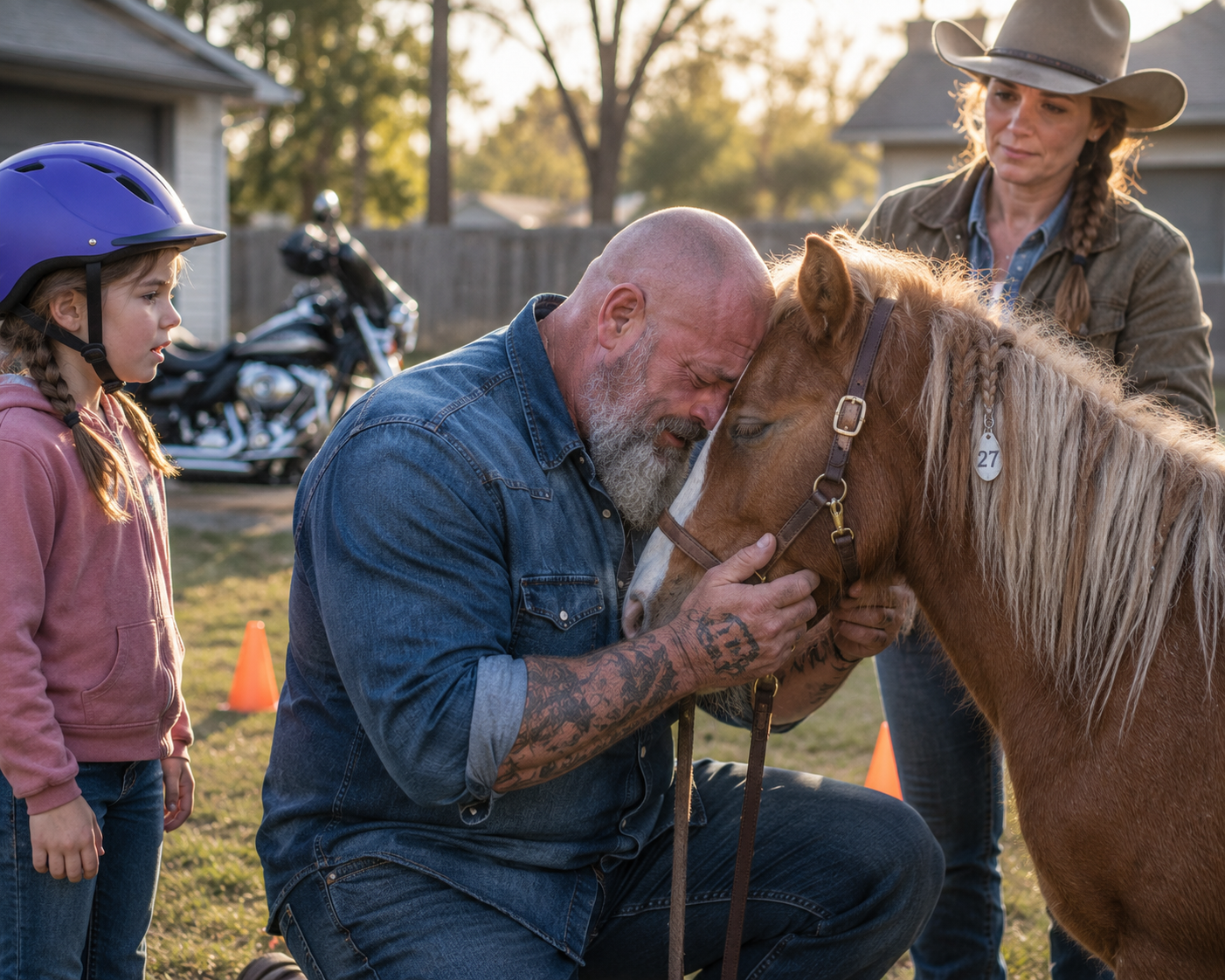
Daisy lifted her head as he crossed the grass.
Lucy stood beside the fence holding a purple crayon.
“Stone?”
He froze.
That one word did what neither Maren nor I could.
He turned around.
Lucy looked worried.
“Are you mad at Daisy?”
His face softened instantly.
“No.”
“Then why are you leaving?”
He looked toward his truck.
Then back at her.
“Because I need to talk to somebody.”
“Will you come back?”
That question landed harder than she intended.
Stone had spent seventeen years running from horses because every hoofbeat carried Caleb’s name.
Now an eight-year-old girl was asking whether he planned to disappear again.
He crouched.
“Yes.”
“When?”
“Tonight.”
Lucy studied him carefully.
“Promise?”
Stone hesitated.
Then nodded.
“Promise.”
He stood and looked at Maren.
“You coming?”
“Yes.”
Then at me.
“You stay with Lucy.”
I crossed my arms.
“No.”
He frowned.
“You have a kid.”
“Exactly.”
I pointed toward Daisy.
“If your brother knows where she is, I’m not leaving Lucy here while you drive off.”
Stone opened his mouth.
Closed it.
Maren said:
“She’s right.”
He hated that.
Good.
We loaded Daisy into Maren’s trailer.
Lucy came with me.
And forty-five minutes later, the strangest convoy I had ever joined headed north toward Pawhuska.
One pickup.
One horse trailer.
One very angry former cowboy.
And no motorcycle.
Crane Ridge looked abandoned.
The ranch gate sagged between two stone posts.
Tall grass swallowed the lower fences.
The main barn had lost half its paint.
But lights were on inside the house.
Wesley Crane opened the door before we knocked.
Stone stopped.
For fifteen years, he had believed this man dead.
Wesley looked seventy now.
Thin.
White beard.
One shoulder lower than the other.
But unmistakably the man from the old rodeo photograph.
Stone said:
“You look terrible for a dead man.”
Wesley almost smiled.
“You look worse for a living one.”
Stone hit him.
Not hard enough to knock him down.
Hard enough to end the joke.
Wesley touched his lip.
Maren stepped between them.
“That’s the only one.”
Stone said nothing.
Wesley nodded.
“Fair.”
Lucy remained beside me near the porch.
Stone noticed her.
His anger changed shape.
“Inside.”
We followed.
The ranch house smelled like dust, coffee, and old wood.
Wesley led us into an office.
Boxes covered the floor.
Folders.
Ledgers.
Photographs.
Veterinary records.
Stone stared.
“You kept everything.”
“I tried.”
“Why fake your death?”
Wesley sat.
“Because seventeen years ago I made the wrong decision.”
Stone laughed bitterly.
“Join the club.”
Wesley opened a file.
Inside were photographs of Caleb’s saddle.
Close-ups.
Leather straps.
One section showed a deep cut nearly through the girth strap.
Stone looked away.
Maren leaned closer.
“That wasn’t wear.”
“No,” Wesley said.
“Blade?”
“Most likely.”
Stone’s voice became flat.
“You said my brother did it.”
Wesley nodded.
Stone had a younger brother named Daniel.
Five years younger.
Good rider.
Bad gambler.
Worse loser.
Stone had barely spoken his name in almost two decades.
Daniel believed Caleb’s success embarrassed him.
That sounds ridiculous when said aloud.
A grown man jealous of a ten-year-old.
But jealousy does not become less dangerous because it looks childish.
Daniel had trained youth riders too.
Caleb kept beating them.
Sponsors began asking Stone whether Caleb would move into national competition.
Daniel’s students began leaving.
Then came money.
A sponsor offered to back Caleb’s next season.
Daniel believed that opportunity should have gone to one of his riders.
The week before the state finals, he argued with Stone behind the arena office.
Wesley heard part of it.
“I thought it was family nonsense,” he said.
Stone stared at the photographs.
“What changed your mind?”
“The strap.”
“You found it when?”
“After the ambulance left.”
“And you didn’t tell me.”
Wesley looked ashamed.
“I thought you’d kill him.”
Stone laughed once.
“You thought correctly.”
“That’s why I hid it.”
“And Bluebell?”
Wesley closed his eyes.
“She wasn’t badly hurt.”
Stone’s hands began trembling again.
“You told me her leg was shattered.”
“I lied.”
“Why?”
“Because you were in the hospital with Caleb, and when you said you never wanted to see another horse again, I believed you.”
“That wasn’t your decision.”
“No.”
Wesley looked toward Daisy outside.
“I kept Bluebell. She recovered. Later I bred her.”
Stone could barely speak.
“You kept my son’s horse alive and told me she was dead.”
“Yes.”
“And then you disappeared.”
“Years later.”
“Why?”
“Daniel came back.”
The room changed.
Wesley continued.
Daniel had vanished after Caleb’s death.
Mexico.
Texas.
Arizona.
No one knew.
Then, eight years later, he returned under another name.
He asked Wesley about Bluebell.
About the old records.
About whether any photographs from the accident remained.
Wesley finally understood that Daniel was not ashamed.
He was afraid.
Afraid the tack would be tested.
Afraid the old saddle would surface.
Afraid somebody would ask the right question.
“So you went to police?” I asked.
Wesley laughed.
“I tried.”
“What happened?”
“No physical evidence chain. Too old. Too many gaps.”
The saddle itself had disappeared years earlier.
The photographs proved damage.
Not who caused it.
Wesley’s word against Daniel.
Then Daniel threatened him.
Not directly.
A barn fire.
Brake line cut on Wesley’s truck.
A dead horse left outside the gate.
“That’s when you faked your death?” Maren asked.
Wesley nodded.
“I sold the ranch through a trust and disappeared.”
“Why keep Daisy?” Stone asked.
“I didn’t.”
Wesley explained that Bluebell’s bloodline had passed through several ranches.
Daisy was the last living mare descended directly from her.
When Wesley found her six months earlier, he bought her.
Then he sent her to Maren.
“Why?”
Wesley looked at Stone.
“Because I’m dying.”
Stone said nothing.
“Cancer.”
Wesley shrugged.
“Not dramatic. Just inconvenient.”
“And that gives you the right to rearrange my life?”
“No.”
“Then why do it?”
“Because Daniel came back again.”
Stone’s jaw tightened.
“He wants Daisy?”
“He wants what’s hidden in her registration file.”
Maren frowned.
“What file?”
Wesley reached into a box and removed an old sealed envelope.
Inside was a microfilm strip.
Stone stared.
“What is that?”
“Copies of my original ranch ledger.”
“Why hide them with her records?”
“Because Daniel searched everything else.”
The ledger documented payments.
One entry stood out.
A cash payment to Daniel three days before the state finals.
From a rival youth trainer.
Not proof of sabotage.
But motive.
Then another entry.
A refund Daniel demanded after Caleb died.
The note beside it read:
JOB FAILED — HORSE SURVIVED
Stone stopped breathing.
Maren whispered:
“Oh my God.”
Wesley looked sick.
“I didn’t understand what it meant then.”
Stone did.
The plan had not been to kill Caleb.
The plan had been to injure Bluebell.
Ruined competition.
Lost sponsorship.
A sabotaged horse.
But a cut girth strap on a fast barrel run had created consequences Daniel either did not imagine or did not care to imagine.
Stone’s voice dropped.
“Where is he?”
Wesley looked toward the window.
“Closer than you think.”
A truck engine sounded outside.
Everyone froze.
Headlights swept across the wall.
Daisy whinnied in the trailer.
Stone moved toward the door.
I caught his sleeve.
“No.”
He looked at me.
“This is my brother.”
“And Lucy is here.”
That stopped him.
Again.
Always the child.
He looked toward my daughter.
Then stepped back.
“Call the sheriff.”
I already had.
Daniel Callahan did not get the confrontation he came for.
That was probably the most important thing Stone did that night.
He did not walk outside.
Did not threaten him.
Did not swing first.
He stayed inside with Lucy while deputies stopped Daniel at the gate.
They found a handgun in his truck.
A pry bar.
Bolt cutters.
And printed directions to Maren’s ranch.
Enough to raise serious questions.
Not enough to convict him of what happened seventeen years earlier.
That case took longer.
The microfilm led investigators to archived sponsor records.
A retired ranch employee remembered Daniel asking for replacement tack the morning after the accident.
Another former trainer admitted paying Daniel to “make sure Caleb didn’t finish the finals,” insisting he believed Daniel would only loosen equipment enough to cause a withdrawal.
Then Daniel’s ex-wife turned over old letters.
One sentence mattered most:
I only meant to scare the horse. Everett made it bigger than it was because the kid got hurt.
That was not remorse.
It was evidence.
The case reopened.
Charges followed.
Legal arguments took months.
Stone attended almost none of the hearings.
When I asked why, he said:
“I spent seventeen years letting that day own every room.”
He looked at Lucy practicing with Daisy.
“I’m done.”
Daisy stayed with Maren.
But every Saturday morning, a truck and trailer appeared outside our house.
Stone began teaching Lucy to ride.
Slowly.
No speed.
No barrels.
No competition.
Just balance.
Hands.
Breathing.
Trust.
The first month, Stone refused to ride.
Then one morning Lucy asked:
“How can you teach me if you don’t do it?”
Stone gave her the look adults use when children become inconveniently logical.
Maren brought out a quiet gelding named Jasper.
Stone stared at the saddle for nearly ten minutes.
Then mounted.
His hands shook.
Jasper waited.
Stone breathed.
Then walked one circle around the field.
Lucy cheered like he had won a championship.
Stone told her to stop.
She cheered louder.
By spring, he rode beside her.
No Harley.
Two horses.
Slow pace.
Sometimes silence.
Sometimes Lucy talking enough for all three of them.
The Harley stayed in his garage more often.
Not because he stopped loving motorcycles.
Because he no longer needed the engine to drown out every memory.
Wesley died seven months later.
Stone visited him twice before the end.
They never completely forgave each other.
I think people expect endings to repair relationships neatly.
They usually don’t.
Wesley had lied.
Stone had disappeared.
Both men had spent years protecting themselves from grief while calling it survival.
At their final meeting, Wesley asked:
“Did you ride again?”
Stone nodded.
“With Lucy?”
“Yeah.”
Wesley smiled.
“Caleb would’ve liked that.”
Stone looked at him.
“You don’t get to tell me what Caleb would’ve liked.”
Wesley’s smile disappeared.
Then Stone added:
“But you’re probably right.”
That was as close as they came.
One year after Daisy arrived, Lucy entered a beginner riding show.
No barrels.
No speed.
Just horsemanship.
Stone stood at the fence wearing his old silver buckle.
The same one Lucy had found beside the Harley.
She rode Daisy past us.
Straight back.
Circle.
Stop.
Daisy behaved perfectly.
When Lucy finished, she waved.
Stone waved back.
Then she shouted:
“HARLEYS STILL SOUND BETTER!”
Everyone laughed.
Stone yelled:
“HORSES ARE STILL SOFTER!”
Lucy grinned.
That night, I noticed something missing from his motorcycle.
The small braid beneath the mirror.
I asked about it.
Stone pointed toward Daisy’s saddle.
The braid had been woven into a new leather strap.
Caleb’s old rodeo tag hung beside it.
Number 27.
“You sure about that?” I asked.
Stone nodded.
“It belongs on a horse.”
Then he touched the Harley mirror.
“Not something I use to run away.”
For seventeen years, Stone believed he had left horses because they remembered too much.
He was wrong.
He left because he remembered too much.
Bluebell had survived.
Her bloodline had survived.
The truth had survived.
Even Caleb’s number had survived.
Everything Stone tried to bury kept finding its way back.
Not to punish him.
To give him another choice.
He could stay the man who heard one backfire and returned instantly to the worst day of his life.
Or he could become the man who held a lead rope while an eight-year-old girl laughed in the saddle.
He could chase the brother who helped destroy his family.
Or he could stay inside and protect the child who trusted him now.
He could keep riding fast enough to outrun memory.
Or he could walk beside a horse.
Slowly.
One circle at a time.
Stone never stopped being a biker.
He never stopped being a cowboy either.
He had simply spent seventeen years believing he had to choose which version of himself was allowed to survive.
Daisy taught him otherwise.
And in the end, the toughest man on our street did not conquer his fear by becoming fearless.
He did something harder.
He took the reins with shaking hands—
and walked forward anyway.