
PART 3
I let the phone ring three times before answering.
“Brooks.”
Commander Dale Mason’s voice was calm.
Too calm.
“Natalie, I hear you’ve been reopening old files.”
I looked at Rebecca.
She had gone pale.
Elias stood beside the garage door with both arms folded.
Nobody spoke.
“Cold cases get reopened,” I said.
“Not without notifying command.”
“My supervisor approved it.”
“I am command.”
There it was.
Not concern.
Control.
I switched the call to speaker.
Mason continued.
“You’re emotionally involved now.”
“Why?”
“Because Claiborne was around your daughter.”
“You know his name.”
Silence.
Half a second.
Enough.
“You just called him Claiborne,” I said.
“So?”
“I never told you his current name.”
“I’ve heard people talking.”
“Who?”
He ignored the question.
“Natalie, leave the Bell case alone.”
Rebecca’s eyes closed.
Elias looked at me.
I asked:
“Why?”
“Because it destroyed enough lives already.”
“That isn’t an answer.”
“It’s advice.”
“From my commander?”
“From the man who trained you.”
That hurt more than I expected.
Mason had taught me how to interview frightened children without feeding them answers.
How to write warrants.
How to admit when evidence did not support what I wanted to believe.
He had been the first person in law enforcement who made me think I belonged there.
Now I was holding a phone containing a child’s voice that he had apparently buried.
I asked:
“Do you remember Simon Pike?”
The line went quiet.
Then:
“Biker. Felon.”
“Dead biker.”
“Yes.”
“He gave you a shoe.”
Another silence.
“Natalie—”
“Hannah Bell’s shoe.”
Rebecca covered her mouth.
I continued.
“You never logged it.”
“I don’t remember that.”
“Rebecca watched him give it to you.”
“That woman has spent eleven years blaming everyone because her family fell apart.”
Rebecca started toward the phone.
Elias stopped her with one hand.
Not forcefully.
Just enough.
I asked:
“What about Pike’s voicemail?”
Mason’s breathing changed.
“You need to come to my office.”
“No.”
“That was not a request.”
“Then suspend me.”
Silence.
He knew what that would look like.
I continued.
“I’m forwarding the recording to Internal Affairs and the district attorney.”
His voice hardened.
“You do that, and you’ll destroy your career.”
There it was.
The threat.
Strangely, it made everything easier.
“Good night, Commander.”
“Natalie, listen to me—”
I ended the call.
Then I looked at Rebecca.
“Play the voicemail.”
The recording was eleven years old.
Poor quality.
Wind.
Movement.
A child breathing too quickly.
Then Hannah’s voice.
“Mr. Pike?”
Rebecca started crying immediately.
A man answered.
Simon Pike.
“Hey, sweetheart. Where are you?”
“Mom’s bathroom.”
“Why are you whispering?”
“V is here.”
My skin tightened.
“Is your mom there?”
“No.”
“Your dad?”
“No.”
“Are you alone?”
Hannah began crying.
“There’s a policeman.”
Everything inside me went cold.
Pike’s voice changed.
“What policeman?”
“The one who comes when Mom and Dad yell.”
“Do you know his name?”
“No.”
“Can you see his badge?”
Hannah whispered:
“He opened the door.”
A sound in the background.
Male voices.
Then Hannah said:
“V told him thank you.”
Pike immediately asked:
“Can you lock the bathroom?”
“No.”
“Window?”
“Yes.”
“Can you get out?”
“I’m scared.”
“I know.”
“Are you coming?”
“Yes.”
“How long?”
“I’m coming right now.”
The recording ended.
Rebecca said:
“Pike drove there.”
“What happened?”
“He got there twelve minutes later.”
“And Hannah?”
“Gone.”
“Police?”
“Mason was there.”
My stomach turned.
“Did Pike confront him?”
“Yes.”
“And?”
“Mason arrested Pike.”
“For what?”
“Interfering with an investigation.”
Of course.
A convicted felon biker accusing a decorated officer.
Easy choice.
“Claiborne?”
“Already gone.”
“And the mother?”
“Sedated at the hospital after what police called a panic episode.”
I stared at the old phone.
The entire case had been framed before anyone honest arrived.
Then another thought hit me.
“Why would Mason help Claiborne?”
Rebecca shook her head.
“I never knew.”
Elias finally spoke.
“Maybe money.”
Maybe.
But the answer turned out to be worse.
Internal Affairs moved quickly because we did not give Mason warning.
Rebecca turned over Pike’s phone.
The original audio file metadata remained intact.
The DA obtained the old dispatch records.
Then someone found what had been missing for eleven years.
Mason’s body-camera predecessor.
Not video.
An early digital patrol audio recorder used by supervisors during custody exchanges.
The device itself was long gone.
But archived files survived on an obsolete county server.
One technician restored them.
At 7:48 p.m. on the night Hannah disappeared, Mason’s voice could be heard speaking with Vincent Claiborne.
Not clearly at first.
Then:
“You have twenty minutes.”
Claiborne replied:
“That’s enough.”
Mason said:
“You never saw me.”
The recording went silent for thirteen seconds.
Then Mason added:
“After tonight, you leave the county.”
That was enough for warrants.
Not enough to explain motive.
That came from bank records.
Eleven years earlier, Mason had been drowning in gambling debt.
Claiborne had not paid him directly.
A construction company owned by Claiborne’s cousin paid off three separate debts through cashier’s checks.
Total:
$47,000.
Mason had sold a child’s safety for forty-seven thousand dollars.
He had arranged the custody-exchange officers.
He had ensured Hannah’s mother would be temporarily removed after a staged disturbance.
Then he gave Claiborne access to the house.
What exactly Claiborne intended was never completely clear.
But Hannah disappeared that night.
And Mason spent eleven years making sure investigators looked anywhere except at him.
He discredited Pike.
Buried the shoe.
Dismissed the voicemail.
Redirected investigators toward Hannah’s parents.
Then trained a young detective named Natalie Brooks to believe evidence mattered.
The irony nearly made me sick.
Mason was arrested two days later.
Claiborne disappeared before police reached his apartment.
This time, however, he did not get far.
The bikers did not chase him.
That surprised reporters.
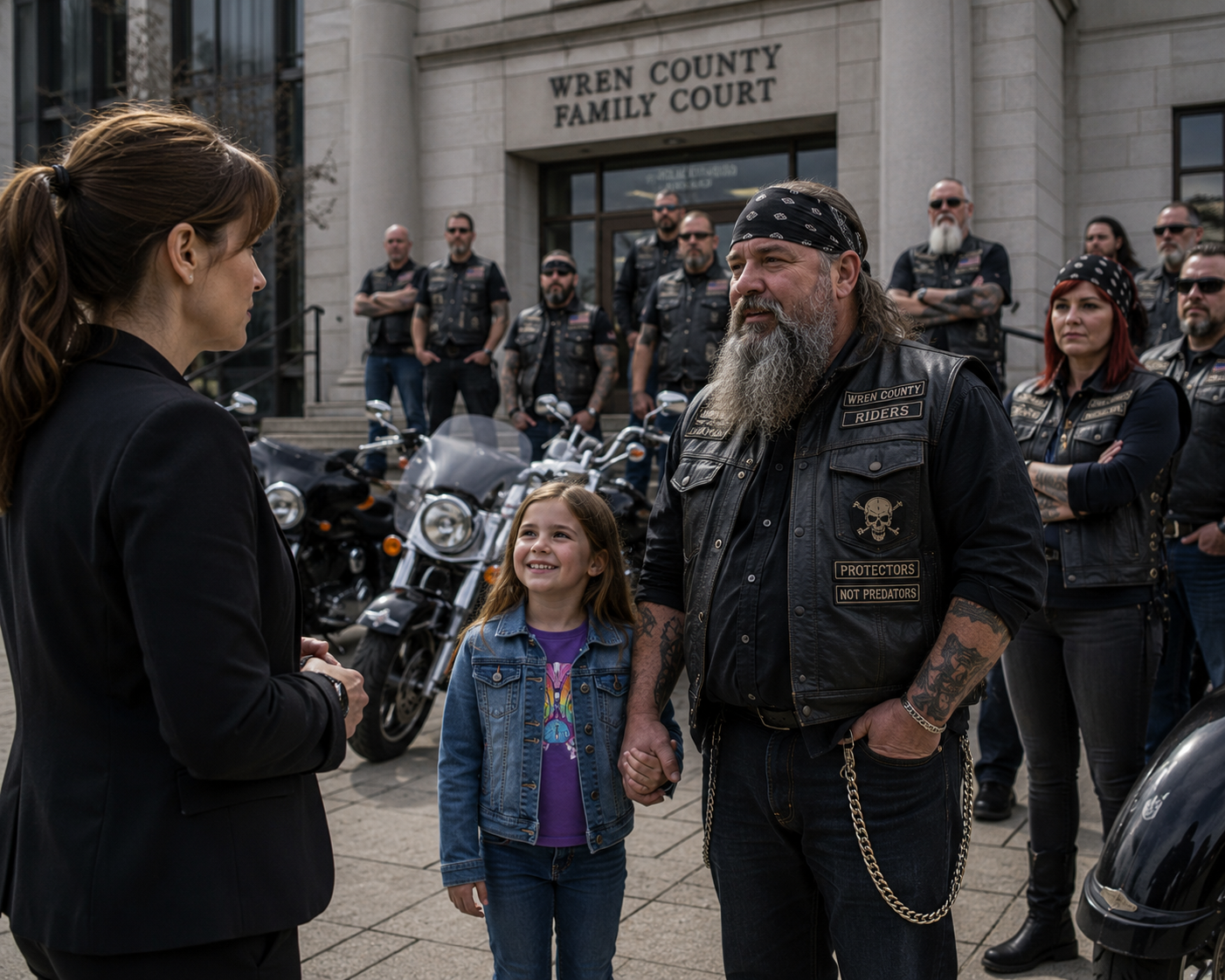
Seventeen motorcycles had been visible outside the courthouse.
People expected vigilante justice.
Instead, Elias called every rider and gave one order:
“No one moves.”
Raven asked:
“What if we see him?”
“You call police.”
Tank complained:
“He’s dangerous.”
“Exactly.”
Elias looked at me.
“We protect Sophie by not becoming another problem.”
That was the moment I finally understood them.
Their motorcycles were not authority.
Their leather vests were not badges.
They were witnesses.
Presence.
A person standing across the street so someone dangerous knew a child was not invisible.
Police found Claiborne at a motel near the Kentucky line three days later.
Inside his room were old photographs.
Copies of custody schedules.
Children’s names.
Including Sophie’s.
That destroyed whatever small part of me still wanted to believe Mark had simply made a foolish social choice.
He had brought this man into our daughter’s life.
Repeatedly.
Mark lost unsupervised custody.
Not because I demanded it.
Because the court saw the evidence.
He admitted that Claiborne had told him his previous accusations were “false claims from bitter families.”
Mark believed him.
Why?
Because Claiborne lent him money.
Introduced him to better-paying warehouse contracts.
Helped him repair his truck.
Small favors.
Then larger ones.
By the time Sophie became uncomfortable, Mark had too much invested in believing Claiborne was innocent.
That pattern haunted me.
It was Hannah’s story again.
Adults protecting relationships, pride, money, or convenience before listening to a child.
The difference was that Sophie had people standing outside.
Hannah had Simon Pike.
One biker.
One man nobody believed.
And eleven years later, his phone finally spoke louder than his criminal record.
The search for Hannah resumed.
Mason eventually cooperated in exchange for consideration at sentencing.
He claimed he never knew where Claiborne took her.
But he gave investigators an old storage property once owned by Claiborne’s cousin.
Excavation teams searched the land.
Three weeks later, they found human remains.
Rebecca was present when the identification came.
She called me.
Neither of us spoke for a long time.
Hannah was finally coming home.
That mattered.
It did not make the ending happy.
Some stories do not become happy because truth arrives.
Truth sometimes only gives grief a name.
Rebecca buried Hannah beside her grandmother.
More than two hundred motorcycles attended.
No revving.
No spectacle.
They parked in silence along the cemetery road.
At the funeral, Rebecca placed Simon Pike’s old phone beside a photograph of Hannah.
Not inside the coffin.
She kept the phone.
“He kept his promise,” she told me.
“What promise?”
Rebecca looked toward the riders.
“He said he was coming.”
Eleven years late, in the only way left, he finally did.
Sophie began seeing a child therapist.
Not because something terrible had happened to her.
Because fear had.
That distinction mattered.
The forensic interview found no evidence that Claiborne had physically harmed her.
He had asked personal questions.
Told her not to mention certain conversations.
Tried to create secrecy.
That was enough for us to take seriously.
But I refused to turn my fear into her memory.
She was still allowed to be eight.
Soccer.
Cartoons.
Bad jokes.
Cereal too sugary for breakfast.
And bikers.
She still called Raven by her road name.
Still thought Tank was funny.
And Elias became “Fence.”
I asked why.
Sophie shrugged.
“He stands where bad people shouldn’t go.”
Fair enough.
One afternoon, six months after the arrests, I found Sophie drawing at the kitchen table.
Motorcycles.
A courthouse.
Stick figures.
I sat beside her.
“What’s that?”
“The day everybody came.”
She pointed.
“That’s Raven.”
“That’s Tank.”
“That’s Fence.”
Then one smaller figure beside them.
“That’s me.”
“And this?”
A woman with a badge.
“You.”
I smiled.
“Why am I so short?”
“You’re far away.”
Children have answers for everything.
Then I saw the words written across the top.
Not the same as Hannah’s old drawing.
Something new.
THEY STAY UNTIL MOM COMES.
My throat tightened.
For months I had tortured myself with one question.
How had I missed it?
I was a detective.
I should have known.
But that was the wrong question.
Profession does not make a parent omniscient.
Training does not eliminate denial.
Experience does not protect you from trusting the wrong person.
The important question was what happened after Sophie said she felt uncomfortable.
Did I demand perfect proof?
Did I protect my pride?
Did I defend Mark because admitting I chose the wrong person would embarrass me?
No.
Eventually, I listened.
Not fast enough for my liking.
But fast enough.
Mason pleaded guilty to corruption, obstruction, evidence tampering, and charges connected to facilitating Claiborne’s access to Hannah.
Claiborne faced separate charges after prosecutors linked him to both the Bell investigation and newer conduct.
I testified.
So did Rebecca.
So did forensic technicians.
The strongest witness in Mason’s case was not a detective.
Not a biker.
Not a prosecutor.
It was an eleven-year-old voicemail.
A frightened six-year-old asking whether someone was coming.
That sound changed our precinct.
Old cases involving dismissed witnesses were reviewed.
Policies changed.
Anonymous information from people with criminal histories could no longer be discarded solely because of the source.
Evidence still required verification.
But credibility became something investigators assessed, not something they assumed from appearance.
Simon Pike would have appreciated that.
One year after the courthouse hearing, Elias stopped by my house.
No club.
No convoy.
Just him.
Sophie ran outside.
“Fence!”
He looked embarrassed every time she called him that.
She handed him a drawing.
He studied it.
“What is this?”
“You.”
He pointed at the giant square around his body.
“Why am I a box?”
“You’re the fence.”
He sighed.
“Should’ve seen that coming.”
Then Sophie ran back inside.
Elias looked at me.
“You okay?”
“Getting there.”
He nodded.
I asked:
“Why didn’t your people just call police when you first saw Claiborne?”
“We did.”
“What?”
“Anonymous tips.”
I stared at him.
“Several.”
“Why didn’t they reach me?”
He gave me a tired look.
“You work there. You tell me.”
Fair.
Then he said:
“Pike taught the old crew something.”
“What?”
“Sometimes authorities listen late.”
I thought about Hannah.
“And sometimes bikers are wrong.”
“Yes.”
I appreciated that answer.
“So what do you do?”
“Document.”
He smiled slightly.
“Funny. Same thing cops say.”
“Terrible habit.”
He started walking toward his motorcycle.
I stopped him.
“Elias.”
He turned.
“Thank you.”
He shook his head.
“For what?”
“For staying.”
He looked toward the house where Sophie was laughing at something on television.
“That part was easy.”
Then he put on his helmet.
I understood what he meant.
Chasing danger looks heroic.
Standing watch is boring.
Waiting across a street.
Sitting outside a school.
Being present without becoming the center of the story.
That is harder.
Because real protection is not always dramatic.
Sometimes it is seventeen motorcycles parked outside a courthouse.
Sometimes it is a red-haired woman returning a lost glove.
Sometimes it is a convicted biker preserving a voicemail nobody wanted to hear.
And sometimes it is a mother finally accepting the lesson she had spent eleven years teaching other families:
A child does not need you to prove that every fear is true before you listen.
Sometimes the first thing they need is simply to know—
when they look toward the window,
someone is already there.